Our Mechanical Senses in Places Humans Cannot Easily Go
Space and exploration robots are machines that travel, observe, sample, or work beyond the ordinary reach of people. They circle planets, cross the surfaces of other worlds, descend through alien atmospheres, enter volcanoes and caves, dive beneath polar ice, and inspect environments where distance or danger makes direct human presence difficult. A space robot may be as large as a car or small enough to ride with another spacecraft. It may operate for minutes during a fiery descent or continue returning measurements for decades. What unites these machines is not their shape but their ability to sense, decide, and act while separated from their builders. That separation changes everything. Commands may take minutes or hours to arrive, repairs may be impossible, and a small mistake can strand an entire mission. Exploration robots therefore combine scientific instruments with power systems, thermal control, communications, navigation, fault protection, and carefully limited autonomy. They are laboratories, vehicles, and messengers built into one resilient package.
A: Robots can scout distant hazards without life support or an immediate return journey.
A: Teams send goals and routes; onboard software handles local movement and hazards.
A: Solar arrays work in many locations, while radioisotope systems support darker regions.
A: Usually only through software workarounds or redundant hardware already onboard.
A: A single preventable mistake can end years of travel and scientific opportunity.
A: It combines star trackers, Sun sensors, gyroscopes, and radio navigation.
A: It is the practice of limiting harmful contamination between Earth and other worlds.
A: Terrestrial laboratories offer larger instruments and future techniques unavailable onboard.
A: Some use bounded autonomy for navigation, prioritization, and fault response.
A: Policies vary, but major scientific missions commonly release calibrated archives publicly.
Why Exploration Depends on Robots
Robots can tolerate journeys and environments that are impractical for human crews. They do not need breathable air, food, living space, or a return ticket. A spacecraft can spend years crossing the Solar System and then begin work on arrival. A rover can remain on a freezing plain while a human mission would require habitats, radiation protection, life support, and emergency plans.
That advantage does not make robotic missions easy or cheap. Machines still need protection from heat, cold, radiation, vibration, dust, pressure, and vacuum. They must carry every essential component at launch. Scientists accept those difficulties because a robotic mission can answer focused questions, scout future destinations, and build knowledge before people attempt a more complex journey.
Orbiters: Global Views From Above
Orbiters travel around a planet, moon, asteroid, or the Sun. Their repeated paths let instruments map terrain, study weather, measure gravity, analyze surface chemistry, and monitor change. Cameras reveal landforms, spectrometers separate light into clues about materials, radar can penetrate clouds or shallow ground, and laser altimeters measure height. An orbiter must control its attitude so instruments point accurately while solar panels and antennas remain useful. Small thrusters or reaction wheels adjust orientation. Navigation teams refine the orbit using radio measurements and models of gravity. Many orbiters also relay data for landers and rovers that cannot communicate directly with Earth at every moment.
Flyby Spacecraft and Deep-Space Probes
A flyby mission passes a target rather than entering orbit. This saves propellant and can reveal distant worlds that would otherwise be unreachable within the mission’s limits. The encounter may last only hours, so cameras and instruments follow a tightly planned sequence while the spacecraft stores data for later transmission.
Deep-space probes continue into regions where sunlight is weak and communication delays are long. They measure particles, magnetic fields, dust, and plasma while watching the Sun and stars for orientation. Their discoveries often come from patient measurements rather than dramatic images. Reliability and careful power management determine how long they remain scientifically useful.
Landers: Science From a Fixed Point
Landers touch the surface and conduct experiments around one location. A landing system may use heat shields, parachutes, rockets, airbags, crushable structures, or combinations of these tools. The appropriate sequence depends on atmosphere, gravity, terrain, and spacecraft mass. The machine must survive the impact and then deploy antennas, instruments, panels, or legs. Remaining still has advantages. Instruments can make long observations without spending energy on travel. A lander may monitor weather, listen for internal seismic activity, drill beneath the surface, or photograph seasonal change. Its limitation is reach. If an interesting rock lies beyond an arm or scoop, the mission cannot drive closer.
Rovers: Mobile Laboratories
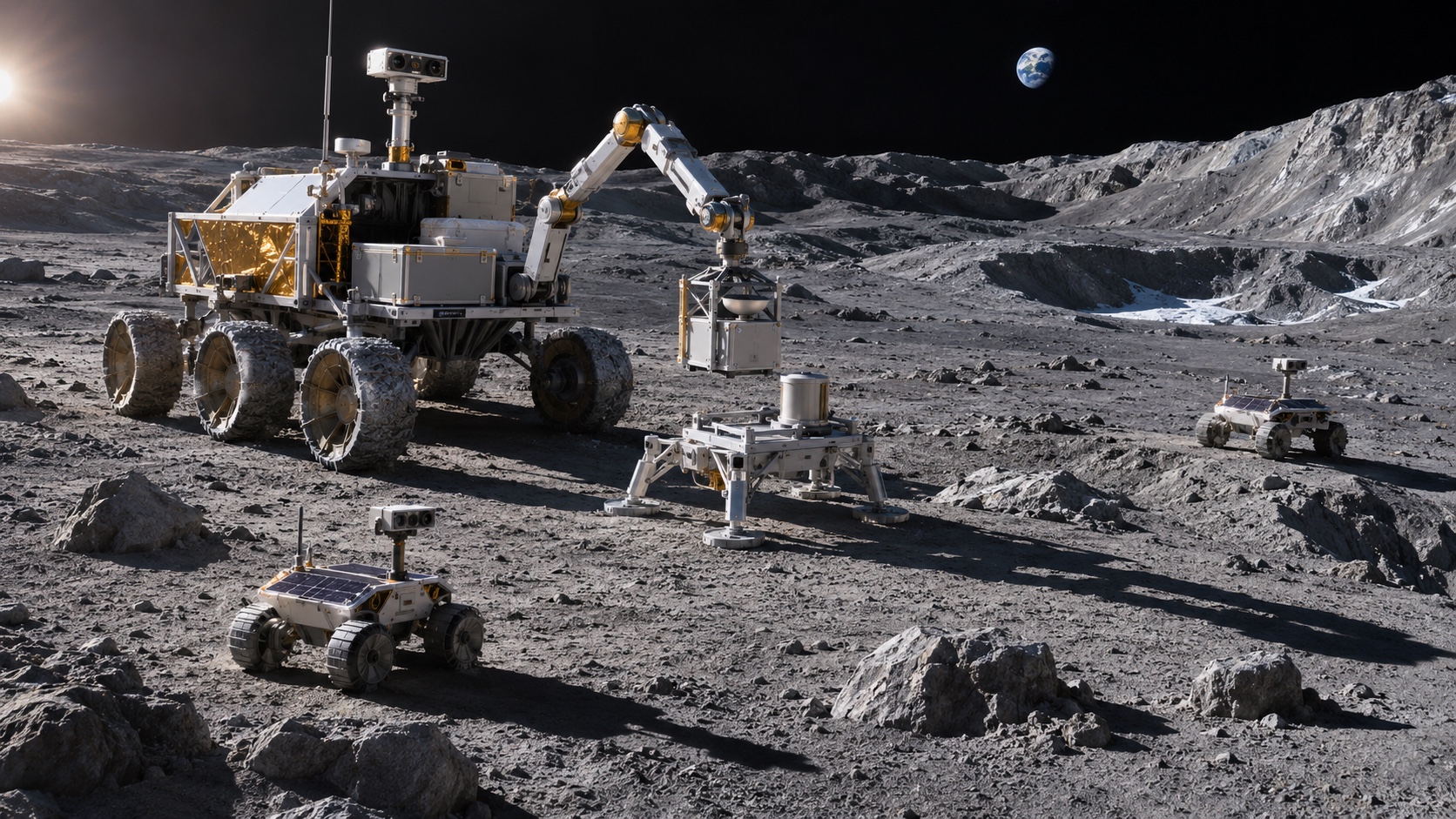
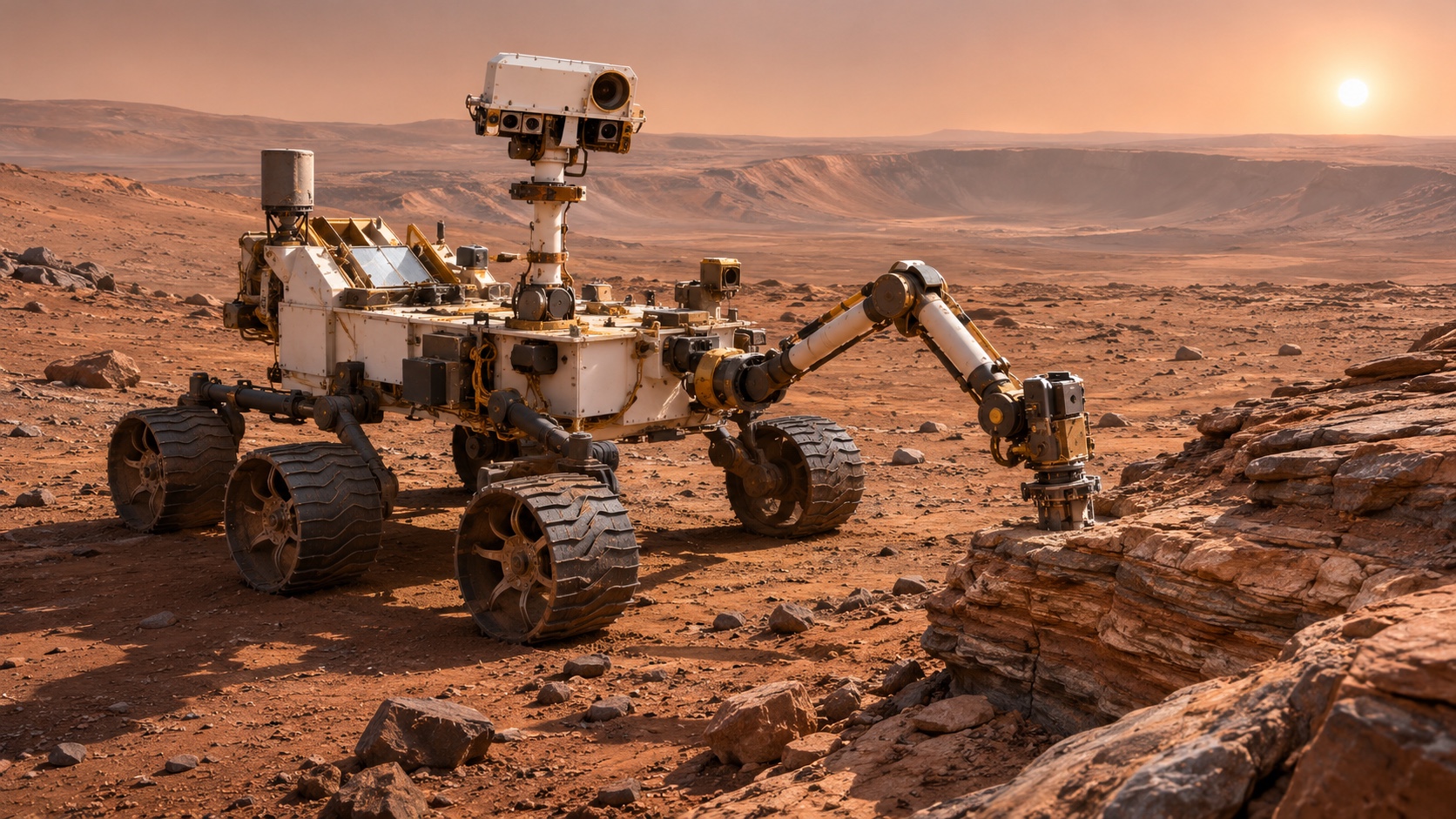
Rovers carry instruments from one site to another. Wheels are common because they are efficient and mechanically understandable, but designs vary with terrain. Suspension systems keep several wheels in contact with uneven ground. Cameras on a mast survey possible paths, while lower cameras inspect hazards near the wheels. Robotic arms place instruments directly against rocks or soil.
Mobility turns exploration into a sequence of choices. Science teams compare destinations, engineers assess slopes and obstacles, and planners create activities that fit available time and energy. The rover may drive part of a route autonomously, stopping when it cannot classify the terrain safely. Progress can appear slow from Earth because cautious decisions protect years of work.
A rover is not merely a remote-controlled car. The delay to another planet prevents continuous steering. It receives goals and constraints, performs local navigation, records what happened, and reports back. That rhythm blends human strategy with machine execution.
Aerial Explorers and Balloon Missions
Flying robots provide access to cliffs, canyons, dunes, and broad regions that challenge ground vehicles. Rotorcraft can hop between sites in a thin atmosphere if blades, motors, and mass are carefully designed. Balloons drift with winds and sample layers of an atmosphere over long distances. Winged aircraft may suit worlds with enough atmosphere for aerodynamic lift.
Flight multiplies the consequences of power loss or navigation error. The robot must judge terrain during landing, manage winds, and keep enough energy in reserve. Dust and temperature affect moving parts. An aerial scout may support a rover by mapping routes, or it may carry its own instruments to locations no wheeled platform could reach.
Sample-Collection and Sample-Return Robots
Some missions gather material for onboard analysis. Others seal samples for eventual return to Earth, where laboratories can use instruments far too large to launch. Collection requires clean tools, documented context, and containers that preserve the material. Engineers must prevent Earth contamination from confusing the science and protect both planets under applicable planetary-protection rules. A sample-return campaign can involve several robots: one collects, another retrieves, a small rocket launches the container, an orbiter captures it, and a return capsule reaches Earth. Every handoff creates risk. The scientific value is exceptional because researchers can reexamine the material as new laboratory techniques become available.
Robotic Arms, Drills, and Other Tools
Manipulators turn a stationary spacecraft or rover into a field scientist. An arm places cameras or spectrometers against a target, moves a sample into an instrument, brushes dust away, or deploys equipment. Drills reach material shielded from surface weathering and radiation. Scoops collect loose soil, while corers preserve layers that record a sequence of events.
Tool use is constrained by reach, force, stability, and visibility. A drill can push the vehicle backward if the chassis is not anchored. An arm may cast a shadow that changes a measurement. Teams rehearse movements with test models on Earth and include stops that prevent a joint from exceeding safe limits.
Power: The Mission’s Daily Budget
Solar panels convert sunlight into electricity, but their output changes with distance from the Sun, angle, dust, season, and temperature. Batteries store energy for nighttime or peak demand. Radioisotope power systems generate electricity from heat released by natural decay, supporting missions where sunlight is weak or long nights make solar operation difficult. Power affects every activity. Driving, transmitting, heating, drilling, and computing compete for the same budget. Mission planners schedule work when energy and temperature allow it. A healthy robot may rest because using power now would leave too little for an essential heater later.
Surviving Vacuum, Radiation, and Temperature Extremes
Space removes the cooling effect of air. Equipment sheds heat through radiation and conducts it through the spacecraft structure. Insulation, reflective surfaces, heaters, radiators, and carefully placed electronics keep components within operating ranges. Lubricants and materials must behave predictably without ordinary atmospheric pressure.
Radiation can corrupt memory or damage electronics. Designers use shielding, tolerant components, error correction, watchdog circuits, and redundant paths. Dust creates different problems: it coats solar panels, enters mechanisms, clings electrostatically, and changes thermal behavior. Survival depends on anticipating many small stresses rather than one cinematic danger.
Navigation Without a Driver at the Wheel
Spacecraft estimate position and orientation from radio signals, stars, the Sun, inertial sensors, cameras, and models of motion. Near a small body, weak and irregular gravity makes familiar orbits difficult. During landing, cameras may compare terrain with stored maps and divert away from hazards. Rovers combine wheel motion, inertial measurements, and visual landmarks to track movement. Every estimate contains uncertainty. Wheel slip makes a rover travel less than its rotation suggests. A bright object may confuse a camera. Navigation software compares sources and reports confidence. Teams preserve margins because a path that is probably safe is not the same as one known to be safe.
Communicating Across Enormous Distances
Radio links carry commands and scientific data. Large antennas on Earth detect extremely weak signals, while spacecraft point their own antennas carefully. Distance reduces data rate and creates delay. A Mars robot cannot be steered in real time because a command and response take many minutes. Outer-planet missions may wait hours for a round trip.
Robots store information and transmit it according to priority. A small preview may confirm an observation before a full image arrives. Compression saves bandwidth, and orbiters can relay surface data when geometry permits. Communication schedules become part of science planning because the mission can collect more than it can immediately send.
Autonomy With Boundaries
Exploration robots use autonomy for tasks that cannot wait for Earth: stabilizing flight, avoiding a collision, protecting batteries, selecting a safe drive path, or entering a fault mode. Some software identifies promising features in images and gives them transmission priority. These tools help missions use limited time and bandwidth. Autonomy is deliberately bounded. The machine receives rules about slopes, temperatures, energy, distance, and instrument safety. If conditions fall outside those boundaries, it pauses or protects itself. Scientists still choose goals and interpret results. The robot handles immediate execution where delay makes direct control impossible.
How Robotic Discoveries Become Knowledge
Raw measurements do not arrive as finished answers. Engineers calibrate sensors and document conditions. Scientists compare observations with laboratory experiments, models, earlier missions, and measurements from other instruments. Images may reveal texture, while chemistry indicates composition and environmental data explains how the surface changed.
Mission archives preserve data so researchers can ask new questions years later. A result becomes stronger when independent observations agree and uncertainty is reported. The robot extends human senses, but discovery still depends on careful interpretation and debate.
From a Mission Idea to an Explorer on Another World
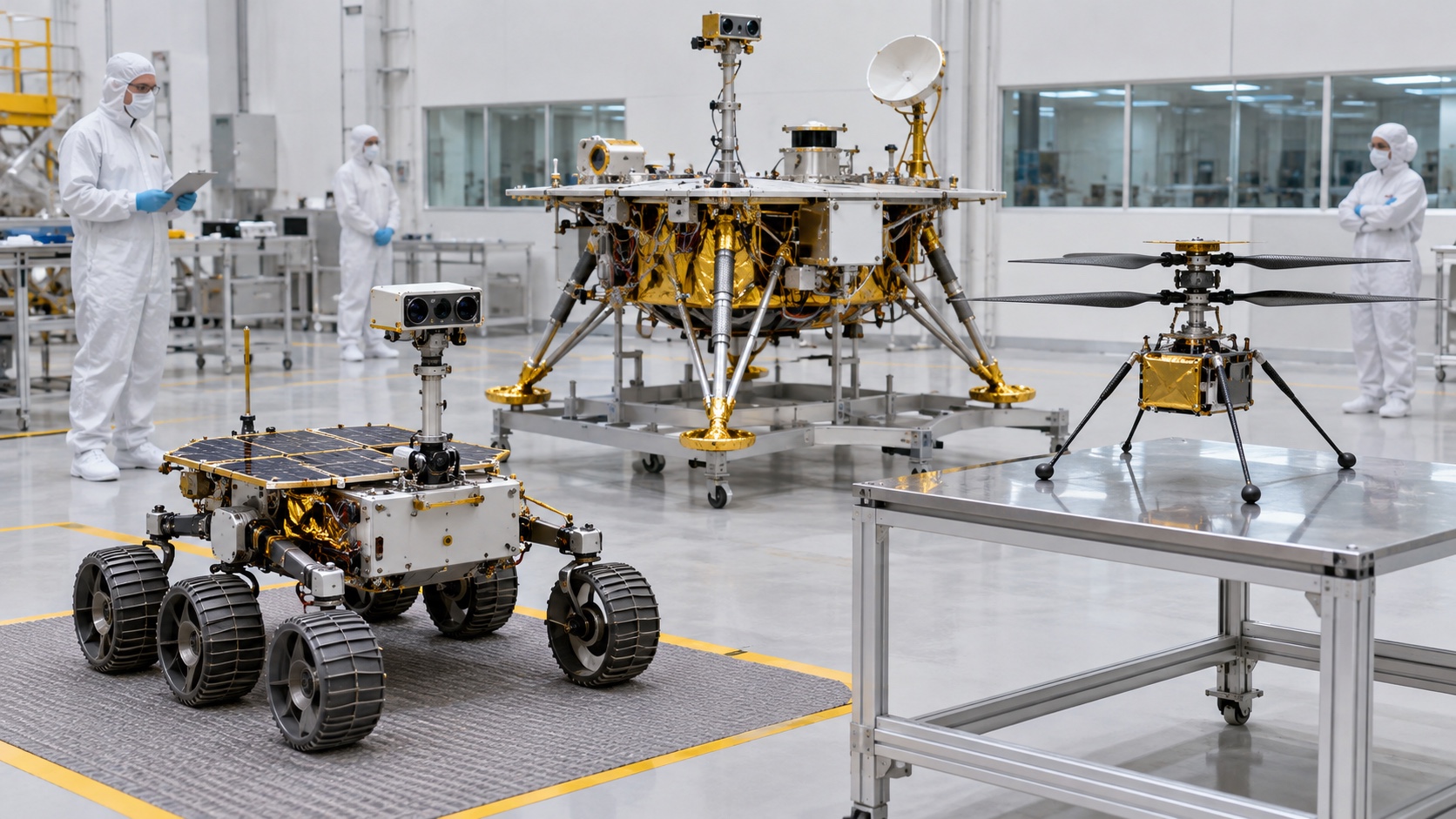
A mission begins with scientific questions. Teams then choose a destination, measurements, platform, trajectory, power source, and communication plan. Engineers build test units, shake them, expose them to vacuum and temperature cycles, and rehearse operations. Software teams simulate faults and unexpected terrain. Launch is one milestone in a long chain, not the beginning of preparation.
Once the robot arrives, operations continue as a conversation between evidence and planning. Each observation changes what the team wants to examine next. The enduring achievement of exploration robotics is this partnership across distance: a machine survives where people cannot yet stand, while people on Earth turn its limited view into an expanding understanding of the universe.
Every successful mission also improves the next one by refining materials, navigation, operations, and the questions scientists know how to ask.