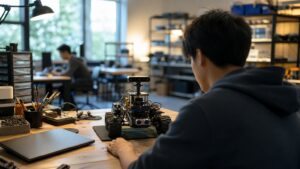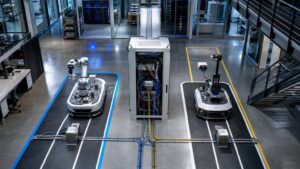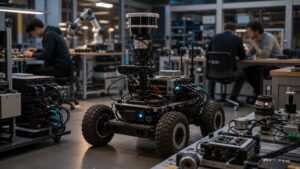
Welcome to Robot Streets’ hub for Robot Operating Systems (ROS)—the connective tissue that lets sensors, motors, and AI speak the same language. Think of ROS as a city grid for robots: nodes are buildings, topics are roads, and messages are traffic flowing with purpose. Here we unpack the essentials—from publishers/subscribers and services/actions to TF transforms, URDF/Xacro models, and launch files that bring complex systems to life with a single command. Explore how ROS 2 upgrades the stack with real-time-friendly DDS, multi-robot discovery, and security—so fleets coordinate safely and reliably. We’ll guide you through simulation with Gazebo/Ignition, visualization in RViz, and modern nav stacks that turn maps into motion plans. You’ll learn how to wrangle bag files for data, compose nodes for performance, and deploy edge inference that plugs into perception pipelines. Whether you’re building a warehouse AMR, a dexterous arm, or a campus delivery bot, this is your fast lane to architectures, tools, and practices that scale from prototype to production.
std_msgs, geometry_msgs, sensor_msgs, or define custom types.src/ → colcon build → source install/setup.*.A: New projects: ROS 2 for DDS, QoS, security, and multi-robot support.
A: Streams, RPC, and long goals with feedback—respectively.
A: QoS mismatch or network multicast blocked—align profiles and allow DDS traffic.
A: Use PTP/NTP, message_filters, and hardware timestamps.
A: URDF/Xacro with proper inertias; verify in RViz and simulation.
A: Yes with careful OS tuning, pinned executors, and RT-friendly drivers.
A: Sim to de-risk; validate with rosbag replays before hardware runs.
A: YAML params, launch args, and per-robot namespaces.
A: Rosbag2 selective topics, compression, and metadata notes for reproducibility.
A: Namespacing, DDS tuning, and a fleet manager for tasks and updates.