Classifying Defense Robots by Environment, Movement, and Mission
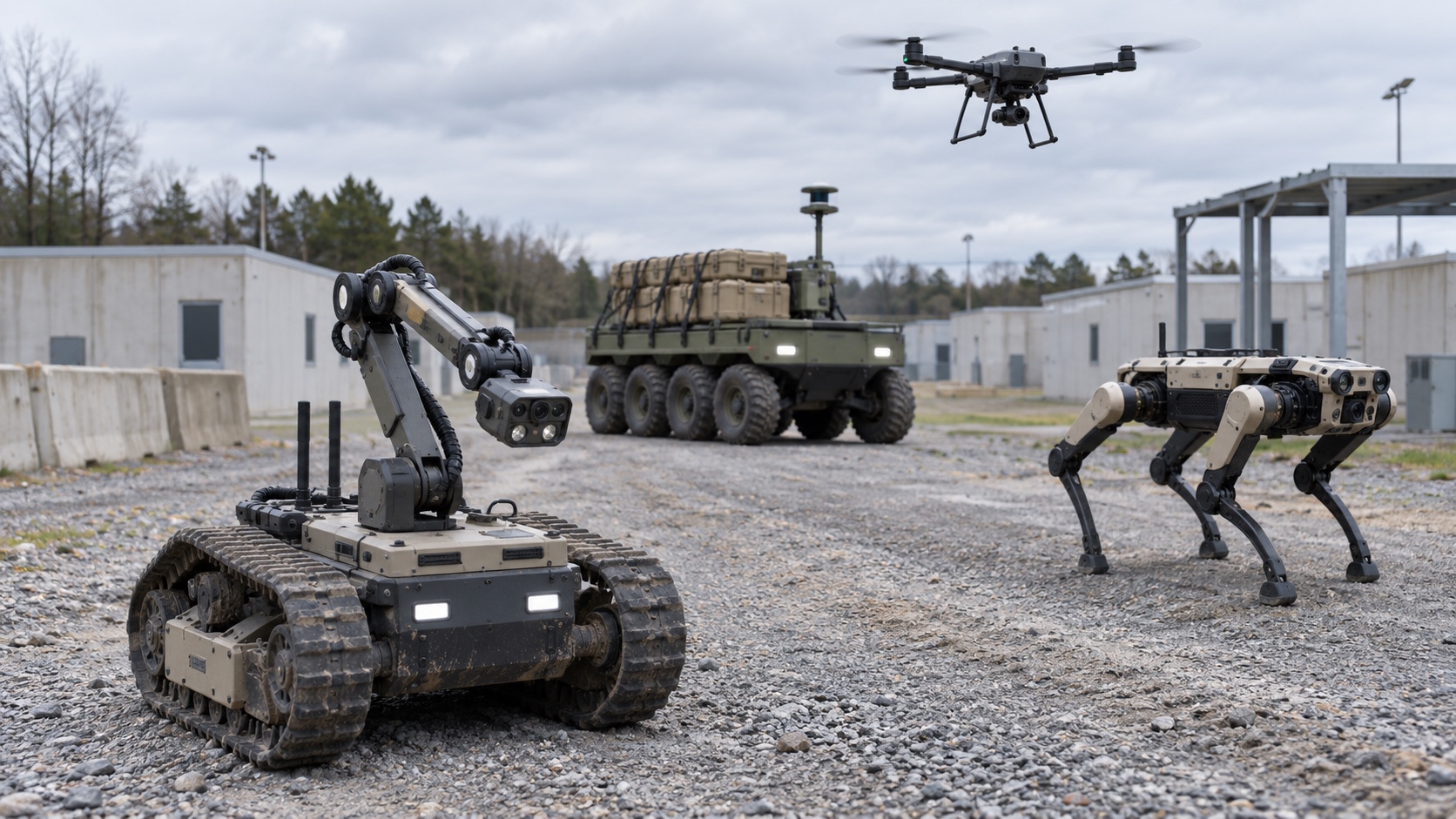
There is no single shape called a military robot. A palm-sized aircraft hovering beside a damaged bridge, a tracked machine gripping a suspicious package, an autonomous truck carrying supplies, and an underwater vehicle mapping a harbor all belong to the same broad family. Their differences become easier to understand when classification starts with three questions. Where does the robot operate? How does it move and stay oriented? What payload or physical action completes the mission? Environment separates air, ground, surface, subsurface, and orbital systems. Mobility distinguishes wings from rotors, wheels from tracks, and propellers from gliders. Mission then explains why the platform exists: reconnaissance, inspection, logistics, communications, engineering, protection, training, or another specialized task. These categories overlap, and many platforms change roles when fitted with a different sensor or tool. A useful guide therefore avoids treating labels as rigid boxes. It shows how each type’s design creates both an advantage and a limitation that planners, operators, and maintainers must manage.
A: In everyday speech often yes, but the term can describe many uncrewed platforms.
A: Tracks offer stability and obstacle crossing for a compact arm-equipped chassis.
A: Only on routes where foothold selection justifies their complexity and energy use.
A: An ROV is tethered for live control; an AUV performs a programmed underwater mission.
A: Modular payloads help, although every change affects power, balance, software, and training.
A: Fixed wings and buoyant systems often outlast multirotors, depending on scale and mission.
A: It can carry substantial sensors while maintaining radio and satellite access.
A: Yes. They sense, compute, communicate, manage power, and control their physical orientation.
A: It is the mission equipment, such as a camera, sensor, arm, relay, or cargo rack.
A: Match environment, route, duration, payload, support, and safe recovery to the mission.
Uncrewed Aerial Vehicles: Fixed-Wing Aircraft
Fixed-wing uncrewed aircraft use forward motion over wings to generate lift. Their efficiency makes them suitable for long routes, broad-area mapping, communications relay, maritime observation, and persistent surveillance. Larger examples may use runways, while compact systems launch from rails, vehicles, or a person’s hands. Some recover with wheels; others use nets, parachutes, skids, or controlled belly landings.
The strength of a fixed wing is endurance relative to many hovering designs. Its limitation is the need to keep moving. It cannot remain motionless beside a window or descend vertically into a confined courtyard. Launch and recovery can demand clear space, trained crews, and careful wind assessment. Payload, altitude, and communication range also affect what the aircraft can actually observe.
Rotorcraft: Hovering and Vertical Access
Multirotors and helicopter-style robots generate lift with powered rotors. They take off vertically, hover over a point, and maneuver slowly around structures. These qualities support close inspection, short-range reconnaissance, route checks, indoor flight, and delivery of small items. Operators can reposition a camera without circling the target, making rotorcraft easy to understand for many visual tasks. Hovering consumes substantial energy, so flight time is commonly shorter than a similarly sized fixed-wing aircraft. Wind, rain, propeller damage, and icing affect performance. Rotors are also hazardous near people and obstacles. Protective cages help indoors but add mass. A rotorcraft’s apparent simplicity hides constant control adjustments that keep it stable.
Lighter-Than-Air and Tethered Aerial Systems
Balloons and airships obtain lift from gas rather than continuous aerodynamic motion. They can remain aloft for long periods carrying cameras, radar, or communications equipment. Tethered aerostats receive power or data through a cable and maintain a stable watch over a base, border, event, or disaster area. Their endurance makes them useful when movement matters less than presence.
These systems are conspicuous and sensitive to weather. The tether limits location and must be managed around aircraft and infrastructure. Large envelopes require handling space and maintenance. They illustrate an important principle: a robot does not need speed to be valuable. Sometimes the mission calls for a quiet, elevated platform that stays in one place.
Wheeled Uncrewed Ground Vehicles
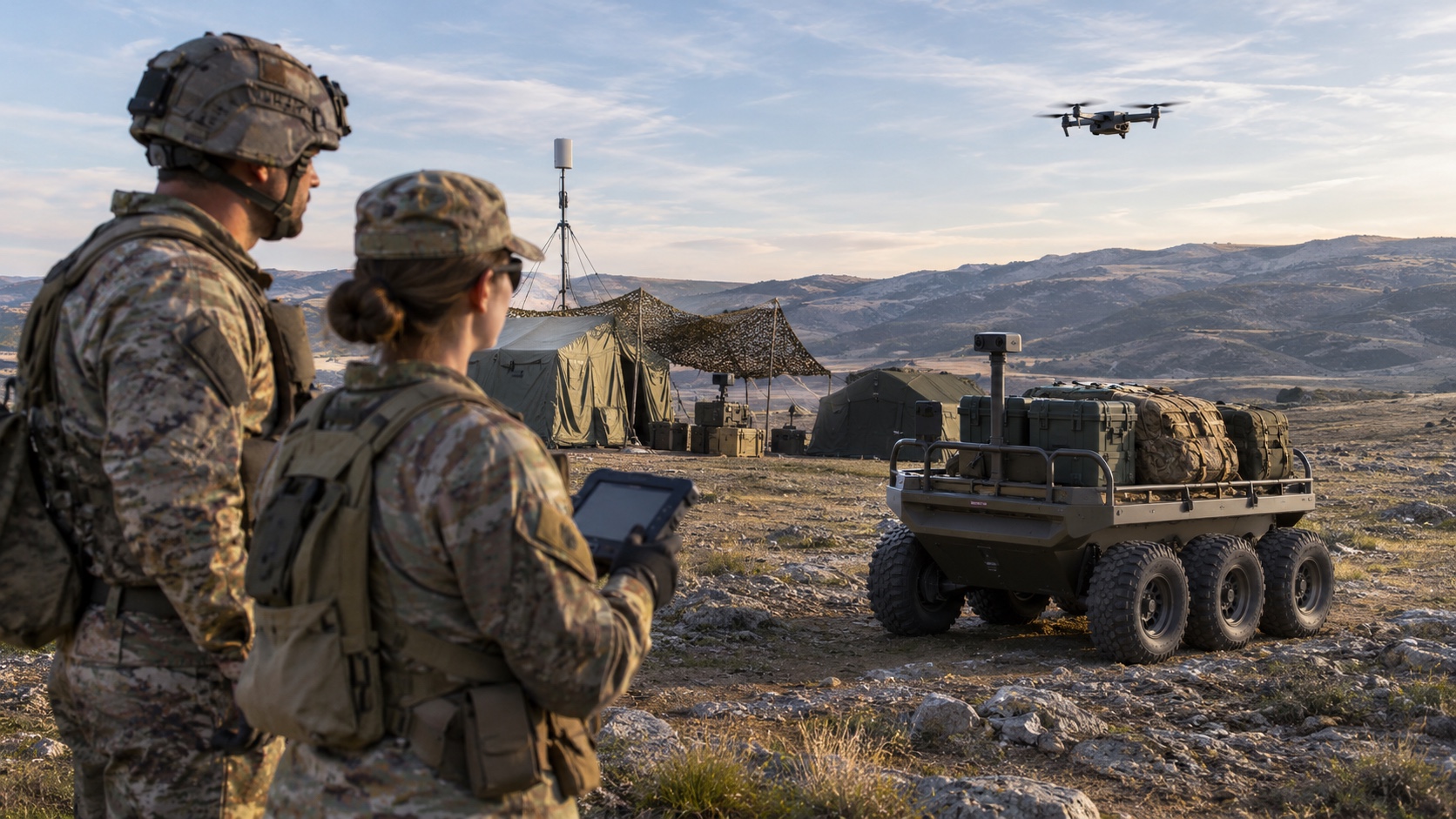
Wheeled robots are efficient on roads, floors, packed soil, and prepared trails. Sizes range from small indoor scouts to autonomous cargo trucks. Wheels are mechanically familiar, relatively easy to maintain, and energy efficient. Steering may resemble a car, use independent wheel speeds, or rotate specialized wheel modules for tight maneuvering. Road-going vehicles support logistics, perimeter patrol, convoy assistance, and transport inside depots. Small wheeled platforms carry cameras through buildings or inspect beneath vehicles. Their weakness appears on stairs, deep mud, rubble, and tall obstacles. Tire damage and wheel slip can stop a capable sensor package, so route knowledge remains essential.
Tracked Ground Robots
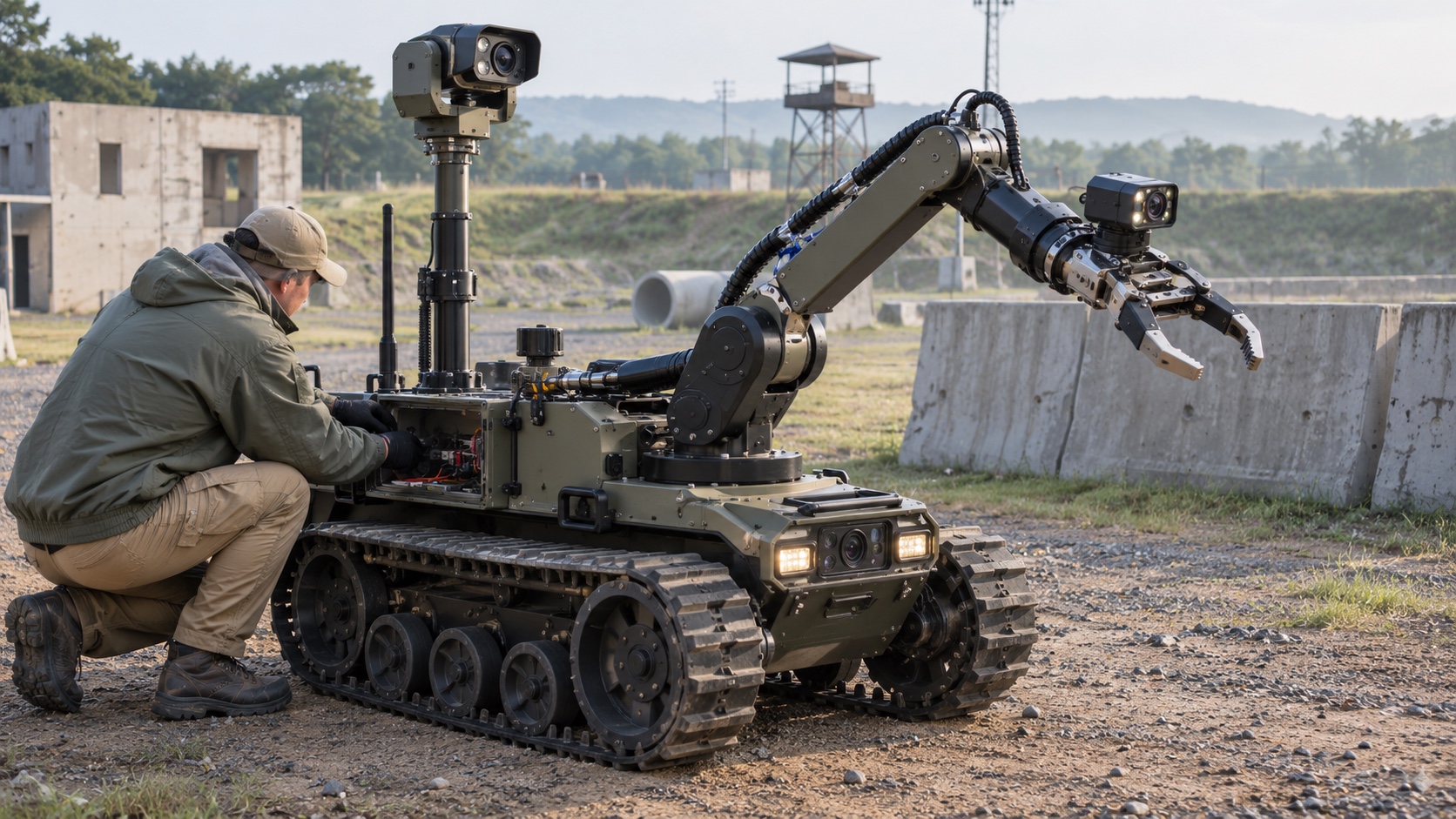
Tracks distribute weight and maintain contact across loose surfaces. Compact tracked robots are common in explosive ordnance disposal, hazardous-material inspection, tunnel reconnaissance, and firefighting. Flippers or articulated track sections help them climb stairs and cross debris. Their low profile supports stability when an arm reaches forward.
Tracks scrub against the ground while turning, increasing power use and wear. They can disturb evidence or damage finished floors. Debris may lodge in the mechanism, and a thrown track can require hands-on recovery. A tracked platform is therefore rugged, not invulnerable. Its design favors obstacle negotiation and tool use over speed and efficiency.
Legged Robots
Quadrupeds and other legged machines place individual feet instead of following one continuous wheel path. They can step over cables, climb industrial stairs, cross grating, and adjust body height for sensors. This makes them attractive for inspection in power plants, ships, tunnels, damaged facilities, and terrain built around human access. Legged locomotion requires continuous balance and coordinated joints. Endurance, payload, noise, and mechanical complexity may be less favorable than a wheeled cart on a smooth route. Feet can slip, narrow openings can trap legs, and a fall may damage expensive actuators. The right question is not whether legs are more advanced, but whether discrete footholds solve a route problem that simpler mobility cannot.
Manipulation and Explosive-Ordnance Robots
Some defense robots are defined less by locomotion than by their ability to handle objects. An articulated arm may open a vehicle door, lift a package, cut a wire, position an imaging device, or place a tool. Cameras mounted on the wrist and chassis give the operator several viewpoints. Force sensing and motion limits help prevent an accidental collision.
Manipulation at a distance is demanding. Video flattens depth, radio delay disrupts fine movement, and a small chassis can tip when the arm extends. Operators train on common tasks until camera selection and joint control become familiar. Tool attachments must be selected before approach because returning for a missing implement wastes time and battery.
Autonomous Logistics and Engineering Vehicles
Logistics robots move supplies or tow equipment. They include follow-me carriers, warehouse movers, off-road cargo platforms, and road vehicles that supervise speed and spacing. Engineering variants clear debris, excavate, grade routes, handle material, or place temporary structures. Removing a crew from repetitive or exposed movement can reduce fatigue and risk. These vehicles encounter heavier loads and longer duty cycles than small scouts. Braking distance, rollover stability, payload restraint, and interaction with pedestrians become central safety concerns. An autonomous excavator also influences the environment, so inaccurate localization can cause more than a navigation error. Work zones require boundaries, spotters, and reliable stop systems.
Uncrewed Surface Vessels
Surface robots operate on rivers, lakes, harbors, and oceans. Small craft sample water, inspect infrastructure, or map shallow areas. Larger vessels carry radar, sonar, cameras, communications relays, and long-endurance power systems. Their hulls may resemble ordinary boats, catamarans, or compact platforms optimized for stability.
Currents, waves, traffic rules, floating debris, and changing weather complicate autonomy. Cameras alone may not reveal distance on open water, so radar, automatic identification information, and charts contribute to navigation. A surface vessel must also avoid becoming a hazard after propulsion or communication fails. Safe drift, anchoring, and recovery plans matter.
Uncrewed Underwater Vehicles
Remotely operated underwater vehicles remain connected by a tether that carries power, commands, or video. They are useful for close inspection and manipulation because operators receive continuous information. Autonomous underwater vehicles travel without a live cable, following programmed missions to survey larger areas. Gliders adjust buoyancy and convert vertical motion into slow forward travel, trading speed for very long endurance. Underwater communication is limited, satellite positioning is unavailable below the surface, and pressure increases with depth. Vehicles rely on sonar, inertial navigation, depth sensors, and acoustic references. Recovery can be challenging if currents move the vehicle or a fault prevents surfacing. Mission plans must account for what the robot can decide when human contact is intermittent.
Space-Based and High-Altitude Robotic Systems
Satellites are robotic platforms that point sensors, manage power, communicate, and adjust orbit or attitude. They support navigation, weather observation, communications, mapping, and early warning. High-altitude long-endurance aircraft or balloons occupy a different layer, offering regional persistence without entering orbit.
These systems operate far from routine repair. Radiation, temperature cycling, power budgets, and communication delay shape their design. Redundancy and fault management are critical because a small component failure can end an expensive mission. Their data influences many other robots by providing timing, maps, weather, and connectivity.
Cyber-Physical, Training, and Defensive Robotic Tools
Not every defense robot travels across a battlefield. Automated test devices exercise networks and hardware. Robotic targets reproduce aircraft, vehicles, or movement patterns for training and system evaluation. Remote weapon stations position sensors or equipment while an operator remains protected, though their governance and use differ from autonomous vehicles. Fixed robotic systems can also inspect fuel tanks, ventilation shafts, and machinery. These categories show why definitions should follow function. A machine may be stationary yet still sense, compute, and act on the physical world. Training robots can reduce ammunition use and create repeatable scenarios. Inspection crawlers prevent technicians from entering confined spaces. The absence of dramatic mobility does not reduce their practical value.
Hybrid Platforms and Modular Payloads
Hybrid robots combine modes. A vehicle may drive and then launch a small aircraft. An amphibious platform crosses shorelines. A wheeled-leg design rolls efficiently on smooth ground and steps over obstacles when needed. Modularity creates another kind of hybrid: the same chassis carries a camera today, a radio relay tomorrow, and a chemical sensor during an emergency.
Each added option increases integration work. A payload changes weight, balance, power use, data formats, and cooling. Launching one robot from another creates communication and recovery dependencies. Hybrid capability is useful when transitions are central to the mission, but unnecessary complexity can reduce reliability.
Choosing the Right Type
Selection begins with terrain, distance, duration, payload, and required action. If the task is to hover beside a tower for ten minutes, a multirotor may fit. If it is to map a long corridor, a fixed wing may be better. Smooth indoor floors favor wheels; rubble may justify tracks or legs. Continuous underwater video suggests a tether, while broad seafloor mapping suggests autonomy.
Support conditions narrow the choice further. Teams must transport the system, secure frequencies, charge or fuel it, maintain sensors, and recover it after failure. A theoretically superior platform can become useless if it needs equipment the unit cannot carry. The best classification is ultimately operational: the robot type whose strengths match the task and whose limitations the team can manage safely.
Climate and infrastructure may eliminate options before performance comparisons begin. Salt water attacks exposed materials, high altitude reduces rotor lift, extreme cold limits batteries, and dense buildings disrupt communication. Launch equipment, deck space, road width, and available cranes also determine which platform can be used routinely.
Classification should remain flexible throughout the service life. A new payload can turn a mapping vehicle into a communications relay, while a software change can add assisted navigation without changing the chassis. Teams should document the tested configuration rather than assume every version of a familiar platform behaves identically.
Recovery deserves a final comparison. A machine that crosses the obstacle but cannot be lifted, towed, landed, or safely abandoned may create more work than it removes.