A Field Guide to the Machines That Explore Beyond Our Reach
Space exploration uses a surprisingly diverse collection of robots. Some never touch a surface; they circle a world for years and assemble global maps one orbit at a time. Others survive a single descent, unfold instruments, and study one patch of ground. Rovers travel between targets, rotorcraft leap over obstacles, probes cross planetary systems, and observatories stare into deep space from carefully controlled positions. Even a spacecraft’s arm, sampling mechanism, or docking vehicle may be a robot in its own right. The differences are easiest to understand through mission geometry. Where must the machine go? Does it need to remain nearby, pass once, orbit repeatedly, land, move, fly, dig, return material, or service another spacecraft? Each answer leads to a different balance of propulsion, power, communications, autonomy, and scientific payload. These machines belong to one family, but they solve distance in distinct ways.
A: A lander remains near its touchdown site, while a rover travels between targets.
A: A flyby avoids the large propulsion requirement needed to slow into orbit.
A: Yes, when atmospheric density, gravity, power, and rotor or wing design allow it.
A: Orbiters, hoppers, touch-and-go samplers, and small landers suit weak gravity.
A: Yes. It senses, points, stabilizes, protects itself, and communicates autonomously.
A: A fleet can measure multiple locations simultaneously and tolerate individual losses.
A: It records atmospheric conditions and composition while descending through successive layers.
A: Proposed cryobots melt downward while managing power, communication, and refreezing.
A: Sample-return systems collect, seal, transfer, launch, and recover selected material.
A: Long seismic, weather, or astronomical observations often benefit from remaining still.
Flyby Probes: One Encounter, Carefully Timed
A flyby spacecraft follows a trajectory that carries it past a planet, moon, comet, or asteroid without stopping. The design saves the propellant that orbital capture would require, making distant targets accessible within a practical mass and budget. During the brief encounter, the spacecraft points instruments through a tightly choreographed sequence. It may photograph the approaching hemisphere, measure particles and magnetic fields near closest approach, then turn to observe the departing side. Data is stored onboard because the antenna cannot always face Earth while instruments face the target. A successful flyby turns a few intense hours into years of scientific analysis.
Orbiters: Repeated Context From Above
Orbiters enter a gravitational path around a destination. Repeated passes allow them to map terrain, weather, composition, gravity, ice, and change over time. The orbit itself becomes part of the instrument plan: a low path reveals fine detail, a polar path eventually covers most latitudes, and an elongated orbit can sample both close and distant environments.
These spacecraft continually manage orientation and energy. Reaction wheels or thrusters point cameras, antennas, and solar arrays. Some orbiters relay data for surface missions, becoming communications infrastructure as well as scientific platforms. Their broad perspective helps teams place a rover’s local observations into regional history.
Atmospheric Entry Probes
An entry probe studies an atmosphere while descending through it. A protective shell absorbs intense heating, then parachutes or other devices slow the vehicle. Instruments measure temperature, pressure, winds, clouds, radiation, and chemical composition at different altitudes. Some probes transmit until impact; others float or land. Because the descent cannot be repeated, timing, sampling rates, and communication paths must be planned in advance. The resulting vertical profile reveals how an atmosphere is layered and how conditions change between space and the surface.
Fixed Landers
A lander reaches the ground and conducts science within the reach of its instruments. Stability is its strength. Seismometers can listen for subtle vibrations, weather stations can build long records, drills can reach below the altered surface, and cameras can revisit the same horizon through seasons. With no drive motors to power, more energy may be available for instruments and thermal control.
Location is the permanent tradeoff. A landing error or unexpectedly poor site cannot be corrected by driving elsewhere. Designers therefore combine orbital reconnaissance, careful landing ellipses, and hazard-detection systems. Arms and scoops extend the working area, but every target remains tied to one patch of terrain.
Wheeled Rovers
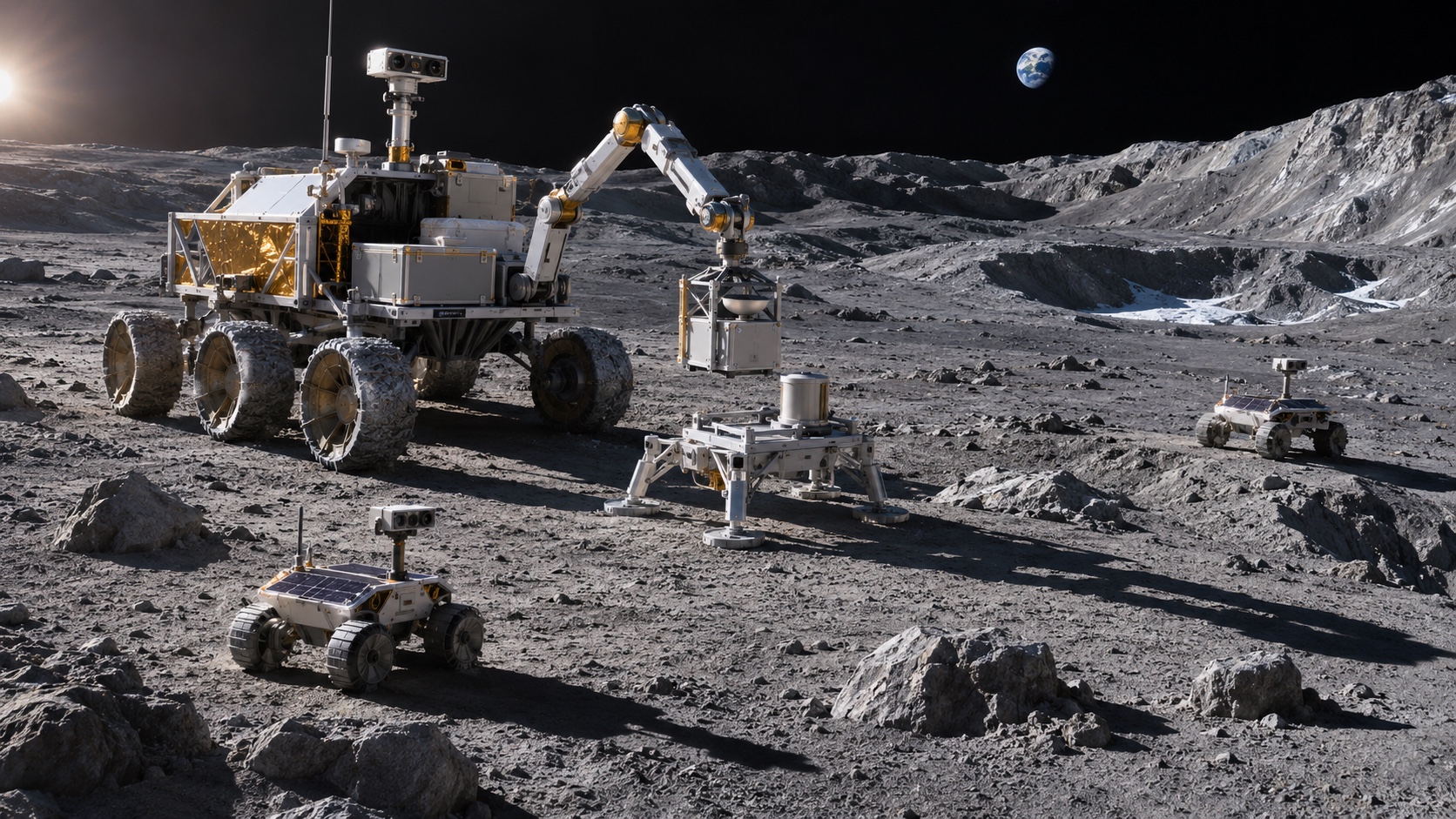
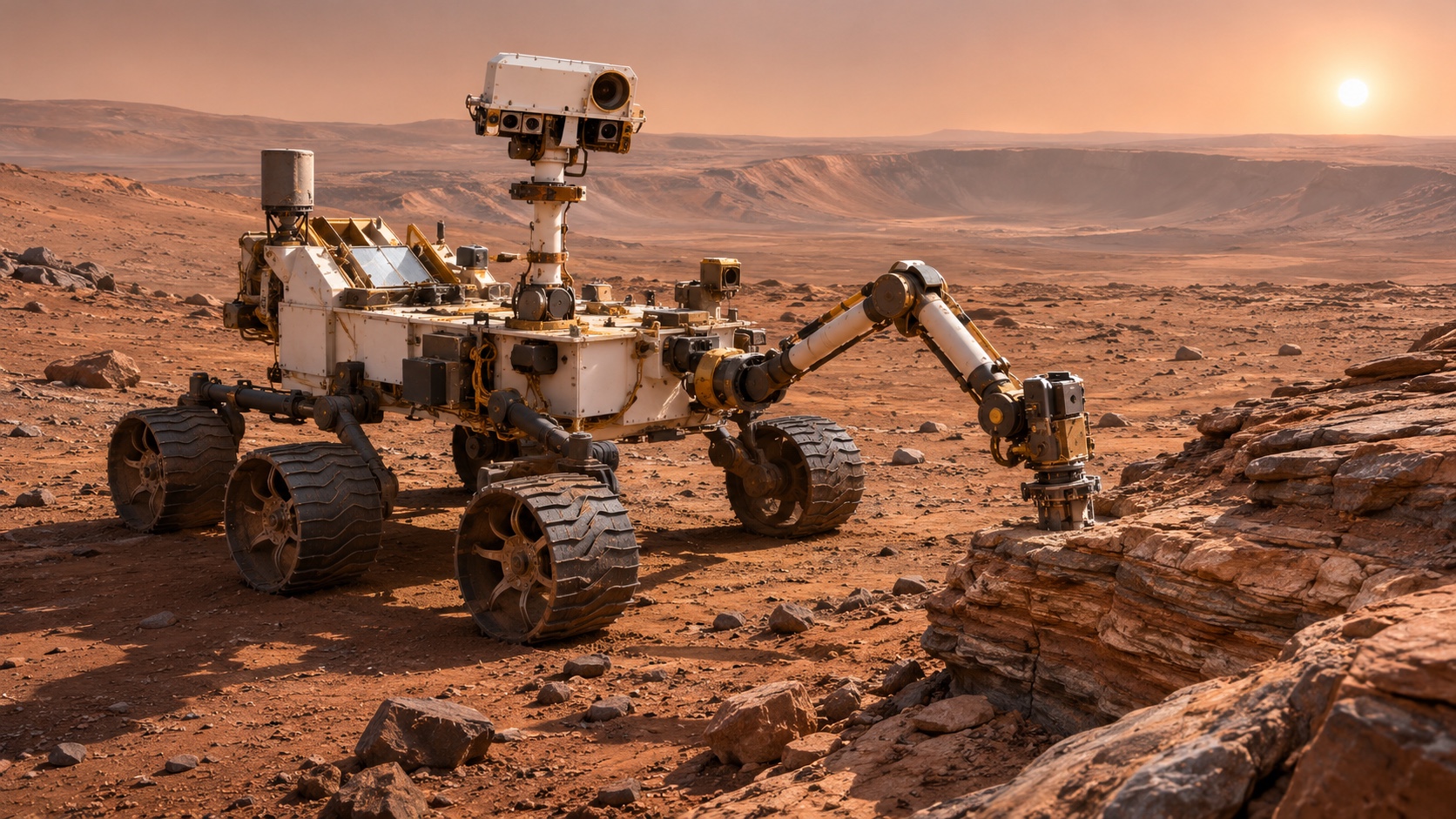
Wheeled rovers carry laboratories across a surface. Small vehicles may travel between a few nearby targets, while larger rovers can cross many kilometers over a long mission. Suspension keeps wheels in contact with uneven terrain, mast cameras survey possible routes, and hazard cameras watch the ground beside the chassis.
Driving on another world is an exercise in uncertainty. Loose soil causes slip, rocks damage wheels, slopes change stability, and shadows obscure obstacles. Visual odometry compares images to estimate true movement. The rover receives a destination and safety limits, then makes local choices that cannot wait for a reply from Earth.
Mobility changes the scientific method. Teams can follow a layer of rock, compare environments, revisit a feature from another angle, or leave an unproductive site. The route becomes a record of decisions rather than a simple line between points.
Hopping and Tumbling Explorers
Small bodies such as asteroids have gravity too weak for ordinary driving. A wheel can push a vehicle away from the surface instead of moving it forward. Hopping robots use internal masses, springs, or brief actuations to travel in controlled jumps. Tumbling designs shift their center of mass and roll to a new orientation. These machines move slowly and must wait for motion to settle, but they can investigate several locations without conventional traction.
Planetary Rotorcraft and Winged Aircraft
Aerial explorers cross terrain that blocks rovers. Rotorcraft take off vertically, examine routes, and land at separated sites. Winged concepts could cover longer distances where an atmosphere provides enough lift. Balloons and aerostats drift through atmospheric layers for persistent regional measurements.
Every world changes the problem. Thin air demands large rotors and low mass, while dense air affects drag and buoyancy. Temperatures influence batteries and lubricants. Landing software must choose safe ground without a human pilot. Flight expands reach, but it makes energy reserve and fault response especially unforgiving.
Penetrators, Moles, and Cryobots
Subsurface robots seek records protected from radiation and surface weathering. Penetrators enter soil at speed and leave instruments below ground. Hammering “moles” advance gradually through loose material. Cryobots use heat to melt through ice, potentially carrying sensors toward buried water. Each concept must manage friction, heat, power, and communication through material that cannot be seen directly. A jammed mechanism may be impossible to retrieve, so engineers test against many plausible soil or ice conditions.
Robotic Arms and Sampling Mechanisms
A manipulator gives a spacecraft controlled physical contact. Arms place spectrometers against rocks, move samples into laboratories, deploy seismometers, brush dust from a target, or grasp a container. Scoops collect loose material; corers preserve layered structure; drills reach beneath exposed surfaces.
These tools work within strict force and geometry limits. A lander can shift if an arm pushes too hard. A sample path can become contaminated if seals or cleaning steps fail. Cameras document the target before and after contact so scientists can connect a measurement with its exact context.
Sample-Return Architectures
A sample-return mission brings selected material to Earth. The simplest design collects and seals material in one vehicle, then launches or departs. More ambitious campaigns divide the work among several robots: a rover caches tubes, a retrieval vehicle gathers them, an ascent stage launches the container, and an orbiter captures it for the trip home. Earth laboratories can then apply instruments far larger and more adaptable than any flight payload. The chain demands precise custody, containment, rendezvous, and documentation at every handoff.
Space Telescopes and Remote Observatories
Observatories are robots built primarily to point and hold still. They aim mirrors or detectors with exceptional precision, manage thermal conditions, protect instruments from bright sources, and transmit carefully calibrated data. Some orbit Earth; others operate near gravitational balance points or follow solar orbits.
Their targets may be stars, galaxies, planets, the Sun, or the cosmic background. Unlike a rover, an observatory explores by collecting light rather than changing location frequently. Minute pointing errors can blur a measurement, so attitude control, vibration isolation, and scheduled momentum unloading are central to the mission.
Solar, Plasma, and Magnetosphere Explorers
Not every exploration robot photographs solid worlds. Spacecraft sample the solar wind, magnetic fields, charged particles, and plasma waves. Some fly in formations so scientists can separate changes across space from changes over time. Heat shields allow close approaches to the Sun, while long booms move sensitive instruments away from the spacecraft’s own electrical and magnetic influence. Their environment is invisible to ordinary cameras but critical to understanding space weather and planetary protection.
Servicing and Assembly Robots
Servicing spacecraft approach other vehicles to inspect, reposition, refuel, or repair them. Robotic arms on crewed stations move cargo and support maintenance. Future assembly machines may join large structures that cannot fit inside one launch fairing. These systems require precise relative navigation because both the servicer and client are moving.
Contact creates risk. A small force can start an unwanted rotation, and a poorly chosen grasp point can damage the client. Standard fixtures, accessible connectors, and cooperative targets make servicing safer. The category will grow as spacecraft are designed for robotic assistance rather than treated as sealed products.
Networked Fleets and Distributed Sensors
A distributed mission uses several robots to measure a system together. Small satellites fly in formation, surface stations monitor different locations, or a rover cooperates with an aerial scout and orbiter. Shared timing and location turn separate readings into one larger instrument. The fleet must coordinate without flooding operators with routine decisions. Members may divide territory, relay messages, or report only changes. Failure of one unit should reduce coverage rather than collapse the entire mission. Distribution trades the depth of a single elaborate platform for spatial reach, redundancy, and simultaneous observation.
Choosing a Robot Type From the Question
Mission designers begin with the evidence needed. A global mineral map suggests an orbiter. A seismic record requires stable contact over time. A cliff face may justify flight. Laboratory analysis favors sample return, while a broad magnetic survey may require a formation. The environment then imposes limits on power, thermal control, propulsion, and communication.
No type is universally superior. A rover’s mobility is unnecessary when a fixed instrument needs years of stillness. A flyby’s speed is a disadvantage when seasonal change matters, yet it may be the only practical way to reach several distant targets. The right exploration robot is the one whose movement, instruments, endurance, and level of autonomy match a precise scientific question.
Reading a Mission as a System of Robots
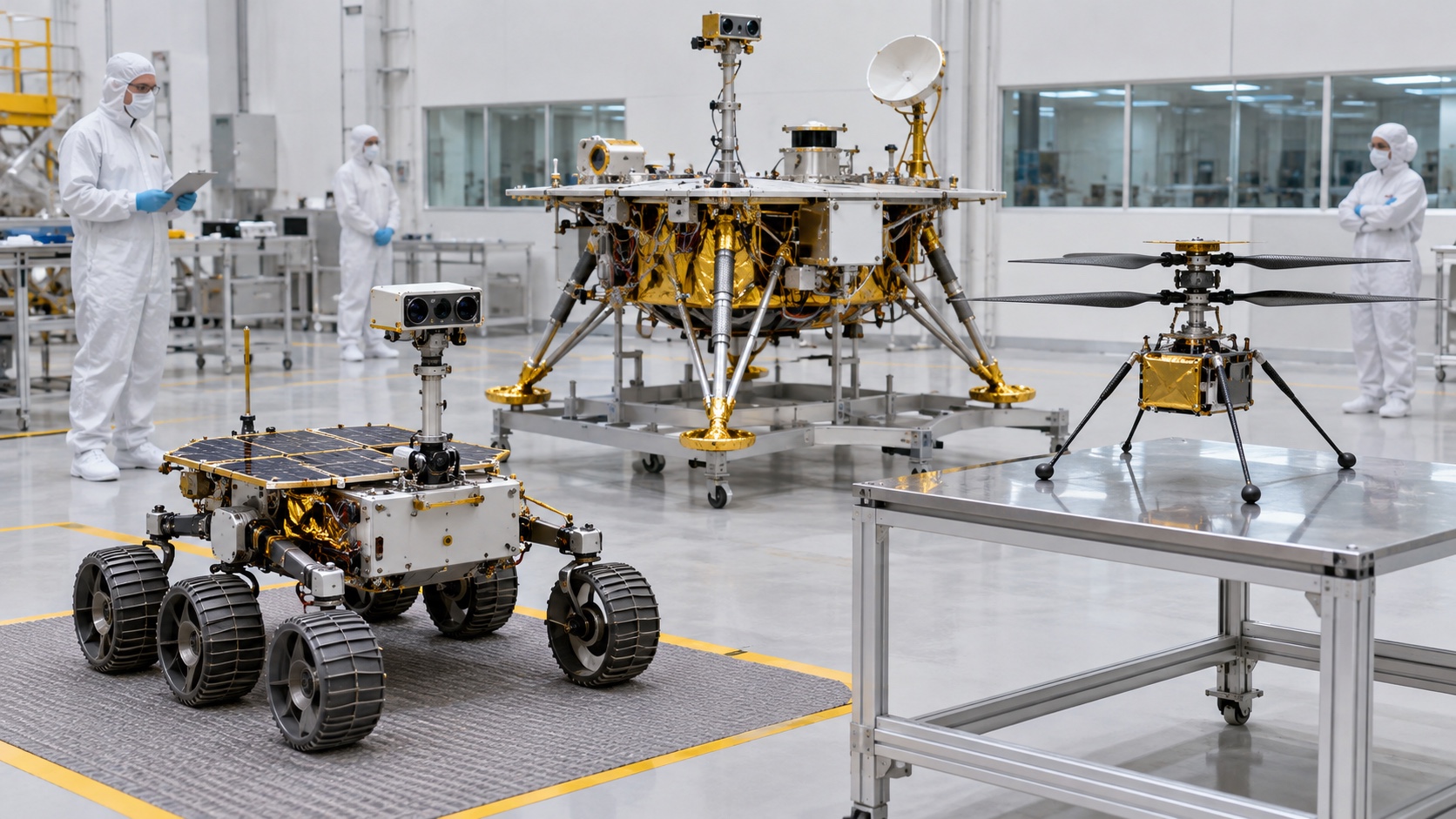
Large missions often contain several robot types even when one vehicle receives most public attention. An orbiter may map landing hazards and later relay data. The descent stage handles navigation and propulsion that the rover does not need after touchdown. A mobile laboratory carries an arm whose joints, cameras, and tools form another robotic system. Sample tubes may be designed for a future retrieval machine and orbital capture vehicle. Seeing those relationships prevents a common misunderstanding: a mission is rarely one self-sufficient robot performing every function. It is an architecture that distributes work according to environment and timing. The best platform for launch is not the best platform for landing, and the best machine for regional mapping is not the best one for microscopic analysis. Interfaces connect the types. Mechanical fixtures, radio protocols, coordinate frames, timing, contamination controls, and shared documentation determine whether separate vehicles can cooperate. When beginners compare exploration robots, they should therefore compare both the individual machine and the chain around it. A modest relay or sample container can be as decisive as a spectacular rover because the mission succeeds only when information, material, and authority move reliably from one stage to the next.
Type Labels Can Change Across Mission Phases
A spacecraft may belong to different categories at different moments. A cruise vehicle becomes an entry system, then a lander, and later serves as a stationary relay. Engineers name the configuration that matters for the current phase and verify each transition separately.
These changing identities are useful rather than confusing. They remind readers to ask what the machine is doing now, which hardware remains active, and what new limits apply after deployment, separation, landing, or docking.