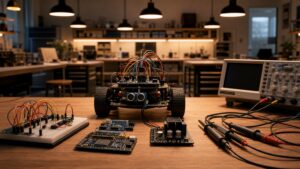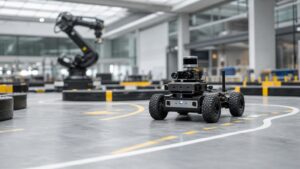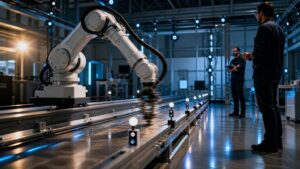
Every smooth motion, steady balance, and precise robotic gesture begins with one thing—control. In Robot Streets’ Control Systems and Motion hub, we explore how robots turn code into coordination and physics into flow. From tiny microcontrollers managing servo angles to powerful PID loops keeping drones level in midair, control systems are the unseen intelligence that brings mechanical life to motion. This is where math meets movement: algorithms adjust torque, correct drift, and synchronize multi-joint choreography in milliseconds. You’ll learn how feedback loops, motor drivers, and motion planning software all work together to transform data into action. Discover how balance bots stay upright, how industrial arms trace perfect paths, and how autonomous rovers adapt to terrain in real time. Whether you’re fascinated by stability, trajectory control, or precision motion design, this is your backstage pass to the rhythm and logic that make every robot move with purpose—and sometimes, grace.
A: PID is simple/robust; MPC/state-space shines for constraints and coupling.
A: Current: 5–20 kHz; velocity: 1–5 kHz; position: 0.5–2 kHz (typical ranges).
A: Too much P or too little D; add feedforward and jerk-limited motion.
A: Add deadband, tune D, check encoder noise and quantization.
A: Steppers are simple/cost-effective; servos give speed, torque, and stall detection.
A: Use absolute encoders or battery-backed multi-turn sensors to start “in place.”
A: Stiffen mechanics, notch resonances, and smooth trajectories (S-curve).
A: Yes for crisp tracking—add kS/kV/kA terms to complement feedback.
A: Spring-applied, power-off with controlled release during motion.
A: Deterministic fieldbuses (e.g., EtherCAT, CAN-FD) with time sync.