

Every robot’s movement, balance, and awareness start with two unsung heroes—sensors and actuators. On Robot Streets, this category dives into the living heartbeat of robotics: how machines sense their world and bring ideas to motion. Sensors act as the robot’s “eyes and nerves,” feeding it information about distance, heat, light, sound, force, and more. Actuators, on the other hand, are the “muscles,” converting commands into precise physical action—from delicate robotic fingers to industrial arms swinging with millimeter accuracy. Here, you’ll explore how ultrasonic sensors help bots navigate rooms, how torque-controlled actuators bring lifelike grace to humanoids, and how feedback loops tie them together for perfect harmony. Discover the core technologies that make robots aware, responsive, and expressive—whether it’s in manufacturing, medicine, exploration, or entertainment. Welcome to the intersection where intelligence meets motion, where sensing meets doing, and where the soul of robotics truly comes alive.
A: Inductive for metal, capacitive for plastics/liquids, IR/ToF for general distance.
A: Servo = precise pos/torque; stepper = simple control; BLDC = efficient speed/torque.
A: Inrush sag — add bulk caps, separate rails, proper grounding, and flyback paths.
A: Shielded cable, differential reads, low-pass filters, and oversampling.
A: Yes — factory + field calibration improves accuracy and drift.
A: Use level shifters or resistor dividers; check datasheets.
A: Combine limit switches, encoders, and force/torque sensing for reliable grasp.
A: Add deadband, tune PID, and filter noisy measurements.
A: Field-oriented control regulates BLDC stator currents for smooth torque.
A: Match motor/driver ratings; higher voltage lowers current for same power.

What Are Sensors and Actuators in Robotics?
A clear beginner explanation of What Are Sensors and Actuators in Robotics?, with plain-English robotics context, practical examples, and useful details for curious beginners.

The Ultimate Beginner’s Guide to Robot Sensors
A clear real-world examples of The Ultimate Beginner’s Guide to Robot Sensors, with plain-English robotics context, practical examples, and useful details for curious beginners.
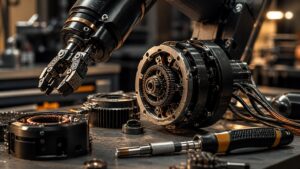
How Actuators Bring Robots to Life
A clear technical intuition of How Actuators Bring Robots to Life, with plain-English robotics context, practical examples, and useful details for curious beginners.