Machines Built to Reduce Risk, Extend Reach, and Support Decisions
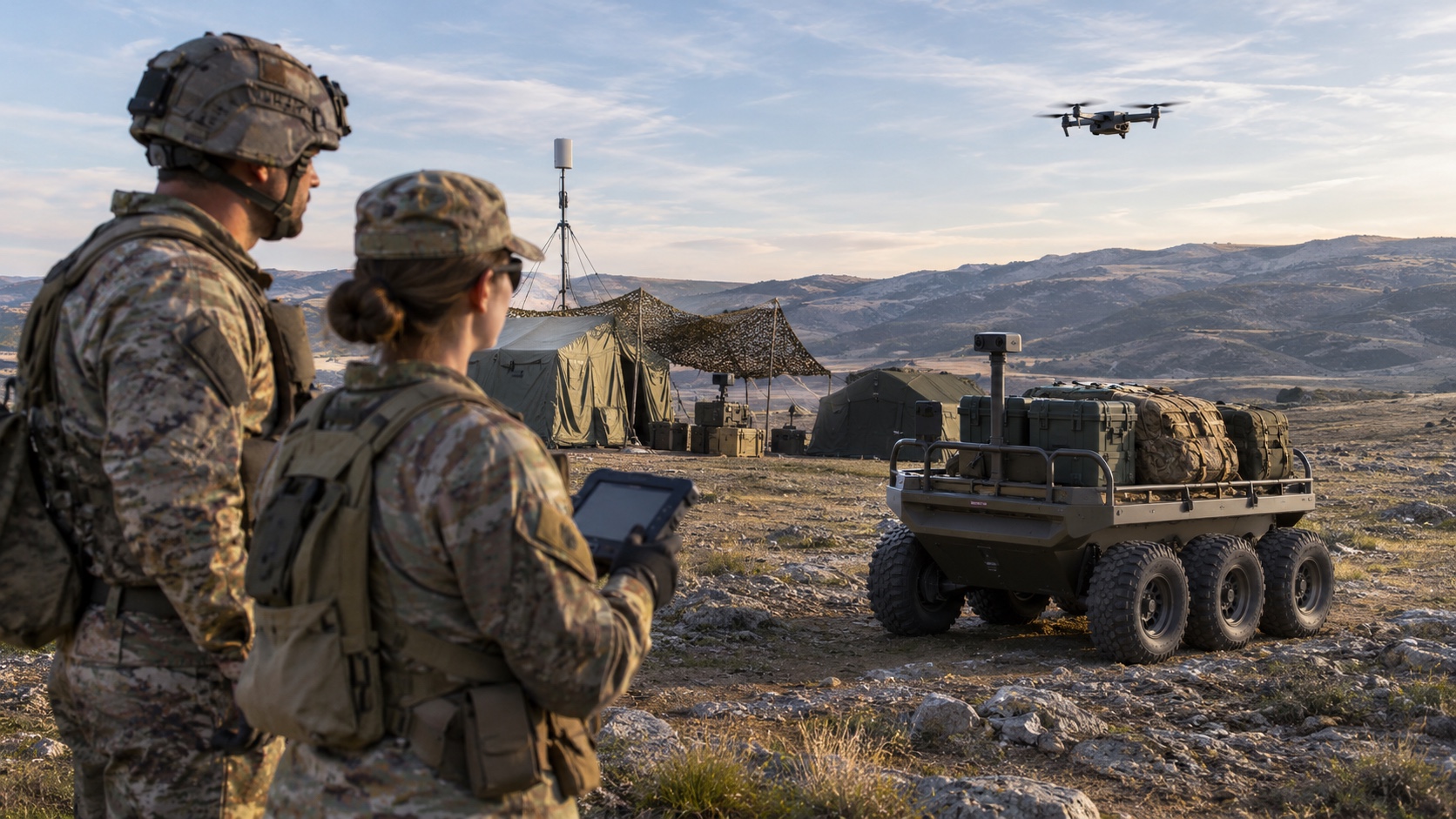
Military and defense robots are machines designed to perform useful work in environments where distance, danger, endurance, or precision matter. Some roll toward a suspicious object so a bomb technician does not have to. Others fly above a disaster area, carry supplies across rough ground, inspect a ship’s hull, or watch a perimeter through the night. The word robot can make these systems sound independent, but most are better understood as combinations of hardware, software, sensors, communications, and human judgment. Their level of autonomy varies widely. A small reconnaissance aircraft may hold its altitude automatically while a person directs the mission. A ground vehicle may follow a planned route but stop when it encounters an uncertain obstacle. Even highly automated systems operate within rules, permissions, and technical limits established by people. Understanding defense robotics therefore requires more than listing impressive machines. It means looking at what the robot is asked to do, how it perceives the world, who controls it, what can interrupt its connection, and how a team decides whether its information can be trusted.
A: No. Many are remotely controlled or use automation only for limited functions.
A: Tracks cross rubble and soft ground well, though they consume more energy.
A: Only according to predefined lost-link behavior such as stopping or returning.
A: It displays differences in emitted heat, not an ordinary color photograph.
A: Trained maintainers handle hardware, batteries, calibration, software, and payload integration.
A: No. They relocate or reduce certain risks while creating technical and procedural ones.
A: Teams expand from controlled trials to realistic terrain, faults, and degraded communications.
A: People need a clear picture of mode, confidence, faults, and remaining authority.
A: No. Most platforms are shaped around mobility, payload, and environmental demands.
A: Ask which specific task the robot improves and how success will be measured.
What Makes a Defense Machine a Robot?
A robot combines sensing, computation, and physical action. Sensors collect information about the machine and its surroundings. Software interprets that information and selects or recommends an action. Motors, control surfaces, manipulators, or other actuators then change the robot’s position or affect an object. A remotely driven camera vehicle qualifies because it senses and acts through a human operator. A fixed surveillance camera usually does not, because it has little ability to move through or manipulate its environment.
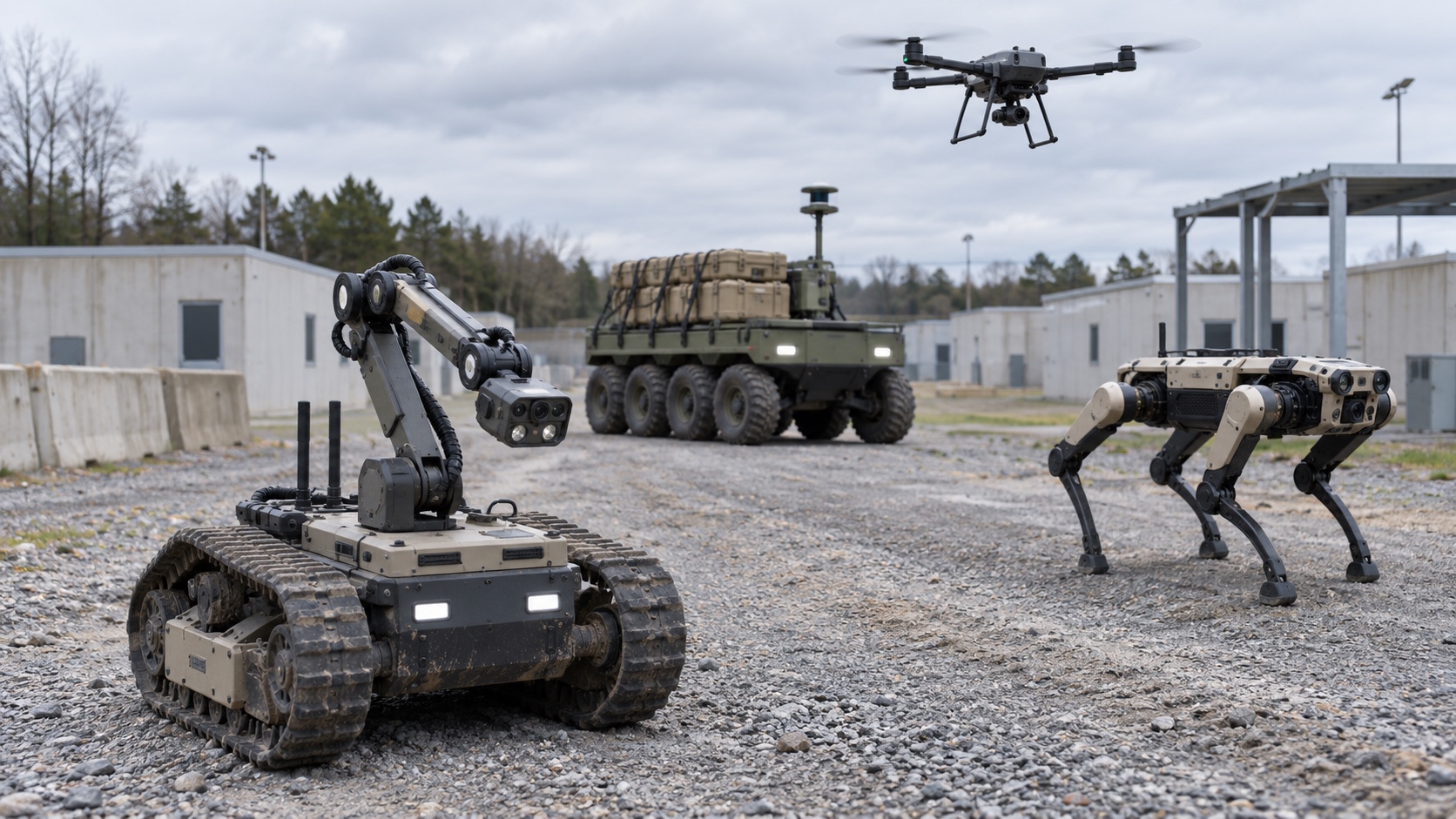
Defense organizations use the term broadly. It can include uncrewed aircraft, tracked inspection machines, autonomous surface vessels, underwater vehicles, robotic arms, supply carriers, and specialized systems that work inside hazardous facilities. The purpose matters more than a humanlike appearance. Most practical defense robots look like the terrain and task shaped them: wheels for roads, tracks for rubble, rotors for hovering, wings for range, and pressure-resistant bodies for deep water.
The Building Blocks Inside the Machine
A robot begins with a platform capable of surviving its operating environment. Frames must tolerate shock, vibration, dust, moisture, temperature changes, and the strain of repeated transport. Batteries, fuel systems, or tethered power supplies determine how long it can work. Actuators turn stored energy into motion, while brakes and mechanical stops prevent uncontrolled movement when something fails.
The sensing package gives the platform awareness. Daylight cameras provide familiar imagery, thermal cameras reveal heat differences, lidar measures distance with light, radar works through some obscurants, and microphones detect sound. Inertial sensors estimate orientation and motion. Wheel encoders record rotation, while joint sensors tell a manipulator where each segment is positioned. No single sensor is perfect, so designers often combine several sources and compare them.
Computers run control software, navigation tools, diagnostic checks, and data processing. A communication link carries commands and returns video or telemetry. Encryption and authentication help prevent unauthorized access, but radio performance still depends on terrain, buildings, interference, antennas, and distance. The complete system also includes the operator console, chargers, spare parts, transport cases, training materials, and maintenance procedures.
Human Control and Degrees of Autonomy
Remote control places a person directly in the loop. The operator chooses speed, direction, camera position, and manipulator movement much as a driver controls a vehicle. This approach is intuitive, but it demands attention and a dependable connection. Delays can make delicate work difficult, and a narrow camera view may hide hazards that would be obvious to someone standing nearby.
Assisted control lets the machine handle lower-level tasks. It might stabilize a camera, prevent a collision, maintain a safe distance, or return along its previous path. Supervised autonomy goes further: a person assigns a destination or task, the robot plans the details, and the person monitors progress. The highest useful level depends on the mission. Predictable navigation can be automated more safely than an ambiguous decision involving people, changing intentions, or incomplete information.
Where Defense Robots Are Commonly Used
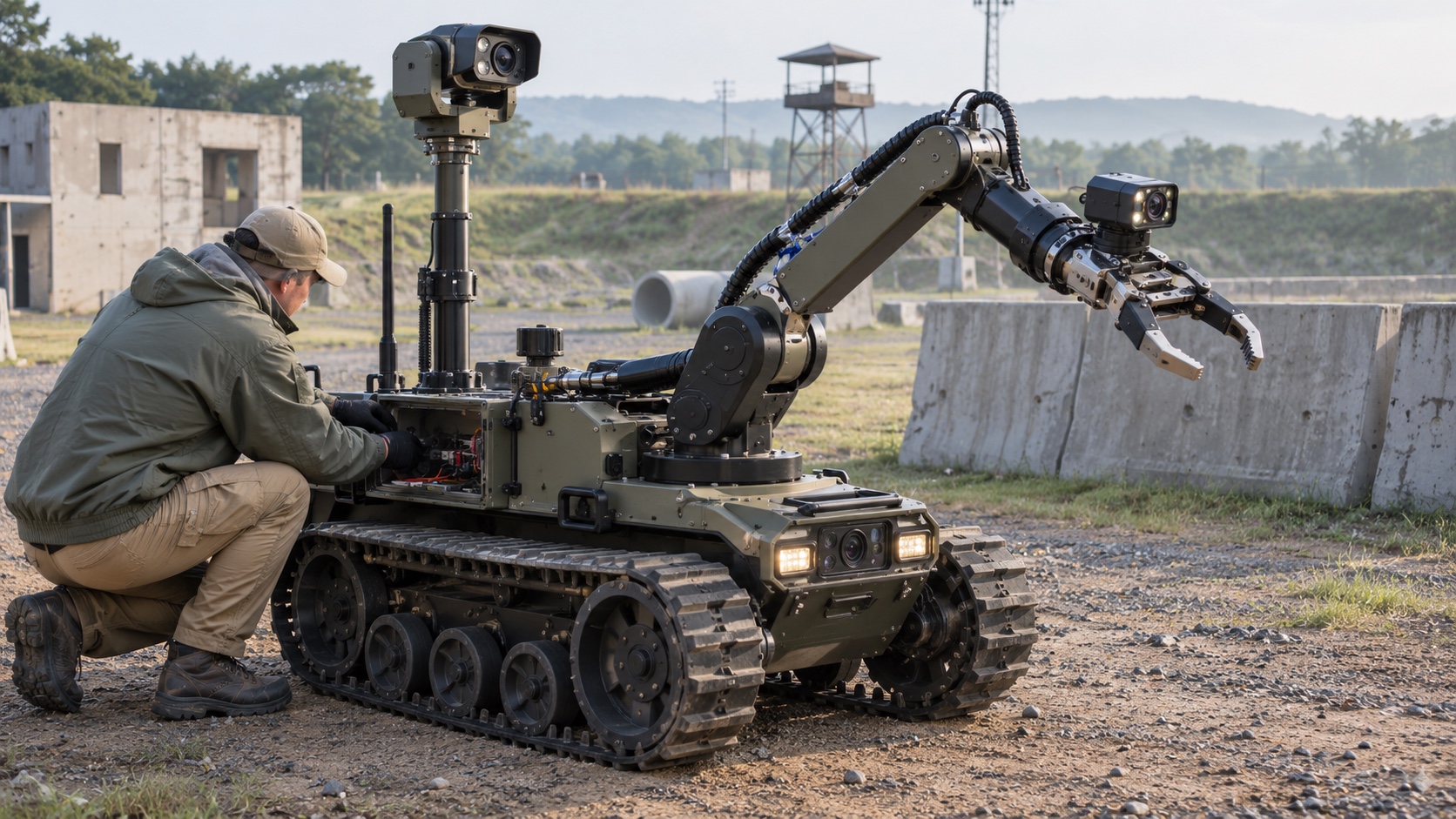
Explosive ordnance disposal is one of the clearest examples. A tracked robot can approach a suspicious object, send close video, use an arm to inspect it, and carry tools selected by a trained technician. The machine does not remove risk, but it moves a person farther from the immediate hazard and gives the team more options before anyone approaches.
Reconnaissance robots observe areas that are difficult to reach or unsafe to enter. Small aircraft can look over a ridge, while ground vehicles can inspect tunnels, damaged buildings, or confined industrial spaces. Maritime robots examine harbor structures, search underwater areas, or map the seafloor. Logistics platforms carry water, batteries, medical supplies, or heavy equipment so people can conserve energy for tasks requiring human skill.
Robots also support base security, firefighting, chemical detection, route inspection, maintenance, and training. These roles are not interchangeable. A machine optimized for quiet indoor inspection will have different mobility, sensors, endurance, and communications than a vehicle expected to haul cargo for many hours.
Why Mobility Is a Design Tradeoff
Wheels are efficient on firm ground and mechanically simple, but they struggle with tall obstacles and soft soil. Tracks spread weight and climb debris well, although they consume more energy and can damage surfaces. Legged machines step over obstacles and use narrow footholds, yet they need sophisticated control and often have limited endurance. Flying robots bypass ground obstacles but trade payload and flight time for that freedom.
Designers rarely seek maximum performance in every category. More armor adds mass. Larger batteries extend endurance but reduce payload. A powerful arm can lift more, yet it may destabilize a small chassis. The best platform is therefore not the one with the most dramatic specification. It is the one whose compromises match the route, task, transport method, support team, and acceptable risk.
How Operators See and Understand the Environment
A video feed is only a partial view of the world. Lens distortion changes apparent distance, dust hides detail, thermal images can confuse hot machinery with living subjects, and shadows may look like obstacles. Skilled operators move cameras deliberately, compare angles, and use scale references. They also watch telemetry such as battery state, radio quality, motor temperature, slope, and wheel slip. Modern software can highlight movement, build maps, identify possible objects, or suggest routes. These tools reduce workload when they are well calibrated, but a suggestion is not the same as a verified fact. Training emphasizes uncertainty: what the system actually detected, what the algorithm inferred, and what remains unknown. That distinction prevents a confident display from replacing careful judgment.
Communications, Navigation, and the Lost-Link Problem
Robots often depend on radio, satellite, wired, or optical links. Every option has limits. Walls and terrain block signals, bandwidth constrains video quality, and interference can delay commands. Defense systems therefore need planned behavior for a degraded or lost connection. A small aircraft might circle, return to a known point, land, or continue a narrowly defined route. A ground robot may stop, reverse to restore contact, or wait for recovery.
Navigation is similarly layered. Satellite positioning is useful outdoors but can be unavailable or unreliable. Robots supplement it with inertial measurements, wheel motion, cameras, lidar, maps, and known landmarks. Comparing sources helps detect disagreement. Operators still need a recovery plan because even good localization can drift over time.
Reliability Is More Than Rugged Hardware
A defense robot must fail in a predictable way. Engineers separate critical functions, monitor temperatures and voltages, limit motion when sensors disagree, and provide emergency stops. Maintenance teams inspect connectors, seals, batteries, tracks, propellers, and calibration. Software configuration matters just as much as a physical inspection; an incompatible update or incorrect map can disable a mission-ready platform. Testing begins in controlled conditions and expands gradually. Teams repeat tasks in rain, darkness, dust, slopes, clutter, and communication dead zones. They record not only whether the mission succeeded but how the system behaved near its limits. A robot that works nine times and fails without warning on the tenth may be less useful than a slower machine that clearly announces when it cannot continue.
Ethics, Law, and Accountability
Military robotics raises questions that ordinary industrial automation does not. Surveillance can affect privacy. Automated classification can be biased or wrong. Systems associated with force require especially strict legal review, command responsibility, and meaningful human judgment. Technical capability alone does not determine whether a use is lawful, necessary, or wise.
Accountability must be designed into the entire process. Teams need clear authority, logs that preserve relevant actions, training that explains limitations, and procedures for reporting unexpected behavior. Procurement decisions also shape ethics: a system that cannot be audited or safely updated may create risks long after its first deployment. Responsible use depends on institutions and people, not a vague promise that software will solve difficult choices.
How to Evaluate a Military Robot
Begin with the mission rather than the machine. Ask what hazard or workload it reduces, what information it must collect, what terrain it must cross, and who will operate and maintain it. Then examine endurance under realistic payload, not an empty-platform laboratory figure. Check how quickly batteries can be changed, what happens when a sensor fails, and whether the system can be transported by the unit expected to use it. Training burden deserves equal attention. A platform that requires rare expertise may sit unused. Interfaces should help operators understand mode, authority, confidence, and faults without burying them in alerts. Finally, consider lifecycle support: spare parts, software updates, cyber protection, repair documentation, and disposal of batteries or sensitive components.
The Future of Defense Robotics
Future systems will collaborate more closely with one another and with human teams. Smaller robots may share maps, relay communications, or divide a search area. Better onboard computing will let them process more sensor data without sending everything over a radio link. Modular payloads will allow one platform to switch between inspection, mapping, communications, and transport roles.
Progress will not eliminate the central tension between speed and certainty. Automation can help people cover more ground and notice patterns, but complex environments will continue to produce surprises. The most useful advances will make limits clearer, recovery safer, and human decisions better informed.
A Practical Way to Think About These Systems
Military and defense robots are not a single invention and they are not mechanical replacements for entire teams. They are task-focused tools that extend observation, reach, endurance, or physical capability. Their value comes from fitting a real need, surviving the environment, communicating their condition, and remaining understandable to the people responsible for the outcome.
For a beginner, the key questions are simple: What does the robot sense? What can it physically do? Which decisions belong to software, and which remain with people? How does it behave when power, navigation, or communication degrades? Those questions reveal more than appearance or marketing language. They show whether a robotic system genuinely reduces risk and supports sound judgment.
Watching a complete team test, deploy, monitor, recover, and maintain a platform provides the clearest practical picture of what the technology can actually accomplish in field use.