The Biggest Change Is Not a Robot Replacing a Soldier
Military robots are changing warfare by redistributing work across people, machines, and networks. A drone can keep watch over a route while a ground vehicle carries batteries and water. An underwater robot can examine a harbor without sending a diver into poor visibility. A small tracked platform can enter a damaged structure before a rescue or clearance team follows. None of these systems acts in isolation. Each depends on operators, maintainers, planners, communications specialists, intelligence analysts, and commanders who decide what the machine should do and how much confidence to place in its output. The important shift is therefore organizational as well as technological. Forces can observe farther, maintain presence longer, and place sensors or tools in locations that were previously costly to reach. At the same time, they must manage crowded radio channels, uncertain software, cyber threats, data overload, and the temptation to act faster than evidence allows. Robots compress distance, but they do not erase uncertainty. Modern warfare is being reshaped by teams that learn to combine robotic persistence with human context, restraint, and responsibility.
A: They relocate some roles while creating others in control, support, analysis, and accountability.
A: They give local teams rapid access to an aerial viewpoint at relatively low cost.
A: No. Mixed traffic, damaged roads, unclear signals, and adversarial conditions remain difficult.
A: No. Excess collection can overwhelm analysts and obscure the observations that matter.
A: Performance depends on local sensors, alternate links, procedures, and predefined limits.
A: Distribution expands coverage and reduces dependence on one costly platform.
A: Only when sources, uncertainty, legal constraints, and context remain visible.
A: They can shift delivery timing, route size, crew exposure, and resupply patterns.
A: Human chains of command and institutions remain responsible for deployment and use.
A: Training, maintenance, spectrum management, cybersecurity, and recovery make it operationally useful.
Persistent Observation Changes the Tempo
Traditional reconnaissance often provides snapshots. An aircraft passes overhead, a patrol reaches a viewpoint, or a sensor is placed for a limited period. Robotic systems can extend that window. Uncrewed aircraft orbit an area, ground sensors reposition themselves, and maritime vehicles revisit the same route. Persistence helps teams notice change: a blocked road, a disturbed shoreline, a damaged bridge, or unusual movement around infrastructure.
Long observation does not automatically produce understanding. Cameras see only their field of view, weather obscures detail, and automated alerts can mistake ordinary activity for something important. Analysts must compare time, location, source reliability, and alternative explanations. The operational advantage comes from combining sustained collection with disciplined interpretation, not from collecting the largest possible volume of video.
Robots Push the First Look Farther Forward
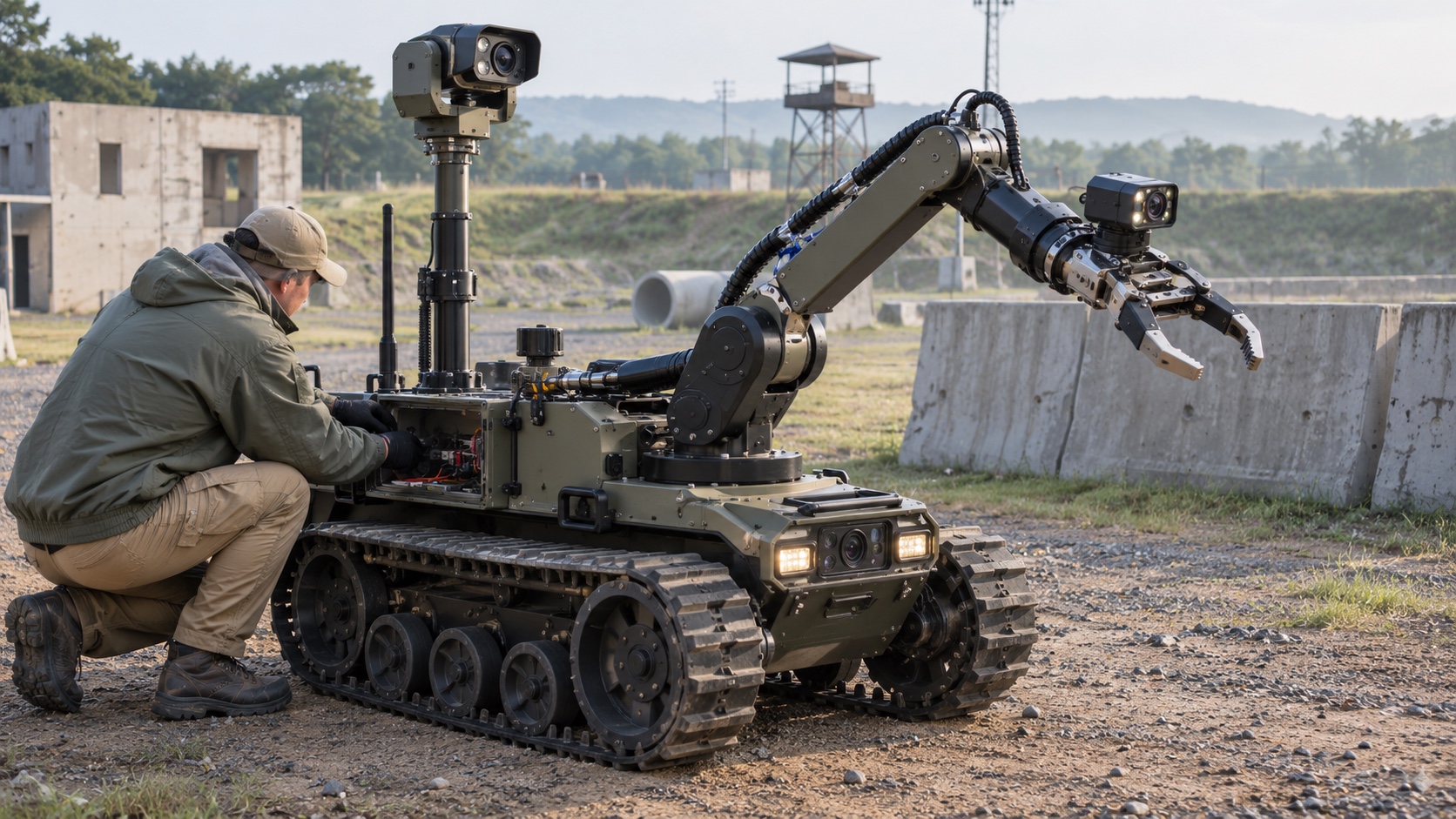
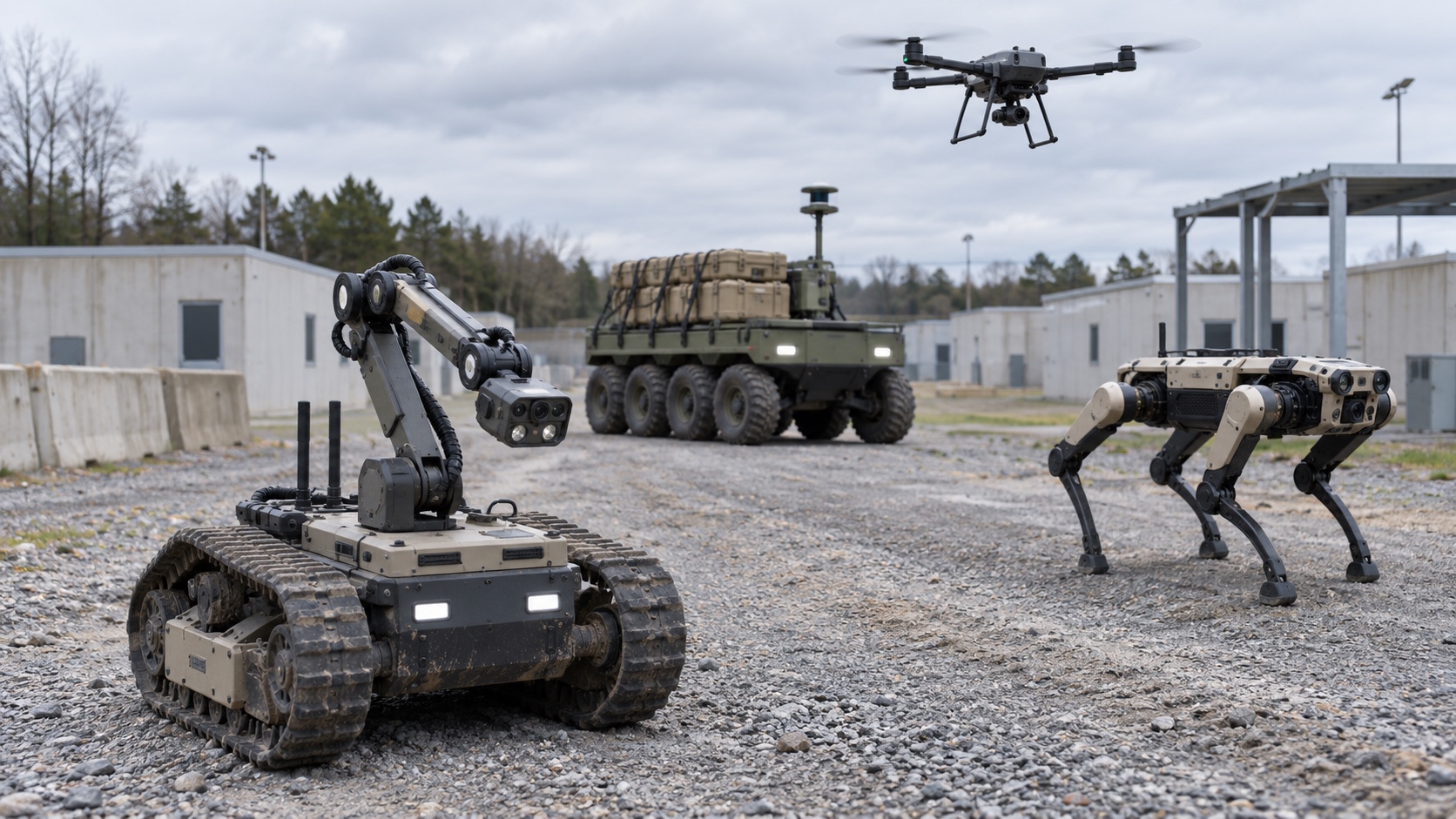
When an area may contain explosives, contamination, fire, collapse, or hostile observation, a robot can provide the first close view. A small aircraft may inspect a rooftop. A tracked machine may look under a vehicle or into a culvert. A quadruped can step through an industrial site with stairs and narrow passages. These platforms give teams information before they decide whether and how to send people. This changes planning because risk can be explored incrementally. Operators can stop, change sensors, approach from another angle, or mark a route for later examination. Yet the robot’s presence may also reveal interest in a location, and a disabled platform can expose equipment or data. The first look is valuable only when the team has considered signature, recovery, and the consequences of losing the machine.
Logistics Is Becoming a Robotic Mission
Supply work is repetitive, heavy, and exposed to road conditions. Autonomous or remotely supervised vehicles can move ammunition, food, water, fuel, medical equipment, and power systems over selected routes. Smaller carriers follow dismounted teams, while larger trucks handle controlled convoys or movement inside bases. Aircraft can deliver compact packages where roads are unavailable.
The attraction is not simply fewer drivers. Robotic logistics can change when and how supplies move. Several small deliveries may replace one large movement. Vehicles can travel during windows chosen for weather, traffic, or concealment. A carrier can wait at a transfer point rather than requiring a crew to remain with it.
Logistics autonomy remains difficult because routes are social spaces. Civilian traffic, animals, damaged signs, improvised detours, and people giving hand signals create ambiguity. Fueling, loading, repair, and security still require human work. Successful programs design the entire supply process around realistic capabilities instead of dropping an autonomous vehicle into an unchanged system.
Smaller Units Gain Access to Aerial Perspective
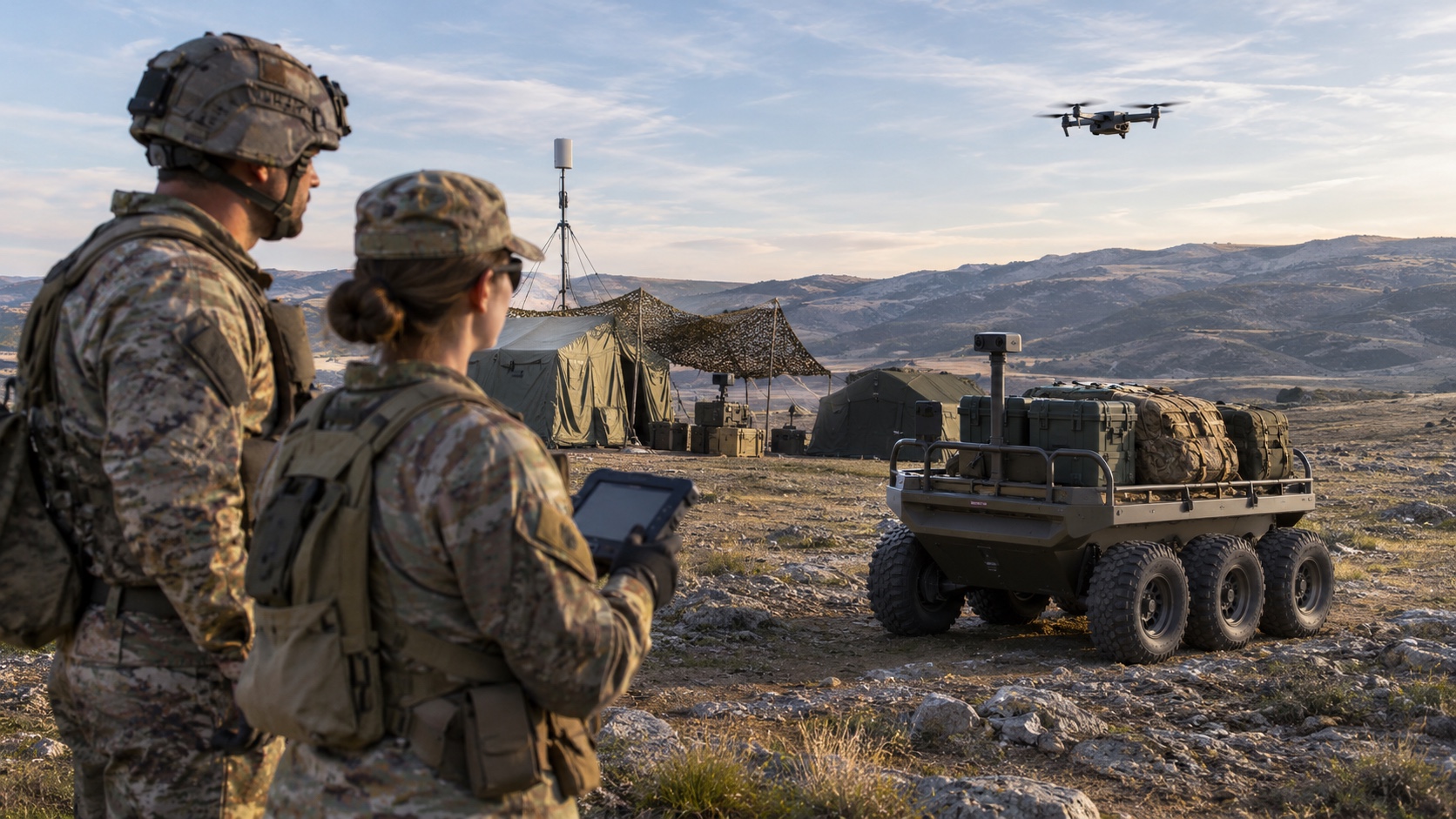
Lightweight drones have made overhead imagery available to units that once depended on larger aviation organizations. A team can inspect the next intersection, map flood damage, check a communications mast, or observe a landing zone. This shortens the time between a question and an answer. It also lets the people closest to the situation direct the sensor.
The same accessibility creates congestion. Friendly aircraft may compete for airspace and radio spectrum. Multiple video feeds can overwhelm limited staff. Batteries, propellers, controllers, and trained pilots become a continuing supply burden. Air defense and electronic warfare can make routine flight dangerous or impossible. Small drones are powerful because they are close at hand, but that proximity requires new coordination habits.
Human-Machine Teams Are Rewriting Roles
A robot introduces new tasks even as it removes others. Someone plans the route, checks software, prepares batteries, configures payloads, watches health data, and interprets results. A commander must know when a platform is suitable and when a person or different sensor is needed. Maintenance personnel need access to diagnostic tools and replacement components that may be unique to the system. Roles also change during the mission. An operator may supervise several machines while automation handles routine navigation, then take direct control for a narrow passage. An analyst may receive an automated detection but examine the surrounding frames before reporting it. The most effective teams define these handoffs in advance. Unclear authority causes delay at exactly the moment the system encounters something unexpected.
Electronic Warfare Makes Autonomy More Valuable and More Dangerous
Robots depend on navigation, timing, and communication signals that opponents may detect, jam, imitate, or disrupt. A remotely piloted platform becomes difficult to control when latency rises. A satellite-guided vehicle may drift if its position source is unreliable. High-bandwidth video can reveal a radio signature or consume scarce spectrum.
Greater onboard autonomy offers one answer. A machine can continue a bounded task, navigate from local sensors, reduce transmissions, or return without constant direction. However, the same independence can carry it into a situation the operator no longer understands. Designers must specify what the robot may do without contact, how long it may continue, and which conditions force it to stop. Resilience is not measured by continuing at all costs; sometimes the safest autonomous action is to do less.
Data Fusion Can Improve Decisions—or Hide Doubt
Modern systems combine imagery, radar tracks, acoustic detections, maps, identity records, and reports from people. Software aligns these inputs and presents a common operating picture. Robots contribute by collecting from new angles and by processing some information before transmission. When sources agree, teams can locate events more quickly and allocate attention efficiently. A polished display can conceal disagreement. Two tracks may represent one object, an old map may shift a location, or an algorithm may attach the wrong label. Operators need access to source, age, confidence, and the chain of transformations behind a conclusion. Good fusion preserves uncertainty instead of smoothing it away. Warfare speeds up when information moves quickly, but sound decisions still depend on knowing what is tentative.
Protection Is Moving From Armor Alone to Distance and Distribution
Robotic systems protect people by creating separation from hazards. They can inspect routes, carry sensors near a chemical release, patrol exposed boundaries, or tow equipment from a dangerous area. Distribution adds another form of protection. Instead of relying on one exquisite platform, a force may use many smaller machines so the loss of one does not end the mission.
Distribution changes cost calculations and tactics. Cheap platforms can be placed where a crewed vehicle would be too valuable, but large numbers increase maintenance, spectrum demand, and identification problems. Recovering or responsibly abandoning disabled robots becomes part of planning. Quantity helps only when the organization can control, support, and account for the fleet.
Maritime and Underwater Operations Are Becoming Less Opaque
Water hides activity and makes human access slow. Uncrewed surface craft can carry cameras, radar, or communications relays across harbors and coastal routes. Underwater vehicles map seabeds, inspect cables, search for hazards, and measure conditions without requiring a crewed vessel to remain directly above them. These robots navigate with acoustics, inertial systems, sonar, and occasional access to satellite positioning at the surface. Communication underwater is narrow and delayed, so missions often depend on preplanned behavior. A vehicle may return with data hours later, turning analysis into a cycle rather than a live feed. This slower rhythm demands careful mission design and clear criteria for when new information warrants another deployment.
Speed Increases Pressure on Law and Command Judgment
Automation can find patterns and recommend actions faster than a human staff can review every raw input. That speed is useful for collision avoidance, cyber defense, logistics routing, and sensor management. It becomes more consequential when a recommendation affects people or the use of force. False confidence, biased training data, or incomplete context can turn a rapid process into a rapid error.
Commanders remain accountable for lawful decisions. They need rules that define acceptable automation, technical reviews that expose limitations, and interfaces that allow meaningful control rather than a ceremonial approval click. Time pressure does not remove the need to distinguish a machine classification from a verified identity or an efficient route from a proportionate course of action.
Adaptation Now Happens Through Software as Well as Hardware
Past military equipment often changed through physical modifications delivered over long cycles. Robotic platforms can gain new mapping tools, detection models, control behaviors, or network protocols through software. Updates let a fleet respond to new terrain and threats without replacing every chassis. Rapid change introduces configuration risk. Different units may run different versions, an update may behave differently with an older sensor, and a model trained on one environment may fail in another. Testing, signed releases, rollback procedures, and clear version records become operational necessities. Software agility works only when reliability engineering keeps pace.
What Modern Warfare May Look Like Next
Robots will increasingly operate as coordinated groups rather than isolated platforms. An aircraft may map a route for a ground carrier. A surface vessel may relay messages to an underwater vehicle. Several small sensors may divide an area and share only the changes that matter. Human supervisors will set goals, boundaries, and priorities while machines negotiate routine movement.
The decisive advantage will not necessarily belong to the side with the most autonomous machines. It may belong to the organization that learns faster, maintains equipment under pressure, protects its data, and knows when not to trust automation. Robots expand the range of possible action, but doctrine and judgment determine whether that range becomes useful.
Change Without the Myth of Effortless Automation
Military robots are making observation more persistent, logistics more flexible, and hazardous work more remote. They give smaller teams access to capabilities once reserved for large organizations and allow forces to distribute sensors across air, land, sea, and subsurface environments. Those changes are real and already visible.
They are not effortless. Every robotic capability brings power demands, training, maintenance, radio planning, data review, legal responsibility, and failure modes. Modern warfare is changing because humans are reorganizing around machines that can sense and act at a distance. The enduring challenge is to use that reach without allowing speed, scale, or technical complexity to outrun accountability.
Readiness therefore belongs to the whole human-machine system, including the quiet support work that keeps equipment understandable and available.