Agricultural Robots Come in Different Types Because Farm Jobs Are Different
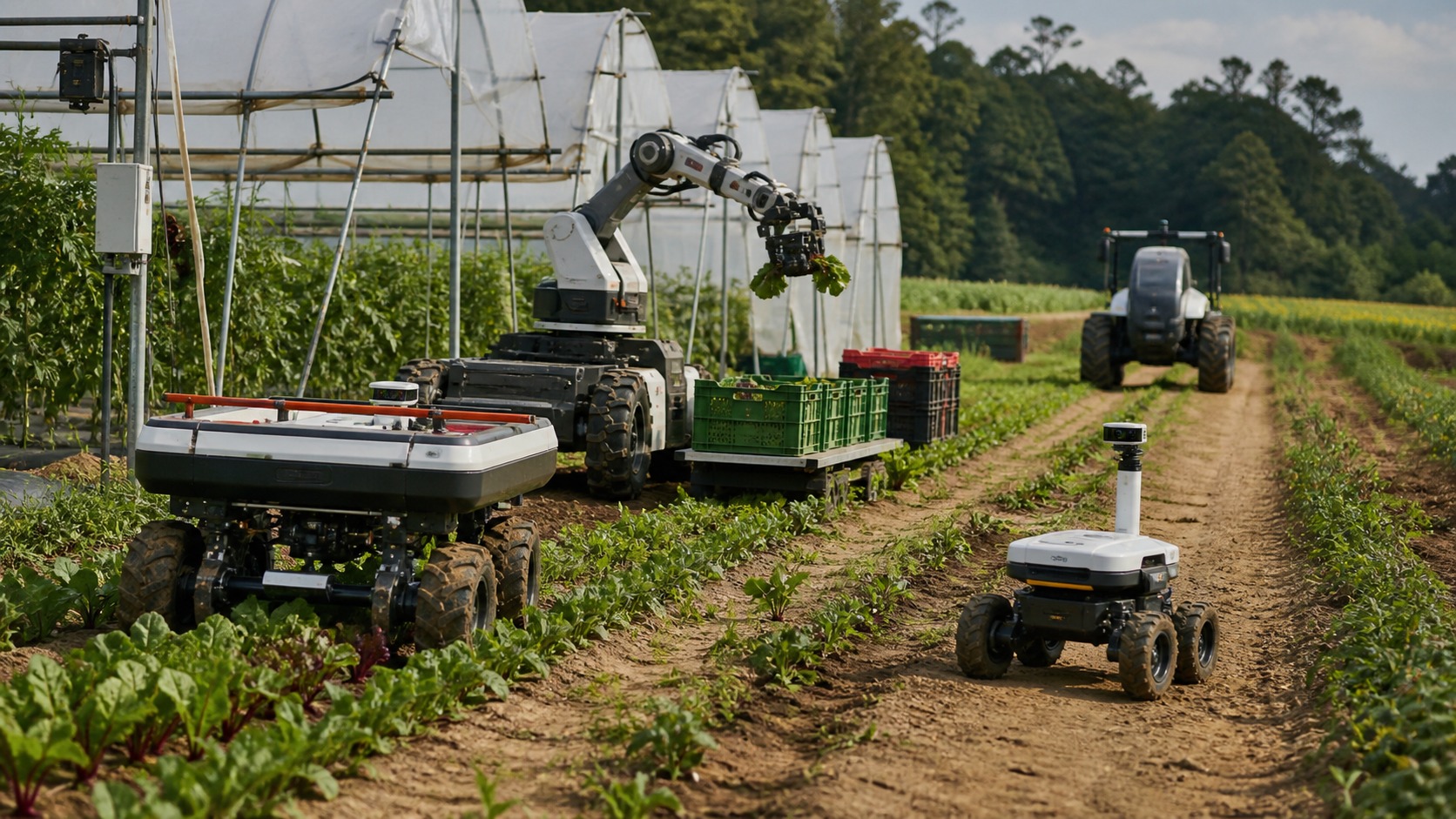
The different types of agricultural robots exist because farming is not one task. A robot that scouts crop health is not the same as a robot that weeds lettuce, picks strawberries, milks cows, sprays orchards, moves greenhouse trays, or drives a tractor path. Each type is shaped by the environment, crop, tool, level of autonomy, and business problem. For beginners, the best way to understand the field is to group agricultural robots by the job they perform: sensing, moving, treating, harvesting, transporting, animal care, greenhouse support, or autonomous field power.
A: Scouting robots are often easiest because they gather information before touching crops or applying treatment.
A: Harvest robots are difficult because produce varies, hides, bruises, and ripens unevenly.
A: Yes, when they perform farm scouting, mapping, spraying, inspection, or monitoring work.
A: It detects unwanted plants and removes, damages, or treats them selectively near the crop.
A: Greenhouses give robots structured paths while still supporting real production tasks.
A: Yes. Dairy, livestock, barn, and animal-monitoring robots are agricultural robots.
A: Compare task, crop fit, speed, reliability, service, safety, evidence, and economics.
A: No. Many useful systems still require setup, supervision, handoffs, or exception handling.
A: Weeding, dairy, harvest, transport, greenhouse, and scouting robots often reduce repeated labor.
A: Classify the robot by the specific farm job it performs and the environment it serves.
Scouting and Monitoring Robots Collect Field Evidence
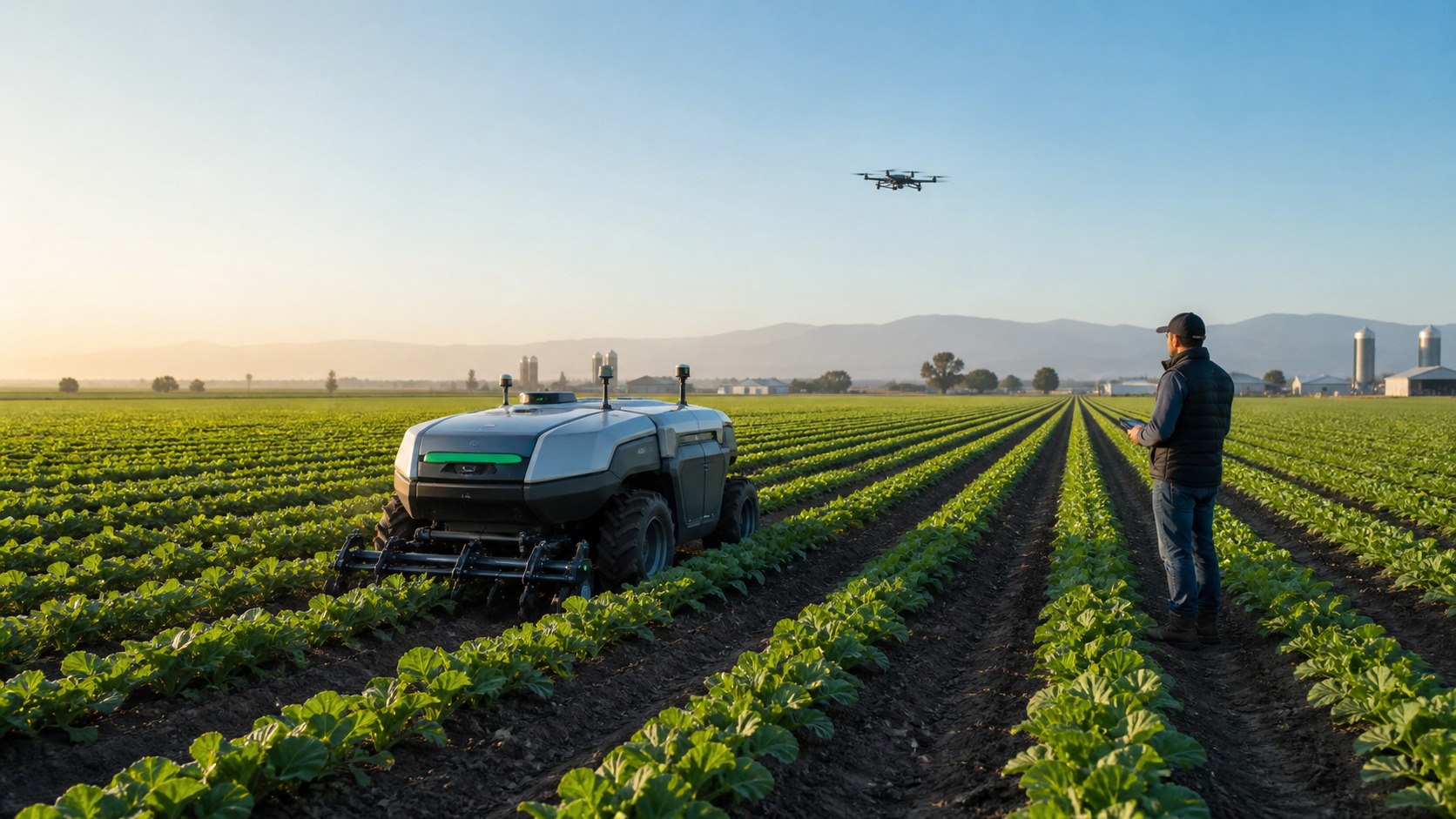
Scouting robots move through fields, orchards, vineyards, greenhouses, or barns to collect information. They may use cameras, lidar, GPS, thermal sensors, multispectral imaging, or environmental sensors to observe crop health, weeds, pests, stand counts, irrigation problems, soil conditions, or animal behavior.
Their main value is visibility. Farmers already scout fields, but robots can support more frequent, consistent, or detailed observation. A ground robot can see crop rows from close range. A drone can cover larger areas quickly. A barn robot can observe routines that happen throughout the day.
Scouting robots are only useful when the information leads to action. If the robot finds water stress, weed patches, or missing plants, the farm needs a way to respond. The type is best judged by whether its data improves timing or decisions.
These robots are often an entry point because they can help before a farm trusts robots with direct crop contact. Scouting systems are often compared by coverage, detail, and usefulness. A drone may see a large area quickly, while a ground rover can inspect under the canopy or move close to the crop. A fixed greenhouse camera may provide frequent views of one zone. None of these approaches is automatically best. The right scouting robot depends on what the farm needs to detect, how quickly the answer is needed, and what action follows. Some monitoring systems are fixed rather than mobile. Sensors mounted in greenhouses, barns, or irrigation systems can still be part of an agricultural robotics workflow when they connect to automated action or robot-supported decisions. Mobility is common, but it is not the only way farms automate observation. The type should be described by the job and the system around it. Monitoring robots also vary in how much autonomy they need. A drone might follow a planned flight path, while a ground rover must avoid ruts, people, plants, and equipment. A fixed sensor may need no mobility at all. These differences matter because autonomy adds cost and complexity. The simplest type that answers the farm question is often the best starting point.
Weeding and Spraying Robots Apply Targeted Treatment
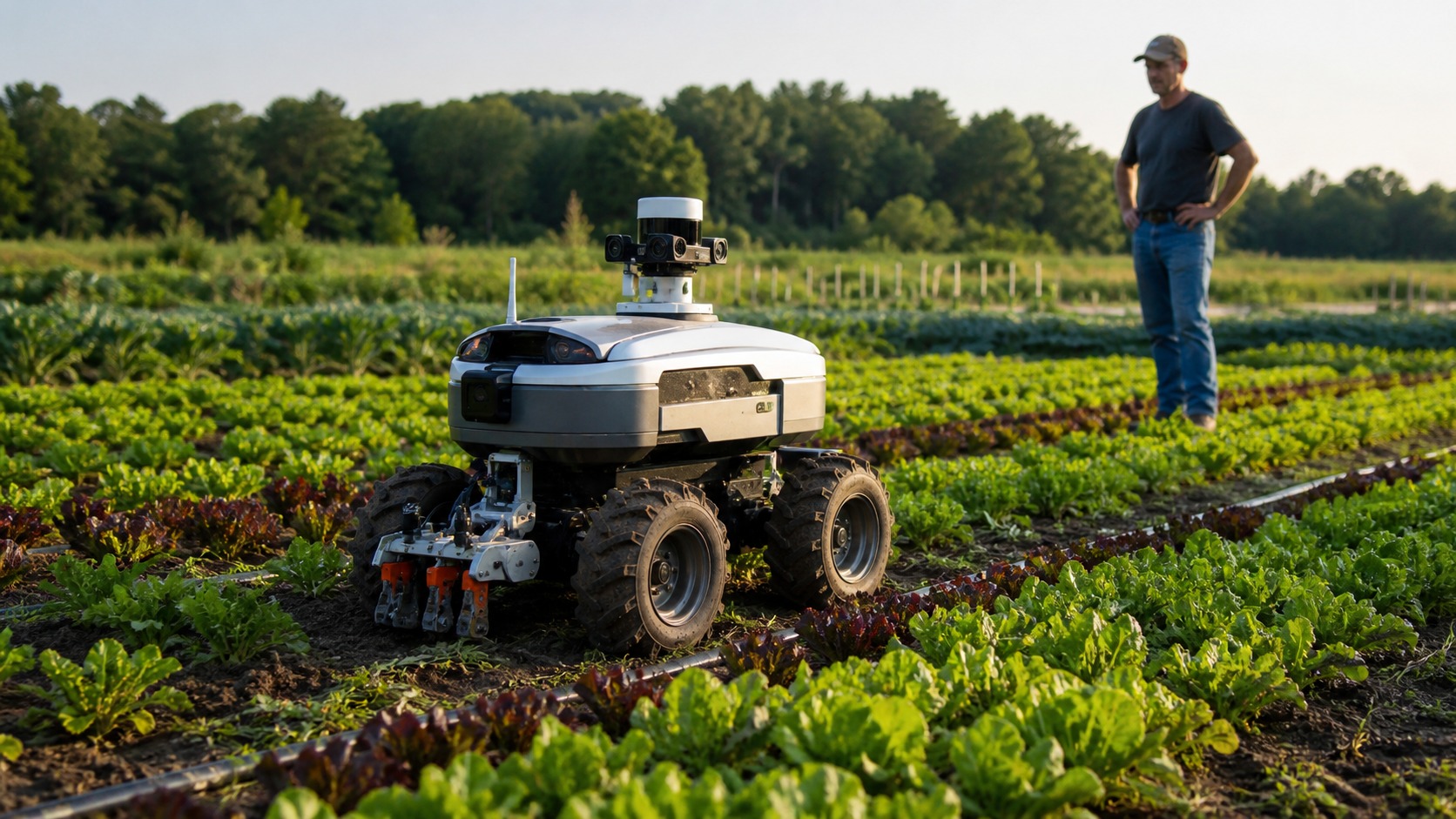
Weeding robots identify unwanted plants and remove or damage them using blades, lasers, heat, electric methods, mechanical tools, or precision application. Spraying robots target inputs more carefully than broad passes when the system can identify where treatment is needed.
This type is attractive because weed control is labor-intensive and chemical use is expensive. A robot that treats only the weed or the weed zone can reduce waste and protect the crop. The challenge is recognizing plants accurately under changing light, growth stages, residue, and field conditions.
The tool must be accurate as well as the vision system. A perfect weed detection result is not enough if the blade damages roots or the sprayer drifts onto the crop. Treatment robots also differ by how they balance speed and selectivity. A broad sprayer covers ground quickly but treats more than the target. A selective weeder or spot sprayer moves more carefully but can reduce waste. Mechanical, thermal, electrical, laser, and chemical approaches all create different safety and crop-protection questions. The type should be judged by the whole job: detection accuracy, treatment precision, field speed, crop safety, and serviceability. Treatment robots also differ in how close they work to the crop. Some operate between rows, some work over the canopy, and some place tools beside individual plants. That geometry affects speed, crop safety, and mechanical design. A tool that fits one spacing may be unsuitable in another field. The robot type is therefore tied to the physical layout of production. Treatment robots are also shaped by regulation and stewardship. Spraying, laser treatment, electrical systems, and mechanical cultivation each create different rules, risks, and training needs. A robot's category should therefore include the treatment method, not only the fact that it moves autonomously. The tool defines much of the responsibility.
Harvest Robots Handle Delicate Timing and Contact
Harvest robots are among the most difficult agricultural robots because they must identify ripe produce, reach it, grip it, detach it, and place it without bruising or damage. Fruit, vegetables, and specialty crops create different challenges. Strawberries, apples, tomatoes, grapes, lettuce, and cucumbers do not ask for the same end effector.
Harvest timing is narrow. A robot that picks too slowly, misses hidden produce, or damages valuable crops may not make economic sense. This is why harvest robots often begin in structured environments such as greenhouses or orchards where rows, lighting, or plant training can be controlled more carefully.
The promise is significant because harvest labor is difficult to staff in many regions. The reality is demanding because biology is irregular. Leaves hide targets, fruit ripens unevenly, branches move, and produce quality depends on gentle handling.
Successful harvest robots tend to combine crop-specific design with careful workflow planning. Harvest systems show why robot types are usually crop-specific. A berry harvester needs gentle contact and careful fruit selection. An apple system needs reach, visibility inside branches, and safe placement. A greenhouse tomato robot faces different spacing, lighting, and support structures. Even when the category name is the same, the actual robot may be deeply shaped by the crop. Beginners should treat harvest robotics as many specialized systems rather than one universal picker. Harvest systems also raise questions about what happens after picking. Produce must be sorted, placed, cooled, packed, or transported. A robot that picks successfully but slows the packing flow may not solve the farm's bottleneck. Understanding the type means looking beyond the gripper to the whole harvest workflow. Harvest robots can also be divided by crop height and plant structure. Ground crops, trellised crops, orchard fruit, and greenhouse vines each require different reach, vision, and handling. That is why a single harvest robot rarely covers the whole market. The type becomes meaningful only when paired with a crop and harvest method.
Autonomous Tractors and Field Platforms Provide Mobile Power
Autonomous tractors and field platforms focus on moving through farm environments while carrying or pulling tools. They may support tillage, mowing, seeding, spraying, hauling, mapping, or other operations depending on the platform and implement.
Some systems are large and tractor-like. Others are smaller electric platforms designed to reduce soil compaction or work between rows. The autonomy challenge includes path planning, obstacle detection, implement control, geofencing, remote supervision, and safe behavior around people, animals, roads, and equipment.
This type matters because many farm tasks are mobile. If the robot can move reliably and carry the right tool, it becomes a flexible base for many operations. Mobile power platforms are useful because many farm tools already depend on movement. If a robot can travel safely, follow rows, manage turns, and carry an implement, it can become a base for mowing, spraying, hauling, mapping, or cultivation. The implement still matters. Autonomy without a useful tool does not complete the farm job. The most practical platforms are the ones that connect reliable movement with an operation the farm already values. Field platforms also raise questions about supervision. Some operations allow remote oversight, while others require someone nearby to handle gates, obstacles, refueling or charging, implement adjustments, and unexpected field conditions. Autonomy is useful only when the farm understands the support it still requires. The platform type should be evaluated as a work system, not as a standalone vehicle. Transport robots deserve attention because moving materials consumes real labor. Crates, trays, feed, tools, samples, and harvested produce all need movement across farms. A transport robot may look less advanced than a picker, but it can remove many repeated trips. That category is often practical because it improves flow around people rather than touching the crop directly.
Barn, Dairy, and Greenhouse Robots Work in More Structured Spaces
Not all agricultural robots work in open fields. Dairy robots help with milking, feed pushing, manure scraping, and monitoring. Greenhouse robots may move trays, inspect plants, assist harvest, or support spraying. Poultry and livestock systems may monitor animals, clean areas, or improve routine observation.
Structured spaces can make robotics easier because paths, lighting, surfaces, and schedules are more controlled. That does not make the work simple. Animals move unpredictably, greenhouses are humid, and hygiene expectations are high. Still, the environment often gives robot designers more repeatability than an open field.
These robots show that agricultural robotics is broader than crop-row machines. Food production includes plants, animals, protected environments, storage, and logistics.
The robot type should match the production system, not a generic idea of farming. Structured-space robots deserve their own category because they often operate on repeatable paths and routines. A dairy barn, greenhouse aisle, nursery bench, or packing area can give robots more predictable surfaces and schedules than an open field. That structure supports earlier adoption, but it does not remove complexity. Animals, humidity, hygiene, workers, and product handling still create challenges. The type is easier to understand when the environment is part of the definition. Type labels should therefore be treated as starting points. A weeding robot, scouting robot, or greenhouse robot still needs a closer look at crop fit, working speed, maintenance, training, and evidence from similar farms. The category tells you what problem the robot aims at. The details tell you whether it is ready for the job. Beginners should also separate field robots from decision-support systems. Some tools move and act. Others collect data or recommend action. Many modern systems combine both. Understanding the type means asking whether the robot observes, decides, moves, treats, harvests, transports, or supports people. That practical sorting step prevents very different machines from being compared by appearance alone. It also helps a farm ask vendors for evidence that matches the crop, environment, and season in question during planning.
How to Compare Agricultural Robot Types
The best comparison starts with the job. Ask whether the robot senses, treats, harvests, transports, powers an implement, supports animals, or works in a greenhouse. Then ask what crop, terrain, timing, and support model it requires. A scouting robot should be judged by useful information. A weeding robot should be judged by plant recognition, crop safety, and field speed. A harvest robot should be judged by quality, throughput, and gentle handling. An autonomous tractor should be judged by safe movement and implement work.
There is no single best type of agricultural robot. There is only the type that fits the farm problem.
Start with the work, then choose the machine.