Industrial Robots Are Machines Built for Repeatable Physical Work
Industrial robots are programmable machines designed to perform physical tasks in production, processing, logistics, and other work environments. They move tools, parts, materials, sensors, or products with repeatable motion. A beginner usually sees the robot arm first, but the full system includes a controller, end effector, fixtures, sensors, safety equipment, power hardware, and the surrounding workcell. Industrial robots matter because they turn precise motion into dependable work at a scale people can plan around.
A: It is a programmable machine integrated into a repeatable work process.
A: No. Tooling, fixtures, sensors, safety, controls, and layout matter too.
A: Factories, warehouses, labs, food processing, packaging lines, and machine shops.
A: Robots provide flexible motion for tasks that need reach, tooling, or path changes.
A: It is the tool attached to the robot, such as a gripper, torch, cup, or dispenser.
A: Through guards, scanners, interlocks, stops, procedures, and safe control behavior.
A: Most useful cells include sensors to confirm parts, tools, positions, or process state.
A: A task with controlled parts, clear success criteria, and manageable recovery steps.
A: Tooling, fixtures, cable routing, safety layout, maintenance, and process variation.
A: Industrial robots turn repeatable motion into repeatable work.
Industrial Robots Are More Than Robot Arms
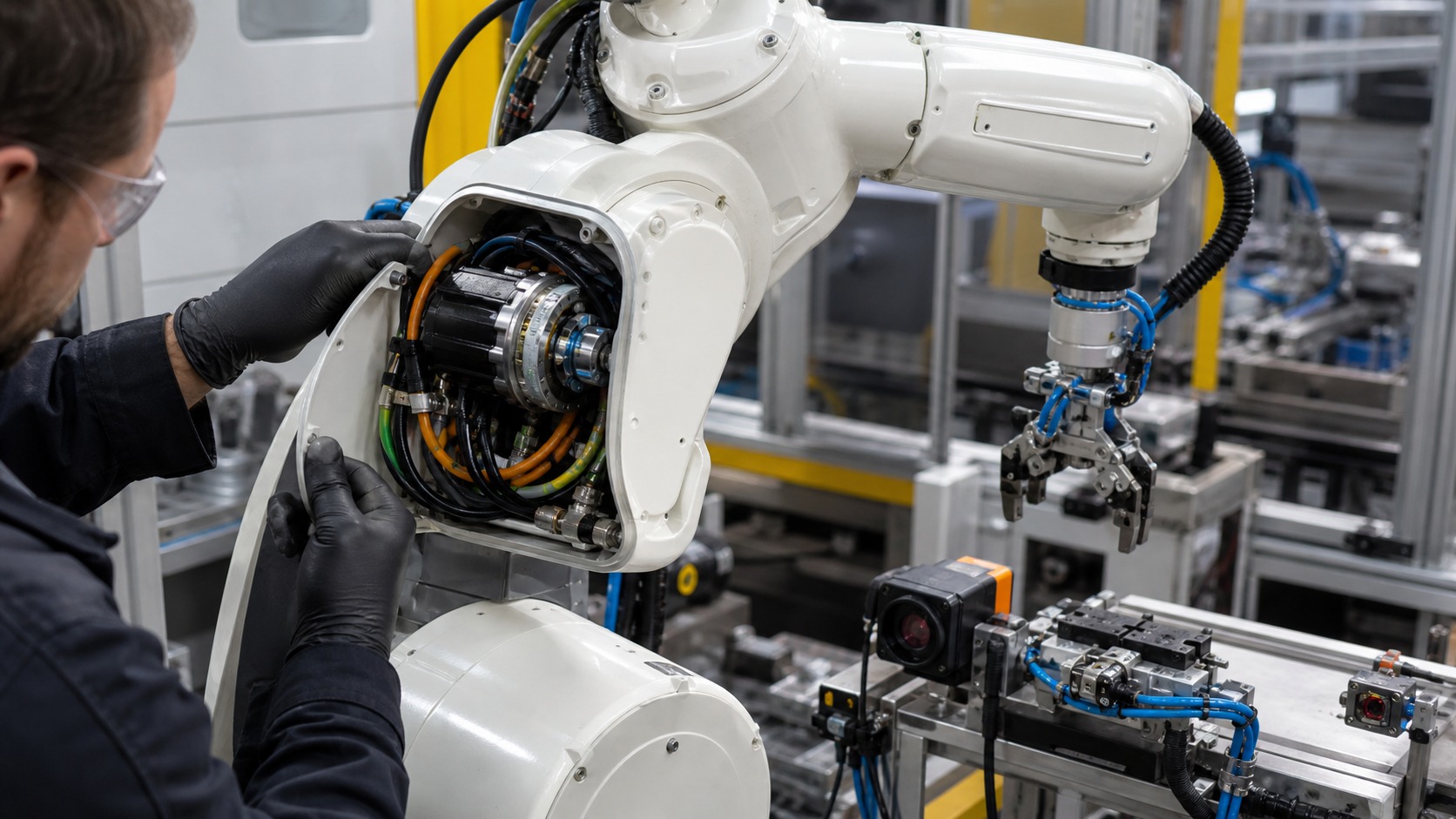
The most familiar industrial robot is the articulated arm: a machine with several rotating joints that can reach, lift, weld, paint, inspect, or assemble. Yet the arm is only one part of the automation system. The robot needs a controller to command motion, tooling to touch the work, sensors to confirm state, and a cell layout that keeps people and parts in the right places. That is also why industrial robots are rarely bought as simple appliances. The robot body may be standard, but the application around it is usually custom enough to require engineering judgment, operator input, and process testing.
A robot arm without tooling is like a hand without fingers. It may move beautifully, but it does not yet perform a useful job. The gripper, welding torch, suction cup, dispenser, camera, or spindle gives the robot a task-specific purpose.
Beginners should think of industrial robots as work systems rather than isolated machines. The useful question is not only what the robot can move, but how the entire cell presents the part, confirms the result, handles exceptions, and returns to production.
That system view also explains why two robots that look similar can perform very different jobs. One arm may place metal castings into a machine tool, while another applies adhesive to a battery tray. The surrounding hardware changes the meaning of the same basic motion.
This is also why industrial robot projects usually involve several disciplines. Mechanical engineers think about reach, payload, tooling, and fixtures. Electrical teams handle power, signals, drives, and safety circuits. Controls specialists build the sequence and connect the robot to other equipment. Operators and maintenance staff explain what recovery needs to look like during a real shift. A beginner gets a much clearer picture by watching how these roles meet inside one cell. This helps explain why successful installations are usually measured in weeks or months of stable operation, not in a single impressive trial run. In practical terms, the robot is one member of a larger production team made of machines, fixtures, sensors, software, and people.
What Makes a Robot Industrial
Industrial robots are built for repeatability, durability, and integration into work processes. They often run for long shifts, follow precise paths, carry defined payloads, and connect to conveyors, machines, sensors, safety systems, and factory controls. The robot's value appears over time, when the system repeats the same work through material changes, shift changes, minor tool wear, and ordinary production pressure without losing the basic process.
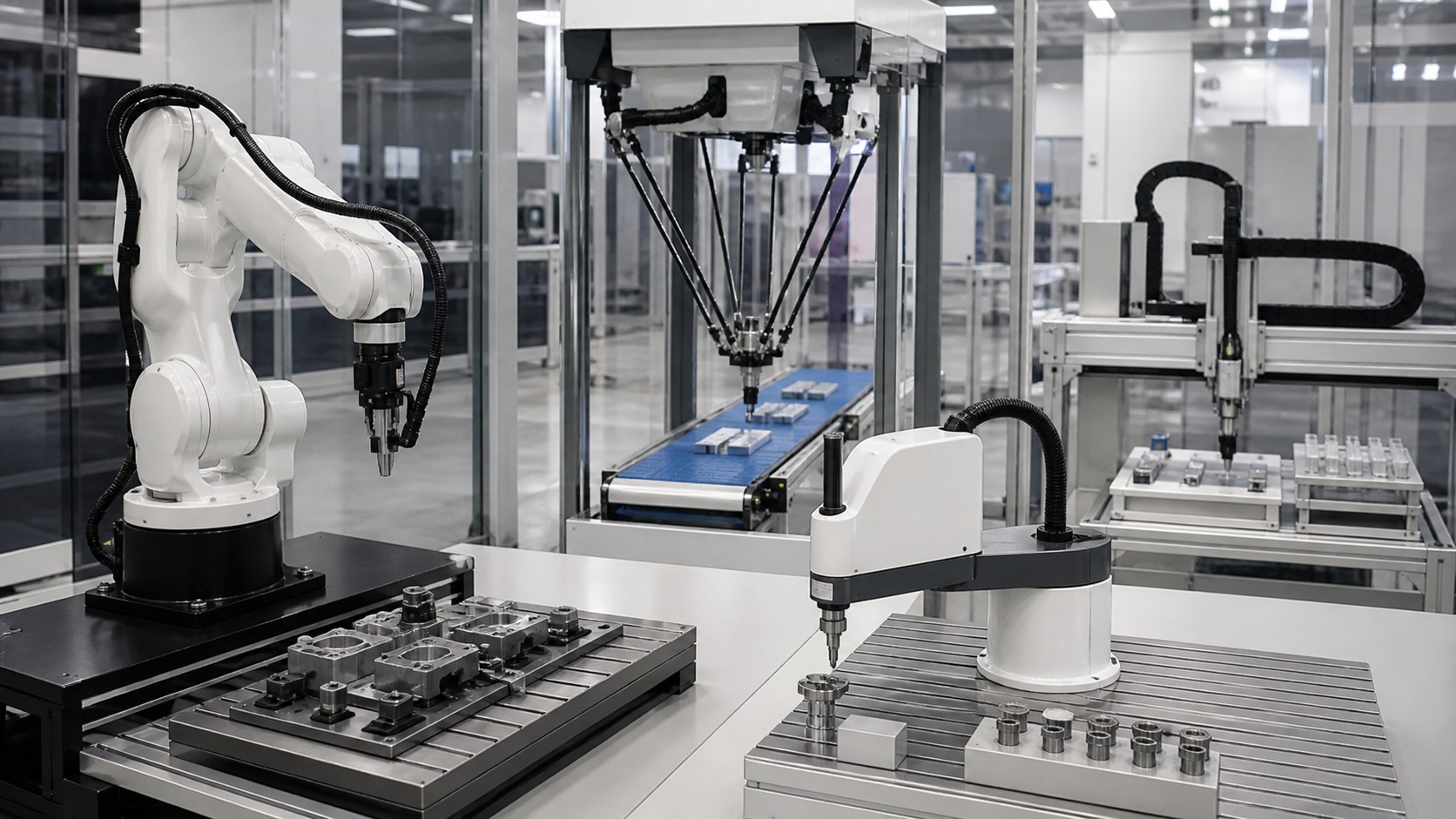
The word industrial does not mean the robot is always huge or dangerous. Some industrial robots are compact tabletop systems, while others are large machines that handle heavy parts. The shared idea is that the robot performs work inside an engineered process.
Industrial also implies a different expectation for uptime. A hobby robot can be restarted, adjusted, or rebuilt whenever its owner has time. A production robot needs predictable support, spare parts, documented settings, and maintenance habits because downtime affects people, schedules, and output. That expectation changes design choices, because a factory robot must be understandable to people who did not build the original demo.
The Workcell Shapes the Robot's Job
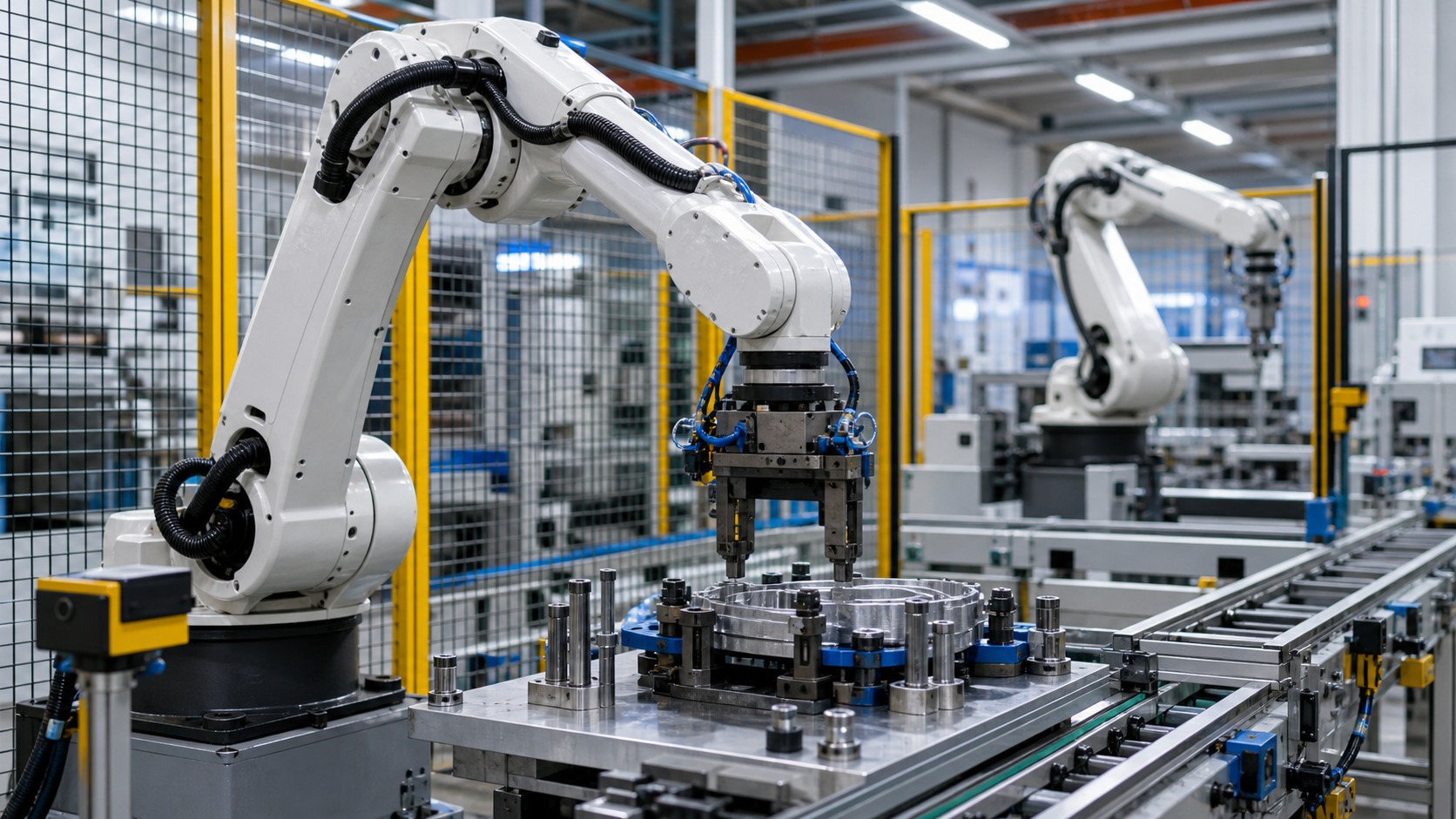
A workcell is the physical area where the robot performs its task. It may include fences, scanners, conveyors, fixtures, part trays, machine doors, inspection stations, operator panels, and service access. The workcell turns robot motion into a repeatable process. A good workcell also makes errors visible. Parts, tools, sensors, and operator steps should be arranged so the system can tell when the expected state is missing instead of blindly continuing.
Fixtures are especially important. They hold or guide parts so the robot does not have to solve random placement every cycle. A strong fixture can make a simple robot extremely reliable, while a weak fixture can make an advanced robot struggle.
The workcell also defines safety. People need predictable entry points, clear stop behavior, and recovery steps when parts jam or tools need service. A robot that is powerful enough for production must be surrounded by hardware and procedures that match that power.
Beginners often focus on the robot's maximum speed or payload, but workcell design usually determines real performance. A fast robot waiting on a slow conveyor, awkward fixture, or confusing recovery step does not create fast production.
The workcell also gives the robot repeatability that the robot cannot create alone. If a part tray always locates the same edge, the robot program can be simpler. If an operator loads parts in several loose positions, the robot may need vision, sensing, or a more forgiving fixture. Good workcell design removes randomness before software has to fight it. The best cells make the correct cycle easy and the incorrect cycle hard to miss. That is why good integrators study the part before they study the robot model.
Common Jobs for Industrial Robots
Industrial robots appear in welding, painting, packaging, palletizing, machine tending, inspection, material handling, assembly, dispensing, sanding, polishing, cutting, and laboratory automation. The same robot platform can take on different jobs by changing tooling, fixtures, and programming. This study also protects people from automating the wrong problem. A robot may move quickly, but if the part feed, inspection method, or downstream process remains weak, the whole line may still struggle.
The best robot tasks are usually repetitive, physically demanding, hazardous, precise, or difficult to staff consistently. A robot may handle hot parts, repeat a weld path, lift boxes, apply adhesive, or load a machine through thousands of cycles.
These jobs often begin with careful process study. The team watches how people do the work, where variation enters, which motions are tiring or risky, and what quality checks matter. The robot is then designed around the real process instead of an idealized version of it. That process-first thinking keeps the robot from becoming an expensive motion device attached to a poorly understood workflow.
Sensors and Tooling Give Robots Context
Sensors help industrial robots avoid blind repetition. A sensor may confirm that a part is present, a gripper is closed, a fixture is seated, a tool reached pressure, or a machine door opened. Vision systems can locate parts, inspect surfaces, read shapes, or guide robot motion. This evidence chain is one of the biggest differences between a reliable cell and a fragile demo. The robot should know enough about each step to avoid pretending success happened when it did not.
Tooling gives the robot physical contact with the job. A gripper must match the part's shape, weight, surface, and tolerance. A welding torch needs routing and cooling. A suction tool needs vacuum sensing. A dispenser needs pressure control and clean paths.
The strongest industrial systems make sensing and tooling work together. A gripper may close, a sensor may confirm the part, the robot may move, and another sensor may verify placement. This chain of evidence keeps bad cycles from spreading.
This is why industrial robotics is not only programming. Mechanical tooling, sensor placement, electrical integration, and process knowledge often decide whether a robot succeeds.
Tooling and sensing also define how gracefully the cell handles mistakes. A robot that can detect a missing part, weak grip, or misaligned fixture can pause before causing damage. A robot that lacks confirmation may continue the cycle and turn one small error into scrap, downtime, or a service call. When every important step has a physical or sensor confirmation, operators gain more confidence in the cell.
Safety Is Part of the Robot System
Industrial robots can move quickly and carry heavy loads, so safety must be designed into the whole system. Guards, interlocks, scanners, emergency stops, safe-rated controllers, brakes, speed limits, and lockout procedures all contribute. Good safety planning also considers maintenance. Technicians need access to tools, fixtures, sensors, and cables without entering confusing or risky states.
Modern collaborative robots can work closer to people in certain applications, but collaborative does not mean careless. Payload, tool shape, speed, pinch points, and workspace layout still need careful review.
Safety planning starts before installation. The team reviews robot reach, tool hazards, part weight, access needs, teaching modes, lockout steps, and expected human interaction. Good safety design supports production instead of merely blocking it. A safe cell should also be serviceable, because frustrated maintenance often leads people toward risky shortcuts.
Why Factories Use Industrial Robots
Factories use industrial robots to improve consistency, protect workers from hazardous or strenuous tasks, increase capacity, and stabilize processes. Robots are valuable when the work can be defined clearly enough for repeatable automation. Consistency also supports training and improvement. When the robot performs the same cycle in a measured way, teams can identify the remaining causes of variation more clearly.
The business case is not always about replacing people. Robots can keep a process running, reduce injuries, improve quality, and let workers focus on setup, inspection, maintenance, programming, and problem solving.
A robot also produces useful data when the system is designed well. Cycle counts, fault logs, sensor checks, and maintenance records help teams improve the process over time.
The best deployments treat robots as part of a production strategy. They include training, spare parts, service plans, process review, and room for future changes.
Robots are also useful when consistency matters more than raw speed. A person may be faster for a short burst, but a robot can apply the same path, force, timing, or placement across many cycles. That repeatability can stabilize quality and make the process easier to measure. Measured repeatability is especially valuable in processes where small differences become scrap, rework, or customer complaints.
What Beginners Should Remember
Industrial robots are programmable work machines built for repeatable physical tasks. They are strongest when the task, tool, fixture, safety system, and recovery process are all designed together. That system-level view is the best foundation for learning more advanced robotics later, because every sophisticated factory cell still depends on these same basic relationships.
A beginner does not need to memorize every robot model to understand the category. Start with the task: what moves, what is touched, how the result is confirmed, and what happens when the cycle goes wrong.
That perspective turns industrial robots from intimidating factory machines into understandable systems. They are arms, tools, sensors, controllers, fixtures, and safety hardware arranged to make physical work more predictable. From there, terms like payload, reach, accuracy, fixture, and end effector become much easier to place. A beginner who sees those relationships can evaluate industrial robots with much more confidence and fewer assumptions. That perspective also makes vendor claims easier to question because the real proof sits in the whole cell.