Industrial Robot Types Match Different Jobs
Industrial robots come in different shapes because factory work is not one kind of motion. Some jobs need long reach and flexible angles. Others need fast vertical picking, precise horizontal assembly, heavy linear travel, or safe shared work near people. The best robot type depends on payload, reach, speed, precision, workspace, tooling, safety, and how the part arrives. Understanding the main categories helps beginners match robot shape to robot job.
A: Articulated arms usually provide the most flexible three-dimensional reach.
A: Compact assembly, insertion, testing, and small-part handling over a table.
A: High-speed picking and sorting of light items over conveyors.
A: Large straight-line movement, heavy handling, and wide rectangular work areas.
A: No. The tool, payload, speed, part, and workspace still need risk assessment.
A: Yes, when they move materials in production, logistics, or operational facilities.
A: Match robot geometry to the task before comparing brand or model details.
A: A stable process can benefit from hardware tuned for that exact work.
A: Choosing a robot shape before understanding the part, tool, and workflow.
A: Pick the robot whose natural motion makes the task simpler.
Articulated Robots Offer Flexible Reach
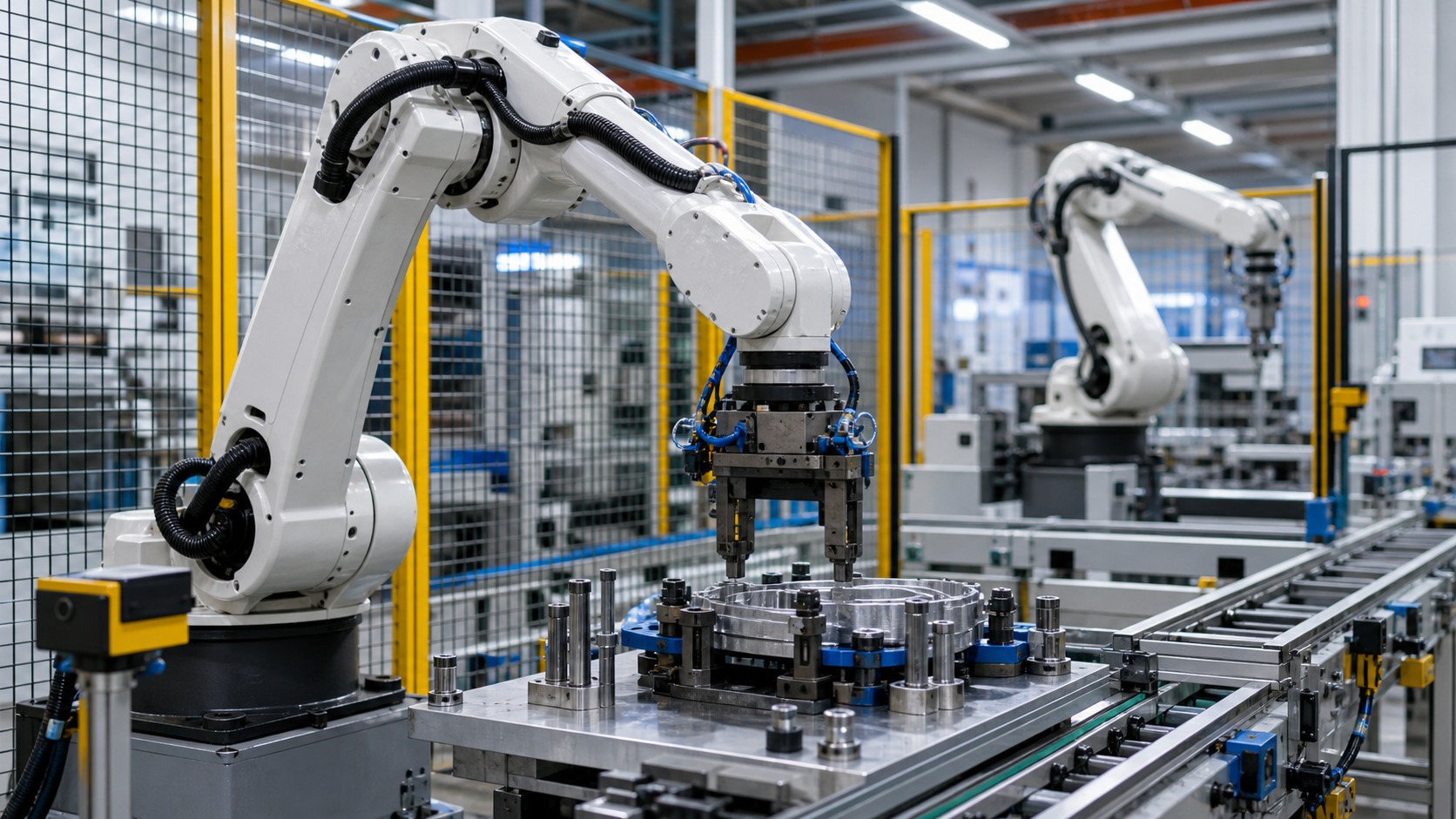
Articulated robots are the classic industrial arms with multiple rotary joints. They can reach around fixtures, change tool orientation, and follow complex paths. This flexibility makes them common in welding, painting, machine tending, material handling, assembly, trimming, and inspection. The reach of an articulated arm also creates layout options. It can serve several fixtures, approach machines from the side, or keep the base outside a messy process area. That flexibility is valuable when the job has many angles.
Their strength is range of motion. A six-axis articulated robot can approach a part from many angles, which is useful when the tool must be tilted, rotated, or guided around obstacles. The same arm can perform many jobs when paired with different end effectors.
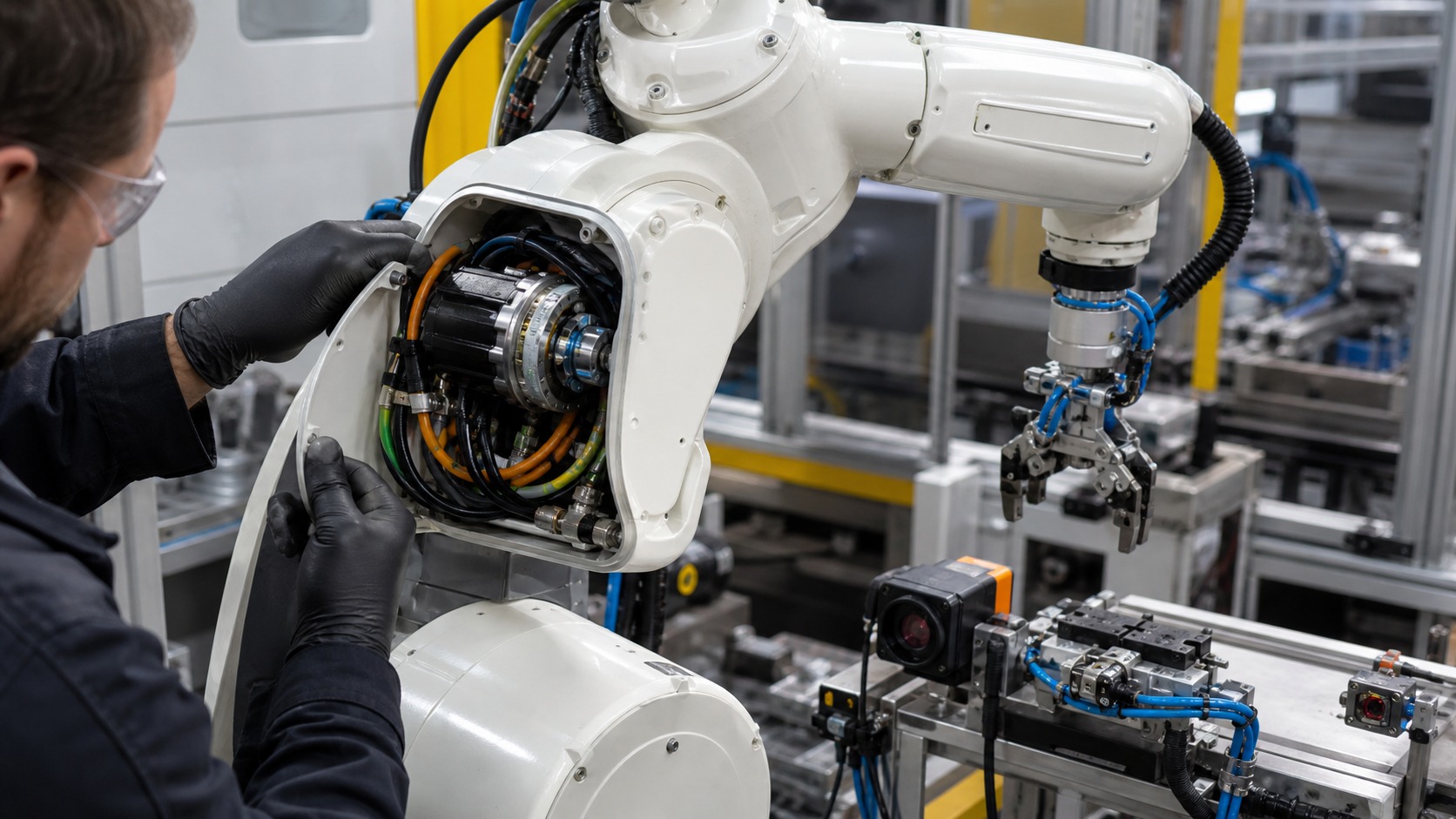
The tradeoff is complexity. Articulated robots need careful programming, payload review, clearance checks, calibration, and safety planning. Their flexible reach can become a hazard if the workcell is crowded or recovery is poorly defined.
They are often the best choice when the task needs a tool to move through three-dimensional space rather than simply pick straight up and down.
Articulated arms are also popular because they can be redeployed. A plant might start with machine tending, then later use a similar arm for inspection, packaging, or deburring. That flexibility has value when product lines change, but it also means the cell must be designed carefully for each new process. The same flexibility can also create overuse, so teams should avoid choosing a large articulated arm for a task that a simpler robot can handle. A plant that needs flexible reach should still compare the arm against simpler options, because unnecessary flexibility can add cost, guarding, and programming effort.
SCARA Robots Excel at Fast Horizontal Assembly
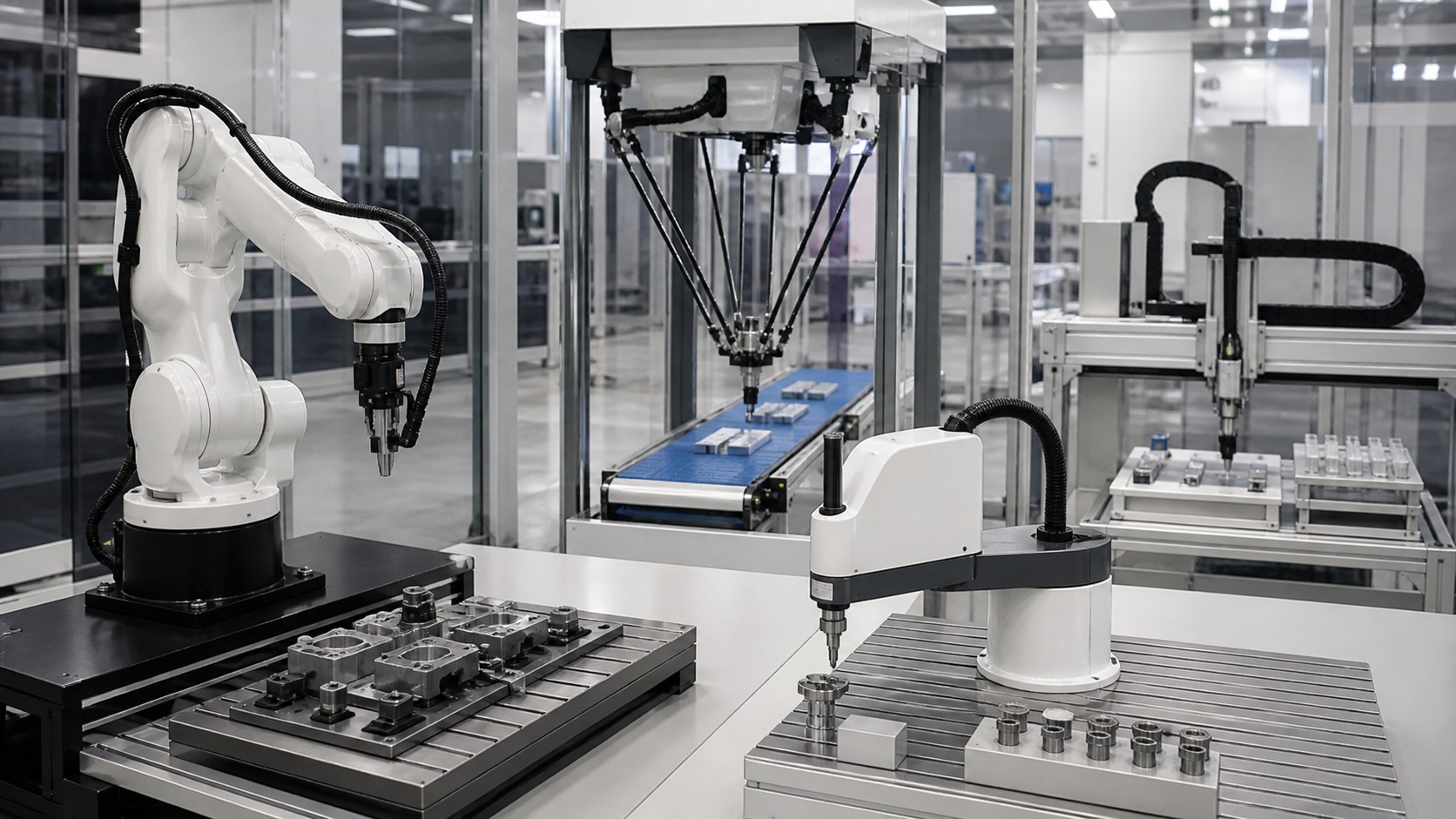
SCARA robots have a selective-compliance arm shape that is strong for horizontal movement and vertical insertion. They are common in electronics assembly, small-part handling, screwdriving, testing, packaging, and light machine loading. SCARA robots can also be easier to guard and integrate because their work area is often compact and table-based. That makes them attractive for assembly islands where the product stays within a defined fixture area.
Their best use is fast, repeatable work over a table or fixture. A SCARA robot can move quickly between points while staying compact, which makes it useful where floor space is limited.
SCARA robots also suit processes where vertical motion is short but horizontal movement is frequent. They often work above trays, nests, and benches, which keeps the cell compact. That compactness can matter as much as speed in facilities with limited floor space. Because the motion is focused, SCARA systems can deliver strong value in small spaces with high repetition. This is why SCARA robots remain common even in factories that also use larger six-axis arms. Their shape is specialized, but that specialization fits many bench-level jobs.
Delta Robots Are Built for High-Speed Picking
Delta robots use lightweight parallel arms mounted above the work area. They are famous for very fast pick-and-place operations over conveyors, especially in food, packaging, pharmaceuticals, and small consumer goods. The end effector on a delta robot must stay light. Heavy tooling reduces the speed advantage and can make the system less useful than a slower but stronger robot type.
Their speed comes from moving light arms rather than a heavy serial structure. A delta robot can pick items rapidly from a moving belt when paired with vision and conveyor tracking.
Delta robots are not the best answer for every task. They usually have limited payload and workspace compared with larger arms. They also work best when the job is within a defined overhead picking area.
For high-speed sorting or packaging, though, the delta form can outperform more flexible robots because it is built around that specific motion.
Delta robots depend heavily on good product flow. Items need to arrive where the robot can see and reach them, and the conveyor tracking must be accurate enough for high-speed picks. The robot form is fast, but the surrounding feeding and sensing system makes that speed useful. A delta cell also depends on feeding discipline; items must be separated, visible, and reachable at speed. The whole system is therefore built around flow: the product arrives, the camera or sensor finds it, the delta robot picks it, and the conveyor keeps moving.
Cartesian and Gantry Robots Provide Straight-Line Control
Cartesian robots move along linear axes, often arranged as X, Y, and Z. Gantry systems are larger cartesian structures that span over machines, conveyors, or work zones. They are useful for precise straight-line movement, large work envelopes, machine loading, dispensing, cutting, palletizing, and heavy handling. Gantry systems are also common when the robot needs to stay above the work. This can leave floor space open for machines, pallets, fixtures, or operators while the robot covers a large area.
Their motion is easier to visualize than a multi-joint arm. If the task is mostly rectangular travel, a cartesian or gantry robot can be stiff, accurate, and space-efficient.
Cartesian systems can also be easier for beginners to reason about because each axis has a visible direction. That clarity helps with dispensing, cutting, scanning, and machine loading tasks where the motion follows a rectangular work area. Their structure can be large, but the control idea is direct, which helps with process stability. A gantry may also carry multiple tools or serve several machines from above, which makes it useful when floor-mounted arms would block access.
Collaborative Robots Support Shared Work
Collaborative robots are designed with features that can support closer interaction with people in approved applications. They often include force limits, smooth surfaces, easier teaching interfaces, and safety-rated behavior that fits certain shared workspaces. Cobots can also help companies learn automation in smaller steps. A team may start with one assisted station, learn what works, and then decide whether a more traditional cell is justified.
Cobots are useful for light assembly, inspection, machine tending, lab automation, and flexible stations where full fencing may not fit the process. They can be easier to redeploy than traditional cells, especially for smaller batches.
A collaborative robot still needs risk assessment. The tool, payload, speed, pinch points, part shape, and surrounding equipment can create hazards even if the arm itself has collaborative features.
Their best use is not maximum speed. Their best use is flexible automation where human access, setup, or frequent changes matter.
Collaborative robots are often chosen for flexibility and ease of setup, not brute force. They can be useful when a company wants to automate a changing station, assist an operator, or start with a smaller deployment. Their value depends on matching expectations to the actual safety and cycle-time limits. That makes cobots useful learning platforms as long as their limits are respected honestly. A collaborative deployment should still be timed honestly, because safer shared motion often means lower speed than a guarded high-speed cell.
Mobile Industrial Robots Move Materials
Autonomous mobile robots and automated guided vehicles move carts, totes, pallets, or supplies through facilities. They are industrial robots when they support production, logistics, fulfillment, hospitals, warehouses, or material flow. Mobile robots are often paired with other automation rather than replacing it. They can bring parts to a cell, carry finished goods away, or keep several stations supplied without building fixed routes.
Their best uses involve movement between stations rather than manipulation at one station. They can reduce walking, connect islands of automation, and keep material flowing without fixed conveyor everywhere.
Mobile robots also change how facilities think about layout. Instead of installing fixed conveyors everywhere, teams can move materials through flexible routes. That flexibility is useful when product flow changes or when several work areas need shared transport. In many facilities, mobile robots are the connective tissue between fixed automation islands. That role becomes important when labor time is lost to walking, searching for carts, or waiting for material movement between stations.
Specialized Robots Fit Specialized Processes
Some industrial robots are designed around one process: welding cells, painting robots, palletizers, inspection robots, dispensing systems, cleanroom robots, and machine-specific loaders. These may use familiar robot forms but include specialized enclosures, tooling, safety, or process controls. Specialized systems also reduce integration uncertainty when the vendor already understands the process. A proven palletizing or painting package may be less flexible than a generic arm, but easier to make productive.
Specialization often improves reliability. A painting robot needs smooth motion and protected hardware. A cleanroom robot needs contamination control. A palletizer needs reach, payload, and stack pattern handling.
The more specialized the process, the more important it is to evaluate the whole cell instead of only the robot body. The tooling, environment, material, and process quality define success.
For buyers, a specialized robot can be ideal when the task is stable and process requirements are clear.
Specialized robots can be harder to repurpose, but they often deliver strong results in their intended job. A painting robot, palletizer, or cleanroom system includes details that a generic arm may not provide by default. That focus can be worth it when the process is stable. The tradeoff is that specialization should match a task that is unlikely to change dramatically next month. Specialized systems work best when the process owner understands the product mix, volume, quality needs, and likely future changes.
Choosing the Right Type
Choosing an industrial robot starts with the task. What does the robot move, how heavy is it, where does it come from, where does it go, how precise must the result be, and what tool touches the work? Choosing by natural motion also helps control cost. If the robot form already fits the task, the team often needs less custom tooling, fewer workarounds, and simpler programming.
Articulated arms fit flexible three-dimensional reach. SCARA robots fit compact horizontal assembly. Delta robots fit fast overhead picking. Cartesian and gantry systems fit straight-line travel and large work envelopes. Collaborative robots fit certain shared or flexible stations. Mobile robots fit facility movement.
The best robot type is the one whose natural motion matches the job. When the robot shape, tool, fixture, and safety plan fit the process, automation becomes simpler, more reliable, and easier to support. This keeps selection practical rather than brand-driven. A good selection conversation ends with the task looking simpler, not with the robot list looking longer. That keeps the choice focused on payload, reach, speed, tool access, layout, and support. It also prevents teams from buying flexibility that the task never needed in production at all.