Robots Designed to Create a Moment Worth Watching or Joining
Entertainment robots are machines built to perform, play, tell stories, capture images, or respond to an audience. They include animatronic characters in attractions, robotic cameras at live events, programmable toys, dancing stage machines, interactive museum figures, and mobile robots that greet or guide guests. What unites them is not a single shape but an experience goal. A warehouse robot is judged mainly by reliable transport; an entertainment robot must also hold attention, communicate intent, fit a story, and behave safely around people who may move unpredictably. The best systems combine engineering with choreography, sound, lighting, character design, and human performance. Many follow carefully prepared sequences while using sensors to adjust timing or acknowledge a guest. Understanding them begins with a useful distinction: apparent personality belongs to the show, while motion, perception, control, maintenance, and supervision make that show possible.
A: Yes, when controlled actuators produce programmed physical behavior.
A: They usually infer limited cues and present designed responses.
A: Robots enable repeatable motion, unusual scale, and specific visual effects.
A: Only systems designed and supervised for contact should allow it.
A: Audio playback or live performers coordinate speech with motion.
A: Good designs offer choices, repeat prompts, or transfer to a host.
A: No; some operate locally while others use optional applications or services.
A: Their controlled movement creates images used in shows and media.
A: Inspection and maintenance follow cycles, condition, and operating environment.
A: Clear intent, coordinated timing, reliable performance, and audience-aware design.
Entertainment Is the Job, Not the Robot’s Shape
A machine qualifies as an entertainment robot when its principal role is to create or support an audience experience. A hidden motion platform under a stage can be as important as a humanoid character. Camera robots produce images viewers could not otherwise see. Kinetic sculptures use coordinated movement as visual art. Game machines turn physical motion into a challenge. Designers therefore begin with what the audience should feel or do, then select mechanics, sensing, and control. A lifelike body is useful only when it serves the experience.
Animatronics Turn Programmed Motion Into Character
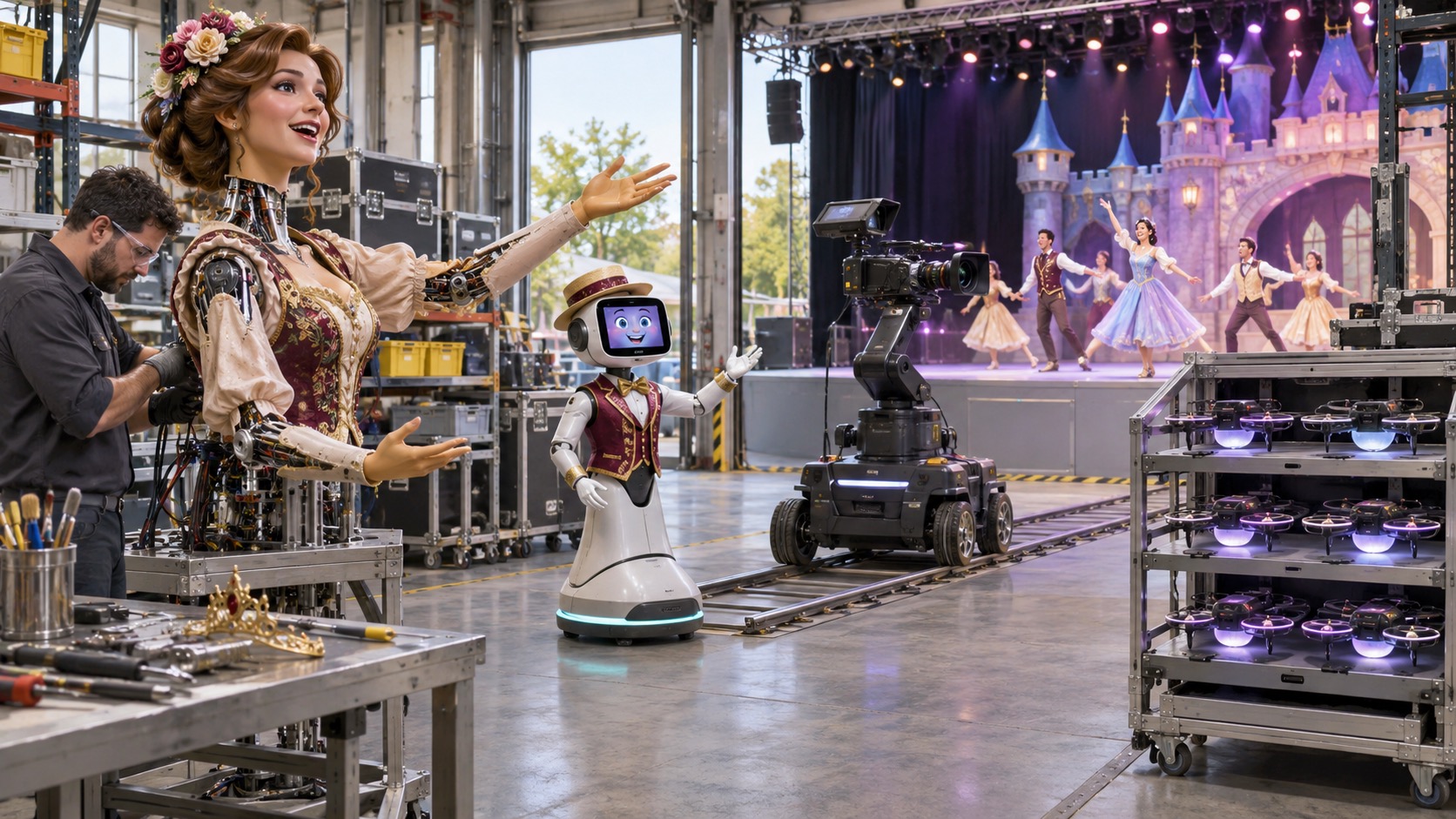
Animatronic figures use motors, pneumatic or hydraulic actuators, linkages, skins, and show-control software to create repeatable character movement. Large figures may coordinate dozens of joints for eyes, mouth, hands, posture, and breathing. Audio and motion share a timeline so expressions support dialogue.
Most animatronics do not independently understand the audience. They perform scenes triggered by schedule, vehicle position, or an operator. Limited sensors may prevent motion when a barrier opens or adjust a short interaction. Their strength is controlled, repeatable storytelling.
Performance Robots Share the Stage
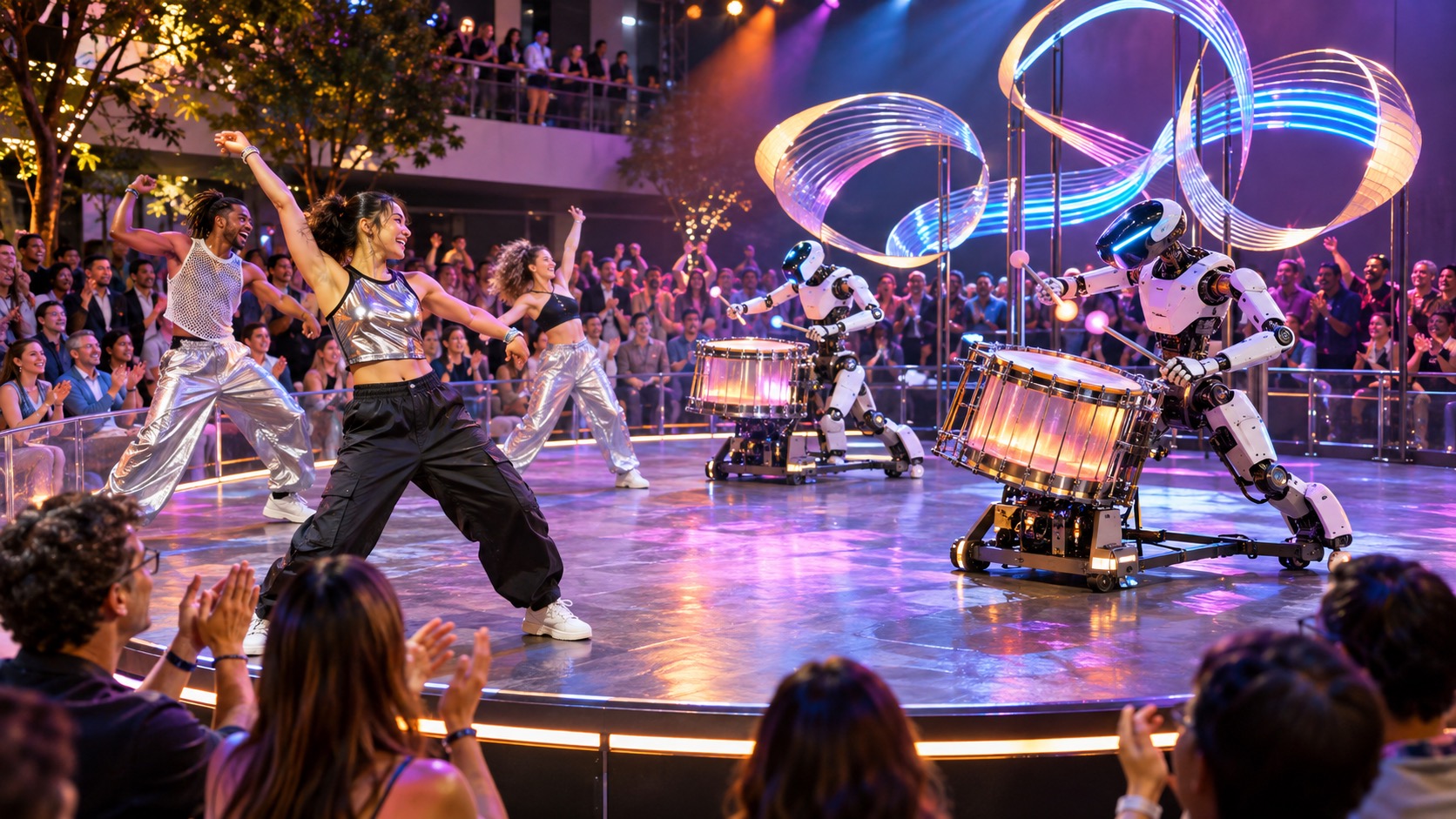
Stage robots dance, play instruments, manipulate props, or form moving scenery. Choreographers work within acceleration, reach, balance, sound, and stopping limits. The robot may repeat a precise cue every show, creating motion difficult for a person to sustain. Human performers learn its path and timing just as they learn lighting and set changes. Rehearsal establishes separation and fallback cues. Successful performance hides technical coordination without pretending risk has disappeared.
Interactive Robots Respond to Guests
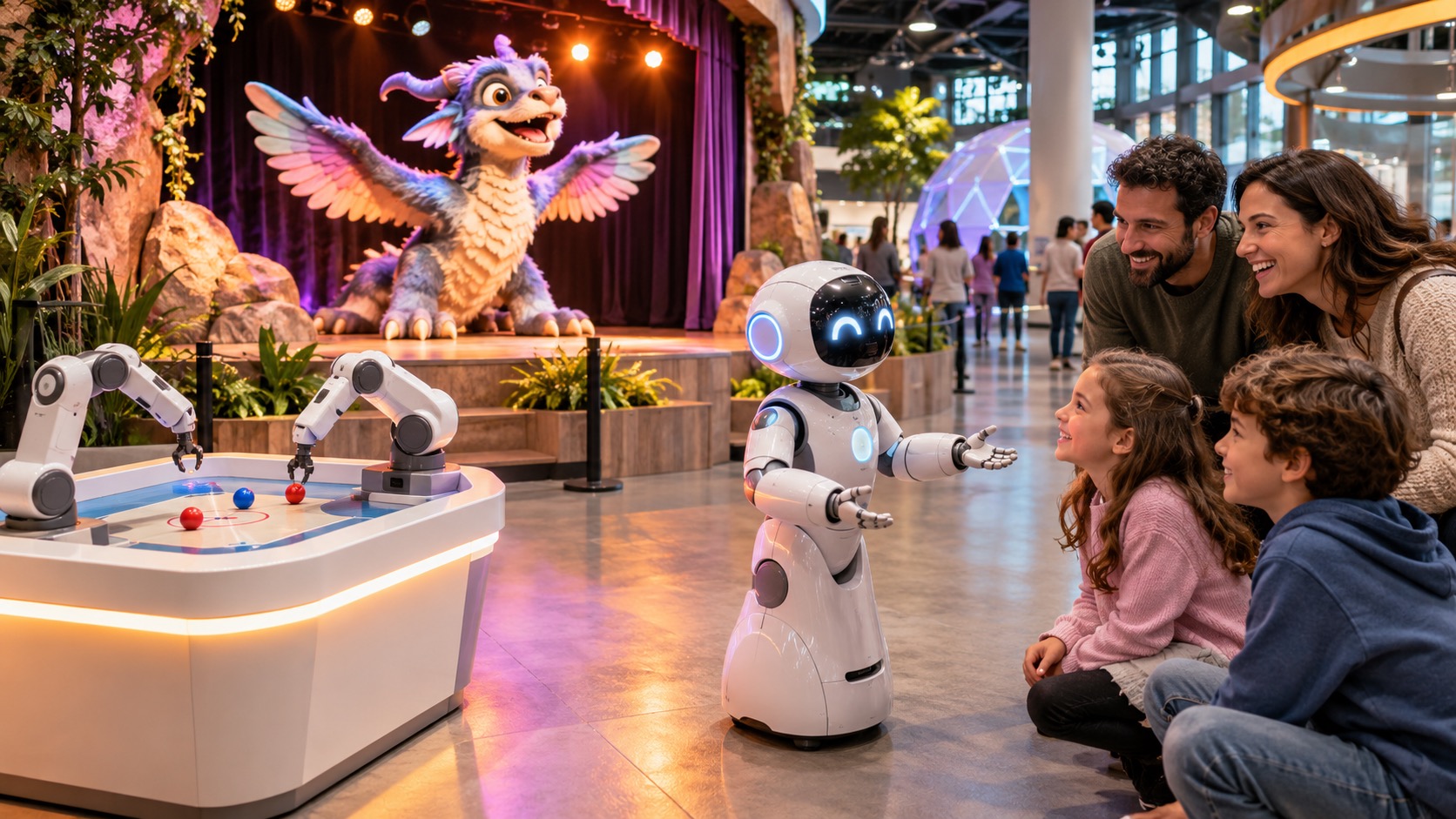
An interactive robot may detect presence, recognize a button press, follow a face, understand a restricted set of spoken requests, or select responses from a prepared library. The sensation of responsiveness comes from timing and clarity as much as intelligence.
Designers constrain the conversation so the machine can recover gracefully. It may ask the guest to repeat, offer choices, or hand control to a nearby host. Open-ended claims create disappointment; a small set of polished responses can feel more convincing.
Robotic Toys Bring the Experience Home
Consumer entertainment robots range from programmable vehicles and construction kits to expressive pets and tabletop games. They use affordable sensors, small motors, speakers, lights, and phone connections. Play may involve coding, racing, collecting, caring, or creative movement. A good toy survives drops, recognizes clear actions, and remains interesting after the first demonstration. Battery access, privacy, spare parts, software support, and age-appropriate pinch protection matter. The product is not only a robot; it is an ongoing play pattern.
Game Robots Make Physical Rules Visible
Robotic games move pieces, launch balls, present targets, or compete directly with players. Sensors detect scores and boundaries while control software adjusts difficulty. Physical motion adds uncertainty and spectacle that a screen cannot duplicate.
Fairness requires consistency. A player should understand what counts as a score and why the machine acted. Recovery must be quick when an object jams or leaves the play area. Operators need safe access without resetting an entire venue.
Camera Robots Create New Viewpoints
Robotic dollies, cable cameras, tracking heads, and automated arms move cameras through repeatable paths. Film crews use them for precise visual effects, miniature work, product shots, sports, concerts, and virtual production. The robot supports entertainment rather than appearing onscreen. Repeatability lets a shot be matched across takes, while high speed creates dramatic movement. These systems operate under strict zones because a camera package has significant mass and momentum. A trained crew plans the path, checks clearance, and retains emergency control.
Theme-Park Robots Work Inside Larger Show Systems
An attraction connects figures, vehicles, doors, scenery, projections, sound, lighting, and safety controls. The robot receives cues from this show network. Position sensors confirm that one event has completed before the next begins. Redundant limits stop movement when conditions are wrong.
Guests see a seamless scene, but operators see states, alarms, access rules, and evacuation procedures. Maintenance windows are part of the creative design because a spectacular effect that is often unavailable weakens the story.
Museum Robots Balance Engagement With Explanation
Museums use robotic replicas, presenters, telepresence devices, and interactive demonstrations. Motion can reveal how an animal walked, how a machine operates, or how control changes behavior. The robot should clarify the subject rather than become unrelated spectacle. Exhibits face heavy daily use, varied ages, background noise, and visitors who approach from unexpected angles. Durable controls and obvious interaction cues matter. Staff also need a non-robotic way to deliver the core information when equipment is offline.
Social Cues Make Motion Understandable
People read gaze, posture, timing, turn-taking, distance, and gesture automatically. Entertainment robots borrow these cues to signal attention and intention. A head turn before movement can make a path easier to predict. A pause invites the guest to respond.
More realism is not always better. Stylized machines can communicate with simple motion while avoiding expectations of human understanding. Designers test cues with actual audiences because a gesture that looks friendly in animation may feel abrupt at full physical scale.
Sound, Lighting, and Scenery Complete the Illusion
Robotic motion rarely carries the experience alone. Sound gives weight and emotion, lighting directs attention, and scenery hides mechanisms or establishes scale. A modest movement synchronized with a strong audio cue can feel more powerful than a complicated unsynchronized sequence. The control system aligns these elements while accounting for mechanical delay. Creative teams also use darkness, framing, and audience position to emphasize reliable angles. This is not a trick that excuses poor engineering; it is theatrical composition that lets the machine perform within its strengths.
Control Can Be Scripted, Operated, or Adaptive
Scripted robots follow timelines and triggers. Teleoperated characters let a performer choose words and gestures in real time. Adaptive systems select behavior using sensors or software models. Many attractions combine all three: a fixed scene, an operator handling unusual guests, and automatic safeguards.
The choice affects staffing and consistency. Live operation supports improvisation but demands trained performers. Automation scales repeated shows but needs well-defined boundaries. Producers select the control style that fits the artistic promise and operational budget.
Safety Starts With the Audience’s Unpredictability
Guests may reach across barriers, drop objects, run into a path, or ignore instructions. Designers limit force and speed, provide guarding, use safety-rated stops, remove pinch points, and preserve separation around heavy machines. Small interactive robots monitor proximity and yield space. Staff know how to stop the experience without confusing other systems. Safety also includes sound levels, flashing effects, battery handling, and accessibility. The goal is not merely compliance; predictable behavior lets guests relax enough to enjoy the illusion.
Maintenance Protects Performance Quality
Repeated motion loosens fasteners, stretches cables, wears skins, changes calibration, and heats actuators. Dust, makeup, confetti, drinks, and outdoor weather add stress. Technicians inspect joints, brakes, sensors, wiring, batteries, and cosmetic surfaces on schedules tied to cycles and condition.
Small degradation changes character. A delayed eyelid or noisy joint can make a figure seem broken before it becomes unsafe. Show teams log defects and substitute approved reduced-motion modes rather than improvising repairs during operation.
Creators Need Both Artistic and Technical Tools
Artists need ways to author movement without writing low-level motor commands. Animation software, motion capture, keyframes, path editors, and rehearsal tools translate creative intent into safe trajectories. Engineers define envelopes, loads, and interlocks. Performers contribute timing and audience awareness. The strongest process lets each specialty see how a change affects the others. A heavier costume alters acceleration; a revised line changes lip timing; a moved prop changes clearance. Entertainment robotics is collaborative because the final behavior crosses many disciplines.
Privacy Matters When Robots Sense Guests
Cameras and microphones may be needed for interaction, navigation, or safety. Venues should collect only what the experience requires, explain meaningful recording, protect stored data, and limit access. Face tracking need not mean identity recognition. A system can follow a nearby person without creating a lasting profile.
Children deserve particular care. Parents and guests should have options that do not depend on hidden collection. Trust is part of the entertainment experience; surveillance uncertainty breaks immersion quickly.
Success Is Measured in Experience and Operations
Useful measures include guest understanding, participation, repeat play, show availability, recovery time, safety events, staff workload, and maintenance cost. Social-media attention may reflect novelty but not lasting value. A robot that draws a crowd while creating queues or frequent downtime may weaken the venue. Teams observe where guests hesitate, what they misunderstand, and which moments they remember. The right entertainment robot delivers a clear creative payoff repeatedly, fits the surrounding operation, and remains safe when real audiences behave differently from rehearsals.
Designing the Guest Journey Around the Robot
The robot’s scene begins before it moves. Guests need to notice the activity, understand whether they may approach, and recognize what kind of response is possible. Queue position, sightlines, noise, language, and group size influence that invitation. A host can establish expectations, but the machine should also communicate through posture, lighting, or an obvious idle behavior. When the encounter finishes, a closing cue should release the guest and prepare the next group rather than leaving both parties waiting.
Operations shape this journey throughout the day. A popular interaction may create a crowd that blocks circulation. A slow response can feel thoughtful to one person and broken to the people behind them. Designers test peak attendance, children entering from unexpected sides, mobility devices, background music, and several people speaking together. They decide when the robot should shorten an exchange, repeat a prompt, or invite a host. These are creative choices because they determine the rhythm and social tone of the experience.
The complete journey also includes downtime. Staff need language that redirects guests without promising an immediate repair, and the surrounding space should retain value when the robot is unavailable. Maintenance access must not require dismantling the audience environment. A strong entertainment installation treats arrival, participation, departure, recovery, and return as one designed sequence. The robot becomes memorable because it fits that sequence, not because a mechanism happened to move in public.
A Beginner’s Best Starting Point
Watch one complete interaction and identify the invitation, response, safety boundary, operator role, and reset. Those five elements reveal more about an entertainment robot than its outward resemblance to a person or character.