A Taxonomy Based on the Experience Each Machine Creates
Entertainment robots can be grouped by the role they play for an audience. Character robots create the impression of a living personality. Performance robots dance, play music, or move scenery. Game robots challenge players, while toys bring programmable behavior into the home. Camera and effects robots help make entertainment without becoming part of the story. Kinetic artworks make movement itself the subject. Telepresence machines give a remote performer a physical viewpoint, and coordinated drone fleets draw temporary forms in the sky. These types often overlap: an animatronic character may be teleoperated, a social robot may host a game, and a camera robot may perform visibly during a concert. Comparing their audience role, mobility, control style, interaction distance, and operating environment makes the category easier to understand than comparing appearance alone.
A: The category is broad, with animatronics, toys, cameras, and games all common.
A: A live person selects behavior while software assists motion and safety.
A: A fixed base supports larger mechanisms and controlled audience distance.
A: Programmable sensed motion can make them robotic artworks.
A: It reproduces lens position and timing across multiple takes.
A: Planned trajectories, positioning, monitoring, and separation rules coordinate the fleet.
A: Some offer complete local play, while others depend on connected controls.
A: They need fair rules, reliable sensing, safe motion, and quick resets.
A: One platform combines roles such as character, game host, and telepresence.
A: Audience distance determines energy, access, guarding, and interaction options.
Fixed Animatronic Figures Deliver Repeatable Scenes
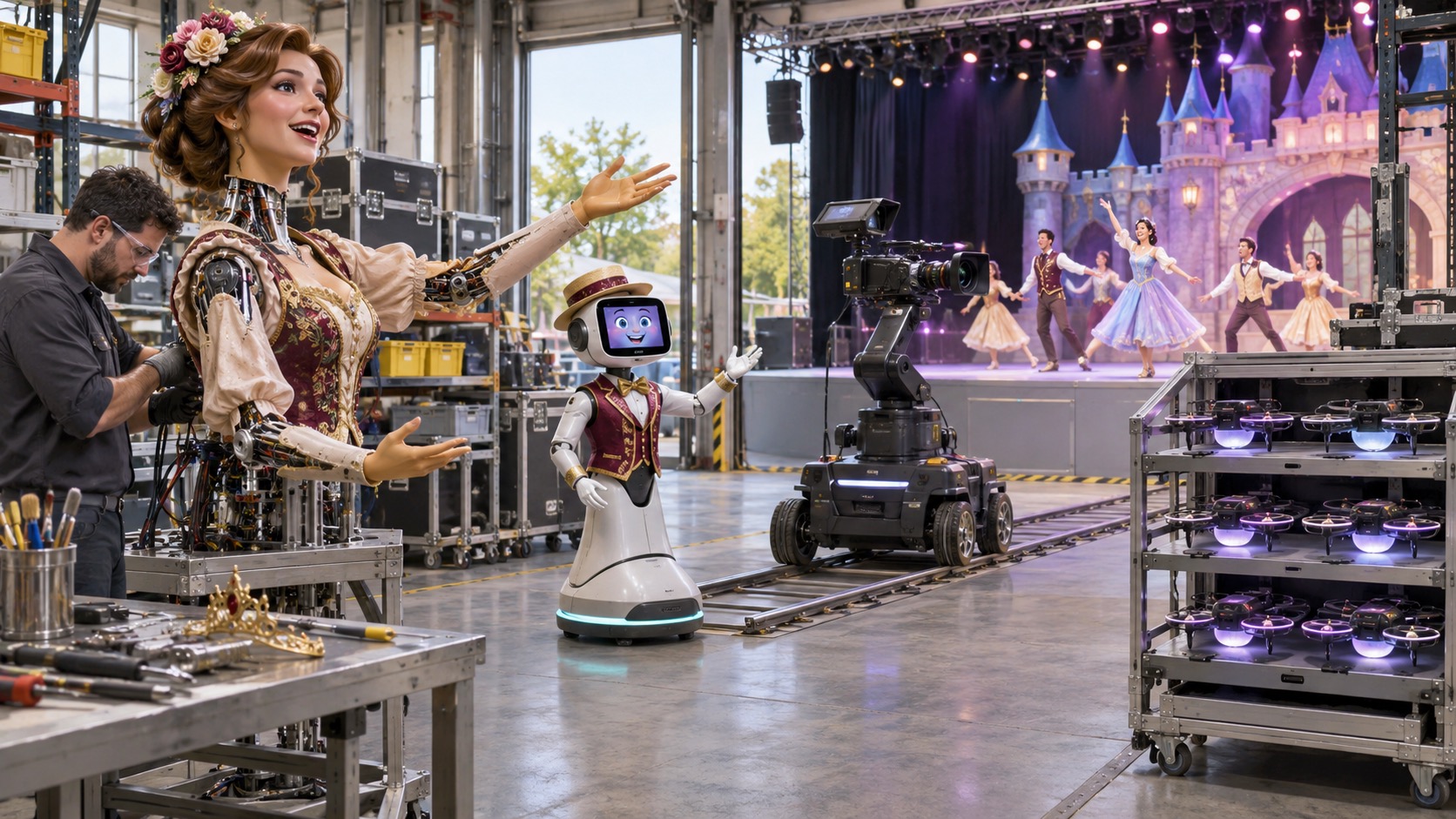
Fixed animatronics mount a character to a base, set, or hidden frame. Actuators move facial features, limbs, and body mechanisms through rehearsed cues. Because the support structure carries weight and utilities, the figure can be larger and more expressive than many mobile robots. Its viewpoint and audience distance are controlled. The limitation is location: the character cannot follow guests or easily change staging. Theme parks, museums, restaurants, and theater use fixed figures when dependable repetition and detailed cosmetics matter.
Mobile Character Robots Bring Personality Into Shared Space
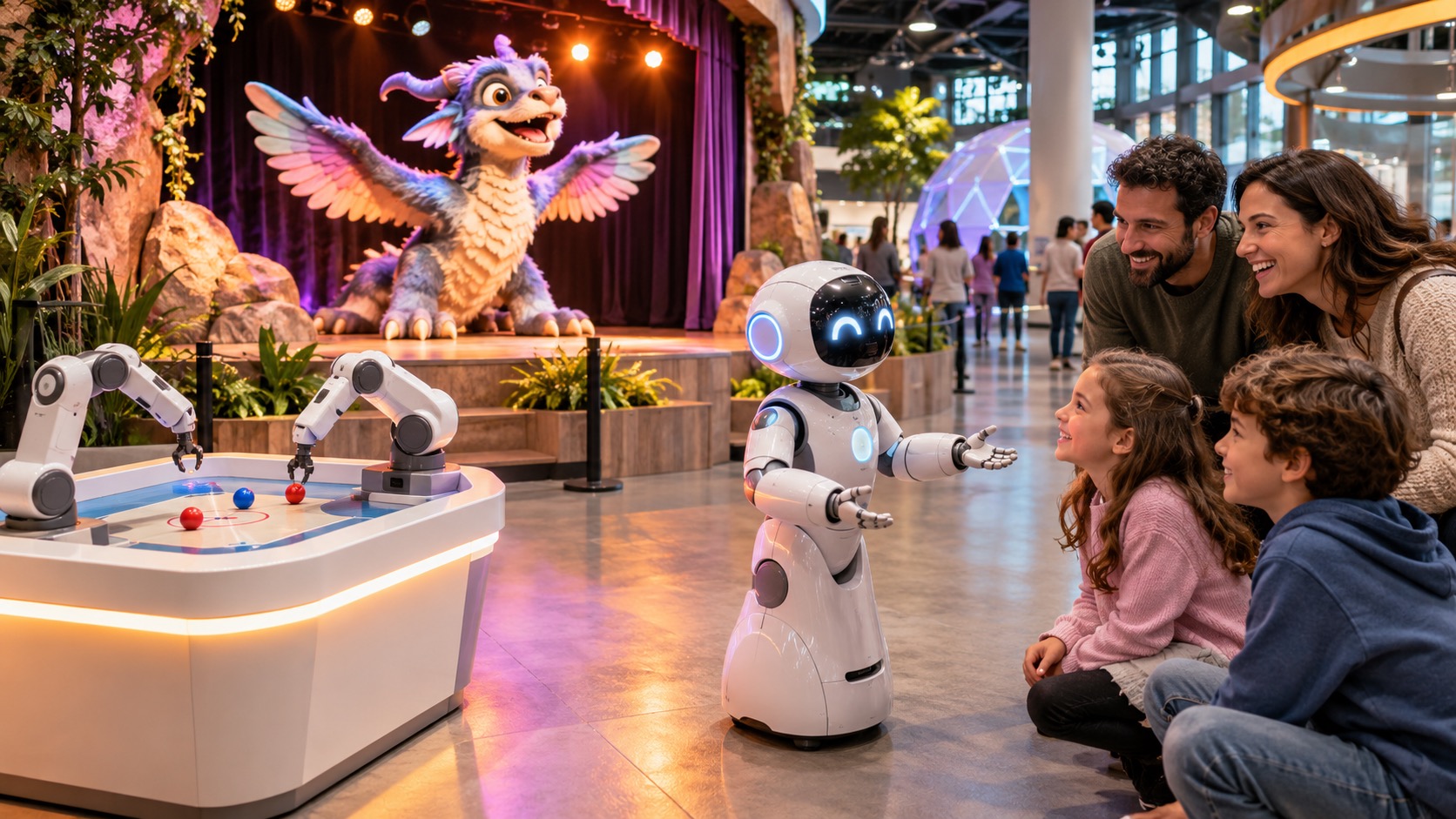
Mobile characters combine a wheeled or legged base with expressive motion, sound, and interaction. They greet visitors, move between groups, or appear unexpectedly within a venue. Mobility makes encounters feel personal.
Shared space increases safety and navigation demands. The character must avoid feet, bags, strollers, and excited children without losing its personality. Hosts often guide the encounter and protect the route.
Teleoperated Characters Put a Performer Inside the Machine
A remote operator watches through cameras, listens to guests, chooses dialogue, and triggers gestures. The robot supplies physical presence while a person provides timing and improvisation. This type works well for roaming characters and conversations that would exceed a scripted system. Communication delay, audio quality, operator workload, and privacy affect performance. Controls constrain motion so expressive choices stay within safe limits. The audience may know a person is operating or accept the character fiction; either way, the interaction depends on live performance.
Social Robots Use Compact Cues for Conversation
Social entertainment robots use gaze, head movement, voice, lights, screens, or simple arms to support turn-taking. They may tell stories, lead quizzes, host activities, or serve as playful companions.
Their strength is structured interaction rather than broad human understanding. A well-designed social robot makes choices clear and recovers from missed speech. Stylized appearance can reduce unrealistic expectations while keeping expressions readable.
Robotic Toys Focus on Personal Play
Toy robots include vehicles, pets, construction kits, programmable figures, and battling machines. They must balance price, durability, battery life, ease of control, and age-appropriate safety. Some arrive with a defined character; others are platforms for building and coding. The best toys support several play loops rather than one demonstration. Children may race, customize, teach routines, create stories, or invent rules. Local operation protects usefulness if an app or service ends, while connected features need transparent privacy and parental controls.
Competition Robots Turn Engineering Into Spectacle
Robot competitions make design, driving, strategy, and repair part of entertainment. Machines race, fight, play sports, or complete obstacle courses. Human teams remain visible, allowing audiences to understand skill and consequence.
Rules define weight, energy, contact, arena protection, and acceptable weapons or mechanisms. Inspection and controlled pits protect participants. The robot’s identity includes both performance in the arena and the team’s creative engineering story.
Robotic Game Masters Operate Physical Challenges
A game-master robot deals pieces, moves targets, launches objects, judges boundaries, or changes a room after player actions. Escape rooms, arcades, exhibitions, and home games use these systems to make rules physical. Sensors need clear scoring conditions, and the machine must reset quickly. Players should be able to predict legal behavior without seeing every mechanism. A game robot can adapt difficulty, but changes must feel fair. It is successful when players focus on strategy and surprise rather than troubleshooting the apparatus.
Dance Robots Emphasize Rhythm and Group Motion
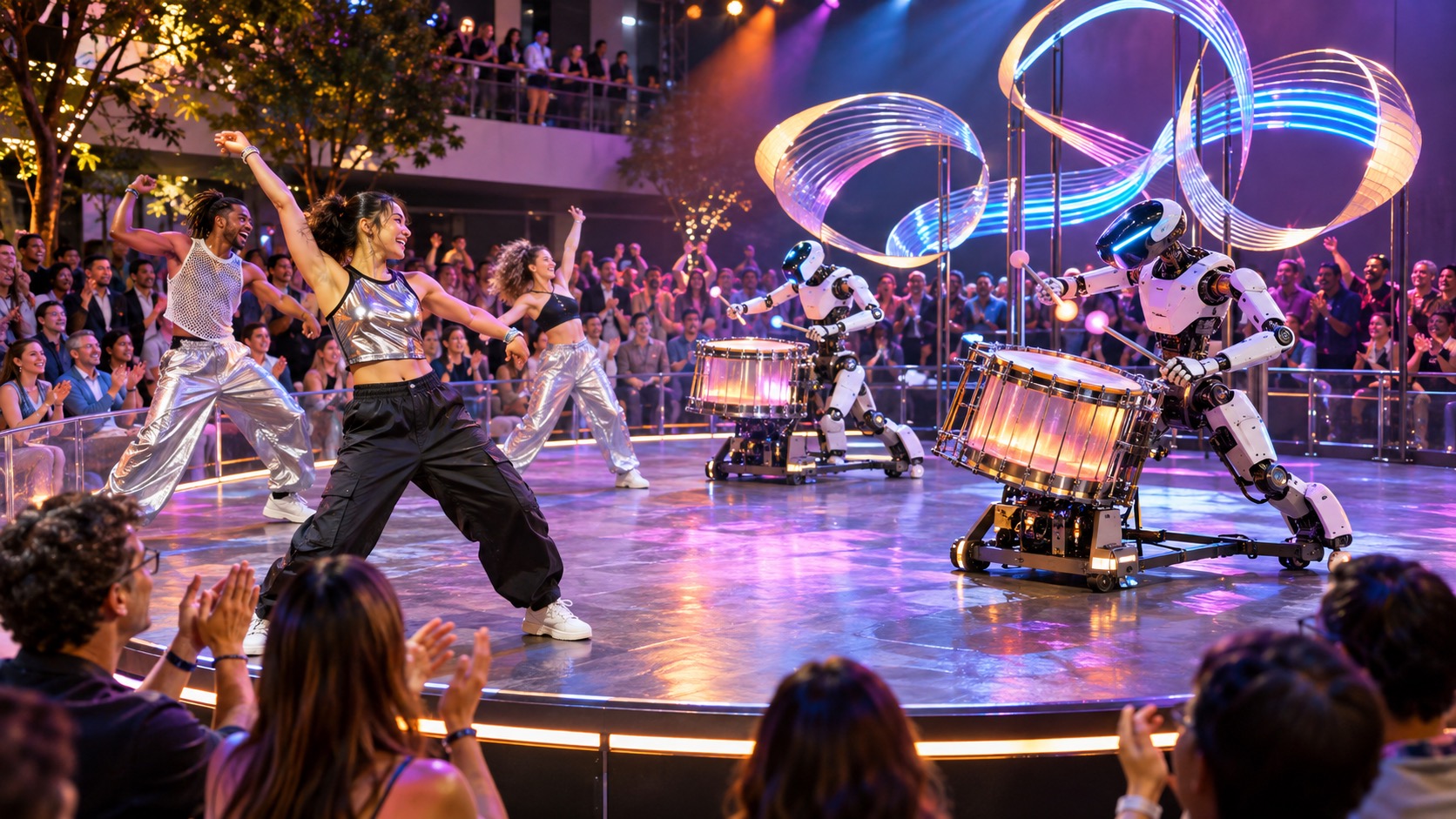
Dance robots range from humanoid performers to abstract moving structures. Choreography can exploit synchronization, mechanical repetition, unusual joint limits, and contrast with human bodies.
Balance and floor condition matter for legged machines. Wheeled bases offer stability but different expression. Multiple robots need timing and spatial coordination so one fault does not create a collision. Rehearsal determines how human dancers respond to a missed cue.
Music Robots Produce Sound Through Physical Action
Musical robots strike drums, pluck strings, bow instruments, blow air, or manipulate electronic controls. Physical performance makes rhythm visible and can explore speed or patterns beyond human anatomy. It can also reveal subtle mechanical variation. Designers manage acoustic noise from motors and impacts. The robot may follow a score, improvise within rules, or respond to human musicians. Listeners often enjoy the relationship between visible mechanism and sound as much as the composition itself.
Kinetic Sculptures Treat Motion as the Artwork
Kinetic robots move panels, cables, mirrors, lights, or articulated forms to create changing shapes. They may react to weather, audience location, music, or time. Unlike a character, the work need not imitate life.
Public installations require durable mechanisms, quiet operation when appropriate, and safe behavior across long unattended hours. The control system preserves artistic timing while monitoring wind, obstruction, and wear.
Robotic Camera Systems Create the View
Camera robots include pan-tilt heads, floor dollies, cable cameras, telescoping cranes, and articulated arms. Sports venues, studios, concerts, and film sets use them for remote placement and repeatable motion. Some automatically follow a defined subject; others are operated by camera crews. Their payload includes lens, focus, power, and communication, so movement affects image stability. Safety zones reflect the combined mass and speed. These robots are part of the production toolchain even when audiences never see them.
Motion Platforms Move People or Scenery
Motion bases tilt seats, vehicles, stages, and scenic elements. They synchronize acceleration with images and sound to simulate travel, impact, or flight. Large platforms use several actuators and safety restraints.
Comfort limits are as important as mechanical range. Mismatched visual and physical cues can cause motion sickness. Emergency behavior must return or hold the platform without trapping occupants, and accessibility procedures need equal planning.
Special-Effects Robots Control Repeatable Action
Robotic rigs move props, creatures, miniatures, lights, water, or breakaway elements for stage and camera. Repeatability lets crews combine multiple takes or place action near a planned camera path. These systems may be temporary and custom-built for one production. Engineering review covers loads, fragments, heat, cable routing, and emergency stops. Effects teams coordinate with performers and stunt personnel. A successful rig produces a convincing moment while behaving exactly as rehearsed.
Drone-Light Fleets Create Aerial Displays
Coordinated drones carry lights through planned three-dimensional formations. Each aircraft follows a timed trajectory while fleet software maintains separation and monitors position, battery, and weather. The display can change imagery without fireworks debris.
Launch areas, geofencing, wind limits, airspace authorization, and contingency landings are central. The art depends on viewing angle; formations that read from one location may look scattered from another.
Telepresence Robots Carry Remote Guests or Performers
A telepresence robot combines video, audio, and mobility so a remote person can attend an event, visit a museum, or interact with a group. It differs from an autonomous character because the identity and decisions belong to the remote user. Navigation may be driven directly or assisted with obstacle avoidance. Venue staff handle charging, access, doors, elevators, and recovery. Good design gives the remote participant social presence without blocking people who are physically present.
Robotic Sports Trainers Return or Place Equipment
Training robots deliver balls, set pace, move targets, or provide repeatable practice. Players can request trajectories difficult for a human partner to repeat. Sensors record outcomes and adapt drills.
Launch energy and unpredictable player movement require protected setup. The machine should signal each action and stop when someone enters a dangerous area. Coaching interpretation remains human even when practice becomes automated.
Choosing a Type Begins With Audience Distance
A fixed figure behind scenery can use powerful mechanisms because separation is controlled. A toy held by a child needs low energy and covered joints. A drone fleet needs remote separation across airspace, while a mobile character shares pedestrian space. After distance, creators define duration, mobility, creative control, sensing, payload, reset time, staffing, and maintenance. The right type supports the intended relationship between machine and audience. A technically impressive platform is a poor choice when its safety zone or downtime destroys that relationship.
Hybrid Entertainment Robots Combine Roles
A mobile social robot may host games, act as a character, and connect a remote performer. An animatronic can become interactive through cameras and live operation. A camera robot may join choreography so its visible movement becomes part of the show. Hybrids create richer experiences but multiply control modes and failure cases. Teams define which function has priority, how transitions occur, and what remains available after a component fault. Clear hierarchy prevents versatility from becoming confusion for operators or guests.
A hybrid should communicate one audience role at a time even when several technical systems remain active.
Support Infrastructure Is Another Way to Classify the Type
Two robots with similar bodies may belong to different operational categories because one needs only a charging cart while the other depends on a control room, motion base, compressed air, tracking cameras, and a large technician team. Portable entertainment robots favor self-contained batteries, wireless control, quick setup, and rugged transport cases. Permanent attractions can use building power, hidden utilities, fixed guarding, dedicated networks, and overnight maintenance access. Touring systems must survive loading, changing floors, uncertain venues, and repeated calibration. Outdoor installations add weather monitoring, drainage, corrosion protection, and wind limits. Creators should classify support before selecting the visible machine, because infrastructure determines where the show can travel, how quickly it can reset, and what staff must be present. A compact mechanism with demanding support may be less flexible than a larger self-contained platform. The complete type is therefore the performing robot plus the equipment, people, and space required to make its promised behavior available safely.
Scale Creates Distinct Entertainment Categories
Desktop robots invite close personal control. Human-scale characters share social distance, while giant figures depend on scenery and separation. Aerial fleets trade individual detail for patterns visible across a city.
Scale changes more than appearance. It determines actuator energy, transport, viewing angle, sound reinforcement, staffing, and the audience’s emotional response. A tiny hesitation can feel charming in a toy but invisible on a stadium stage.
Creators should prototype at representative size before committing to a type. Video can hide how fast, loud, imposing, or distant a machine feels. Full-scale tests reveal whether the intended wonder survives the practical relationship between body, venue, and viewer.
The Best Type Makes Its Purpose Obvious
Audiences should not need an engineering explanation before they can enjoy the machine. Form, motion, placement, and invitation should reveal whether the robot is a character, partner, opponent, artwork, or production tool.