Fun Is Becoming More Physical, Responsive, and Participatory
Entertainment robots are changing fun by giving digital ideas a physical presence. A character can look toward a guest, a drum machine can trade rhythms with dancers, a camera arm can repeat an impossible shot, and a toy can change behavior as a child learns its rules. These systems blur familiar boundaries between audience and performer, screen and stage, fixed attraction and changing experience. The important shift is not that robots are replacing artists. Choreographers, actors, designers, operators, technicians, game developers, and safety teams shape what the machine does and how people meet it. Robotics adds repeatable motion, sensing, scale, and controlled surprise to their toolkit. When it works, the technology disappears into a moment of play. When it fails, confusion, delay, or safety barriers become the experience. Lasting change therefore depends on creative direction and dependable operations together.
A: Interactive systems can let guest choices influence physical events.
A: They add new partners and tools while people direct meaning and improvisation.
A: Repeatable camera motion supports precise shots and layered visual effects.
A: Some variation is practical, but capacity and reliable inputs limit it.
A: A human performer can improvise while the robot supplies physical presence.
A: They should rely on observable actions rather than strong emotional claims.
A: Programmable pace, placement, and multimodal cues can expand participation.
A: Motion, interaction, integration, safety, operation, and maintenance roles grow.
A: No; lasting value needs story, play, beauty, mastery, or connection.
A: Real audiences do, through understanding, participation, return, and enjoyment.
Audiences Are Moving From Watching to Influencing
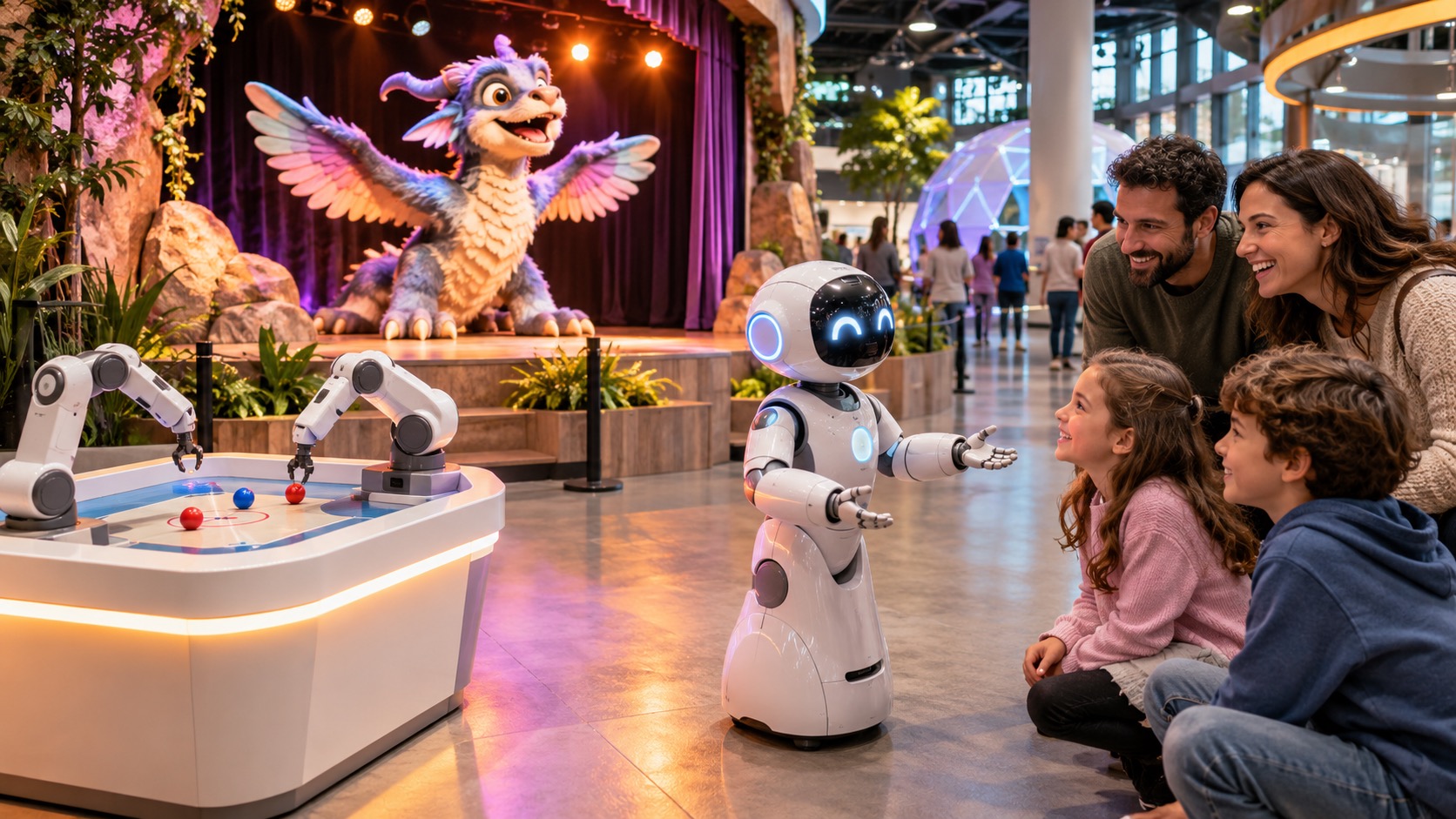
Traditional shows establish a firm boundary between performer and audience. Interactive robots can acknowledge a person, change a sequence after a choice, or move the action into shared space. The guest becomes a cause rather than only an observer. Designers must make that influence legible. If a robot reacts too late, people do not connect response with action. If every guest triggers it at once, the scene loses focus. Successful experiences control the invitation, signal whose turn it is, and reward participation without embarrassing someone who prefers to watch.
Live Performance Gains a New Kind of Partner
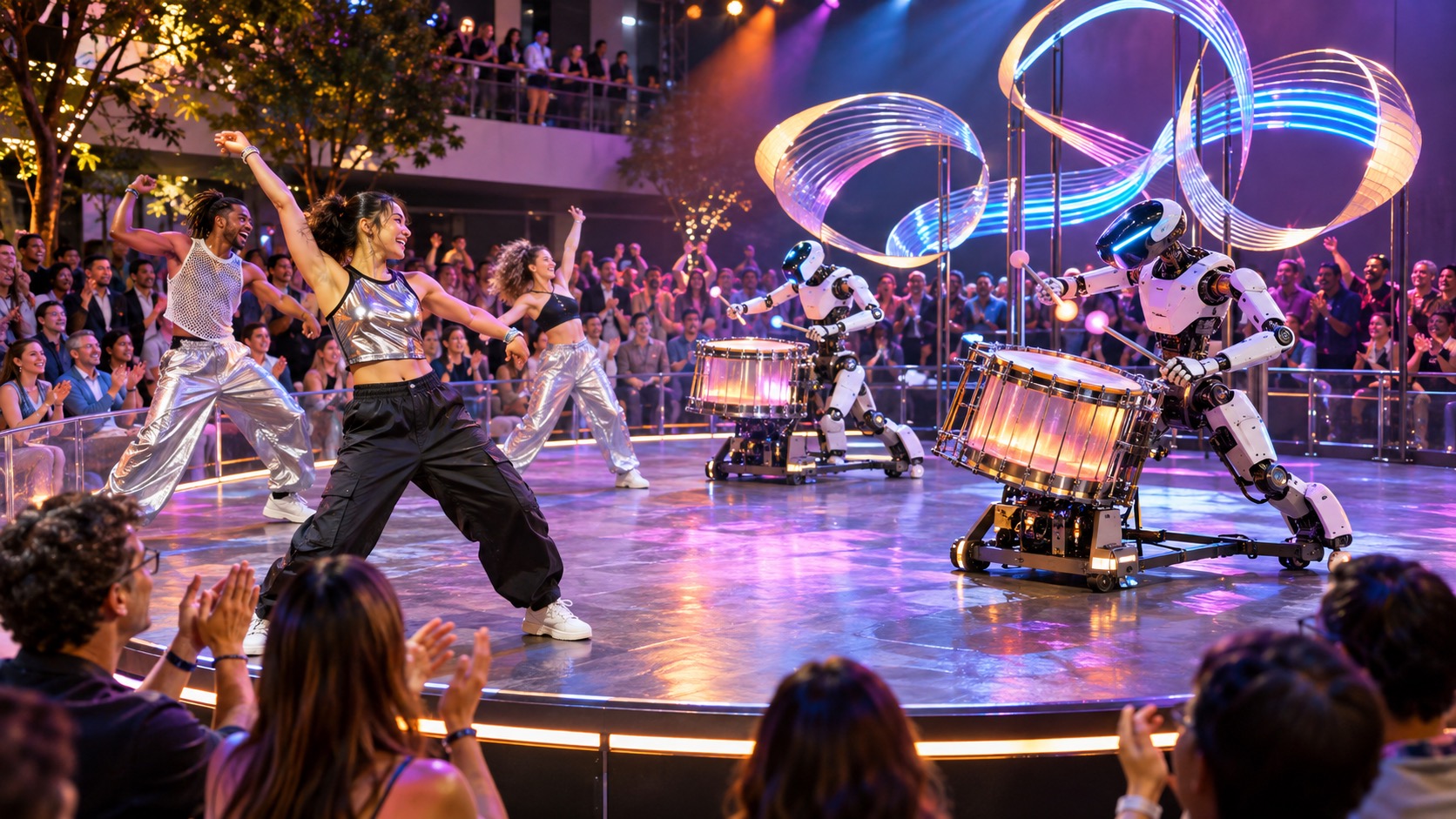
Robots can play instruments, carry scenery, shape light, or execute motion with repeatable timing. Human performers respond to a partner whose path is exact but whose mechanical limits differ from a person. The contrast can become part of the choreography.
Creators rehearse transitions, separation, tempo changes, and emergency cues. A robotic performer may sustain a demanding pattern without fatigue, while people provide interpretation and improvisation. The result is a new ensemble, not an automatic show.
Attractions Can Offer Variation Without Rebuilding Sets
Programmable characters and mobile effects let venues change dialogue, motion, game rules, or event timing within one physical environment. Seasonal content can reuse reliable hardware. Repeat visitors may encounter a different path or character response. Variation increases complexity, however. Every version needs clearance checks, audio alignment, accessibility review, and operational rehearsal. Content management becomes part of ride maintenance. A flexible machine creates value only when staff can deploy new material without destabilizing the core experience.
Games Are Leaving the Screen
Robotic games move targets, pieces, obstacles, or opponents in the player’s physical space. Motion adds momentum, friction, sound, and imperfect bounce. Players read the machine’s posture and anticipate what it will do.
Difficulty can adjust through speed, path, or response time, but fairness must remain visible. Designers avoid hidden sensing advantages and provide consistent reset behavior. Physical games also require safe boundaries that do not feel like a laboratory cage.
Characters Can Continue Beyond a Single Scene
A mobile or networked character may appear in a lobby, attraction, online channel, and home product with related behavior. Robotics gives the character a body people can encounter. That continuity deepens attachment, but it also raises expectations. Voice, gesture, vocabulary, and temperament must remain recognizable across operators and venues. Producers develop character rules alongside mechanical limits. A response that is technically possible may still be wrong for the story. Consistency turns isolated demonstrations into a believable world.
Filmmakers Can Repeat Motion With Precision
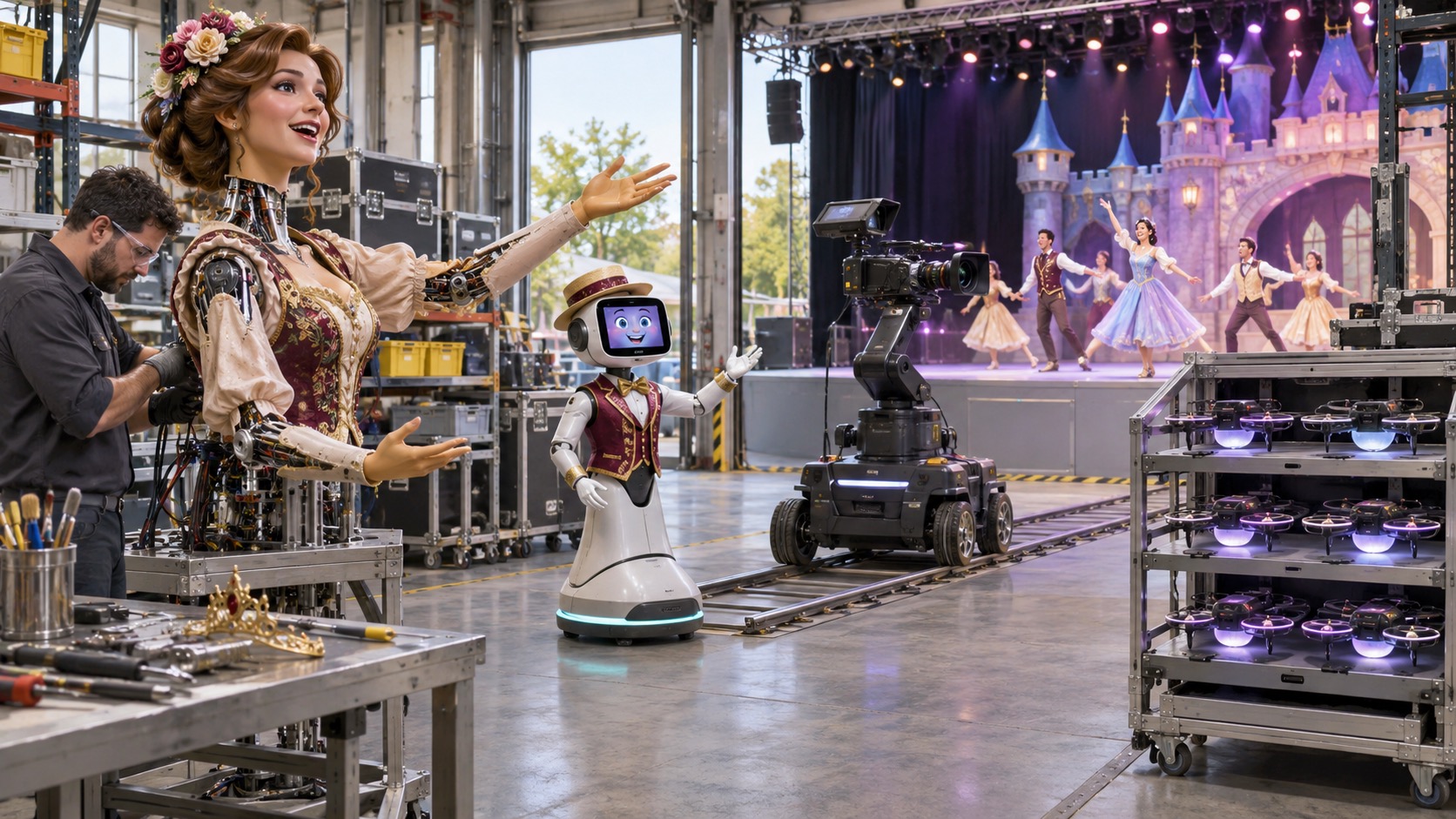
Robot arms, dollies, cable systems, and motion-control rigs move cameras through exact trajectories. Multiple passes can combine actors, miniatures, lighting, and visual effects because framing repeats closely. High acceleration creates shots beyond manual rigs.
Precision changes preproduction. Crews plan positions, focus, timing, and set clearance before the take. It can reduce trial and error, yet it requires skilled programming and strict zones. Robotic cameras expand cinematography rather than remove the camera department.
Virtual Production Connects Physical and Digital Movement
In virtual production, camera position affects a rendered background so perspective changes correctly. Encoders and tracking systems connect physical lenses with digital scenes. Robotic camera movement makes complex passes repeatable and allows digital elements to be prepared around a known path. Moving lights, props, and platforms can share the same timeline. The creative benefit is earlier feedback: directors see a closer approximation of the final image on set. The operational challenge is calibration across several coordinate systems. A small mismatch can make the background appear to slide.
Theme Parks Are Becoming More Responsive
Attractions increasingly connect vehicles, characters, props, projection, and guest choices. A robot may perform a scene only when a vehicle reaches the correct position, then select a variation from earlier input.
Responsiveness must survive high throughput. Guests cannot wait while a system interprets an ambiguous signal. Designers use robust choices, short loops, and defaults that keep the attraction moving. Personalization is valuable when it fits inside dependable capacity.
Museums Use Motion to Make Ideas Tangible
A robotic animal can demonstrate gait; a manipulator can show industrial coordination; a telepresence platform can bring a remote guide into a gallery. Movement gives visitors something to compare, predict, and question. Museums are shifting from robots as futuristic objects toward robots as interpretive media. The best exhibits connect motion to evidence and let visitors test a concept. They also explain uncertainty. A reconstruction of extinct-animal movement is a scientific model, not a recording of the past. Robotics can make that distinction vivid.
Home Play Is Becoming More Programmable
Robotic toys let players create paths, routines, personalities, and games instead of consuming one fixed sequence. Construction kits expose sensors and logic; expressive pets encourage care and observation. Updates can add activities after purchase.
Long-term fun depends on understandable tools and continued support. A connected toy that loses its service may become inert. Products that preserve useful local play, repair options, and exportable creations give families more control over the experience.
Creators Can Prototype Movement Earlier
Simulation, keyframe tools, motion capture, and digital twins let creative teams test behavior before final hardware is complete. A choreographer can explore timing while engineers check speed and clearance. Early prototypes reveal whether the audience can read an intended gesture. This changes collaboration: creative decisions no longer wait until a finished figure arrives, and mechanical constraints become visible before scenery is locked. Simulation cannot reproduce every cable, costume, reflection, or human reaction, so full-scale rehearsal remains essential.
Teleoperation Preserves Human Improvisation
Some of the most convincing robot encounters are performed live. A hidden operator listens, chooses dialogue, and controls gestures while the physical character supplies presence. The audience interacts with a human performance through a machine body.
Teleoperation handles names, jokes, and unusual situations better than a narrow script. It requires trained performers, reliable communication, privacy rules, and a way to transfer or end conversations. The technology changes the stage, not the need for acting.
Adaptive Systems Can Shape Pace and Challenge
Sensors can estimate whether a player is present, successful, hesitant, or waiting. A game may slow, offer a hint, or introduce a more difficult pattern. An attraction may route capacity around a stalled interaction. Adaptation works when its purpose is clear and its evidence is modest. Inferring identity or emotion from uncertain signals can create uncomfortable mistakes. Designers favor observable actions and give people control. The best adaptive entertainment feels attentive without claiming to know more than it does.
Accessibility Can Be Designed Into the Interaction
Robots can present information at different heights, repeat cues consistently, use visual and auditory signals together, or bring an activity to a guest. Programmable experiences can offer more time or alternate inputs.
Accessibility is not automatic. Fast speech, flashing lights, narrow pathways, unfamiliar gestures, and required phone apps can exclude people. Teams test with disabled guests and preserve human assistance. Choice should expand participation rather than create a separate inferior mode.
Safety Design Is Becoming Part of Choreography
As machines enter shared performance space, motion planning and creative blocking become inseparable. A dramatic sweep needs safe distance, a visible warning, and a verified stop. Costumes and lighting must not hide protective boundaries. Performers need escape paths and cues that remain understandable when audio fails. Designers may use lightweight materials or compliant mechanisms so close interaction carries less energy. Safety choices can inspire aesthetics: slow deliberate movement may feel more characterful than speed.
Entertainment Work Is Expanding Around Integration
New roles connect art and engineering: robot choreographers, show-control programmers, interaction writers, motion designers, safety specialists, and technicians who understand both character and mechanism. Existing roles also change. Stage managers monitor machine state, camera crews plan robotic paths, and hosts recover conversations.
This work is not less creative because it uses constraints. Reliable limits create a frame within which performers and designers can make bold choices repeatedly.
Novelty Is Giving Way to Repeat Value
Audiences quickly stop rewarding a machine merely for being a robot. A lasting experience needs humor, challenge, story, beauty, social connection, or mastery. Venues study whether people return, invite friends, understand the interaction, and encounter the robot in working condition. Creators are learning to use robotics where physical behavior is essential rather than as decoration. That shift is healthy. It moves investment from one-time spectacle toward experiences that can mature through new content and better performance.
Fun Remains a Human Judgment
Robots can measure turns, scores, dwell time, and reactions, but they cannot settle what people will find meaningful. Culture, age, group dynamics, expectation, and context shape enjoyment. Creative teams observe real audiences and revise pacing, invitation, difficulty, and tone. The transformation is not a machine deciding how everyone should have fun.
It is creators gaining another physical medium and audiences gaining more ways to affect what happens around them.
Shared Experiences Can Change After Opening Night
Traditional physical attractions are expensive to revise after construction. Programmable robots create another path: teams can refine timing, add game variations, update dialogue, or coordinate new music while preserving tested machinery. Audience observation becomes part of continuing production. If guests miss an invitation, designers can change the cue. If one exchange creates a queue, they can shorten it or move optional depth elsewhere. The venue becomes capable of learning rather than freezing every creative decision at launch. This flexibility still needs governance. Each update must preserve character, accessibility, safety, privacy, and compatibility with the operating team. Uncontrolled novelty can overwhelm hosts and technicians or create inconsistent experiences across shifts. Producers therefore treat behavior as maintained content, with review, rehearsal, version history, and rollback. Over time, the robot’s value may come less from its original trick than from the organization’s ability to keep the experience relevant without discarding the physical platform.
Public Spaces Are Becoming Playable
Robots can turn lobbies, plazas, galleries, and queues into places where movement has a response. A passing person may influence light, music, or a character without entering a formal game.
This broadens entertainment beyond scheduled performances, but it requires clear consent and pathways. People who are commuting, working, or seeking quiet should not be forced into participation.
The strongest public installations reward curiosity while remaining understandable from a distance. They add a layer of possibility to ordinary space without making the machine an obstacle.