A Field Guide Organized by Terrain, Access, and Mission
Disaster response robots are built around the places emergency crews need to reach. Aircraft survey wide areas and look over obstacles. Tracked crawlers push into rubble, while legged machines step across stairs and broken floors. Snake robots enter narrow voids, firefighting platforms carry heavy nozzles, uncrewed boats work across floodwater, and underwater vehicles inspect submerged structures. Other machines do not travel far at all; they hold a communications relay, monitor a hazardous boundary, or operate a tool from a protected position. Each type exchanges one strength for another. A small drone gains speed and perspective but sacrifices endurance and payload. A heavy tracked robot carries tools but may not fit through a doorway. Understanding the category means matching mobility, sensing, manipulation, communication, and recovery to a particular emergency task.
A: A powered tethered drone can provide extended coverage from a fixed area.
A: Efficient forward flight supports longer regional mapping routes.
A: No. Large gaps, loose wire, steep slabs, and unstable debris remain barriers.
A: They can negotiate some stairs, grating, hoses, and uneven surfaces.
A: Pipe crawlers exploit known enclosed geometry, while snakes enter irregular tight voids.
A: It supports flood, bridge, levee, sampling, sonar, and surface search missions.
A: ROVs use a control tether; AUVs follow autonomous underwater survey plans.
A: It applies substantial force while moving the operator away from the hazard.
A: Deployable sensing can form part of a robotic response system despite little movement.
A: Complementary specialized machines usually cover varied terrain more effectively.
Multirotor Drones Provide Fast Local Overviews
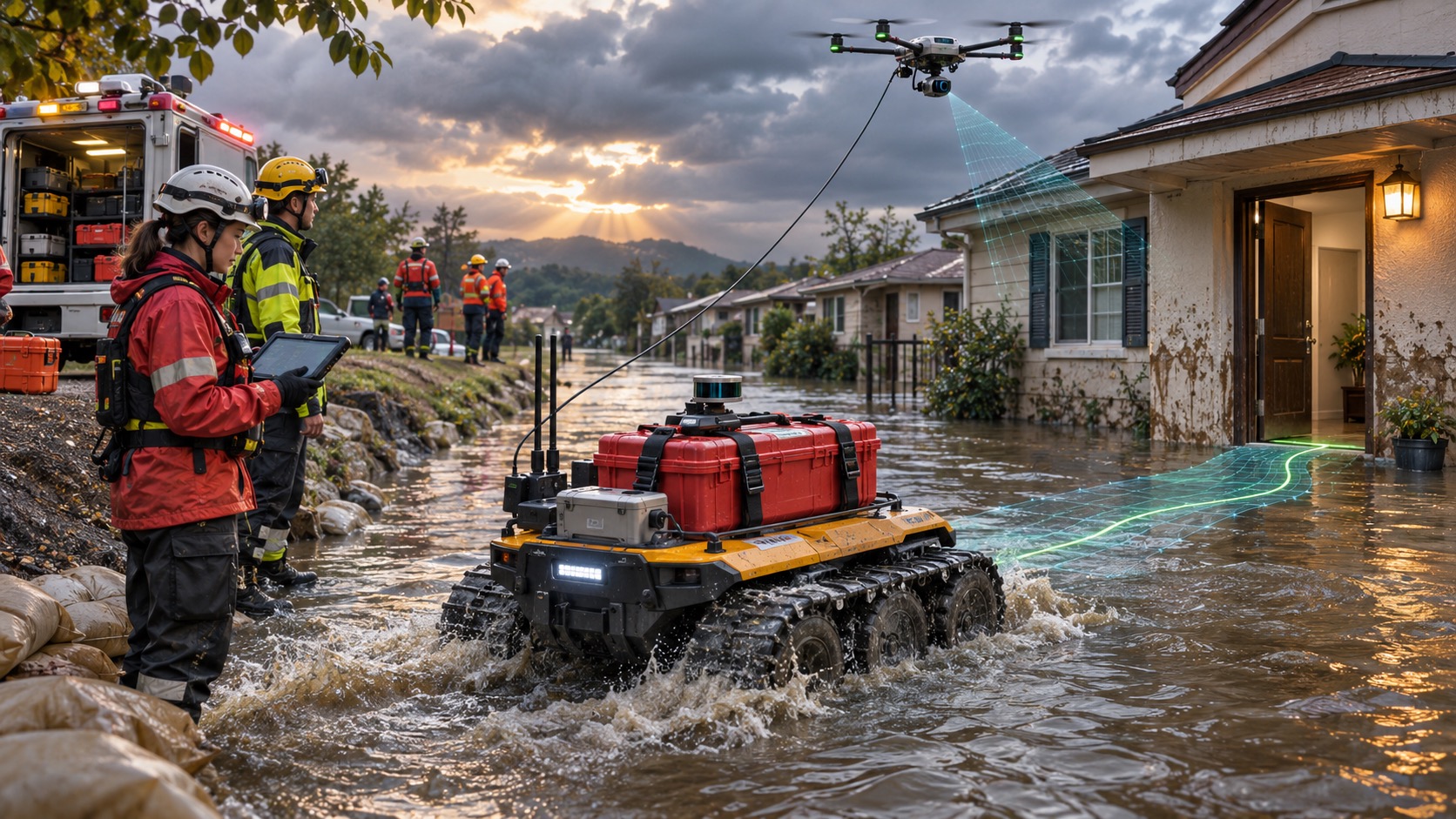
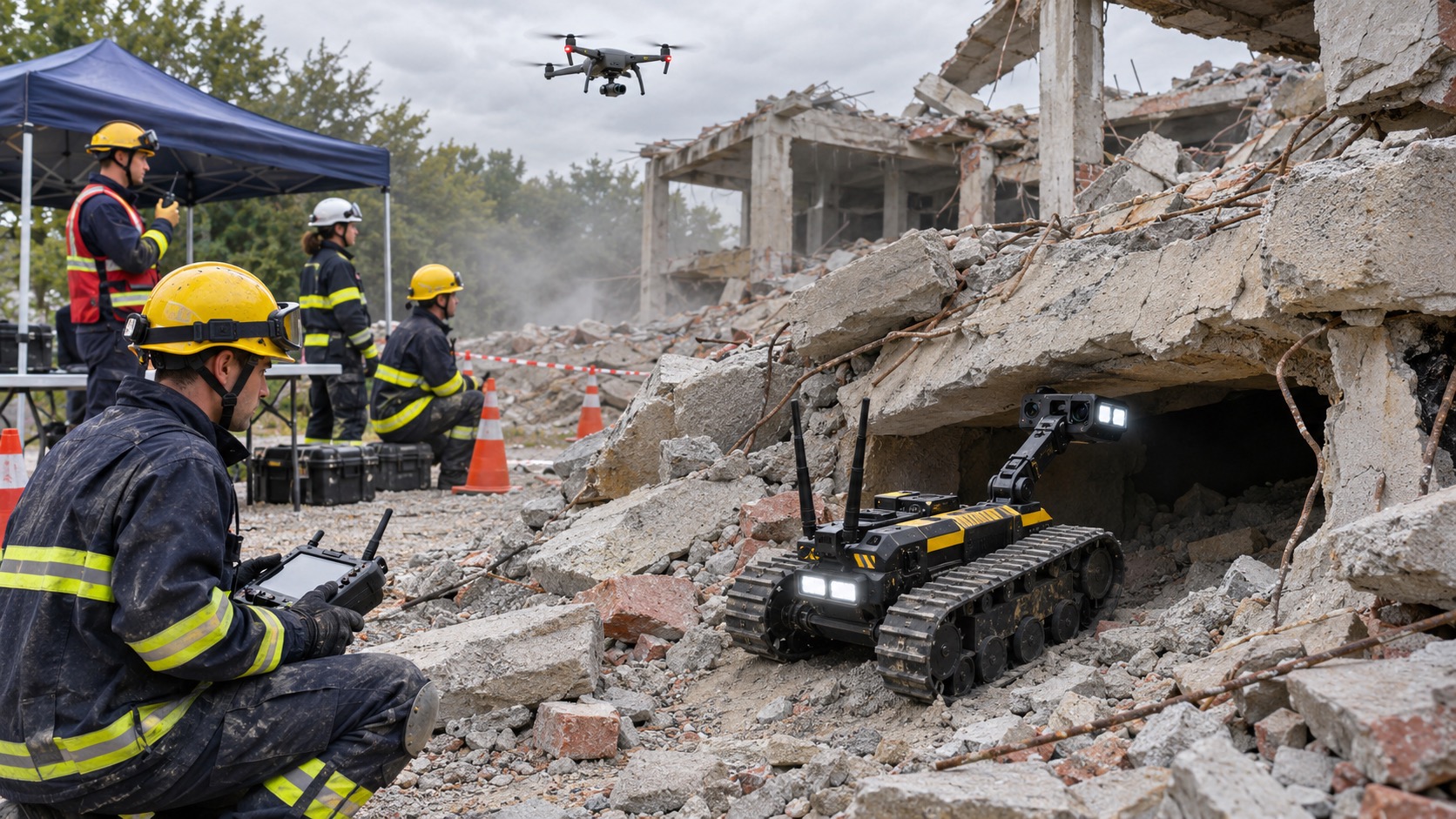
Multirotor aircraft take off vertically, hover, and maneuver around structures. Responders use them for visual and thermal search, roof inspection, flood reconnaissance, fire observation, and close mapping. Their ability to stop over a point supports detailed viewing. The tradeoffs are short flight time, modest payload, propeller risk, sensitivity to wind, and the need to coordinate airspace. Smoke, wires, branches, precipitation, and featureless surfaces can challenge navigation. A multirotor is strongest when a team needs immediate perspective within a defined area and can land regularly for battery changes.
Fixed-Wing Aircraft Cover Broad Areas
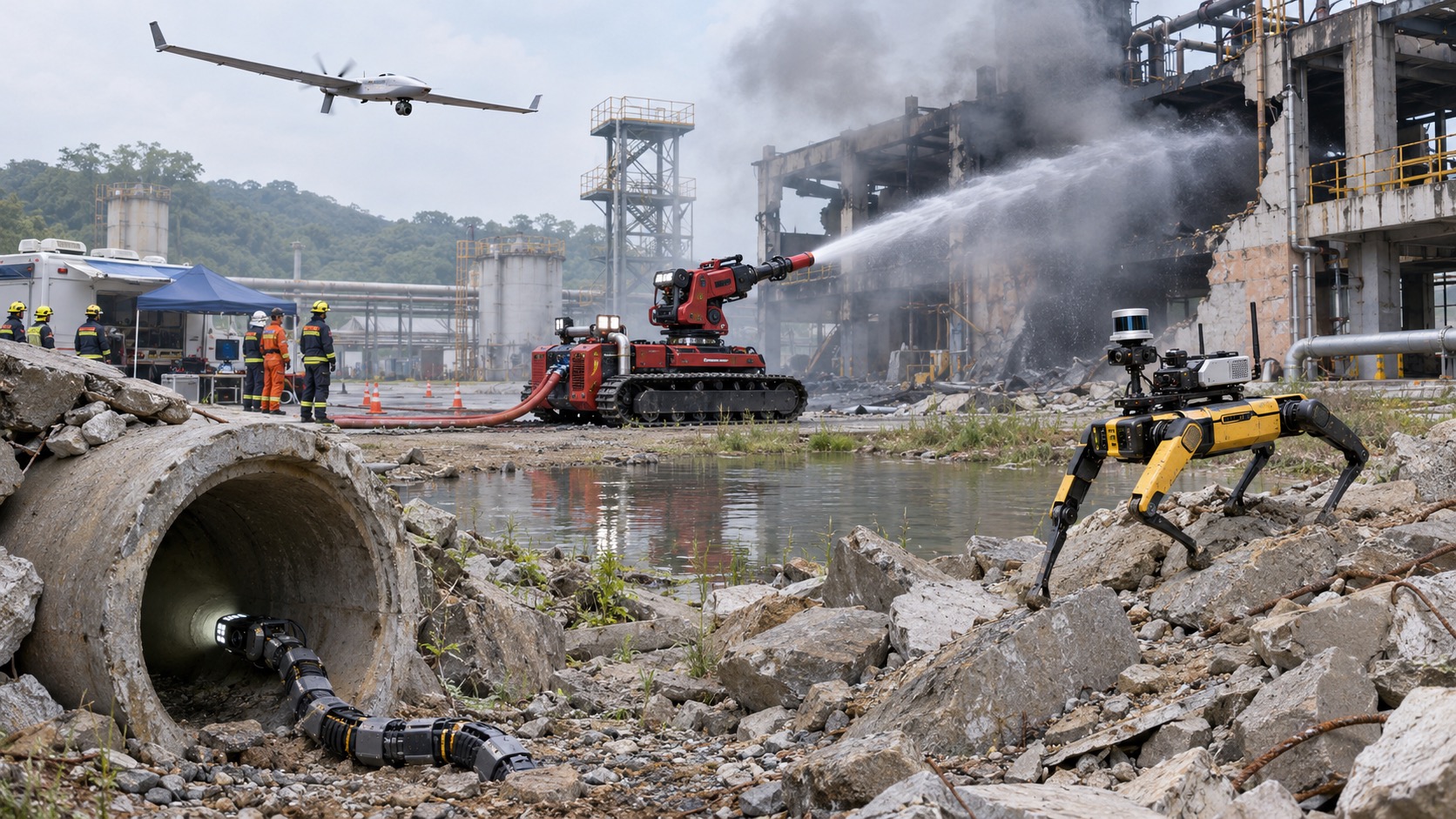
Fixed-wing drones use aerodynamic lift to fly farther and longer than many hovering aircraft. They map wildfire perimeters, coastlines, landslides, rural flooding, and transportation corridors. Efficient forward flight suits broad coverage.
They need room or specialized mechanisms for launch and recovery, and they cannot hover over one location. Turning radius, terrain, weather, and airspace affect the route. Hybrid vertical-lift designs improve access but add weight and mechanical complexity.
Tethered Drones Trade Range for Persistence
A tethered aircraft receives power through a cable and may remain aloft for hours as an observation or communications platform. It can monitor a fireground, illuminate an area, or relay radio and data over obstructions. The physical cable limits movement and can snag structures, trees, vehicles, or other aircraft. Ground equipment needs a protected placement, and the operator must manage tension and emergency descent. This type is useful when continuous coverage from one position matters more than free-ranging flight.
Small Tracked Crawlers Enter Rubble and Confined Spaces
Compact tracked robots carry cameras, lights, thermal imagers, microphones, and gas sensors through damaged interiors. Tracks spread load and climb small obstacles better than ordinary wheels. Articulated flippers help the chassis approach stairs or lift the camera.
Loose wire, fabric, dust, and sharp reinforcing steel can jam or damage the running gear. The robot may become high-centered on a slab edge. Size must balance access against stability, battery, radio capacity, and useful payload.
Heavy Tracked Platforms Carry Tools and Water
Larger tracked machines support firefighting, hazardous-material work, demolition, and debris handling. They carry monitors, hoses, arms, cameras, or cutting tools closer to heat, explosion risk, and unstable structures. Weight improves traction and tool stability but complicates transport and recovery. Floors, bridges, and buried surfaces may not support the machine. A heavy platform also needs wide turning space and a deliberate route that does not block crews. Its value lies in sustained physical work where a small reconnaissance robot can only observe.
Wheeled Robots Favor Roads, Floors, and Long Travel
Wheeled response vehicles move efficiently over pavement, corridors, warehouses, and prepared routes. They can patrol a perimeter, carry sensors, deliver supplies, or map large indoor spaces. Simpler running gear may offer greater speed and battery life than tracks.
Broken stairs, deep debris, mud, and large gaps quickly limit them. Larger wheels and suspension improve access but raise the body and payload. Teams choose wheeled designs when the route is mostly intact and distance matters more than climbing.
Quadruped Robots Step Through Irregular Facilities
Four-legged robots can climb stairs, cross grating, step over hoses, and adjust posture on uneven ground. They carry cameras, lidar, thermal sensors, gas instruments, or small manipulators through industrial sites and damaged buildings. Their height gives sensors a useful viewpoint. Legs require energy and complex control, and loose rubble may shift under a chosen foothold. The machine can fall, kick debris, or struggle with narrow openings. Quadrupeds are best treated as mobile sensor platforms for routes that are structured enough to support deliberate steps but hostile to wheels.
Snake Robots Reach Through Narrow Voids
Snake-like machines use linked segments, flexible bodies, or articulated joints to move through pipes, holes, and spaces beneath rubble. A small front camera and light can reach beyond a straight inspection pole. Some designs brace against surfaces or climb vertically.
The long body can snag, and friction increases around multiple turns. Power and communication may travel through a tether, which also aids retrieval but limits reach. These robots observe confined paths; they carry little payload and cannot clear major obstacles.
Pipe Crawlers Inspect Hidden Utility Networks
Pipe robots use wheels, tracks, or expanding mechanisms to travel inside sewers, drains, ducts, and industrial lines. Cameras, sonar, and chemical sensors reveal breaks, obstructions, leaks, or contamination routes. In a disaster, underground networks can spread flooding or hazardous material far from the visible source. The crawler must match pipe diameter, bends, flow, and access points. Retrieval is essential because a disabled machine can worsen a blockage. Unlike a rubble snake, a pipe crawler works within a known enclosed geometry but may travel much farther from the operator.
Teleoperated Excavators Move Dangerous Debris
Remote-control kits and purpose-built machines let operators run excavators, loaders, dozers, and skid steers from a safer location. They remove unstable debris, build fire breaks, handle contaminated soil, or approach landslide and explosive hazards.
Heavy equipment can alter a scene rapidly, so spotters, engineers, and rescue specialists coordinate every movement. Cameras narrow depth perception and may hide people or utilities. The machine needs reliable emergency shutdown and a recovery plan if controls fail inside the zone.
Firefighting Robots Specialize in Suppression
Firefighting platforms combine rugged tracks or wheels with a monitor, thermal camera, hose connection, and protective cooling. Some tow hose; others carry onboard agent for a limited attack. They work in tunnels, industrial plants, warehouses, ships, or wildland interfaces where heat and collapse risk restrict crews. Water reaction pushes against the chassis, and hose drag changes with every turn. Operators manage nozzle direction, supply, traction, and escape routes. These machines extend suppression reach, but only coordinated crews can maintain water, ventilation, rescue, and exposure protection.
Uncrewed Surface Vessels Work Across Floodwater
Robotic boats map water depth, inspect levees and bridges, sample contamination, carry cameras, or transport light supplies. Propellers, water jets, or air thrust move them through different depths. Sonar reveals submerged obstacles that aerial cameras cannot see.
Current, floating debris, vegetation, docks, and damaged lines can trap a vessel. Operators maintain downstream recovery options and distinguish a robot-safe route from a route suitable for a rescue boat. Stable hulls favor sensors, while compact craft fit narrow streets.
Underwater ROVs Inspect Submerged Hazards
Remotely operated vehicles, or ROVs, use a tether for control, power, and video. Divers and emergency teams deploy them around bridges, dams, ports, vehicles, and flooded structures. Sonar supports navigation where water is dark or muddy, and manipulators can attach a line or retrieve a small object. The tether provides reliable communication but can snag. Current and turbulence challenge station keeping. ROVs reduce exploratory dive time, yet divers may still be needed for complex rescue or repair once conditions are understood.
Autonomous Underwater Vehicles Survey Larger Zones
Autonomous underwater vehicles follow programmed routes without a continuous tether. They map seafloors, reservoirs, pipelines, or broad search areas using sonar and navigation sensors. Endurance and freedom from a cable support efficient coverage.
Limited communication means the vehicle may not report discoveries until it surfaces or reaches a relay. Response teams use this type when systematic survey is more important than immediate manipulation. Recovery planning and conservative energy reserve are central.
Amphibious Robots Cross the Waterline
Amphibious machines drive, paddle, or use screw-like propulsion across mud, shallow water, snow, and flooded ground. They can carry supplies or sensors without transferring payload between a boat and land vehicle. The transition is their advantage and their engineering challenge. Seals, buoyancy, traction, propeller protection, and stability must work across changing conditions. A machine capable in calm shallow water may be unsafe in current. Teams define depth, slope, flow, and obstacle limits before using it as a delivery platform.
Manipulator Robots Perform Deliberate Contact Tasks
Robotic arms mounted on ground vehicles open doors, turn valves, place instruments, cut wires, collect samples, and move light debris. Several camera angles and force feedback help operators judge contact. Manipulation is slower than human hand work, especially with poor visibility and an unstable base.
The type is valuable when a single action can reduce a major hazard. Tool choice, reach, payload, and backlash determine what is realistic. Operators rehearse the motion on a mockup when time permits.
Supply Carriers Prioritize Payload and Handoff
Some response robots are designed mainly to carry. Ground vehicles deliver food, medicine, radios, batteries, hose, or protective equipment. Aircraft drop or lower lightweight packages, while boats transport goods across water. Navigation receives attention, but the final handoff defines success. The recipient must locate, open, and use the payload safely. The carrier needs secure retention, weather protection, understandable release, and enough reserve to return or remain without obstructing rescue. Simple transport can have high value when terrain separates people from urgent supplies.
Relay Robots Extend Communication Coverage
A relay robot positions radios or network nodes where concrete, terrain, distance, or damaged infrastructure blocks signals. An aircraft may hover above an obstruction, a ground unit may park at a corridor junction, or a sequence of machines may drop nodes along a route.
These platforms often perform little visible work, yet communication supports every other mission. Power duration, antenna orientation, compatibility, security, and physical protection determine whether the link remains useful.
Stationary Sensor Nodes Watch a Boundary
Deployable sensors monitor water level, slope movement, gas, radiation, temperature, vibration, or weather after a mobile robot places them. A network can warn when conditions change between staffed inspections. Nodes trade mobility for endurance and stable measurement. Their location must be documented, and the measurement must represent the intended hazard. Batteries, calibration drift, contamination, and lost backhaul can produce gaps. Teams establish thresholds and responsibility for acting on alarms; a warning without an owner is not a response system.
Choosing a Robot Type Begins With Access
Teams first define the question or action, then trace the physical route. Flight suits broad overview and blocked ground. Tracks suit debris, wheels suit distance on intact surfaces, legs suit stairs, and snake bodies suit narrow openings. Water separates surface vessels, underwater vehicles, and amphibious carriers. Heavy platforms perform forceful work; small machines fit restrictive access.
Payload, duration, communication, transport, launch time, decontamination, airspace, safety, and recovery narrow the choice. A simple camera rover ready in five minutes may be more useful than a powerful machine arriving tomorrow.
Mixed Teams Cover What One Machine Cannot
Disasters rarely match one robot type. A fixed-wing aircraft maps the region, a multirotor inspects a building, a tracked crawler enters it, and a relay holds communication. A boat may carry a ground robot to an isolated site. Combining types expands reach but creates more operators, frequencies, batteries, maps, and data formats. Command must establish who assigns each platform and how findings share one location reference. The best fleet is not a collection of impressive machines. It is a set of complementary tools that can deploy together without competing for airspace, routes, attention, or recovery resources.