Machines That Extend a Response Team Into Dangerous Places
Disaster response robots are machines used to gather information or perform physical work where an emergency has made access dangerous, slow, or impossible. They may fly over a flood, crawl into a collapsed building, inspect a chemical release, carry a camera through smoke, deliver a radio, or direct water at an industrial fire. Their purpose is not to replace firefighters, rescuers, medical teams, or incident commanders. A robot extends those people’s reach while keeping judgment with the response organization. Emergencies are especially difficult environments for automation because the map is incomplete and conditions continue to change. Dust obscures cameras, debris blocks wheels, radio signals disappear behind concrete, and survivors may be hidden in spaces no machine can enter. Useful response robots are therefore rugged tools with clear limits, dependable communication, and operators trained to connect machine observations with rescue decisions.
A: No. Many valuable systems are remotely controlled with limited automatic assistance.
A: The robot team works from assignments and priorities established through incident command.
A: Usually not; it detects surface heat patterns and has important material limits.
A: Tracks spread weight and cross small debris better than many ordinary wheels.
A: Preplanned behavior may stop, return, hold, surface, or continue briefly.
A: They require strict airspace coordination and must yield to crewed operations.
A: No. It supplies partial evidence for qualified structural and command decisions.
A: Retrieving equipment is never worth exposing a person to disproportionate danger.
A: Teams plan covering, decontamination, controlled retention, or disposal before deployment.
A: Rapid availability, reliable access, clear data, known limits, and operational integration.
What Makes a Robot a Disaster-Response Tool?
The category is defined by purpose rather than shape. A familiar commercial drone becomes a response tool when a trained team uses it to map flood extent or inspect a damaged roof. A tracked vehicle may carry cameras into rubble, while a remotely operated excavator removes unstable material. The machine must sense or act in the incident environment and provide information or capability that improves the response. Reliability, rapid deployment, transport, decontamination, and compatibility with incident procedures matter as much as advanced autonomy. A laboratory prototype may be impressive but unsuitable if it takes hours to assemble or cannot tolerate rain.
Why Emergencies Need Remote Reach
Disasters create hazards that responders cannot fully observe from a safe boundary. Structures may continue shifting. Fire can weaken floors and release toxic smoke. Floodwater hides holes, current, and contamination. Industrial sites may contain pressure, electricity, radiation, or dangerous chemicals.
A robot can cross the boundary first and return evidence. That evidence helps commanders choose protective equipment, entry routes, priorities, and exclusion zones. Remote reach does not make the hazard disappear. It reduces uncertainty before people commit and allows repeated observation without accumulating the same exposure.
Robots Work Inside an Incident Command System
Emergency operations depend on roles, communication, and shared priorities. A robot team needs an assignment, operating area, radio contact, launch or staging location, and a way to deliver findings to the people making decisions. The operator cannot focus only on piloting. Someone must interpret video, mark locations, preserve timestamps, and explain uncertainty. Air operations must coordinate with crewed aircraft. Ground machines must not block hose lines, evacuation routes, or rescue teams. When the robot becomes a separate demonstration rather than part of the incident plan, even accurate data may arrive too late to matter.
Remote Control and Autonomy Serve Different Moments
Many response robots are remotely operated because a person understands the mission and can interpret unusual scenes. The operator drives, steers a camera, moves an arm, or selects flight paths. Autonomy can hold altitude, avoid obstacles, stabilize a view, return after signal loss, or map an area systematically.
Higher autonomy is useful when communication is delayed or the environment is repetitive, but it must fail predictably. A machine should not improvise near survivors, responders, or unstable structures beyond tested limits. Teams choose the level of autonomy that reduces workload without hiding consequential decisions.
Sensors Turn Access Into Information
Visible cameras provide context, but emergencies often require other senses. Thermal imagers reveal heat patterns through darkness and light smoke. Lidar measures three-dimensional geometry for maps and change detection. Gas detectors sample oxygen, combustibles, and toxic compounds. Microphones can capture calls or tapping. Radiation instruments measure dose rate, while sonar maps underwater obstacles. Position, orientation, temperature, battery, and link quality describe the robot itself. Responders need calibrated readings and known limitations. A hot surface is not automatically a person, and a gas value taken beside the floor may not represent conditions near the ceiling.
Communication Is Often the Hardest Component
Concrete, steel, earth, water, distance, and electrical noise weaken radio links. A robot descending underground may lose connection after a few turns. High-resolution video consumes bandwidth just when range is poor.
Teams use relay nodes, tethered cables, mesh radios, directional antennas, or robots that drop communication repeaters. The machine may store data locally and retrace its route after a loss. Operators need a clear signal-loss behavior: stop, return, surface, hold position, or continue a short approved task.
Communication planning includes more than the vehicle link. Findings must reach command in a usable format. A map that remains on the operator’s laptop does not guide another rescue team.
Mobility Must Match the Hazard
Wheels are efficient on roads and floors but struggle on loose rubble. Tracks spread weight and climb small obstacles, though debris can jam them. Legs step across gaps and stairs but consume more energy and require complex control. Snake-like robots enter pipes and narrow voids. Aircraft ignore many ground obstacles but face wind, smoke, wires, and limited flight time. Boats and underwater vehicles serve floods, ports, and submerged structures. There is no universal rescue chassis. The terrain, access opening, payload, duration, and recovery method determine which mobility is useful.
Payloads Give the Platform Its Mission
A mobile base becomes operationally valuable through what it carries. Cameras and lights support search. Thermal and chemical sensors characterize hazards. Two-way audio allows responders to speak with a trapped person. Small compartments deliver medicine, water, radios, or flotation aids. Manipulators open a valve, move light debris, place a sensor, or retrieve a sample.
Every payload changes balance, power use, clearance, and control. A heavy arm may make a small robot tip while climbing. An exposed sensor can break on concrete. Teams configure the smallest useful payload rather than loading every instrument onto one machine.
Earthquake and Collapse Missions Begin With Structure
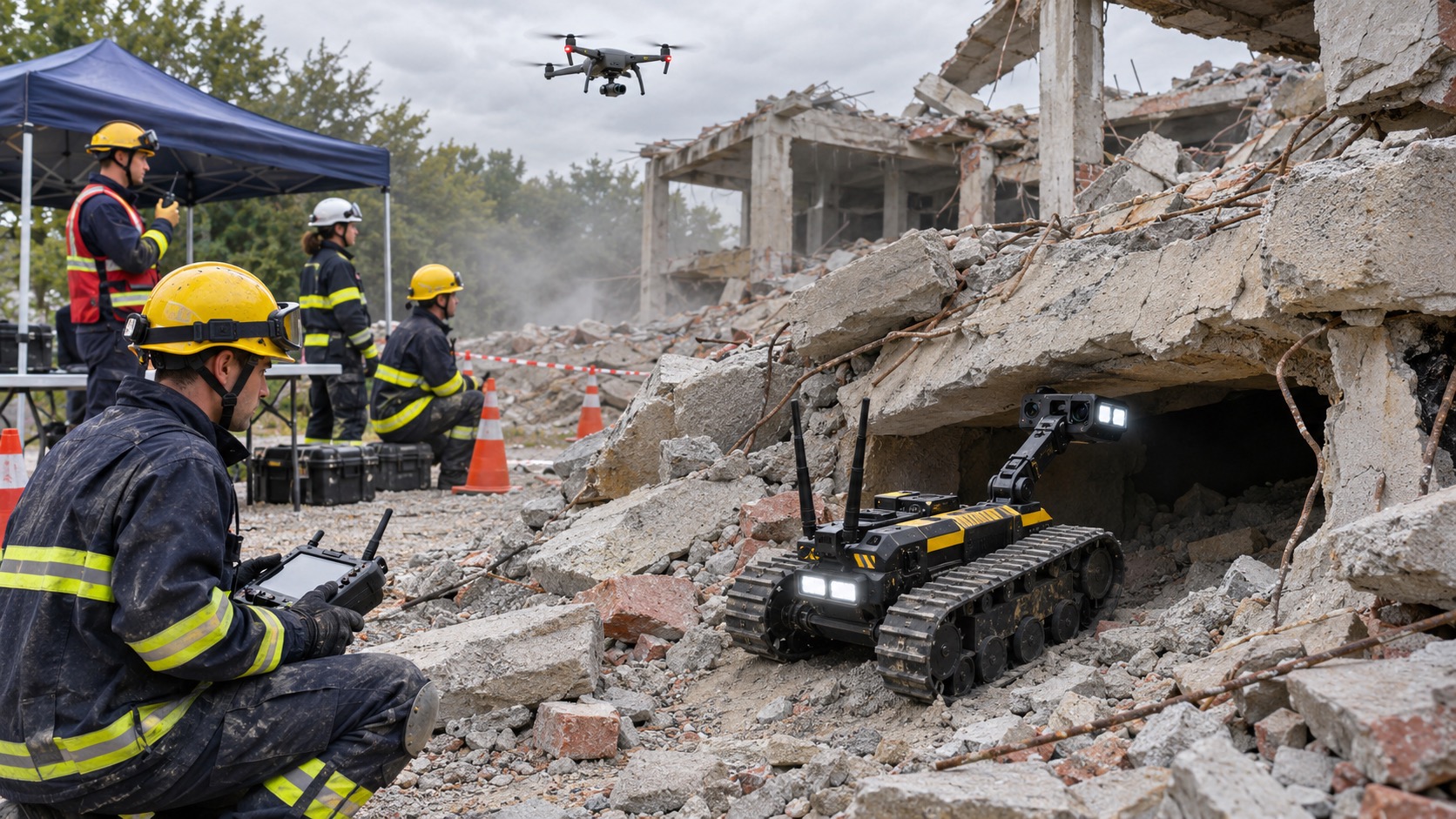
After a collapse, aerial robots survey roofs, walls, and access points while ground robots inspect voids beneath slabs. Engineers compare images and scans to determine whether cracks or leaning elements are changing. Small machines may carry microphones or thermal cameras into spaces too narrow for rescuers. Rubble is hostile to machinery. Dust covers lenses, reinforcing steel catches cables, sharp edges cut tracks, and shifting fragments trap the vehicle. Operators avoid disturbing material that could affect a survivor or the stability of the void. Robot findings guide careful rescue planning rather than trigger automatic excavation.
Firefighting Robots Add Distance From Heat
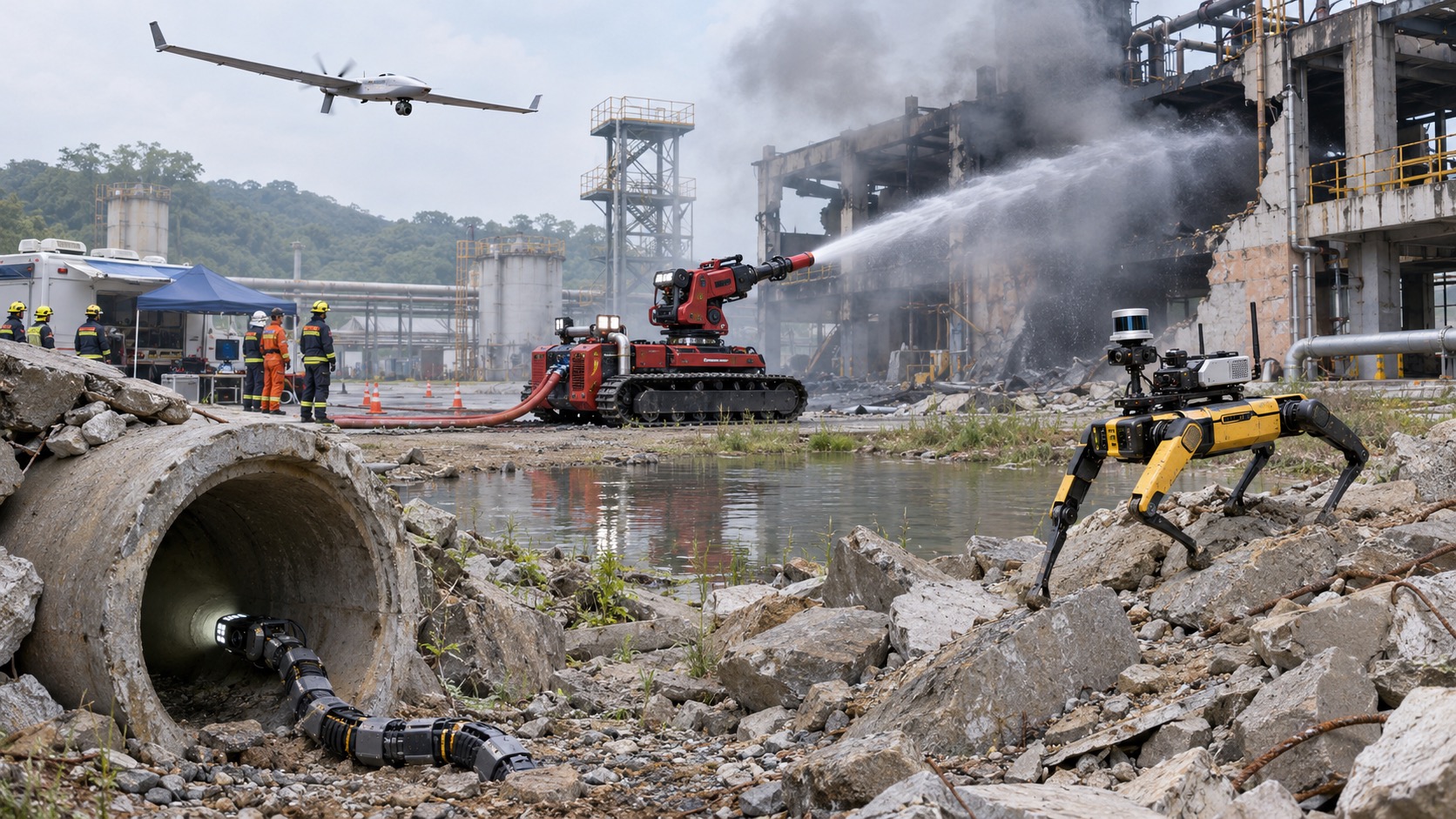
Tracked firefighting machines can carry hoses, nozzles, cameras, and thermal sensors toward industrial fires, tunnels, warehouses, or hazardous storage. Remote control lets firefighters direct water or foam while standing farther from heat, smoke, explosion risk, and collapse. Aerial systems provide an overhead view of roof conditions and fire spread.
These robots need water-resistant electronics, protected hoses, traction on wet debris, and reliable emergency stops. They cannot read every interior condition, and water streams create reaction forces that affect stability. Human crews remain responsible for strategy, water supply, ventilation, and rescue.
Flood Response Requires Surface and Aerial Awareness
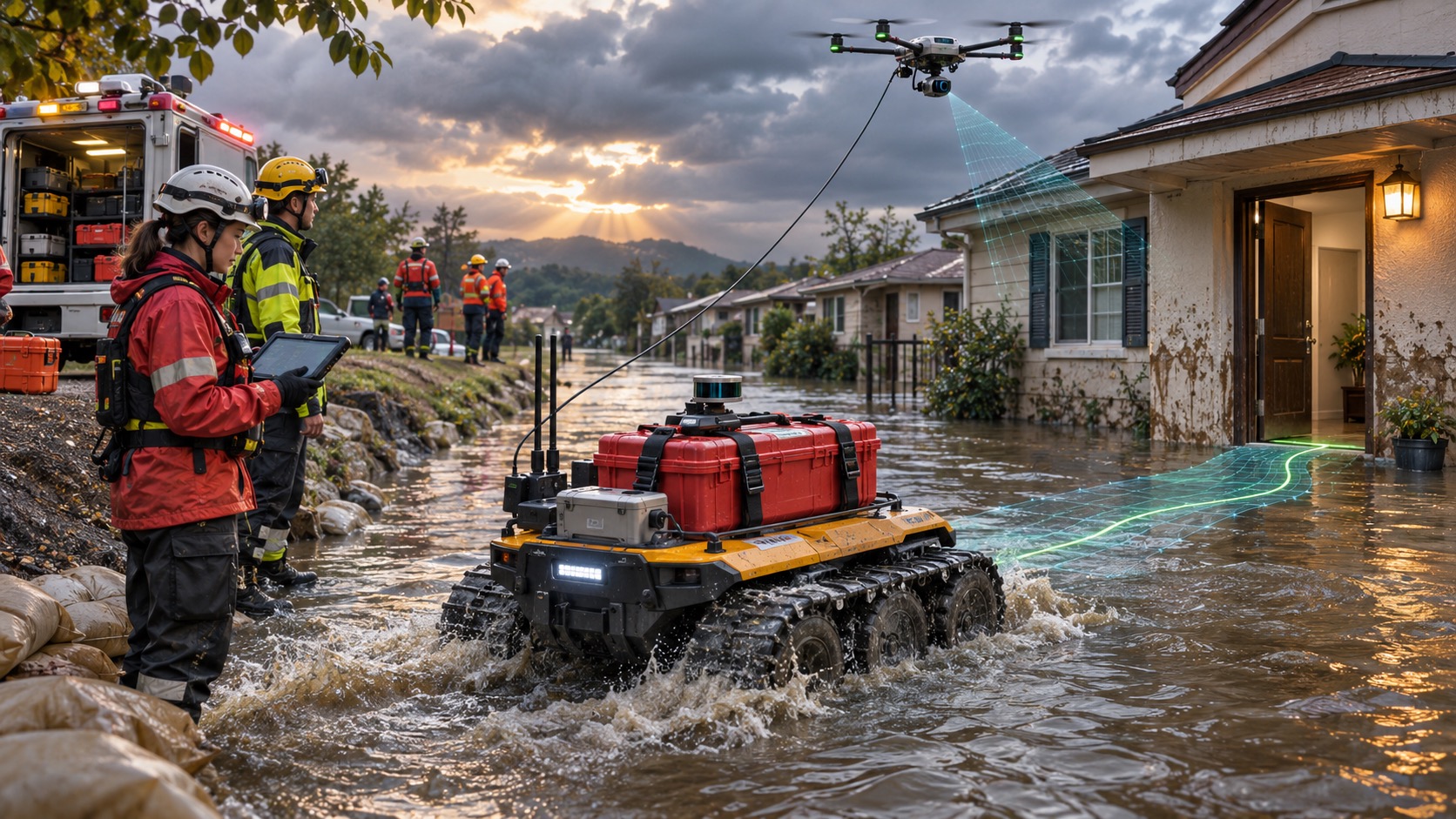
Drones map inundation, identify stranded people, inspect levees, and check routes without sending vehicles into unknown water. Uncrewed boats measure depth, current, contamination, or submerged obstacles. Amphibious ground robots can carry supplies through shallow zones. Floodwater changes quickly. A safe path can become a current, and GPS accuracy does not reveal a missing road beneath the surface. Operators consider wind, rain, power lines, floating debris, battery reserve, and downstream recovery. A robot delivering supplies must also reach a handoff point that people can access safely.
Hazardous-Materials Incidents Need Measured Sampling
Chemical, biological, and radiological scenes benefit from instruments that can approach the source without exposing a person. Robots carry gas monitors, radiation detectors, cameras, sampling tools, or manipulators for valves. Readings are linked to time and location so specialists can map the hazard.
Decontamination must be planned before launch. Porous surfaces, cooling fans, joints, and batteries may trap contaminants. A machine that cannot be cleaned may need to remain inside the controlled zone or be discarded. Sample custody and instrument calibration determine whether evidence can support health and regulatory decisions.
Medical Support Is Usually Focused and Immediate
A robot may deliver a trauma kit, radio, oxygen sensor, water, or flotation device before a responder can reach the location. Two-way audio can connect a survivor with medical guidance. Larger systems may transport a patient over a known route, but movement through rubble or floodwater carries risk. The machine does not replace assessment. Responders must know whether the recipient can use the supplies and whether delivery could worsen the situation. Simple payload release, clear instructions, and reliable location often matter more than sophisticated manipulation.
Safety Includes the Robot, Responders, and Survivors
Response teams assess spinning propellers, heavy moving tracks, hot batteries, radio interference, entanglement, falling equipment, and unintended motion. They create launch areas, establish approach rules, and announce robot movement over the appropriate channel. Aerial vehicles remain clear of crewed aircraft and hoisting operations.
Recovery is part of safety. A disabled machine should not tempt a responder into an unstable space merely because the equipment is valuable. Tethers, sacrificial design, retrieval points, and loss criteria let teams abandon a robot when human risk would exceed its worth.
Deployment Speed Comes From Preparation
Useful teams maintain charged batteries, tested sensors, current software, transport cases, spare parts, checklists, maps, permissions, and trained operators. Readiness also requires current airspace contacts, radio plans, decontamination supplies, and a vehicle that can reach the incident without repacking the entire system.
Each kit should have a named custodian who verifies availability between emergencies and records changes that could surprise the next operator.
Teams practice under rain, dust, darkness, noise, protective clothing, and competing radio traffic. Exercises reveal whether a controller can be used with gloves and whether video reaches command. Mutual-aid agreements clarify who can request the equipment and how evidence is shared. Preparation turns a capable machine into an available capability. Without it, an incident may be ending before the robot is ready.
Limitations Must Travel With Every Observation
Robot data is partial. A thermal camera may miss a person behind insulation. A drone map may hide conditions beneath trees. A gas sensor has response time and detection limits. A tracked vehicle sees only the surfaces within its camera angle. Operators report confidence, blind areas, timing, sensor position, and reasons for missing coverage. Commanders combine that evidence with witness accounts, structural assessment, fixed instruments, and human reconnaissance. Honest limitations protect teams from treating a vivid image as complete situational awareness.
After-Action Review Improves the Next Mission
Following deployment, teams inspect damage, save logs, recharge equipment, document contamination, and review decisions. They ask whether the robot arrived early enough, whether the assignment was clear, which data changed an action, where communication failed, and how recovery proceeded.
Lessons may lead to a new antenna location, smaller payload, clearer map format, or different staffing. Equipment damage and near misses should be shared with partner agencies, because rare incidents give every team limited opportunities to learn. Disaster robotics advances through ordinary operational learning. A machine earns its place when responders trust not only its successful moments but also its known behavior when conditions exceed the plan.