Life-Saving Value Comes From Better Decisions Made Earlier
A disaster robot does not save a life merely by entering a dangerous place. It saves time, preserves options, and gives responders evidence they could not obtain safely enough by other means. A drone may reveal that one road remains open before ambulances are dispatched. A tracked camera may find a survivable void beneath a collapsed floor. A gas-sensing machine may show where crews can approach in protective equipment, while a supply robot carries medicine or a radio across floodwater. These actions shorten the interval between uncertainty and an informed response. They also protect the people who must continue working through a long incident. The greatest benefit appears when robotic information is tied directly to triage, route selection, structural assessment, medical contact, fire attack, or evacuation. Saving lives is therefore an operational chain: access, observe, interpret, communicate, decide, and act.
A: Usually it supports locating, contacting, supplying, or planning for human rescue.
A: Timing depends on area, weather, permissions, processing, and product detail.
A: Comparison can reveal movement that a single image cannot show.
A: Yes, when payload protection, route, recipient access, and medical direction align.
A: They can move sensing or suppression closer while crews remain farther away.
A: No. Specialists consider location, timing, calibration, weather, and other hazards.
A: Reliable communication can accelerate rescue requests, warnings, and coordinated withdrawal.
A: Teams follow retrieval or abandonment rules that keep people from chasing equipment.
A: A documented change in decision, time, exposure, access, or survivor support.
A: It supplements other evidence and may reduce exposure, but remains partial.
Minutes Matter Most When Information Is Missing
The opening phase of an emergency is filled with incomplete reports. Roads may be blocked, addresses duplicated, utilities damaged, and witnesses separated from the people who need help. Responders must allocate limited crews before the full picture exists. Rapid aerial imagery and remote ground reconnaissance can replace broad guesses with specific locations. A map showing an intact bridge, an isolated neighborhood, or a new fire front changes dispatch immediately. The robot’s contribution is not speed in isolation. It is the time removed from finding, verifying, and sharing facts that guide the next human action.
Aerial Mapping Establishes the Scale of the Incident
Drones can survey a wide area soon after storms, earthquakes, landslides, or wildfires. Overlapping images produce maps that reveal flooded blocks, damaged roofs, debris fields, washed-out roads, and possible landing areas. Thermal sensors may identify active fire edges or unusual heat at night.
Coverage must be turned into assignments. Analysts mark inaccessible areas, compare new imagery with earlier passes, and distribute products in formats that field teams can use. A beautiful mosaic that takes hours to process or never reaches dispatch does not improve survival. Fast, sufficiently accurate mapping usually matters more than perfect presentation.
Remote Reconnaissance Protects the First Team In
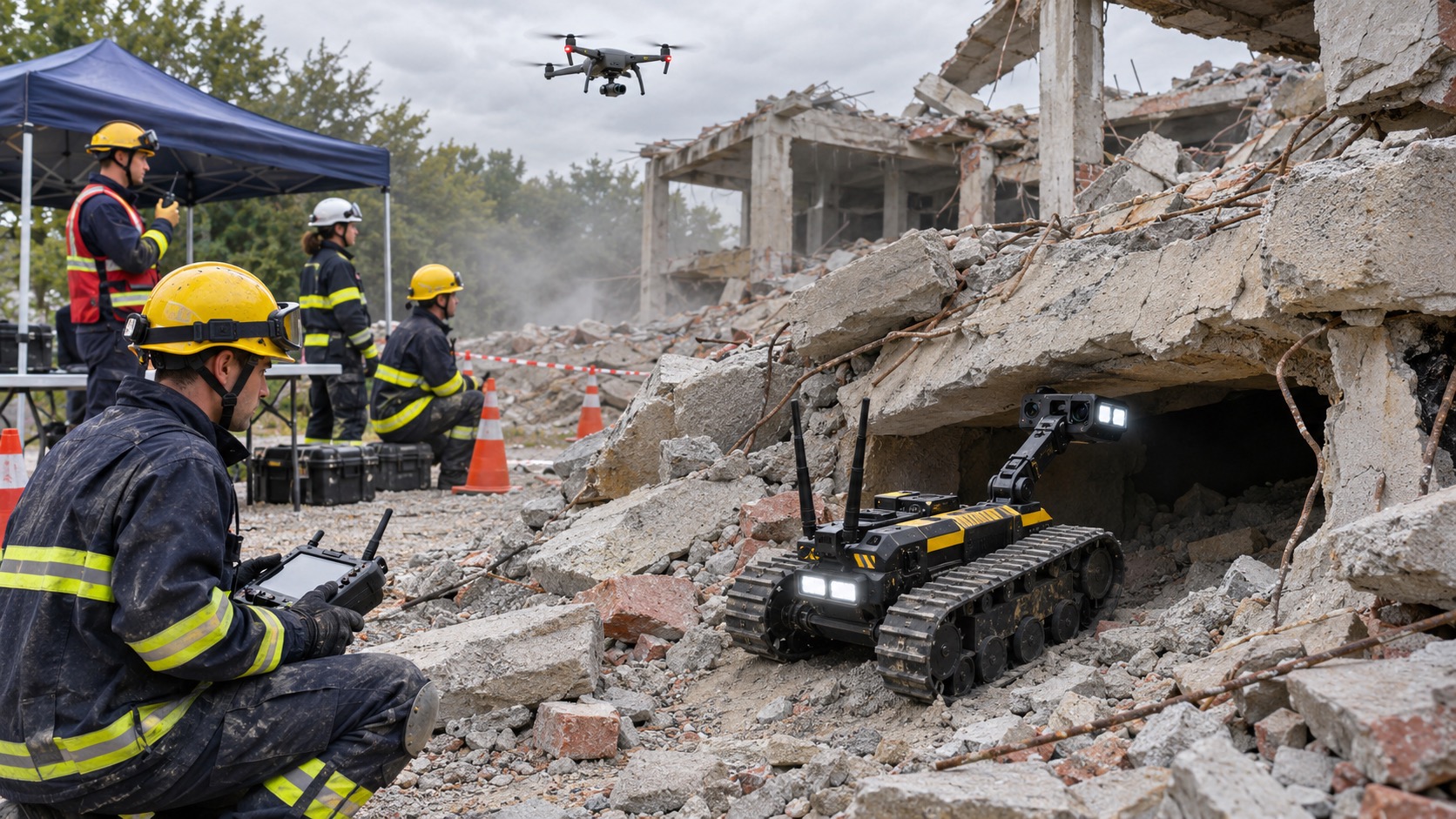
The first entry into a damaged structure carries uncertainty about collapse, fire, electricity, gas, water, and access. A small robot can check corridors, basements, tunnels, or industrial spaces before a crew crosses the threshold. Cameras show obstacles and door conditions. Thermal and gas sensors provide another layer of evidence. The operator can pause at a suspicious area and let specialists review it. This reconnaissance helps responders choose protective equipment and a route, or decide that stabilization and ventilation must come first. Avoiding one preventable responder injury preserves the team for every later rescue.
Robots Search Voids That People Cannot Enter
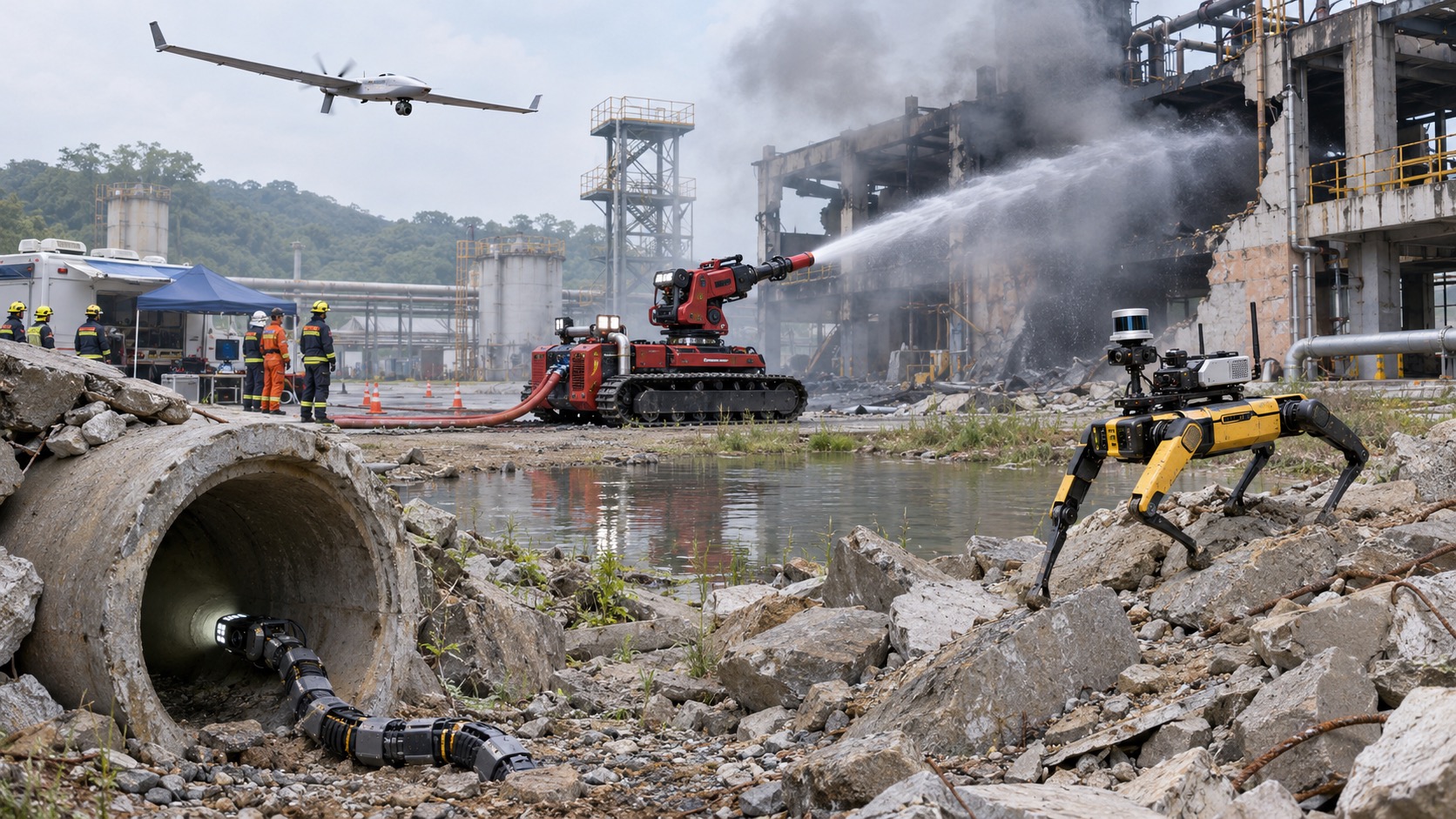
Collapsed buildings contain narrow spaces beneath slabs, around pipes, and between crushed furnishings. Tracked, wheeled, snake-like, or tethered robots can carry light, video, microphones, and two-way audio into selected voids. They look for movement, sound, personal belongings, and paths that connect to larger spaces.
The search is deliberate. Moving debris can harm a survivor or alter structural support, so the machine should not force its way through. Operators describe where the camera traveled and what remained unseen. A promising observation is marked for rescue specialists who plan shoring, access, and medical support.
Repeated Scans Reveal Dangerous Change
A single image freezes one moment. Repeated robot surveys can reveal movement in a leaning wall, growth in a debris crack, rising water, spreading fire, or a shifting chemical plume. Lidar and photogrammetry allow engineers to compare geometry. Fixed or mobile sensors record trends without keeping a person inside the hazard zone. Change detection is especially valuable during aftershocks, long fire operations, and severe weather. It supports decisions to withdraw, reinforce, reopen, or redirect teams. The life-saving act may be an evacuation triggered before visible failure reaches the occupied work area.
Thermal Imaging Extends Search Through Darkness
Thermal cameras detect infrared energy rather than visible light. On aircraft and ground machines, they help search large dark areas, examine roofs, trace fire spread, and identify warmer or cooler features. They can guide responders toward locations worth investigating.
Heat is not identity. Sun-warmed surfaces, machinery, animals, insulation, water, and ventilation can confuse interpretation. Thick materials block the view. Operators report a thermal anomaly rather than declaring a survivor unless other evidence supports it. Careful language prevents scarce crews from being diverted by an appealing but uncertain image.
Two-Way Communication Can Stabilize a Rescue
A robot carrying a speaker and microphone can establish contact before physical access is possible. A trapped person may describe injuries, nearby hazards, other occupants, or the shape of the space. Responders can explain that help is coming, ask the person to conserve phone power, and provide instructions that reduce panic or prevent dangerous movement. Audio quality, language, hearing, noise, and the survivor’s condition affect the exchange. Even a short conversation can confirm location and guide the tools, medical equipment, and specialists needed for extraction.
Medical Supplies Can Arrive Before a Rescuer
Ground vehicles, aircraft, or boats may deliver bleeding-control materials, medications, flotation devices, water, radios, or protective equipment. This is valuable across floodwater, ice, unstable ground, or an isolated road. The payload must be simple to release and usable by the recipient. Packaging protects it from weather and contamination.
Medical direction remains essential. A survivor may be unable to reach the package or use it correctly. Teams verify the person, location, instructions, and retrieval plan. Delivery buys time; it does not end the rescue.
Hazard Mapping Opens Safer Approach Corridors
Gas, radiation, heat, and contamination readings collected along a route can show where exposure rises or falls. Specialists combine these measurements with wind, terrain, source information, and fixed instruments to establish zones. A robot may sample near the source, place a remote detector, or inspect a valve. Measurements need context. Sensor height, response time, calibration, weather, and the robot’s path affect interpretation. A low reading is not a universal declaration of safety. It is evidence used to select approach direction, protective equipment, work duration, and monitoring needs.
Firefighting Machines Sustain Work in Extreme Heat
Heavy tracked robots carry monitors, hoses, cameras, and tools toward fires where explosion or collapse risk limits human approach. They can cool tanks, protect exposures, or direct water deep into a large industrial space. Because the operator stands farther away, the team can maintain suppression while conditions remain intolerable.
The machine also preserves a stable stream without exhausting a firefighter at the nozzle. Hose drag, water pressure, traction, visibility, and thermal limits still require supervision. Robots support strategy; they do not replace water supply, ventilation, rescue, or structural judgment.
Flood Robots Reach Beyond the Safe Shoreline
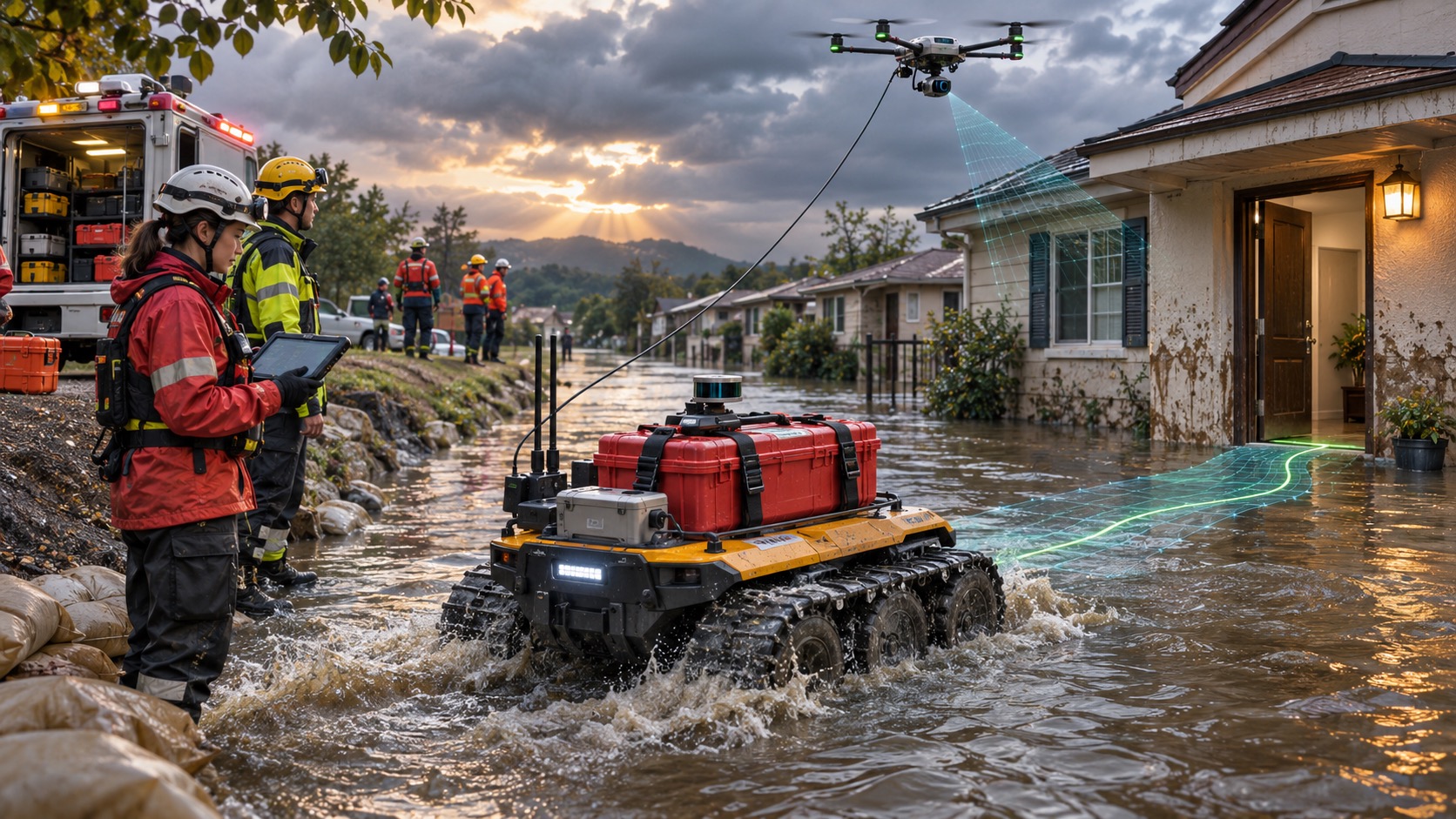
Uncrewed boats and amphibious vehicles inspect submerged roads, carry lines, survey current, and approach stranded buildings. Drones look ahead for debris, downed power lines, and usable landing or transfer points. These tools reduce the temptation to drive ordinary vehicles into unknown water.
Water changes faster than maps. Operators maintain downstream observers, energy reserve, weather awareness, and a recovery plan. The safest robotic route may still be unsuitable for a person, so findings must distinguish machine access from human evacuation access.
When conditions allow, a robot can establish a communication link or deliver flotation before a boat crew commits. That staged approach keeps options open while rescuers prepare.
Robotic Manipulation Handles Focused Hazardous Tasks
An arm may turn a valve, open a door, move a small obstruction, place a sensor, or collect a sample. Bomb squads have long used this model: a person interprets the scene and directs a machine through a specific physical action. Disaster sites add unstable footing and poorly known geometry. Force feedback and several camera angles help, but fine manipulation remains slow. Teams use robotics when distance from the hazard is more valuable than speed. They also define what the machine must not disturb, especially near survivors, evidence, live utilities, or structural supports.
Robots Preserve Responder Endurance
Long incidents exhaust people through heat, protective clothing, repetition, noise, and emotional stress. Machines can repeat perimeter scans, carry sensors, monitor a hot zone, or transport equipment without consuming the same physiological reserve. This matters because judgment deteriorates with fatigue. A robot does not need to replace a complete job to improve safety; removing a heavy shuttle or repeated exposure can keep a skilled responder effective for critical decisions.
Robots also require attention. Operators need relief, maintenance staff, batteries, and disciplined handoffs. Endurance improves only when the technology reduces total workload rather than shifting an invisible burden onto one small team.
Evidence Supports Triage and Resource Allocation
When many locations compete for help, command must determine where action can produce the greatest benefit. Robot imagery, survivor contact, hazard readings, and access maps add evidence to witness reports and field assessments. They can confirm that a location is empty, identify a viable rescue space, or show that one route is impossible. No algorithm should quietly turn incomplete observations into final human priorities. Qualified leaders weigh the evidence, including who was not visible and how old the data is. Transparent uncertainty makes robotic information safer to use.
Communication Relays Keep Teams Connected
Some robots carry repeaters into tunnels, buildings, canyons, or broad damaged areas. Aerial relays can rise above terrain, while ground units drop nodes along a route. Better communication lets teams report discoveries, request medical support, and coordinate withdrawal sooner.
The network must remain secure, compatible, and manageable under incident radio discipline. Relay placement also needs power and recovery planning. When communication enables a rescue, the crucial robot may be the quiet platform holding position rather than the machine closest to the survivor.
Safe Recovery Prevents a Second Emergency
A disabled robot can become an obstacle or a temptation. Teams establish retrieval points, tethers, abandonment criteria, and procedures before launch. They avoid sending a person into a collapse zone to rescue equipment. Aircraft have automatic responses for low energy or lost link, while ground machines may stop with brakes applied. Recovery plans protect responders and preserve access for stretchers, hoses, and evacuation. A sacrificial robot has fulfilled its purpose if losing it prevented human exposure and delivered the needed evidence.
Training Converts Capability Into Timely Action
Operators who practice only in clean daylight will struggle in rain, dust, darkness, gloves, masks, and crowded radio channels. Exercises pair robot teams with incident commanders, structural specialists, medical groups, and air operations. They rehearse requesting a mission, sharing coordinates, annotating imagery, handling signal loss, changing batteries, and explaining sensor limits.
Training also teaches when not to deploy. Launching a drone into active helicopter space or driving a robot across a rescue corridor can cost time. Mature teams choose the tool only when it improves the operational sequence.
The Measure of Success Is a Changed Outcome
Flight hours and distance traveled are easy to count, but they do not prove life-saving value. Teams should document whether the robot found a person, shortened a search, identified a safe route, prevented entry, delivered essential supplies, improved fire attack, preserved communications, or reduced exposure. They should also record delays and failures. This evidence guides purchasing and procedure. Disaster robots earn trust when their contribution can be traced from observation to decision to action, including the occasions when the best result was keeping a responder out of danger.