A Practical Taxonomy Based on What Moves and Where It Goes
Delivery and warehouse robots can look similar while performing very different jobs. Some move only themselves, carrying sensors through aisles. Others tow carts, slide beneath shelves, lift pallets, or combine a mobile base with an arm. Fixed robots may never travel at all; they pick products, build pallets, pack orders, or sort parcels while goods come to them. Beyond the loading dock, sidewalk machines, aerial vehicles, and autonomous road vehicles face public spaces that are far less predictable than a warehouse. The clearest way to compare these machines is to ask what they carry, how they navigate, where the handoff occurs, and how much variability they can manage. Those questions reveal the practical difference between a guided vehicle and an autonomous mobile robot, between a transport platform and a mobile manipulator, and between a warehouse machine and a delivery service.
A: Terminology varies, but AMRs usually plan routes more flexibly than guided vehicles.
A: It raises a compatible storage pod and transports the whole unit.
A: Tuggers efficiently move several wheeled containers along a repeated route.
A: Damage, protruding wrap, or shifted loads can make automatic pickup unsafe.
A: It observes available identifiers and conditions, then flags uncertainty for review.
A: One manipulator can serve dispersed tasks instead of remaining at one cell.
A: Most practical indoor drones focus on scanning because payload and safety are limited.
A: Planned robotic palletizing cells place cases according to stability and sequence constraints.
A: It may replan, stop safely, or request help from a remote operator.
A: Yes, when capacity, identity, traffic, and task handoffs are coordinated.
Automated Guided Vehicles Follow Established Routes
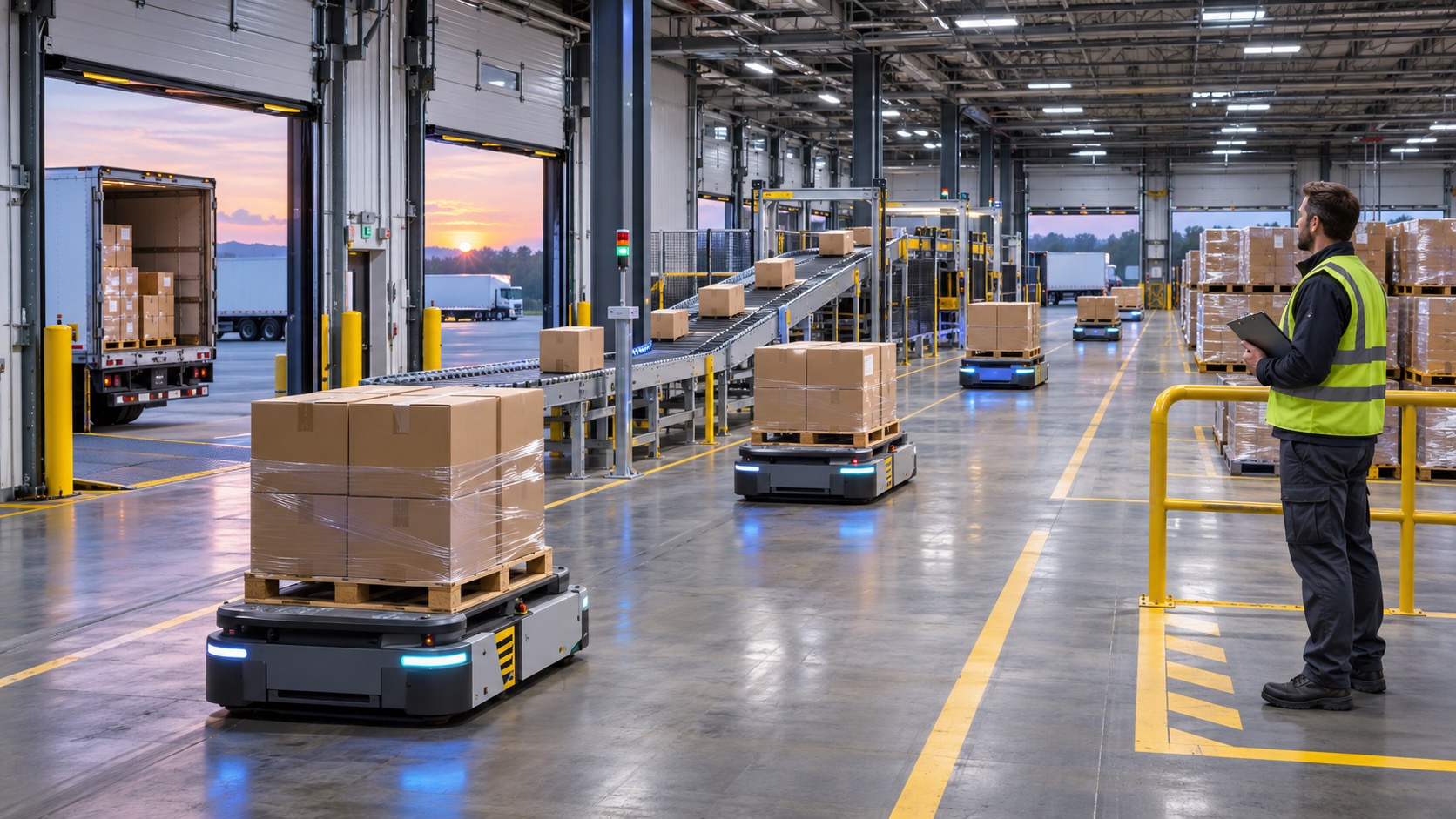
Automated guided vehicles, commonly called AGVs, move along paths defined by wires, magnetic tape, reflectors, markers, or tightly controlled maps. They excel when pickup points, drop-off points, and traffic patterns change little. Factories and warehouses use them to pull trains of carts, carry pallets, or transfer materials between fixed stations. The constrained route simplifies behavior and can make capacity predictable. It also makes detours difficult. A pallet left across the lane may stop the vehicle until a person clears it. AGVs remain useful because not every operation needs free navigation; stable repetition can be an advantage.
Autonomous Mobile Robots Plan Around Obstacles
Autonomous mobile robots, or AMRs, use lidar, cameras, wheel motion, and mapped landmarks to estimate position and select a route. They can slow, stop, or replan around temporary obstacles. Facilities use them for totes, carts, shelves, parcels, tools, and waste.
Autonomy does not mean unlimited access. Narrow aisles, blind corners, floor damage, doors, lifts, crowds, and wireless gaps still require design. A fleet manager coordinates intersections and priorities so individually sensible routes do not create system-wide congestion.
Shelf-Carrying Robots Bring Storage to a Station
Shelf carriers drive beneath compatible storage pods, lift them slightly, and deliver the entire unit to a picking station. Software rotates the pod so the correct face is presented and returns it to an available location. The system greatly reduces walking and allows dense storage because people do not enter every aisle. It works best when inventory fits standardized bins and replenishment keeps the pod accurate. Fire protection, floor quality, pod stability, and station queues become part of the design. These robots transport access to goods rather than selecting the goods themselves.
Tote and Cart Carriers Support Zoned Picking
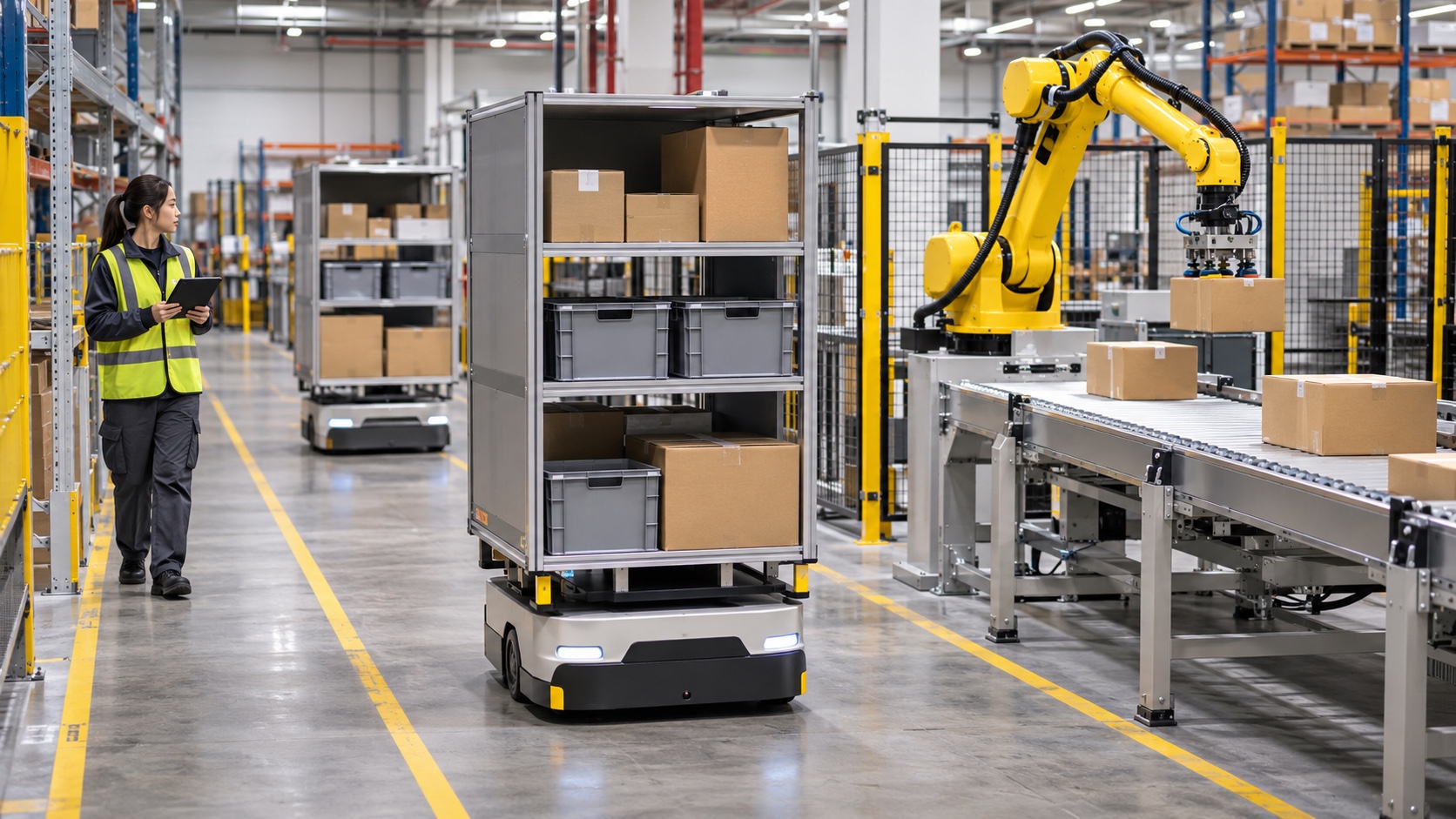
A tote-carrying robot may follow a worker through a zone, wait at a meeting point, or move completed containers between stations. Cart-moving platforms slide under wheeled racks or connect to a tow point. They preserve familiar shelves while removing pushing and long return trips.
Zoned systems divide a large order among several areas. Software must merge the partial picks before packing. The robot’s payload, deck height, attachment, and container retention must suit the load. An ordinary open tote needs different handling from a tall rolling cage.
Autonomous Pallet Movers Replace Selected Forklift Trips
Pallet robots lift from below, use forks, or carry pallets on a platform. They transfer loads between receiving, reserve storage, production, staging, and shipping. Some operate only at floor level; others interface with racks or conveyors. These machines reduce routine forklift travel, but pallet condition and placement matter. Broken boards, protruding wrap, offset loads, or an unexpected pallet type can prevent a safe pickup. Heavy payloads also increase stopping distance and consequence. Protected transfer points, load sensing, and disciplined staging are therefore as important as navigation.
Robotic Tuggers Move Trains of Containers
Tugger robots pull several carts along a scheduled route. They suit milk-run operations that replenish many stations and collect empties on the return. One tractor can move more material per trip than a small deck robot, while carts allow rapid loading without waiting for each item.
The train needs room to turn and stop. Long combinations can cut corners, block crossings, and become difficult to reverse. Cart couplings, wheel condition, weight distribution, and route discipline determine whether the apparent capacity is usable.
Fixed Picking Arms Select Individual Items
A robotic picking cell uses cameras to locate products and a gripper to transfer them into totes, cartons, or sort destinations. Vacuum tools favor sealed surfaces, fingers suit objects that tolerate side contact, and soft grippers adapt to delicate shapes. The arm may work from one presented bin or track products moving on a conveyor. Success depends on item visibility, separation, packaging strength, and an accurate destination. A cell can handle a valuable portion of the catalog without handling every product. Difficult items need an exception lane rather than repeated failed attempts.
Depalletizers Remove Cases From Inbound Loads
Robotic depalletizers unload layers or individual cases. Uniform pallets allow fast, repetitive motion, while mixed pallets require vision and sequencing. The machine must avoid pulling a supporting carton from beneath an unstable stack. It may remove slip sheets and place damaged goods aside.
Inbound conditions are rarely perfect. Leaning loads, crushed corners, reflective wrap, and unknown stacking patterns complicate perception. Cells often include guarded work areas and a method for operators to correct the load safely before restarting.
Palletizers Build Stable Outbound Loads
Palletizing robots place cases according to a pattern that balances stability, weight, crush limits, dimensions, and customer sequence. Layer-forming systems arrange a full row before transfer; articulated arms place cases individually. Mixed-order pallets require more planning because every addition changes the remaining support surface. Some systems insert sheets or corner protection and coordinate with wrapping equipment. The finished pallet must survive acceleration, vibration, turning, and unloading, so speed alone is not the goal. Load quality and traceability matter throughout transportation.
Parcel Sorters Direct High-Volume Flow
Sortation robots include tilting trays, sliding shoes, cross-belt carriers, articulated arms, and small mobile units moving across a grid. All receive an identity and a destination before a decision point. Fixed sorters offer enormous throughput on known routes; mobile sorters can reassign destinations more easily.
Induction is often the hidden limit. Parcels need enough spacing and orientation for scanners and diverters. Oversize, cylindrical, damaged, or unreadable pieces require another path. Destination containers must also be exchanged before they overflow.
Packing Robots Form and Close Shipments
Packaging automation erects cartons, measures orders, dispenses cushioning, seals packages, and prepares them for carrier processing. Robotic arms may place products inside or arrange several items to avoid damage. Right-sizing machines reduce empty volume by creating packages closer to the contents. These systems handle predictable materials best. A leaking product, open bag, gift request, or unusually fragile combination belongs at a staffed exception station. Packing robots sit late in fulfillment, so a short stoppage can quickly hold completed orders that have already consumed picking capacity.
Inventory Rovers Scan Shelves From the Floor
Inventory robots travel aisles with cameras, barcode readers, radio-frequency antennas, or depth sensors. They flag empty faces, misplaced cartons, label problems, and differences between observed and expected stock. Repeated routes turn counting into a frequent background process.
They do not automatically prove every quantity. Products may hide behind one another, tags may be unreadable, and a full-looking case may be empty. The robot creates a targeted investigation list. People correct the record and the physical cause of the discrepancy.
Warehouse Drones Reach High Storage
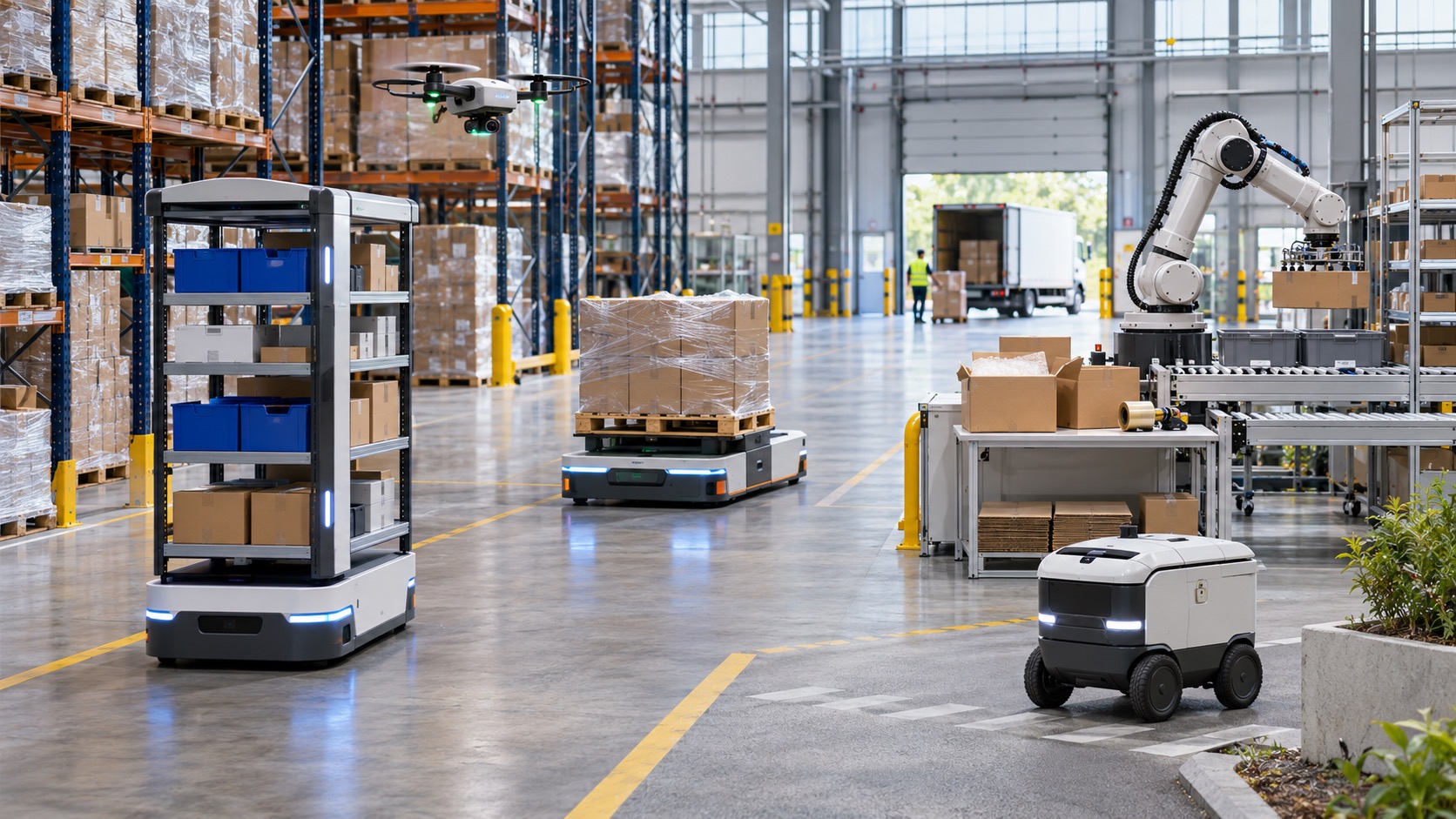
Small indoor drones can scan upper rack labels without lifts or climbing. Protective cages, controlled flight zones, and automated routes reduce contact risk. They are light enough for inventory sensing rather than freight transport. Propeller wash, battery duration, narrow spaces, reflective surfaces, people below, and local rules shape use. Some facilities fly only during closed shifts. A drone is valuable when vertical access is the central problem; a floor rover may be simpler when labels can be seen from the aisle.
Mobile Manipulators Combine Travel With an Arm
A mobile manipulator carries a robotic arm on an autonomous base. It can travel to several workstations, open compatible doors, move totes, operate fixtures, or pick objects from different locations. Combining mobility and manipulation expands reach but also compounds uncertainty. The base must stop accurately, remain stable while the arm moves, and understand whether the surrounding station is ready.
These systems suit low-volume tasks spread across a building, especially where a fixed arm at every station would be wasteful. Payload, reach, battery use, and safety zones change as the arm extends.
Sidewalk Delivery Robots Serve Short Local Routes
Compact ground vehicles carry secured compartments through campuses, neighborhoods, or business districts. Cameras and range sensors detect paths and obstacles, while remote operators assist with unusual events. They move slowly and carry modest payloads. Curbs, snow, crowds, animals, construction, theft, and inaccessible entrances limit service. The robot solves transportation only to a reachable handoff point. Recipient authentication, compartment security, loading discipline, and customer support complete the delivery.
Delivery Drones Trade Payload for Direct Flight
Aerial delivery vehicles can cross terrain without following roads. They favor lightweight, time-sensitive goods and routes with safe launch, flight, and receiving areas. Weather, noise, battery reserve, airspace, privacy, and drop accuracy restrict operation.
The delivery method matters. Landing requires a clear area, lowering a package needs precise control, and dropping is inappropriate for many products. A drone network also needs maintenance, charging, monitoring, and a ground process that loads the correct parcel.
Autonomous Road Vehicles Handle Larger Loads
Road-going delivery robots range from small low-speed pods to trucks. They operate in a regulatory and safety environment far more complex than a private warehouse. Lane markings, intersections, emergency vehicles, weather, pedestrians, cyclists, and uncertain human behavior demand robust perception and fallback. Some deployments use constrained routes, remote support, or supervised operating domains. Their economic value depends on route density, loading and unloading, depot design, insurance, and what happens at the curb. Driving is only one portion of delivery work.
Choosing a Type Starts With the Handoffs
Selection begins where the load starts, where it must end, and who or what handles it next. A shelf carrier is ideal when standardized pods can visit fixed stations. A tugger fits replenishment loops. A pallet robot serves stable heavy-load transfers, while an arm handles items presented within reach. Public delivery adds weather, access, regulation, and recipient behavior.
Managers should define payload, route variability, floor and aisle conditions, required rate, peak demand, identification method, charging plan, safety interaction, and exception ownership. The best type is the one that makes the entire handoff more reliable, not the machine with the broadest feature list.
Hybrid Fleets Need Clear Division of Labor
Large operations often combine several robot types. Pallet movers feed reserve storage, shelf carriers serve picking, arms handle suitable products, and sorters direct packed orders. Shared software must prevent one fleet from overwhelming the next. Interfaces define container identity, readiness, acceptance, cancellation, and recovery. A hybrid fleet can adapt to diverse work, but it creates more vendors, spare parts, training, and integration dependencies. Clear boundaries let each system do what it handles well while people manage ambiguity across the network.