Robotic Tools Are Entering a Jobsite Built Around Constant Change
Construction robots are machines that sense their surroundings and perform physical or measurement tasks during building, infrastructure, and site work. They may survey a floor, grade soil, drill overhead anchors, tie reinforcing steel, print concrete, place bricks, scan progress, move materials, or inspect spaces that are difficult to reach. Unlike factory robots, they rarely work in a stable environment. A construction site changes by the hour. Materials arrive, walls rise, access routes move, weather alters the ground, and several trades share limited space. A useful construction robot must therefore do more than repeat a precise motion. It must fit a sequence of work, understand or receive an updated location, protect nearby people, tolerate dust and vibration, and produce results that the next trade can use. Most systems remain supervised by skilled crews. Their purpose is not to build an entire project alone, but to take a defined operation and make it safer, more consistent, easier to document, or less physically punishing.
A: Usually not. People prepare, supervise, supply, inspect, and handle exceptions.
A: It normally needs coordinated digital geometry, survey control, and task-specific instructions.
A: Repetitive work with stable access and measurable acceptance criteria is the best candidate.
A: They require risk assessment, protected zones, detection, stopping systems, and trained crews.
A: The system must align its sensors, tools, and digital coordinates with actual site control.
A: Some are ruggedized, but conditions still affect sensors, traction, tools, and materials.
A: Current systems automate narrow operations and increase demand for planning and quality judgment.
A: Models and task files must be updated, checked, and redistributed before work continues.
A: The answer depends on utilization, support, transport, project pipeline, and technical capacity.
A: Pilot one well-defined task and measure the complete workflow rather than peak speed.
What Qualifies as a Construction Robot?
A powered machine becomes robotic when sensing and control allow it to perform part of the task automatically or under remote supervision. A conventional excavator follows every movement of its operator. A robotic excavator may receive a digital terrain model, compare its bucket position with the planned grade, and execute repeated passes within a restricted zone. A layout robot navigates a slab, measures its position, and marks locations from a building model. Both still depend on people for planning, setup, inspection, and exceptions.
The category includes mobile vehicles, stationary arms, gantries, climbing machines, drones, wearable systems, and software-connected instruments. The machine’s appearance matters less than the closed loop between measurement and action.
Not every automated construction tool is autonomous. A drill rig that repeats a fixed pattern can be valuable without navigating freely. Remote control also remains common when a task is hazardous or visibility is poor. The practical question is which decisions the machine handles and which remain with the crew.
Construction Is Harder to Automate Than a Factory
Factories control lighting, floor condition, part location, and traffic. Jobsites contain uneven surfaces, temporary structures, open edges, moving equipment, weather, dust, and incomplete information. Drawings may not reflect a field change made that morning. A robot must be configured for this uncertainty or confined to a work zone that the team can stabilize. Reliable deployment begins by preparing the environment and workflow, not by assuming the machine will adapt to everything.
Digital Models Give Robots a Shared Reference
Many construction robots connect to building information models, survey control, or machine-control surfaces. The model supplies coordinates, geometry, and sometimes task order. The robot still needs to locate itself on the real project using total stations, satellite positioning, lidar, cameras, targets, or local beacons.
Alignment is critical. A precise robot working from the wrong control point produces a precise mistake. Crews verify benchmarks, coordinate systems, elevations, and current design revisions before work begins. Field measurements then show whether actual conditions match the model closely enough for the planned operation.
Site Preparation and Earthmoving
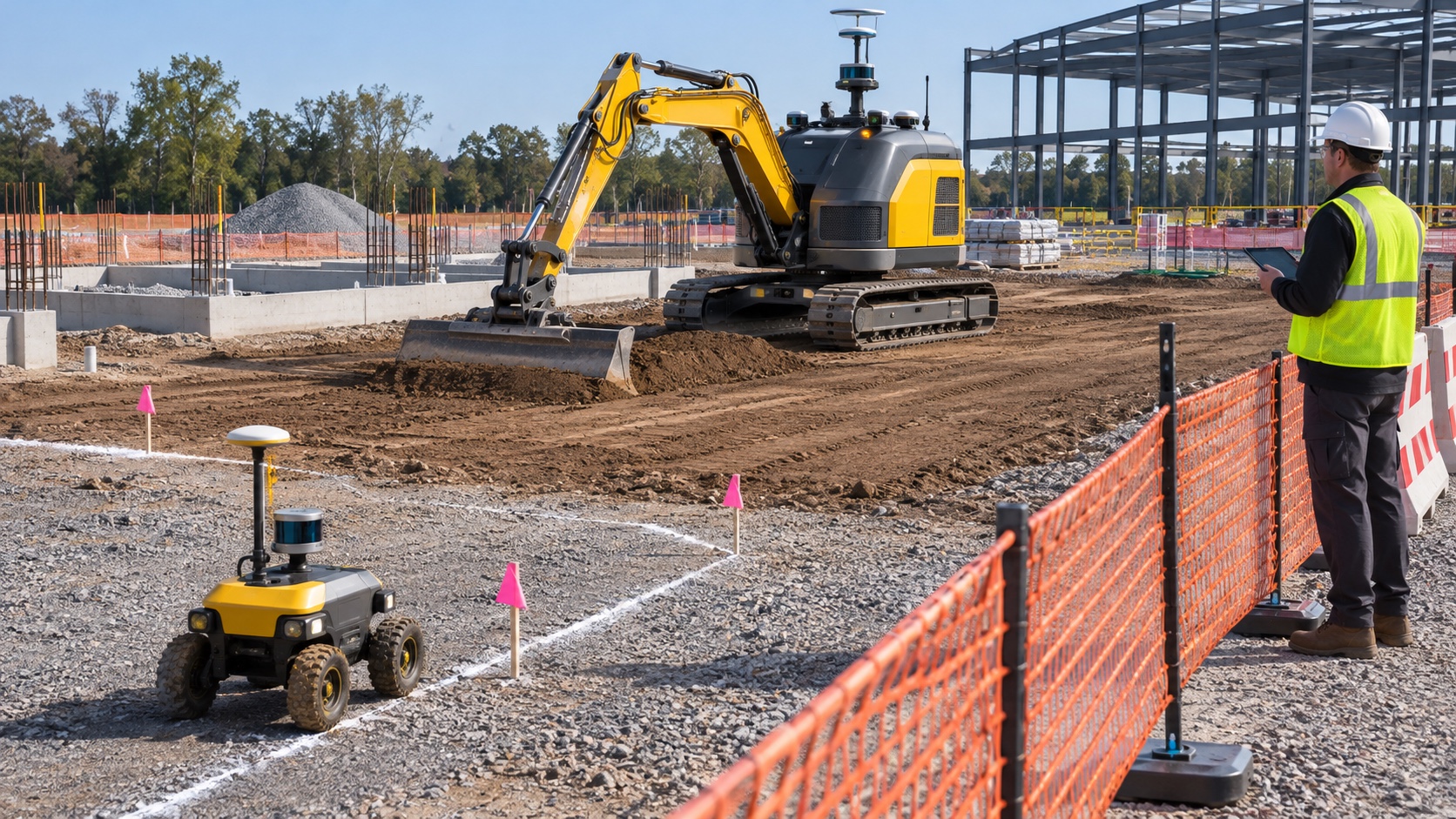
Robotic or semi-autonomous excavators, dozers, compactors, and graders shape terrain within defined boundaries. Sensors track the machine and tool, while control software compares the surface with the target design. Automation can repeat passes, maintain grade, or follow a planned compaction pattern. These systems are especially useful in large, repetitive areas or zones where rollover, unstable ground, or contamination makes remote operation attractive.
Layout and Measurement Robots
Layout traditionally requires crews to interpret drawings, establish lines, and mark many locations by hand. Mobile layout robots travel across a prepared floor and print or mark wall lines, penetrations, sleeves, and reference points. Robotic total stations follow a prism and calculate coordinates for installers. Drones create site maps and volume estimates from overlapping images.
Measurement robots reduce repetitive walking and produce digital records, but they do not decide what should be built. Someone must resolve conflicts, confirm tolerances, and protect marks from damage. Reflective surfaces, blocked sightlines, and moving equipment can reduce accuracy or stop operation.
Material Handling and Jobsite Logistics
Construction consumes labor simply moving panels, blocks, fasteners, tools, and waste between storage and work areas. Autonomous carts and forklifts can follow planned routes, while lifting aids position heavy components. Some machines deliver materials to a trade at scheduled times so corridors remain clear. The task looks simple but requires careful traffic design because people, vehicles, and temporary obstacles constantly cross the same paths.
Payload stability, stopping distance, floor capacity, and edge protection must be considered. A route valid for an empty cart may be unsafe when it carries a tall pallet. Teams establish loading rules and recovery procedures before relying on autonomous delivery.
Good logistics automation begins with clean material data. The robot needs to know what it carries, where it belongs, and whether the destination is ready. Otherwise, faster movement only creates a faster pileup.
Robotic Drilling, Cutting, and Fastening
Mobile or track-mounted arms can drill anchor holes, cut openings, or install fasteners in repetitive patterns. Overhead drilling is a strong candidate because it exposes workers to dust, noise, vibration, and awkward posture. The robot references the digital layout, positions the tool, applies controlled force, and records the completed point. Dust extraction and tool-wear monitoring are part of the system, not optional accessories.
Bricklaying, Block Placement, and Rebar Work
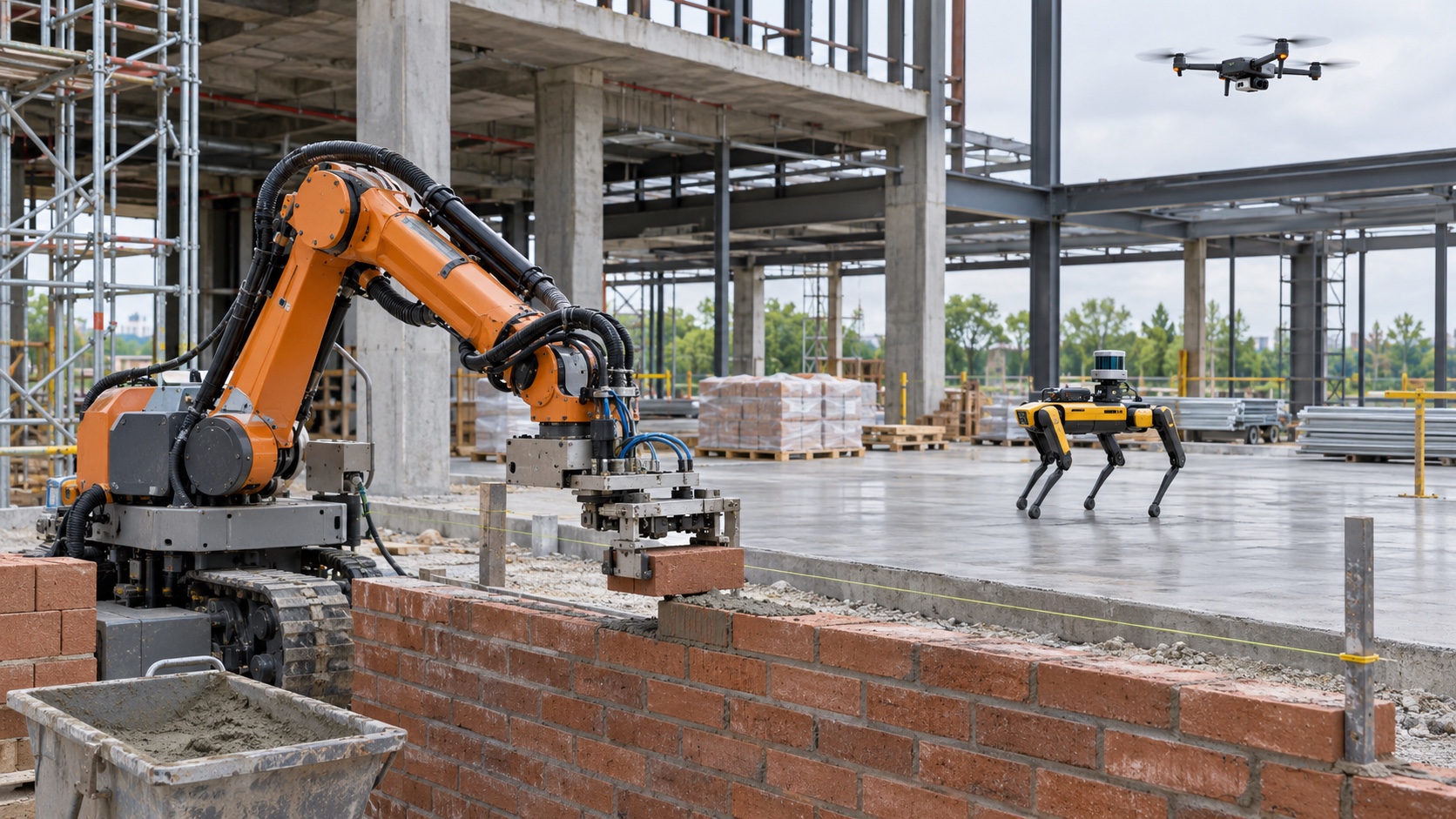
Masonry robots feed and place units while controlling mortar or adhesive. Some work from a mobile base alongside masons who handle corners, openings, ties, and finishing. Rebar-tying machines travel across reinforcing mats and make repeated ties, reducing crouching and hand strain.
Materials vary more than perfect demonstrations suggest. Blocks chip, mortar consistency changes, reinforcing bars move, and dimensions accumulate tolerance. Skilled workers remain essential for preparation, quality checks, adjustments, and details that do not repeat cleanly.
Concrete Printing and Automated Forming
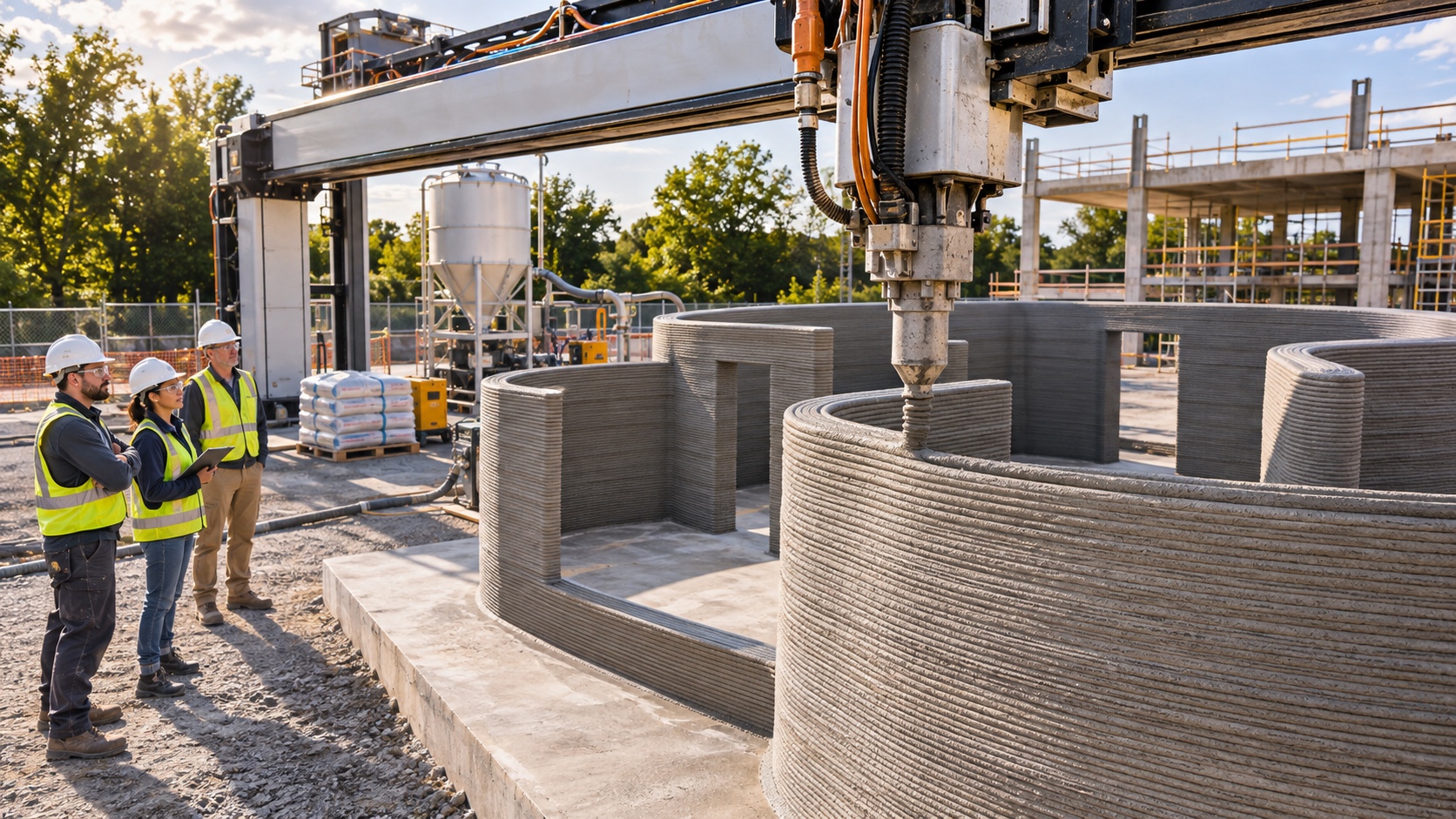
Large gantries or robotic arms extrude cementitious material in programmed layers. Printing can create curved forms and reduce conventional formwork for selected structures. The machine controls nozzle path, speed, and material flow, while crews manage mixing, reinforcement, utilities, openings, curing, and inspection. A printed wall is a construction assembly, not simply a shape produced by software.
Inspection, Progress Capture, and Quality Control
Drones, quadrupeds, and wheeled scanners collect images and laser measurements as work advances. Software compares the resulting point cloud with the design model, highlights missing elements, or measures deviation. Regular capture creates a time record that helps teams coordinate and document concealed work before it is covered.
Detection does not equal acceptance. A scan may identify a difference without explaining whether it is an approved field change, a modeling error, or defective work. Quality staff interpret results against specifications and tolerances. Data collection is valuable when it leads to timely, responsible decisions.
Safety Systems and Work-Zone Design
Construction robots need defined operating limits. Fencing, geofenced zones, warning lights, spotters, scanners, emergency stops, and speed restrictions separate automated motion from people. The exact combination depends on machine mass, reach, tool hazard, visibility, and traffic. A small layout robot presents different risk than an excavator or masonry arm. Teams plan startup, normal work, material replenishment, fault response, and shutdown. Lockout procedures cover maintenance and tool changes. Everyone nearby needs to understand the robot’s signals and who has authority to restart it.
What Crews Need to Operate the System
Successful use depends on more than a trained operator. Survey control must be current, models must be coordinated, material must be within specification, and access must remain clear. Batteries, chargers, network coverage, spare tools, calibration equipment, and technical support all affect daily production.
The surrounding trades also need a shared plan. They must know when the zone opens, which marks or surfaces are ready, where the robot will travel, and how to report a conflict without entering protected motion.
Evaluating Return on Investment
A robot should be measured against the whole workflow. Purchase price is only one cost. Mobilization, setup, transport, supervision, software, maintenance, training, and idle time matter. Savings may come from reduced rework, better documentation, fewer injuries, longer operating windows, or more predictable output rather than direct headcount reduction.
The strongest candidates are tasks with enough repetition, measurable quality, costly exposure, and reliable access. A robot that performs quickly but waits most of the day for materials may not improve the project. Pilot results should include setup and recovery, not only the fastest production interval.
Contractors also need an exit plan. Rental, service agreements, and phased adoption can reduce risk while the team learns which project conditions support the technology.
A Practical Definition for Beginners
Construction robots are specialized members of a project team. They translate survey control, digital models, sensor data, and human instructions into physical movement or repeatable measurement. Their value appears when a defined task becomes safer, more consistent, or more visible without disrupting the rest of the site. The best starting point is not a futuristic promise of an automated building. It is one well-chosen operation, prepared carefully, measured honestly, and improved with the people who already understand the work.
How a Robotic Workday Actually Unfolds
A productive shift begins before the machine moves. The crew reviews the current work package, confirms that the area has been released, checks survey control, inspects the tool, and verifies that material meets the expected specification. Barriers and signs establish the operating zone. The operator calibrates the system and completes a short test where the result can be measured easily. Only after that check does production expand. During the run, someone monitors quality, consumables, battery or fuel, tool condition, access, and changes elsewhere on the site. Material replenishment is planned so it does not require people to enter hazardous motion unexpectedly. When an alarm occurs, the team identifies whether it reflects a true obstruction, a sensor problem, a model issue, or a mechanical fault. The response is documented instead of bypassed. At the end of the work window, the crew inspects completed output, records exceptions, cleans dust or residue, secures stored energy, and updates the handoff for the following trade.
This routine explains why the operator’s skill remains central. Good performance depends on recognizing conditions the machine was not designed to interpret, such as a shifted embed, inconsistent mortar, an unplanned opening, or a floor that no longer matches the scan used for navigation. The operator is not merely pressing start. The role combines task knowledge, situational awareness, measurement, basic diagnostics, and the authority to stop production. Contractors that invest only in hardware often struggle because no one owns the surrounding process. Contractors that train a small cross-functional team can reuse the learning across projects, improve setup, and identify which tasks genuinely deserve automation. The workday becomes repeatable because the people make it repeatable.
Documentation Turns One Deployment Into Organizational Learning
Every project presents a different combination of access, material, weather, trade sequence, and supervision. Contractors need a simple record of the conditions under which a robot succeeded or struggled. That record should capture setup time, control checks, route changes, consumables, alarms, quality findings, maintenance, and the decisions that resolved exceptions. Photos and scans help, but the most useful notes explain why the team changed the plan. Over several projects, patterns emerge: which floor tolerances disrupt navigation, which material batches create feed problems, how much staging space is really needed, and when a service technician must be present. This evidence improves estimates and prevents each new crew from repeating the same experiments.