The Industry Is Changing Where Decisions Become Physical Work
Construction has spent years improving digital design, estimating, scheduling, and coordination, yet the final product still depends on thousands of actions performed in changing field conditions. Robots are beginning to connect those two worlds. A machine can take coordinates from a model and mark a slab, place a masonry unit, drill an anchor pattern, grade a surface, or scan completed work. That connection is transforming more than production speed. It changes when errors are discovered, which information a crew needs, how safety zones are organized, and how managers measure progress. It also exposes weak processes. An uncoordinated model becomes a bad instruction set, irregular material interrupts automated placement, and late decisions stop a robot just as surely as they stop a crew. The building industry is not moving toward unattended sites. It is learning to design projects in which people handle judgment, coordination, craftsmanship, and exceptions while robotic systems carry out selected physical routines with consistent measurement and documentation.
A: Some tasks accelerate, but project gains depend on materials, access, coordination, and downstream capacity.
A: It shortens the time between installation, comparison, and corrective action.
A: It can reduce selected forms, while reinforcement, services, finishes, and inspection remain.
A: They can add distance from hazards and take repetitive high-strain cycles.
A: Teams need people who combine trade knowledge with survey, models, diagnostics, and controls.
A: Rentals, specialty subcontractors, and service providers lower the ownership barrier.
A: Accelerating one operation may overwhelm the trades or inspections that follow it.
A: Robotic access, digital fabrication, and automated assembly can influence future design choices.
A: Repeatable setup, support, training, cost history, safety practice, and suitable project flow.
A: Digital intent is connecting more directly with measured physical work.
Design Information Is Reaching the Work Face
Robots create a direct path from coordinated geometry to physical execution. Layout machines mark locations from a model. Machine-control systems compare a blade or bucket with a target surface. Drilling robots position tools at planned anchors. This reduces repeated interpretation between drawing, measurement, and action, but only when the underlying information is current. The transformation begins upstream: design teams must resolve coordinate systems, tolerances, revisions, and constructability earlier because the machine cannot improvise around an unresolved detail.
Reality Capture Is Shortening the Feedback Loop
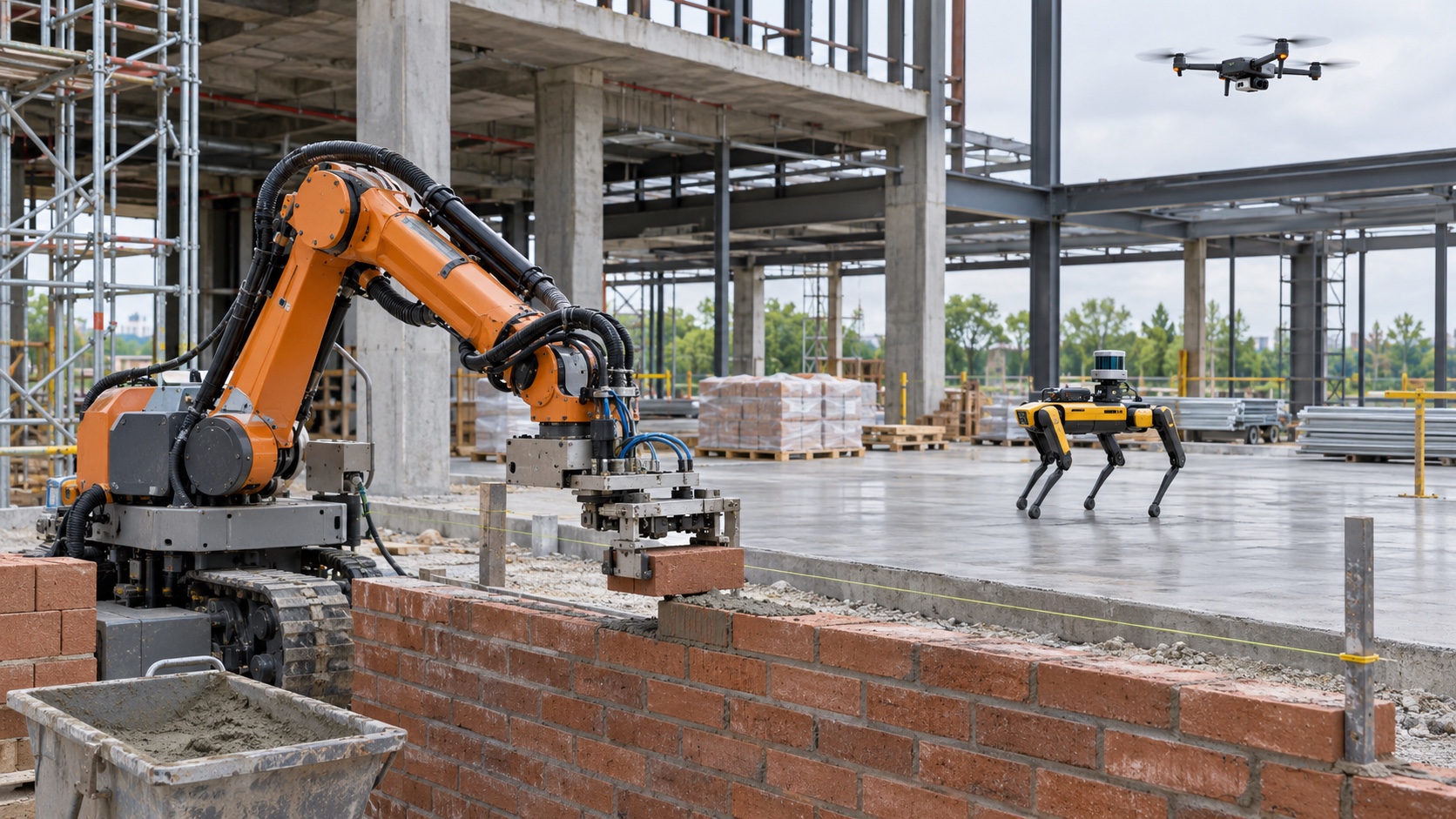
Drones, mobile scanners, and quadrupeds collect images and point clouds during construction. Software aligns those observations with the design and highlights differences in position, completeness, or clearance. A superintendent can see that installed work conflicts with a future system before the area is enclosed.
Faster feedback changes management behavior. Instead of waiting for a milestone survey, teams can inspect smaller increments and correct drift before it spreads. The record also supports payment, coordination, and handover. Accuracy still depends on calibration, coverage, and interpretation; a colorful deviation map does not decide whether the work is acceptable.
Hazardous Work Is Moving Behind Distance and Barriers
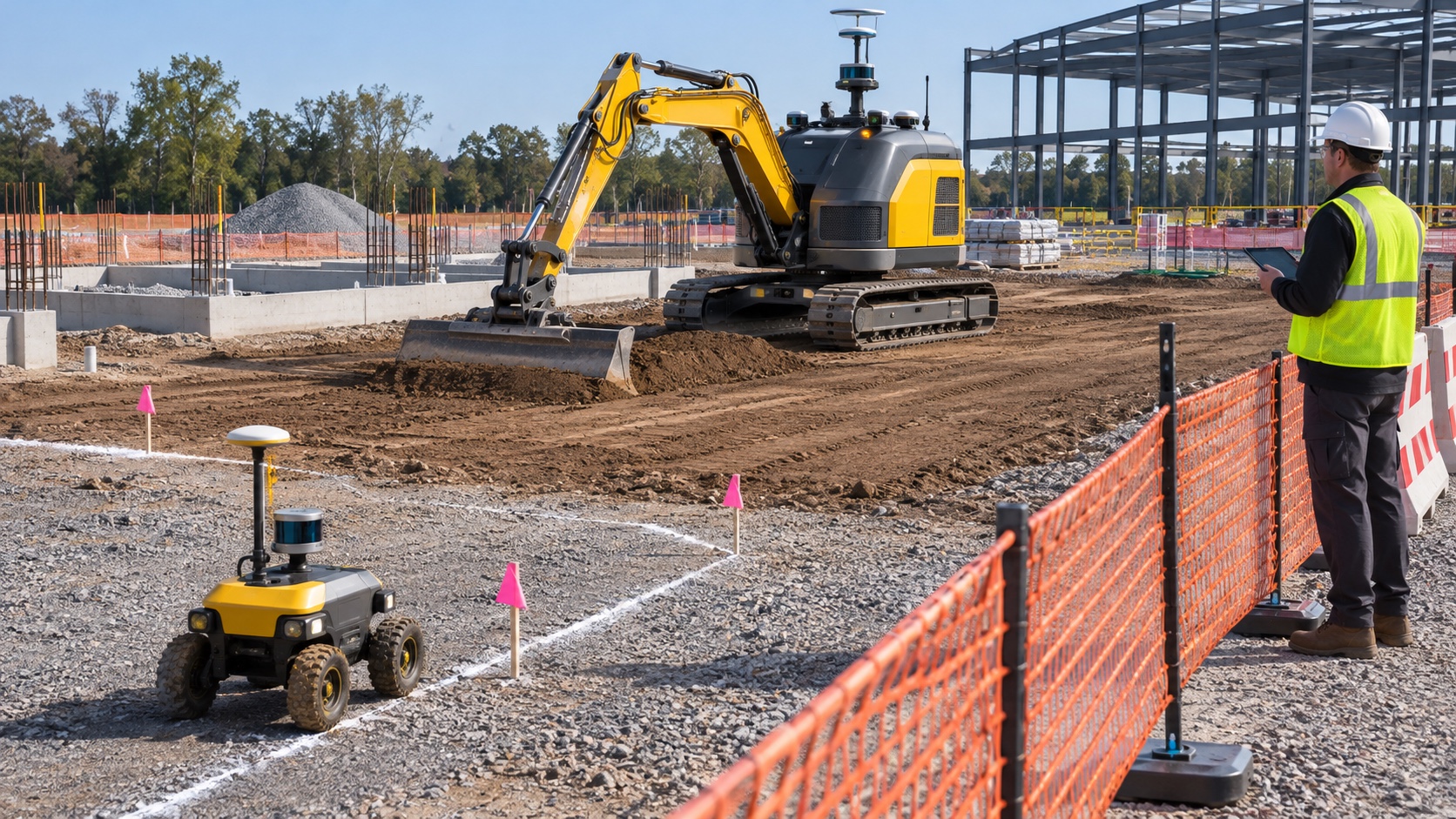
Remote demolition machines, robotic drills, inspection crawlers, and autonomous earthmoving equipment put separation between people and unstable structures, silica dust, vibration, heat, contamination, or falling material. Distance does not eliminate risk, but it changes exposure and provides more options for planning. Safety professionals can design exclusion zones around predictable machine motion rather than placing a worker at the tool. New risks appear in communication, recovery, unexpected entry, and energy isolation, so procedures must evolve with the technology.
Some of the strongest business cases come from this safety value rather than pure labor savings. Avoiding one serious exposure or injury can outweigh modest production gains.
Ergonomics matters as well. Rebar tying, overhead drilling, floor grinding, and repetitive material handling impose cumulative strain. Robots can take the most punishing cycle while skilled workers prepare, inspect, and finish.
Production Is Becoming More Measurable
A robotic system records path, cycle, tool status, alarms, and completed locations. Managers can compare planned and actual output without relying only on end-of-shift estimates. This visibility supports maintenance and scheduling, but it can also create misleading precision. A completed motion is not necessarily acceptable work. Useful metrics connect machine activity with verified quality and downstream readiness.
Concrete Printing Is Challenging Conventional Formwork
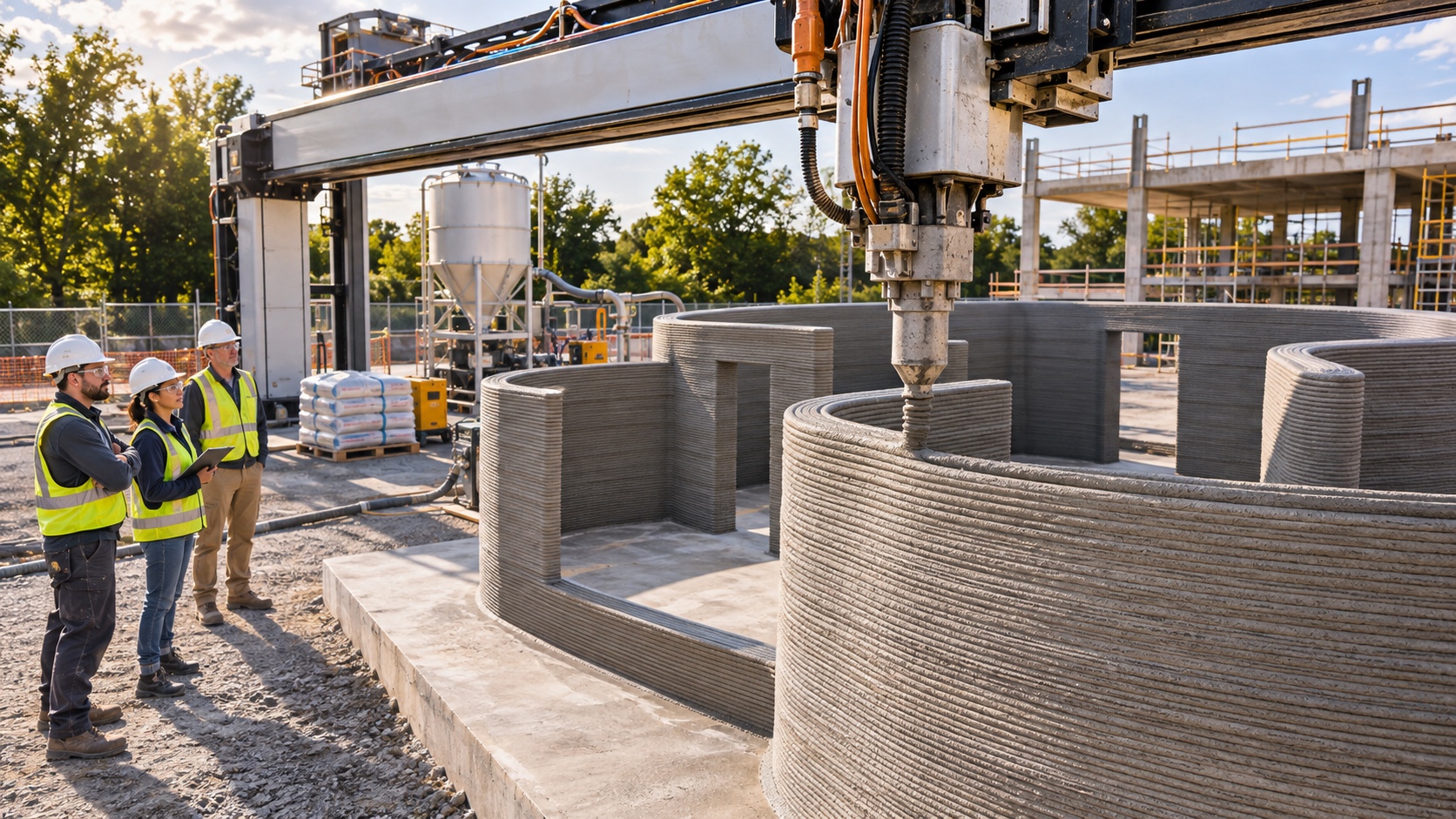
Robotic gantries and arms deposit cementitious material in programmed layers. Curved walls and customized shapes can be produced without building a unique form for every surface. The method can reduce waste and compress selected workflows, especially where geometry repeats digitally but not physically.
Printing does not eliminate reinforcement, foundations, openings, utilities, waterproofing, curing, finishes, or inspection. Material rheology must stay within a narrow range so each layer supports the next and bonds correctly. The important transformation is design freedom paired with process control, not a nozzle replacing an entire project team.
Earthmoving Equipment Is Gaining Repeatable Autonomy
Excavators, dozers, compactors, and graders can follow digital surfaces or prescribed coverage patterns inside controlled areas. Automation is well suited to repeated passes, volume removal, and compaction where boundaries are surveyed and traffic is managed. Equipment can work during extended windows without the same fatigue profile as a human operator.
Material Flow Is Becoming a System Problem
A robot only produces while material arrives in the right form and at the right time. Masonry units must be staged, concrete must maintain consistency, fasteners must be replenished, and autonomous carts need clear destinations. This pressure encourages better kitting, inventory visibility, and just-in-time delivery to the work face.
The result can improve the whole site. Corridors hold less excess stock, crews spend less time searching, and shortages become visible sooner. Poor logistics also becomes impossible to hide. Automation often reveals that the supposed production bottleneck was actually supply, access, or decision latency.
Quality Control Is Shifting Toward Continuous Verification
Tool sensors can monitor force, depth, flow, or torque while work occurs. A drilling robot records each anchor location and depth. A fastening system confirms achieved torque. A printer tracks bead geometry and material delivery. These records allow targeted inspection rather than assuming every repeated operation is identical.
Continuous data does not remove independent verification. Sensors can drift, tools wear, and a process can meet its internal parameter while violating a project requirement. The transformation is a richer evidence trail that helps inspectors focus on exceptions and trends.
Owners may eventually receive structured installation records connected with asset locations. That information can support maintenance long after construction ends, provided formats remain usable and responsibility for data quality is clear.
Workforce Roles Are Expanding Around Integration
Robotic construction needs people who understand both the trade and the system. Operators must recognize when material, geometry, or site conditions fall outside the machine’s assumptions. Survey and model specialists keep digital control aligned with reality. Mechanics handle actuators and tools, while software support manages configurations and updates.
Small Contractors Can Access Automation Through Services
Ownership is not the only adoption path. Specialty subcontractors, equipment dealers, rental firms, and robotics-as-a-service providers can mobilize systems with trained operators. This spreads utilization across projects and lets contractors buy an outcome rather than build a technical department.
Service models also concentrate expertise, but they create scheduling and dependency risks. The provider must understand project sequencing, and the contractor must prepare access, control, materials, and approvals before mobilization. A robot arriving to an unready site is expensive regardless of who owns it.
Schedules May Become Less Sensitive to Repetition
Robots can maintain consistent cycles and operate during windows that would be difficult for a full crew, subject to noise, lighting, supervision, and site rules. Their benefit grows when a repetitive activity sits on the critical path. Yet acceleration in one trade can create congestion downstream. Faster layout is useful only if installers can act on it; faster printing is useful only if reinforcement and services remain coordinated. Scheduling must absorb the changed production rhythm.
Buildings May Be Designed for Robotic Assembly
Today, many machines adapt to details created for manual work. Future projects may use standardized connection points, robot-accessible clearances, modular components, and tolerances suited to automated handling. Designers can divide complex assemblies into operations that machines and people perform well.
This does not require uniform architecture. Digital fabrication can support variation when the process and material remain controlled. The deeper change is that means and methods influence design earlier, allowing robotic access and sequence to be considered before documents are complete.
Adoption Is Moving From Demonstration to Operations
A dramatic prototype proves that a machine can perform a task. Operational adoption asks whether it can be transported, calibrated, supplied, repaired, insured, scheduled, and used repeatedly by ordinary project teams. Contractors are building checklists, training paths, contract language, and cost histories that turn isolated trials into a capability.
The Transformation Depends on Better Construction Management
Robots reward clear scope, reliable information, stable handoffs, and honest measurement. They struggle when access changes without notice, models lag field decisions, or responsibility is unclear. In that sense, the technology is transforming the industry by forcing greater discipline around work packaging.
The likely future is mixed. People will perform judgment-heavy, variable, and finish-sensitive work. Machines will handle selected cycles that are hazardous, repetitive, measurable, or physically demanding. The projects that benefit most will not simply own advanced equipment. They will coordinate design, materials, trades, data, and safety so that the robot’s narrow strength fits the construction system around it.
Contracts and Responsibility Must Catch Up
Robotic work creates questions that ordinary equipment clauses may not answer. The contractor may supply the machine while a designer supplies geometry and a vendor supplies remote support. If an outdated model guides a repeated error, responsibility crosses several parties. Contracts need practical rules for approved data, permitted remote access, software updates, machine logs, cybersecurity, inspection, and ownership of generated records. They should also define what happens when the system is unavailable. A schedule cannot assume robotic output without a fallback or an agreed relief mechanism. Insurance and safety documentation must reflect the actual work zone rather than treating the machine as a familiar piece of equipment with a new name. Clear responsibility makes adoption easier because teams can resolve problems without debating basic authority during production.
Evidence Will Separate Durable Change From Novelty
The industry will learn through repeated use across ordinary projects, not only through demonstrations designed around ideal conditions. Useful evidence includes accepted units per shift, setup time, recovery time, energy use, tool consumption, maintenance, rework, ergonomic exposure, and downstream effects.
That record should include failure and inactivity. A robot that produces rapidly for two hours but waits six hours for access may still be the wrong solution. A slower system that eliminates a hazardous exposure or creates reliable quality documentation may be valuable for a different reason. Transformation becomes durable when contractors can predict where the technology works, price it honestly, train crews consistently, and decline it when project conditions do not support the promised result.
Public Expectations Will Be Shaped by Ordinary Results
Robotic construction attracts attention because moving machines and printed structures are easy to photograph. Long-term acceptance will depend on quieter outcomes. Owners will ask whether buildings perform as intended, inspectors will ask whether records are trustworthy, workers will ask whether jobs become safer and more sustainable, and communities will ask how noise, traffic, and accountability are managed. A project that uses a robot but delivers poor quality will not advance the industry. A project that reduces dust exposure, documents concealed work, and finishes reliably may change practice even if the machine is never visible to the public. Contractors should communicate capabilities without presenting supervised tools as independent builders. Honest descriptions build confidence and help clients understand where innovation affects risk, schedule, cost, and design.
Standard Interfaces Could Accelerate Adoption
Common data and attachment interfaces would let contractors connect models, survey control, tools, and project records without rebuilding every integration. Standards can reduce switching cost and make training more transferable.
They will not make machines identical. Vendors can still compete on reliability, sensing, and workflow, while shared foundations help project teams combine equipment without treating each deployment as a custom experiment.