A Trade-by-Trade Map of Robotic Construction Equipment
Construction robots are easiest to understand when they are grouped by the work they perform. Some establish where the work belongs. Others move earth, transport materials, place components, create building elements, finish surfaces, inspect progress, or protect workers from hazardous conditions. A second distinction is mobility. Stationary arms deliver precise repeated motion inside a prepared cell. Mobile bases carry tools through a changing site. Large vehicles automate heavy equipment functions, while small climbing or flying machines reach areas that would otherwise need scaffolding or rope access. Wearable devices assist a person rather than operating separately. These categories overlap, and one platform can change roles with a new attachment. The useful comparison is not which robot looks most advanced. It is which combination of tool, movement, sensing, and supervision matches the trade’s material, tolerance, access, and safety needs.
A: Automation is spread across survey, machine control, inspection, fabrication, and specialized tools.
A: Many are remotely operated so a person controls the tool from farther away.
A: It marks coordinated points and lines for walls, sleeves, openings, or embeds.
A: No. Obstructions, flight rules, weather, and close-detail requirements limit them.
A: Legs help it cross stairs, cables, grating, and irregular industrial routes.
A: Powered models are robotic assistive devices; passive versions are wearable mechanisms.
A: It creates geometry by controlled material deposition rather than assembling standard units.
A: They fabricate building components under stable conditions before field assembly.
A: Some modular platforms change attachments, although each configuration needs testing.
A: Match material, task, tolerance, access, repetition, supervision, and recovery needs.
Surveying and Layout Robots
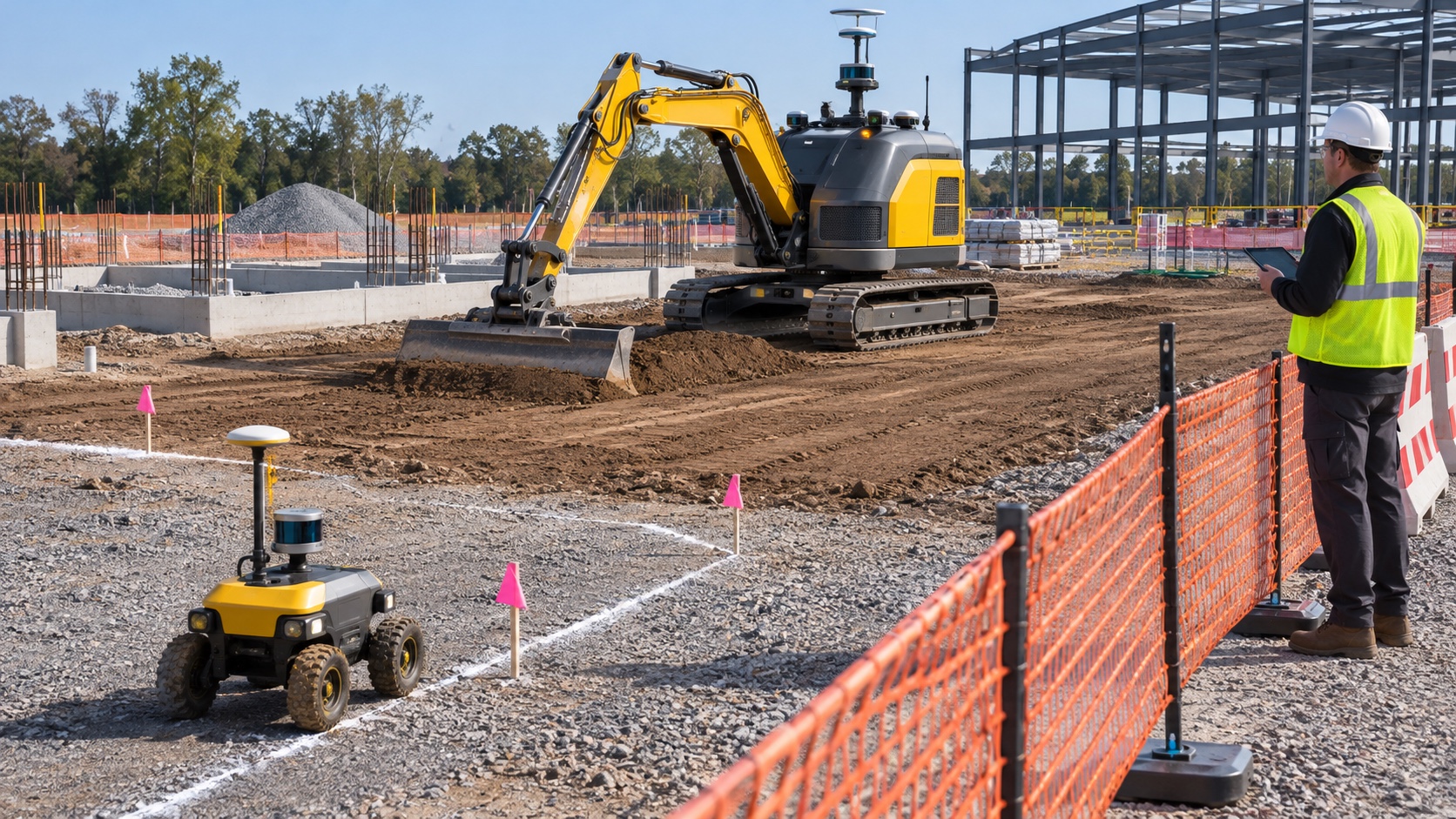
Surveying systems connect design coordinates to physical locations. Robotic total stations track a prism and calculate precise points for layout or machine control. Mobile layout rovers navigate prepared floors and mark wall lines, sleeves, embeds, and penetrations. Survey drones photograph broad sites so software can build maps and measure stockpiles. These tools reduce repetitive walking and transcription, but they depend on verified benchmarks, current models, clear sightlines, and disciplined coordinate management.
Autonomous Excavators
Robotic excavators use sensors and digital terrain information to dig within defined boundaries. Some execute repeated trenching or loading cycles; others are remotely controlled so the operator remains away from unstable, steep, or contaminated ground. Position systems track the machine and bucket, while cameras and scanners monitor the surroundings.
Excavation remains variable. Buried debris, changing soil, unknown utilities, and water can interrupt the plan. Safe use requires utility information, geofencing, exclusion zones, haul coordination, and a clear process for unexpected material.
Robotic Dozers, Graders, and Compactors
Dozers and graders shape surfaces by comparing blade position with a target model. Compactors follow coverage patterns and record passes, speed, and sometimes material response. Automation is valuable across broad areas where repeated movement and consistent overlap matter. Site traffic, slopes, edges, and changing fill conditions still require supervision. These machines are most effective when survey control and work boundaries remain stable.
Demolition Robots
Demolition robots are compact tracked machines carrying breakers, crushers, shears, buckets, or other tools. An operator controls them from a safer distance while the low chassis enters buildings, industrial facilities, or contaminated zones. Their electric power and compact size can suit indoor work where exhaust and floor loading matter.
Remote operation does not make the structure predictable. Falling debris can block escape, damage cables, or alter floor capacity. Engineers and crews plan the sequence, protect services, control dust, and maintain a recovery route. The robot extends the operator’s reach into danger; it does not replace structural judgment.
Masonry and Block-Placement Robots
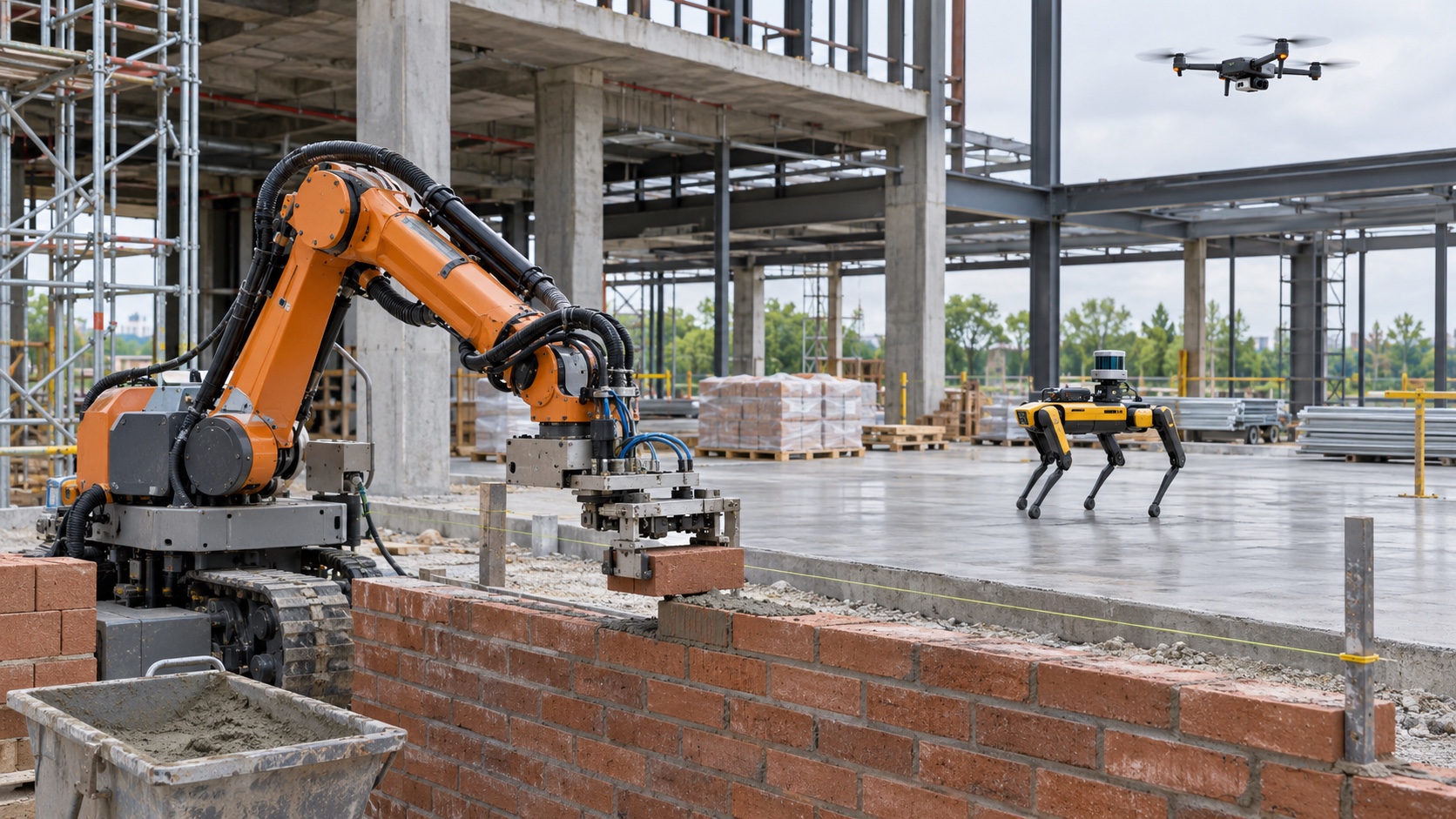
Masonry systems position bricks or blocks along planned courses. A robotic arm may ride a mobile base, receive units from a feeder, apply mortar or adhesive, and place them at controlled spacing. Masons manage corners, openings, ties, joint finishing, irregular units, and quality review. The system works best on long repeating walls with organized material supply and accurate base conditions.
Rebar-Tying and Reinforcement Robots
Rebar-tying robots travel over reinforcing mats and create ties at selected intersections. The task is repetitive and physically demanding, making it a strong target for ergonomic improvement. Other systems bend, cut, weld, or assemble reinforcement in controlled fabrication environments.
Field mats vary in spacing and support. The machine must avoid openings, edges, and unstable bars. Crews inspect tie placement, replenish wire, correct shifted steel, and confirm that robotic access does not disturb required cover or geometry.
Drilling, Cutting, and Fastening Platforms
Tool-carrying arms drill anchors, cut openings, grind surfaces, or install fasteners. Overhead drilling units reduce exposure to silica dust, noise, vibration, and awkward posture. They locate each point from digital geometry, position the tool, control feed, and record completion.
Different substrates demand different bits, force, cooling, extraction, and detection of embedded services. Tool wear changes hole quality. A robotic pattern can magnify the same configuration error across many locations, so crews inspect early output before allowing a long run.
Some platforms mount on tracks or wheels; others attach temporarily to a slab or wall. Mobility determines setup time and reachable area, while stiffness determines precision under tool force.
Concrete 3D Printers
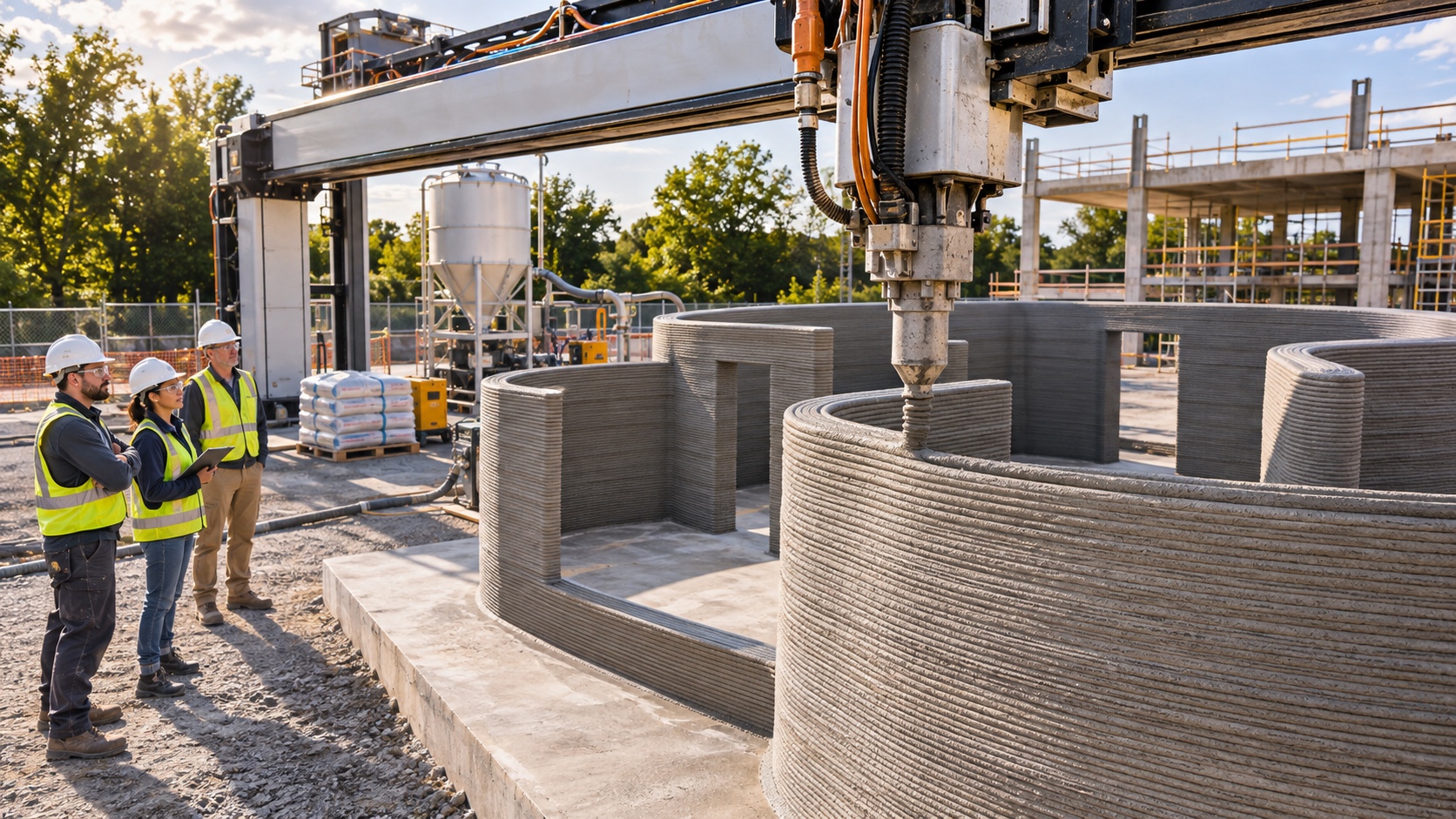
Construction printers use gantries, cable systems, or robotic arms to extrude cement-based material. The nozzle follows a programmed path, building layers that form walls or components. Printing can create curves and internal geometries without custom formwork.
Prefabrication and Assembly Robots
Factories that produce wall panels, trusses, modules, ducts, or reinforcement use industrial arms in a more controlled environment than the jobsite. Robots cut, weld, fasten, apply adhesive, move parts, and inspect dimensions. Controlled fixtures and repeated product families make automation easier.
Field assembly robots handle panels, glass, or modular elements at the point of installation. These systems must adapt to wind, tolerance accumulation, lifting plans, and neighboring trades. Standardized connection details improve the opportunity for robotic handling.
Material-Transport Robots
Autonomous mobile robots, carts, forklifts, and follow-me carriers move tools and materials. Indoor vehicles navigate mapped corridors, while outdoor platforms need more rugged localization and traction. Their benefit comes from reducing nonproductive travel and maintaining planned deliveries.
Drones for Mapping and Inspection
Aerial drones survey earthwork, inspect roofs and facades, document progress, measure stockpiles, and view areas beyond ordinary access. Overlapping photographs become orthomosaics or three-dimensional models. Thermal or specialized sensors can reveal additional conditions.
Flight rules, weather, batteries, privacy, and airspace coordination constrain use. Drones cannot see through every obstruction, and image-based measurements require appropriate control and processing. They are observation tools rather than substitutes for all close inspection.
Ground Inspection Rovers and Quadrupeds
Wheeled scanners travel smooth floors efficiently. Quadrupeds climb stairs, step over cables, and move through industrial spaces. Payloads include cameras, lidar, thermal sensors, gas detectors, and acoustic instruments. Repeated autonomous walks produce comparable records and keep people away from selected hazards.
Finishing Robots
Finishing machines paint, sand, grind, polish, spray fireproofing, or finish concrete. Broad surfaces and repeated coverage patterns favor automation. Control of speed, overlap, pressure, and material flow can improve consistency.
Edges, corners, penetrations, texture changes, and occupied areas complicate the task. Surface preparation remains critical because a robot applies material consistently to good and bad substrates alike. Ventilation, overspray containment, dust collection, and cleaning affect the full workflow.
Wearable Exoskeletons and Assistive Devices
Exoskeletons support rather than replace a worker. Passive devices redirect loads during overhead work or bending. Powered systems add assistance for lifting or tool handling. The worker retains perception and judgment while the device reduces fatigue in a specific motion.
Climbing and Cable-Suspended Robots
Magnetic, suction, adhesive, rail-mounted, or cable-supported robots inspect and maintain vertical surfaces. They can examine bridges, tanks, facades, towers, and confined structures while reducing rope or scaffold exposure.
Attachment reliability is central. Surface condition, curvature, coatings, dirt, wind, and cable geometry affect stability. Teams plan secondary retention, falling-object controls, rescue, and safe retrieval after a power or adhesion failure.
Payloads range from cameras and thickness gauges to cleaning heads and coating tools. The attachment method, service line, and tool reaction must be evaluated together because a safe inspection configuration may not support a forceful maintenance task.
Choosing Among Construction Robot Types
Begin with the material and operation. Earthmoving requires mass and traction; layout requires localization; drilling requires stiffness and extraction; inspection requires sensor coverage; transport requires dependable routes. Then examine repetition, tolerance, cycle volume, access, and how often the environment changes.
The best robot may be a service brought in for one phase, a tool shared across several crews, or a permanent part of a prefabrication shop. A platform fits when its work zone can be prepared, its output can be inspected, and the rest of the project can absorb its production without disruption.
Stationary, Mobile, and Wearable Systems Compared
A stationary robot gains precision from a rigid base and a controlled reach envelope. It suits prefabrication, cutting, welding, or repetitive placement when parts can be brought to the cell. Safety fencing and fixtures are easier to maintain because the machine does not travel. The cost is inflexibility. Moving the cell or changing the product family may require new tooling, programming, and material flow. Mobile robots carry capability to the work instead. Wheels save energy on finished floors, tracks tolerate debris, and legs reach stairs or grating. Mobility adds localization, traffic, charging, stability, and recovery to the task. A tool that performs perfectly in place is useless if its base cannot reach the next location. Wearable systems make a different compromise. The person supplies perception, balance, and continuous judgment while the device supports a limited motion. An overhead exoskeleton may reduce shoulder fatigue without deciding where to fasten. A powered lifting aid may amplify force while the worker guides alignment. Selecting among the three categories depends on where uncertainty is best handled: in fixtures and programming, in navigation and supervision, or by a person who remains physically engaged.
How Tools, Materials, and Tolerances Shape the Choice
Robots interact with materials through tools, and the interface often determines success. A suction gripper needs a surface that seals. A masonry feeder needs units within dimensional and damage limits. A drill needs the right bit, feed rate, dust extraction, and detection of reinforcement or services. Concrete extrusion depends on mix consistency, pumping distance, temperature, and the time each layer can support another. These details make broad labels such as “masonry robot” less informative than the complete configuration.
Tolerance also changes across trades. Layout may require millimeter-level location, earthmoving may accept broader variation, and finishing is judged through appearance as well as measurement. A system must sense the variable that matters and provide evidence tied to the specification. When buyers compare robot types, they should request results on representative material under actual tolerance and access conditions. Peak speed on ideal samples says little about chipped blocks, damp aggregate, a sloped slab, or the finish expected at handover. Tooling, consumables, calibration, and inspection belong in the type comparison because they determine whether the machine produces usable construction rather than impressive motion.
Hybrid Systems Blur the Categories
Many practical machines combine several types. A tracked base may carry a drilling arm, scanner, and material rack. A survey drone may update a map used by an autonomous dozer. A quadruped can transport a sensor, stop at a fixed point, and act as a stationary monitor. Tool changers let one manipulator switch between gripping, drilling, and inspection. These hybrids can reduce mobilizations, but every added role changes weight, balance, energy, software, calibration, and operator training. Teams should evaluate the complete configuration rather than assuming capabilities can be combined without tradeoffs. A versatile platform is valuable when the project uses its flexibility. If most shifts require one task, a simpler dedicated machine may be easier to support and safer to validate.
Support Models Are Another Type Choice
Two identical machines can create different outcomes depending on support. Dealer service suits firms that already maintain heavy equipment, while robotics specialists may provide remote diagnostics and application engineering.
Rental and service models fit occasional work, ownership fits repeatable pipelines, and subcontracted outcomes fit teams that want production without operating the system. The commercial model should match utilization and internal skill.