Prestige Comes From the Quality of the Test, Not the Size of the Trophy
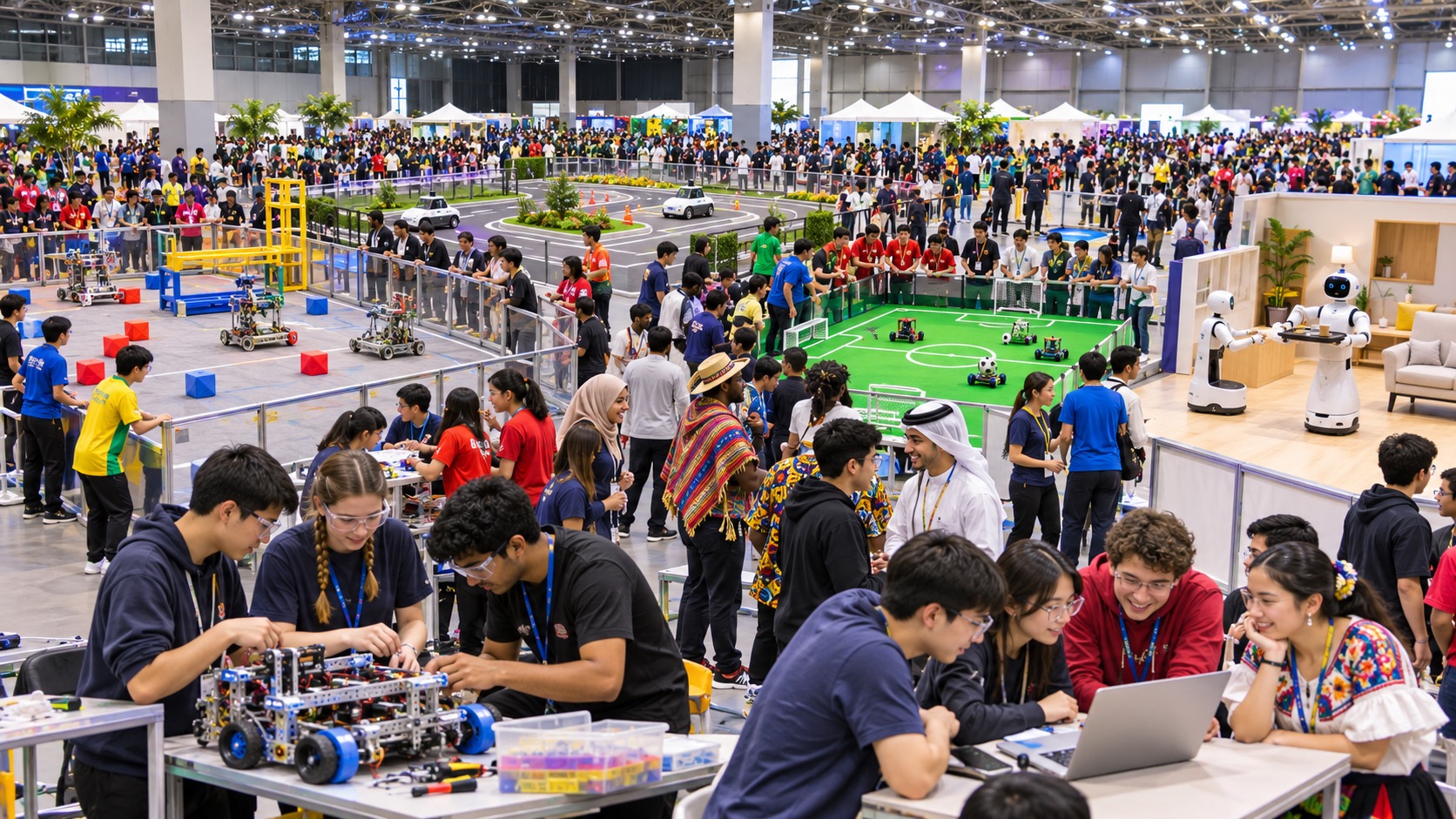
A robotics competition becomes prestigious when success means something beyond winning a staged event. The problem must be difficult enough to expose genuine capability, the rules must let strong teams distinguish themselves, and the evidence must matter to a community after the arena is dismantled. Some competitions earn influence by accelerating research against a grand challenge. Others create an educational culture that trains large numbers of students in engineering, leadership, and public service. A famous prize purse can attract attention, but transparent scoring, credible qualification, reliable field design, open technical exchange, and a history of consequential alumni create longer value. The events below serve different participants, so they should not be forced into one ranking. DARPA challenges, RoboCup leagues, FIRST programs, international student championships, and field robotics contests test different forms of excellence. What connects them is a demanding shared constraint that turns claims into observable performance.
A: A consequential task, credible rules, strong participants, visible evidence, and lasting community influence matter more than publicity alone.
A: No, it was a defined historical challenge; DARPA creates different prize competitions for specific programs.
A: It gives many annual leagues a shared long-term direction for advancing integrated robotics and AI.
A: Yes, its award culture also recognizes engineering, leadership, teamwork, and community impact.
A: They span autonomous missions, robot sports, innovation projects, and advanced engineering challenges.
A: It gathers a very large field of qualified student teams across multiple age and program divisions.
A: Research teams integrate autonomous aerial, ground, or marine systems for complex field missions.
A: Planetary constraints bring systems engineering, operations, autonomy, safety, and mission context into evaluation.
A: A well-instrumented failure can generate methods and credibility that outlast one event result.
A: No, research breakthroughs, student development, international reach, and field reliability are different forms of excellence.
DARPA Challenges Make a Public Problem Technically Urgent
DARPA prize competitions have repeatedly concentrated ambitious teams on capabilities that conventional procurement or isolated research might advance more slowly. The Grand Challenge series pushed autonomous vehicles into long desert and urban tasks. The Robotics Challenge asked human-supervised machines to perform disaster-response operations in degraded environments. Later challenges have addressed underground autonomy and mass-casualty triage.
Their prestige comes partly from consequence. A task is tied to a real operational gap, and the field is designed to reveal failure in mobility, perception, communication, manipulation, or human-machine coordination. Teams often build systems at a scale unavailable to ordinary contests.
DARPA events are not annual leagues with stable participation. Each challenge has a defined program and era. That scarcity can increase historical importance, but it also means readers must distinguish a celebrated past event from a current opportunity.
RoboCup Turns a Distant Goal Into Annual Engineering Pressure
RoboCup’s long-range objective is a team of fully autonomous humanoid robots capable of defeating the human soccer world champion around the middle of the century. The value of that aspiration is not a prediction about one match. It gives research communities a landmark problem involving perception, locomotion, strategy, teamwork, learning, and real-time action. Annual rules can raise difficulty while results remain comparable enough to track progress.
RoboCup also extends beyond soccer through home, rescue, industrial, simulation, and junior activities. Its prestige is scientific: teams often publish methods, share platforms, and return for many seasons. A robot must work amid opponents, field variation, and time pressure rather than only in its home laboratory.
RoboCupRescue Makes Robustness Part of the Result
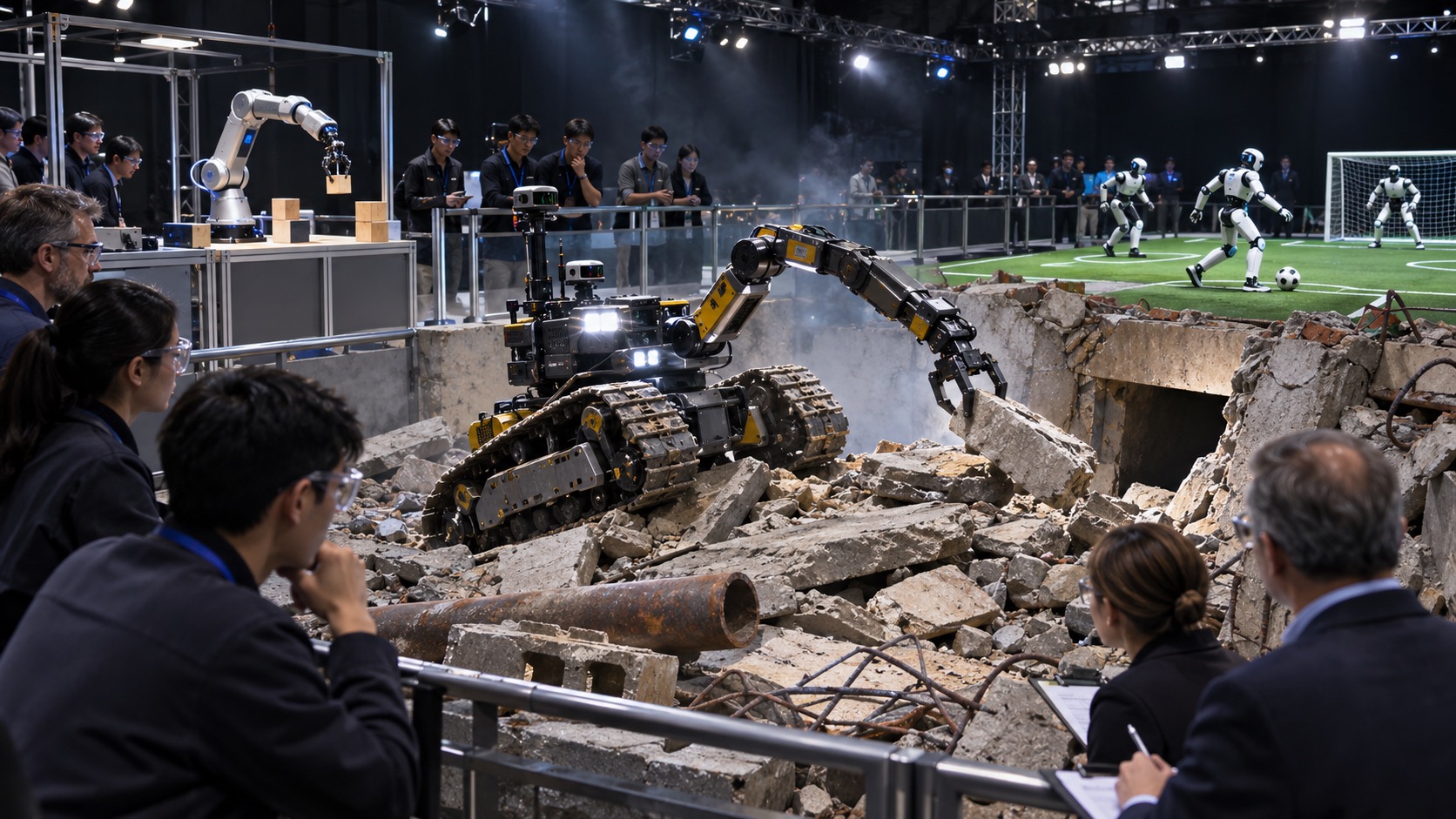
Rescue leagues and related trials ask robots to navigate difficult terrain, perceive hazards, manipulate objects, or provide useful information under constrained communication. The special quality is that a technically impressive subsystem earns little if the integrated machine cannot deliver information or action reliably. Courses can reveal mobility limits, operator workload, sensor placement, and recovery behavior. Prestige here is connected to public-safety relevance and to a culture of repeatable benchmarks rather than theatrical destruction.
FIRST Robotics Competition Combines Engineering With Institution Building
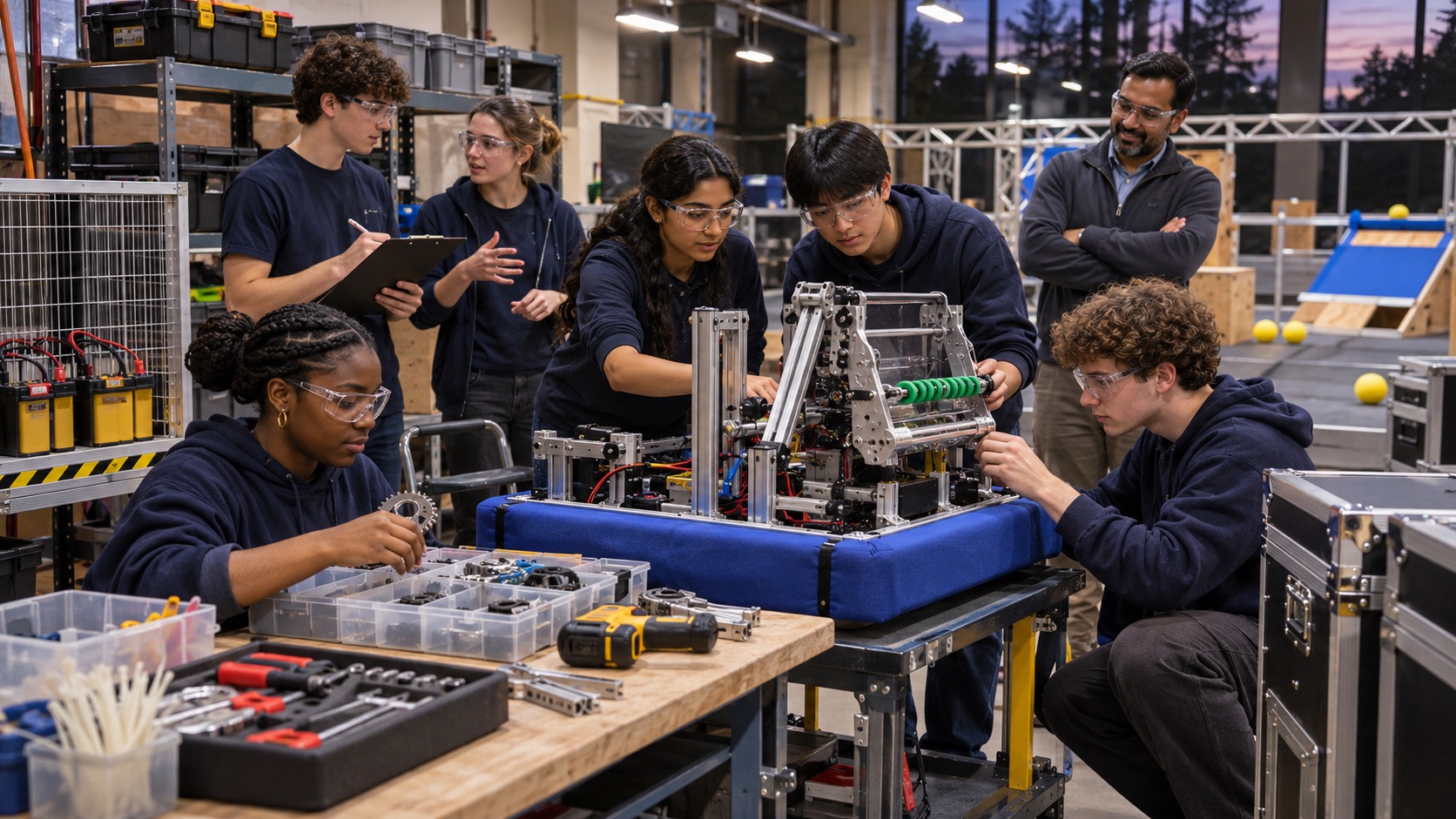
FIRST Robotics Competition gives high-school teams a new game, a fixed season, large robots, alliance play, judged awards, and advancement through regional or district events toward a championship. The engineering challenge is only one part. Teams must recruit, fundraise, manage tools, communicate with judges, build community programs, maintain a machine through repeated matches, and collaborate with partners they may have just met.
This broader model makes FIRST prestigious within education. Excellence includes technical performance, gracious conduct, mentorship, and sustained impact. The best teams function like durable institutions that transfer knowledge across graduating classes.
Its limitations are also instructive. Access depends on mentors, workspace, fundraising, travel, and regional infrastructure. Recognition should include programs that reduce those barriers rather than assuming every school begins with equal resources.
World Robot Olympiad Rewards Several Kinds of Student Excellence
World Robot Olympiad operates through national pathways and an international final, with categories that can include autonomous field missions, robot sports, innovation projects, and future-engineering challenges. Platform choice is broadly open within category rules. That flexibility lets teams work with locally available technology and places emphasis on how they solve the task.
WRO is special because it does not define one image of robotics talent. A small autonomous machine responding to randomized field conditions, a judged solution to a social problem, and an advanced driving challenge require different evidence. Teams must check their national organizer’s rules because local adaptations and available categories can differ from the international final.
VEX Worlds Creates Prestige Through Competitive Scale
VEX programs culminate in a world championship that brings together large numbers of qualified student teams across age and program divisions. Repeated matches reward fast diagnosis, strategic preparation, driver practice where applicable, and mechanisms that survive a long event. A common ecosystem lowers some entry friction and makes direct comparison possible across a wide international network.
Scale changes the engineering experience. Teams encounter many design interpretations, alliance strategies, and pit practices in a compressed period. Qualification itself becomes an achievement because the world event sits at the end of local and regional competition pathways.
Scale can also tempt observers to judge only match results. Engineering notebooks, judged awards, teamwork, and the learning process remain important parts of the program’s educational value.
MBZIRC Tests Autonomy Through Complex Field Missions
The Mohamed Bin Zayed International Robotics Challenge has brought international research teams together around demanding autonomous tasks involving aerial, ground, and sometimes marine systems. Multi-robot coordination, perception in open environments, object handling, and operations under time limits create integration problems that resist a polished laboratory demonstration.
What makes this style of challenge prestigious is the concentration of research capability on a common field mission. Teams must convert papers and prototypes into a deployable system, manage logistics, and recover from conditions they do not fully control.
NASA Lunabotics Grounds Student Design in Planetary Constraints
NASA’s Lunabotics competition challenges university teams around robotic excavation and operations inspired by lunar resource needs. Dust, regolith-like material, mass, energy, communication, autonomy, and remote operation turn a familiar mobile robot into a systems problem shaped by another world.
The prestige comes from engineering context. Students must connect requirements, design reviews, testing, and field performance with a mission-driven purpose. A machine that moves material efficiently but cannot satisfy operational or safety constraints is not a complete solution.
University teams also gain experience in documentation and workforce practices that matter in aerospace. The competition becomes a recruiting and educational bridge, not only a race through simulated soil.
European Robotics League Links Local Events to Repeatable Benchmarks
The European Robotics League has used tournaments and major events to evaluate service, industrial, and emergency robots in task environments. A distributed model can let teams test more often than a single annual championship. Benchmarks create a vocabulary for comparing navigation, manipulation, human interaction, and integrated missions.
This is special because progress can accumulate across events. A laboratory sees whether a capability remains reliable in another venue instead of optimizing for one memorable final.
ABU Robocon Makes Mechanism Design a Regional Broadcast Event
ABU Asia-Pacific Robot Contest brings university teams from participating broadcasters and countries into a yearly game shaped by the host. The challenges often produce inventive mechanisms, rapid cycles, and highly visible head-to-head performance. National selection adds another competitive layer before the international event.
Its prestige rests on regional reach and the way a changing game forces fresh design. Teams cannot rely indefinitely on one mature robot. They must interpret rules, fabricate quickly, train operators, and represent their country or region under public attention.
The event also shows that robotics competition culture is not centered in one educational system. Distinct regional traditions can be technically serious and culturally important without copying a North American or European format.
University Rover Challenge Rewards Field Reliability
Student rover competitions ask teams to operate in outdoor terrain, perform manipulation, navigate, and execute science or service tasks under mission constraints. Dust, sun, radio limitations, transport, and repair make the field part of the test. A rover that looks sophisticated but cannot be deployed repeatedly will not succeed.
This kind of event earns respect because it reveals the unglamorous work behind autonomy: packaging, connectors, thermal management, procedures, spares, operator training, and recovery. The competition converts systems engineering into visible performance.
Formula Student Driverless Brought Autonomy Into Vehicle Engineering
Driverless classes and autonomous events within student vehicle competitions connect perception and planning with a platform already constrained by vehicle dynamics, safety inspection, energy, and team manufacturing. The robot is not a small educational kit but a fast machine whose mechanical and electrical heritage matters.
Prestige arises from crossing disciplines. Autonomy teams must integrate with chassis, brakes, steering, power, telemetry, and the broader vehicle organization. Technical inspection can be as revealing as a timed run.
As event formats evolve, prospective teams should verify which autonomous classes are active in their region. The lasting lesson is the value of testing AI inside a rigorously engineered physical system.
A Prestigious Competition Publishes a Credible Standard
Strong rules specify what is measured, what assistance is allowed, how safety is enforced, and how disputes are resolved. They create room for innovation without rewarding ambiguity. Field elements and judging should behave consistently enough that teams can learn from results.
Qualification and peer quality matter because victory against weak or self-selected opposition proves little. A respected event attracts capable teams, maintains meaningful advancement, and recognizes more than expensive hardware.
Technical exchange multiplies impact. Proceedings, team descriptions, open code, recorded runs, and post-event analysis let people who did not attend inspect what happened. Prestige grows when knowledge survives the ceremony.
Governance completes that standard. Competitors need timely clarifications, conflict-of-interest safeguards, consistent inspection, and a route for raising concerns. Trust in the process lets teams accept difficult outcomes and continue contributing.
Failure Under Shared Conditions Can Be More Valuable Than Victory
Competitions compress uncertainty. Lighting changes, networks become crowded, replacement parts arrive late, and a mechanism that survived practice fails after travel. These conditions can expose assumptions faster than months of isolated work.
The best teams instrument failure and return with evidence. They distinguish a strategic loss from a control defect, a random collision from structural weakness, and an operator mistake from poor interface design. A competition worthy of respect makes that learning possible without compromising safety.
The Most Special Events Change Work Outside the Arena
DARPA challenges helped move autonomy and field robotics into new phases. RoboCup sustains long-horizon research communities. FIRST, WRO, and VEX create educational pathways at enormous scale. NASA, rover, industrial, and regional competitions connect technical work with mission cultures and employers. Their influence cannot be captured by one trophy table.
When evaluating prestige, ask what capability the event made measurable, what community it built, and what participants carried into laboratories, companies, classrooms, and public service. A competition becomes historically important when its constraint remains useful after the winners leave the field.
The strongest legacy can be ordinary practice: safer battery handling, clearer software releases, shared test fixtures, better mentoring, or a graduate who knows how to diagnose an integrated system under pressure. Those effects rarely appear in final standings, yet they explain why respected competitions continue to attract effort.