The International Competition World Is Larger Than Any Single Robot Arena
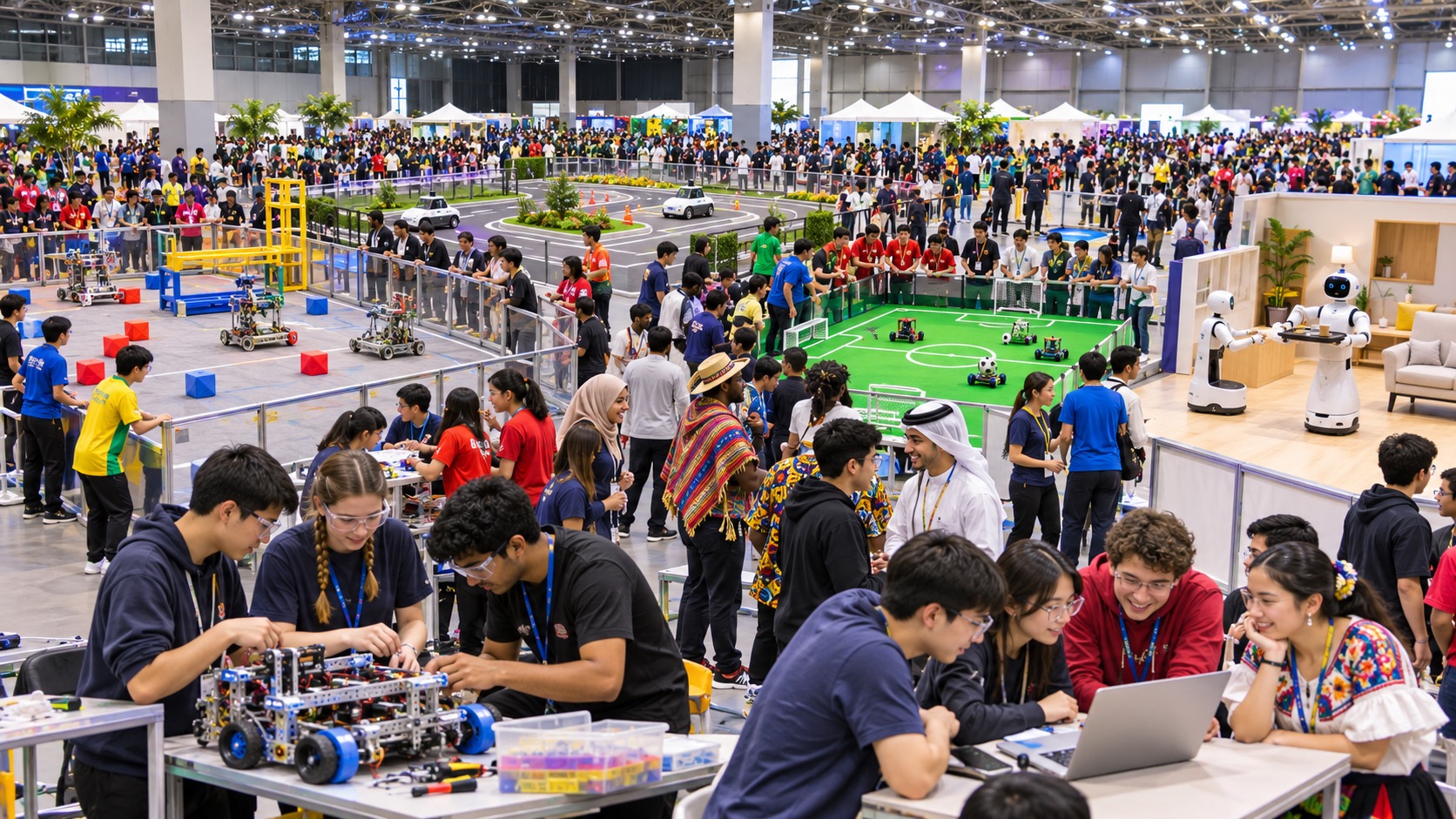
Robotics enthusiasts often encounter competition through one dramatic video: a student machine scores in seconds, humanoids chase a ball, a rover crosses broken terrain, or a research robot opens a door. The global calendar is much broader. Some programs begin with thousands of local teams and narrow toward a world championship. Others invite university or laboratory teams directly into specialized technical trials. “Biggest” can mean participant network, international final attendance, research influence, robot scale, or geographic reach, so this guide avoids a false universal ranking. Instead, it maps the events worth recognizing and explains what a viewer should watch. Rules, hosts, divisions, age limits, qualification routes, and even competition names change. Anyone planning to enter must use the current official materials. For an enthusiast, however, learning the recurring formats reveals how different communities turn robotics into a shared public test.
A: Counts depend on whether one measures global season participation, qualified finalists, divisions, or a single venue.
A: Both use student seasons and advancement, but their platforms, games, awards, organization, and team experiences differ.
A: They generally register through national organizers and qualify through regional or national pathways.
A: No, its federation includes service, rescue, industrial, simulation, and junior domains alongside soccer.
A: A new host-designed challenge forces fresh mechanisms, strategy, and national selection each season.
A: Table-sized autonomous tasks create understandable objectives with considerable strategic and mechanical depth.
A: Terrain, weather, radio distance, deployment, and field repair are central parts of planetary-style systems engineering.
A: Water adds waves, reflections, sealing, corrosion, launch logistics, navigation, and challenging communications.
A: Yes, official streams, rules, team reports, and recorded runs reveal complementary parts of the event.
A: Hosts, divisions, eligibility, qualification routes, and technical requirements can change every season.
FIRST Championship Crowns Several Global Student Pathways
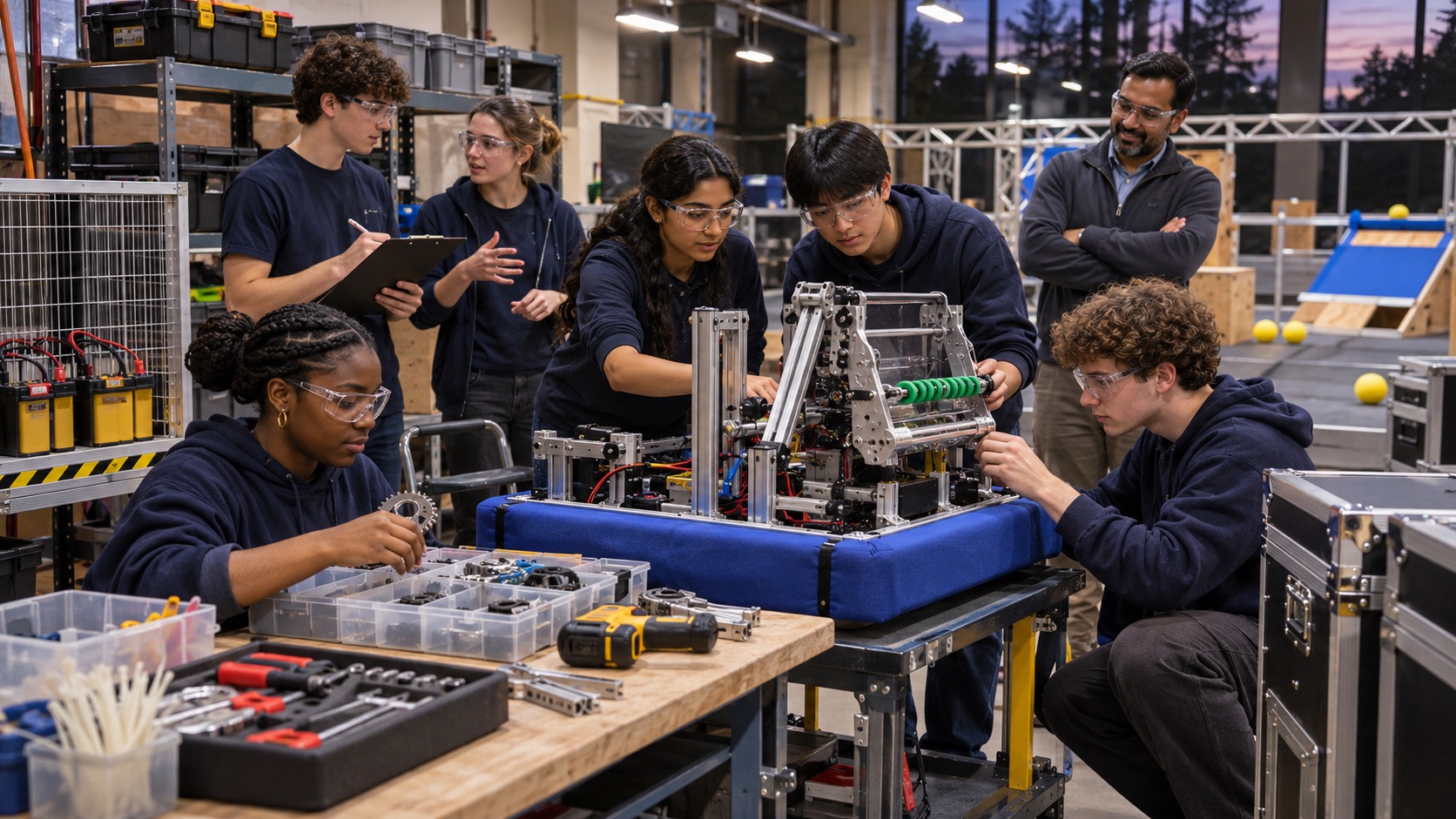
FIRST programs lead students from local seasons toward championship events through age-appropriate formats. FIRST Robotics Competition features large machines in alliance games; FIRST Tech Challenge uses a smaller platform and field; younger programs emphasize accessible design and teamwork. The Championship is both contest and festival, with judged awards, pits, outreach, and partner organizations surrounding the fields.
Watch how teams cooperate inside alliances. A robot with modest scoring may contribute defense, feeding, endgame reliability, or strategic flexibility. The event rewards preparation between matches as much as one perfect run.
VEX Robotics World Championship Is Defined by Scale and Repetition
VEX Worlds gathers qualified teams from a wide international season across multiple divisions. Common field and hardware ecosystems create rapid comparison, while teams differentiate themselves through mechanisms, programming, driving, strategy, and reliability. Repeated qualification matches and elimination rounds mean a design must survive sustained use.
For spectators, the most interesting view is often the pit-to-field cycle. Teams inspect damage, revise code, scout partners, and return quickly. The championship compresses a season of iterative engineering into a few intense days.
Different VEX programs serve different ages and levels, so claims about records or champions should name the exact program and division.
World Robot Olympiad Brings National Teams Into Four Formats
WRO operates in more than ninety countries and culminates in international events. Its categories include RoboMission, RoboSports, Future Innovators, and Future Engineers. Small teams may solve autonomous field tasks, build paired sports robots, present a solution to a real-world theme, or tackle advanced autonomous driving.
The breadth makes WRO useful to enthusiasts who want to compare educational philosophies. Some categories emphasize a scored run; others require explanation, innovation, and entrepreneurship. Hardware is broadly open within requirements, so local availability can shape designs.
RoboCup Is an International Federation of Technical Leagues
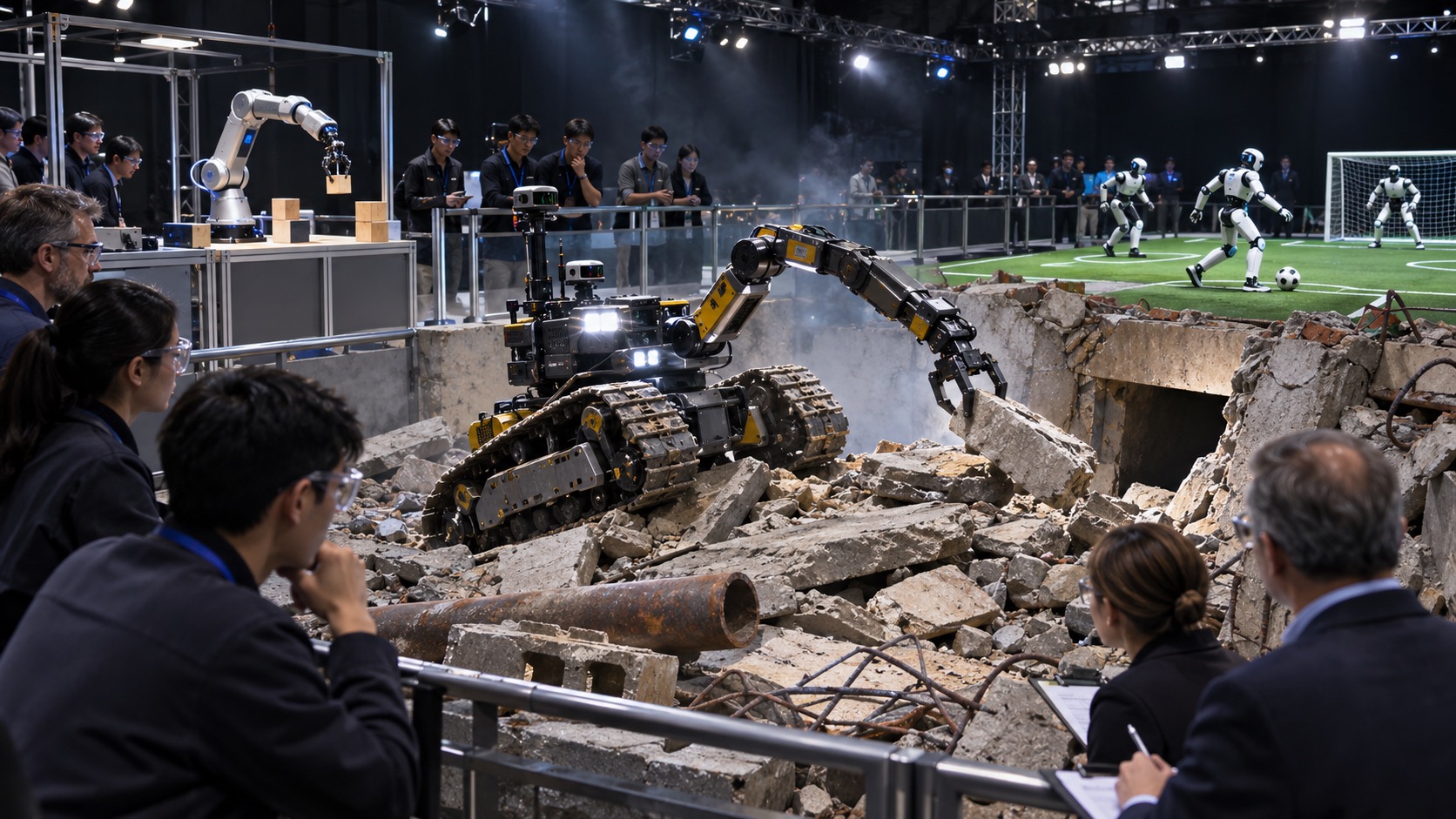
RoboCup is best known for robot soccer and its long-term humanoid goal, but the world event encompasses multiple domains and age groups. Depending on the season, visitors may see physical and simulated soccer, home-service tasks, rescue activities, industrial logistics, and RoboCupJunior challenges.
Each league has its own technical committee, qualification, rules, and platform assumptions. Treating RoboCup as one tournament hides that diversity.
Enthusiasts should watch recovery. A soccer robot that rises after falling, a service robot that asks for clarification, or a rescue system that preserves localization after rough terrain may reveal more maturity than its fastest moment.
ABU Robocon Turns a New University Game Into Regional Theater
National broadcasters and organizers select university teams for the Asia-Pacific Robot Contest. The host shapes a new game, often drawing on a cultural motif or physical challenge. Teams build mechanisms for speed, accuracy, cooperation, and sometimes direct interaction with an opponent.
Because the design problem changes, each year creates a fresh visual language. One season may favor throwing, another stacking, carrying, or navigating. National qualification means the international field has already survived serious competition.
Eurobot Rewards Clever Autonomous Machines and Open Exchange
Eurobot is an international amateur robotics competition built around an annually changing theme and table-sized autonomous tasks. Teams plan scoring routes, manipulate objects, avoid opponents, and fit substantial mechanism into bounded dimensions. The format encourages ingenuity without requiring a full research laboratory.
Its appeal lies in accessible complexity. Spectators can often understand the field objective quickly, then appreciate how differently teams solve it. Strategy must account for limited match time, imperfect localization, and another autonomous machine sharing the table.
Regional and national organization affects the path to finals, so prospective entrants should verify the route for their country.
FIRA RoboWorld Cup Explores Sports and Service Robotics
FIRA has organized international competitions across robot sports, humanoid activities, simulated environments, and application-oriented challenges. Its evolving leagues provide another route for teams working on locomotion, coordination, service behavior, and intelligent systems.
Enthusiasts should examine the current league list rather than assuming every historical format remains active. International federations adjust divisions as platforms and research priorities change.
RoboMaster Combines Large Mobile Robots With Live Strategy
RoboMaster competitions are known for highly engineered mobile robots, active game elements, team strategy, and a polished spectator experience. University teams divide work across chassis, gimbals or launch mechanisms, vision, embedded systems, communications, operations, and match analysis.
The arena makes integration visible. A fast robot without reliable sensing or coordination can be neutralized, while a disciplined team can create advantages through positioning and resource management.
Participation details and regional access may vary. Viewers should distinguish official international events, regional contests, and university programs when following results.
University Rover Challenge Makes the Desert a Systems Test
University teams bring Mars-inspired rovers to outdoor courses involving traversal, manipulation, science, and autonomous navigation. The setting imposes dust, heat, radio distance, transport, and repair demands that a campus demonstration cannot reproduce.
Watch the operators as well as the rover. Interface design, camera placement, communication discipline, and recovery procedures determine whether a capable machine completes a task. Field robotics is a team performance even when the vehicle is autonomous for part of the mission.
European Rover Challenge Connects Competition With a Space Community
The European Rover Challenge similarly gives international student teams planetary-style tasks while surrounding the event with space-sector discussion and outreach. Terrain and mission operations force teams to think beyond a single mechanism.
Multiple rover events are valuable because they create different fields, logistics, and communities. A team successful in one environment still learns when rules, terrain, and judges change.
Fans can compare design choices such as wheel geometry, arm placement, mast height, communications, and the division between autonomy and teleoperation.
International Aerial Robotics Competition Extends the Meaning of Flight
The International Aerial Robotics Competition has historically posed mission problems that require more than piloting around obstacles. Autonomous perception, interaction, navigation, endurance, and strategy define its challenge generations. Long-running missions can remain unsolved across seasons, making persistence part of the culture.
Aerial events are especially sensitive to safety and venue constraints. Official rules, approved platforms, and operating procedures shape what teams can attempt.
RobotX Tests Maritime Autonomy at Full Operational Scale
RobotX and related maritime challenges bring student teams to autonomous surface vehicles, sensor integration, navigation, perception, and mission tasks on water. Reflections, weather, waves, corrosion, GPS behavior, and long communication distances distinguish the domain from a wheeled field.
The competition is large not merely because the vehicle is physically substantial. It requires logistics, launch procedures, power management, waterproofing, and a shore team capable of diagnosing problems between runs.
Viewers should notice mission completion and recovery, not just top speed. Returning a heavy autonomous craft safely is part of competent operation.
NASA Lunabotics Brings Excavation Into Mission Design
University teams develop robotic systems for excavation and resource-handling challenges informed by lunar exploration. Traction, dust-like material, energy, mass, autonomy, communication, and throughput must be balanced. The robot has to operate inside formal constraints rather than simply move the most material by any means.
Design reviews and systems reasoning make the program relevant to enthusiasts interested in aerospace careers. The visible run is the final expression of requirements work performed throughout the year.
RoboSub and RoboBoat Move Autonomy Below and Across Water
International student competitions for autonomous underwater and surface vehicles test sensing, navigation, control, mission planning, and mechanical integrity in aquatic environments. Underwater robots cannot rely on ordinary radio or GPS while submerged, and a minor seal failure can end an entire run.
The events show how domain changes architecture. Cameras, sonar, inertial sensing, pressure, buoyancy, propulsion, and acoustic communication create a very different autonomy problem from a ground robot.
Spectators may see fewer obvious actions than in an arena match, but reliable submergence, localization, and recovery represent major achievements.
International Service Robot Events Put People Into the Task
Home and service leagues ask robots to navigate human spaces, recognize or retrieve objects, follow spoken instructions, interact appropriately, and recover from ambiguity. The field may resemble an apartment or public environment, but the challenge spans perception, manipulation, language, mobility, and social behavior.
Watch how the robot handles uncertainty. A system that requests clarification or reports a limitation can be safer and more useful than one that acts confidently on a wrong interpretation.
Competition Archives Reveal Progress Better Than One Final
Return to several seasons of rules and recorded runs. A task that once consumed an entire match may become routine, while organizers add randomness, autonomy, or interaction to restore difficulty. Team technical reports show which platforms persist and which ideas disappear after one promising demonstration. Historical comparison also protects against judging older robots by current hardware. Their contribution may have been the first reliable integration under the rules available at the time.
Volunteering Offers Another Way Into the International Community
Not every enthusiast arrives with a funded team. Major events depend on inspectors, referees, field reset crews, judges, safety staff, translators, queuers, media volunteers, and local organizers. Official volunteer roles can provide a close view of how rules become operations and how experienced teams behave between runs.
Apply through the organizer and respect training, neutrality, confidentiality, and youth-protection requirements. Volunteering is service, not privileged access for scouting. Done well, it builds relationships and practical understanding that can help someone mentor or form a team later.
The Best Event to Follow Depends on the Robot Question
Choose FIRST, VEX, or WRO to see broad student participation and rapid iteration. Follow RoboCup or service leagues for long-running research benchmarks. Rover, maritime, aerial, and lunar events reveal how environments reshape engineering. ABU Robocon, Eurobot, and RoboMaster turn changing games into inventive mechanism and strategy.
Official livestreams, rulebooks, team technical reports, and recorded finals provide different kinds of understanding. Watch a match for drama, then read the rules to see what was actually difficult. A winning action can be the result of months of mechanical simplification, calibration, scouting, and failure recovery that the camera never shows.
The international calendar changes continuously. Treat this map as a set of communities to investigate, and confirm current dates, eligibility, qualification, and divisions at each organizer’s official site. Following one team across an entire season adds another layer: its design revisions, resource limits, travel decisions, and changing strategy reveal how competitive performance develops rather than appearing fully formed at a championship. That longer view makes apparent surprises much easier to understand.