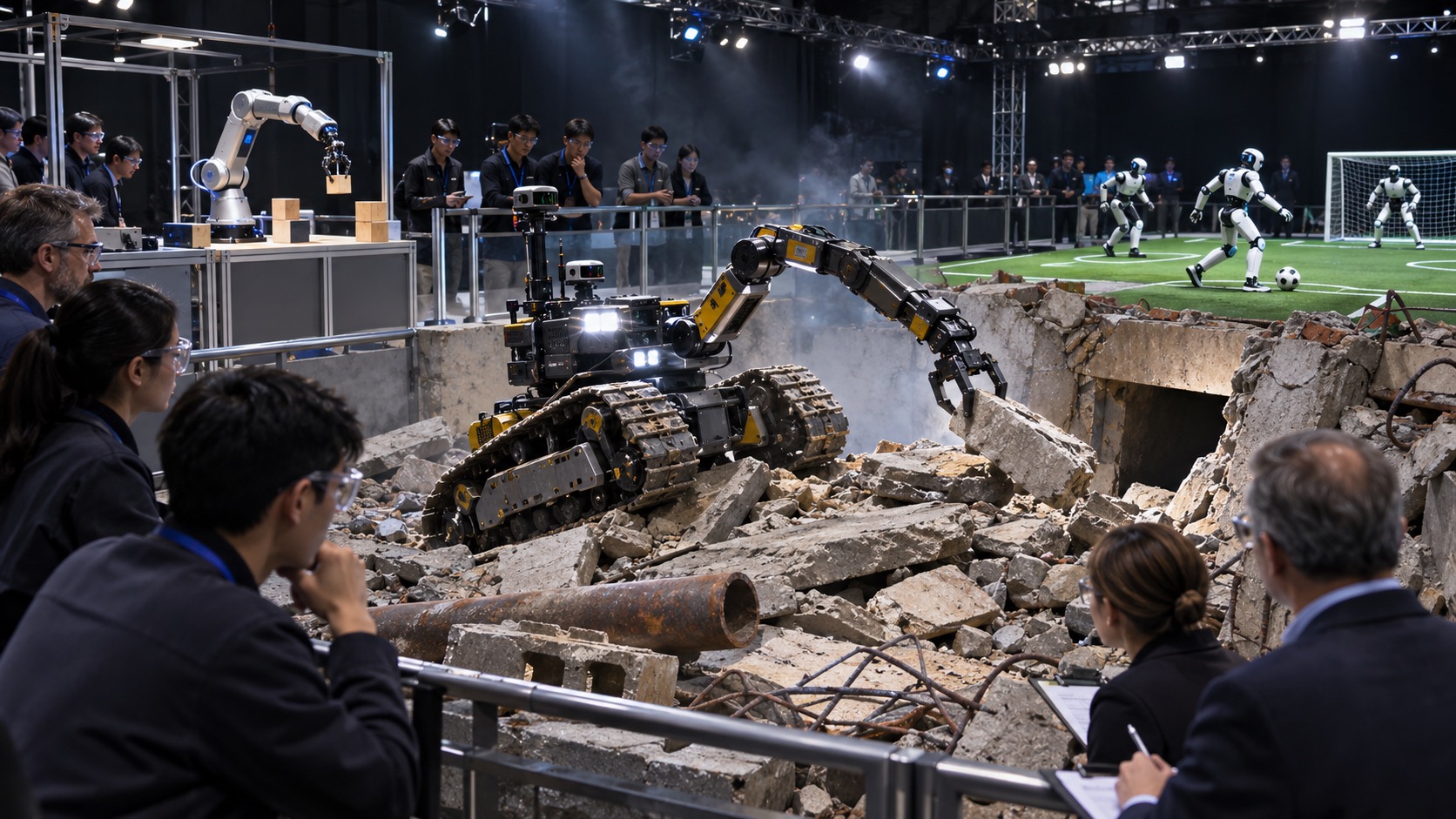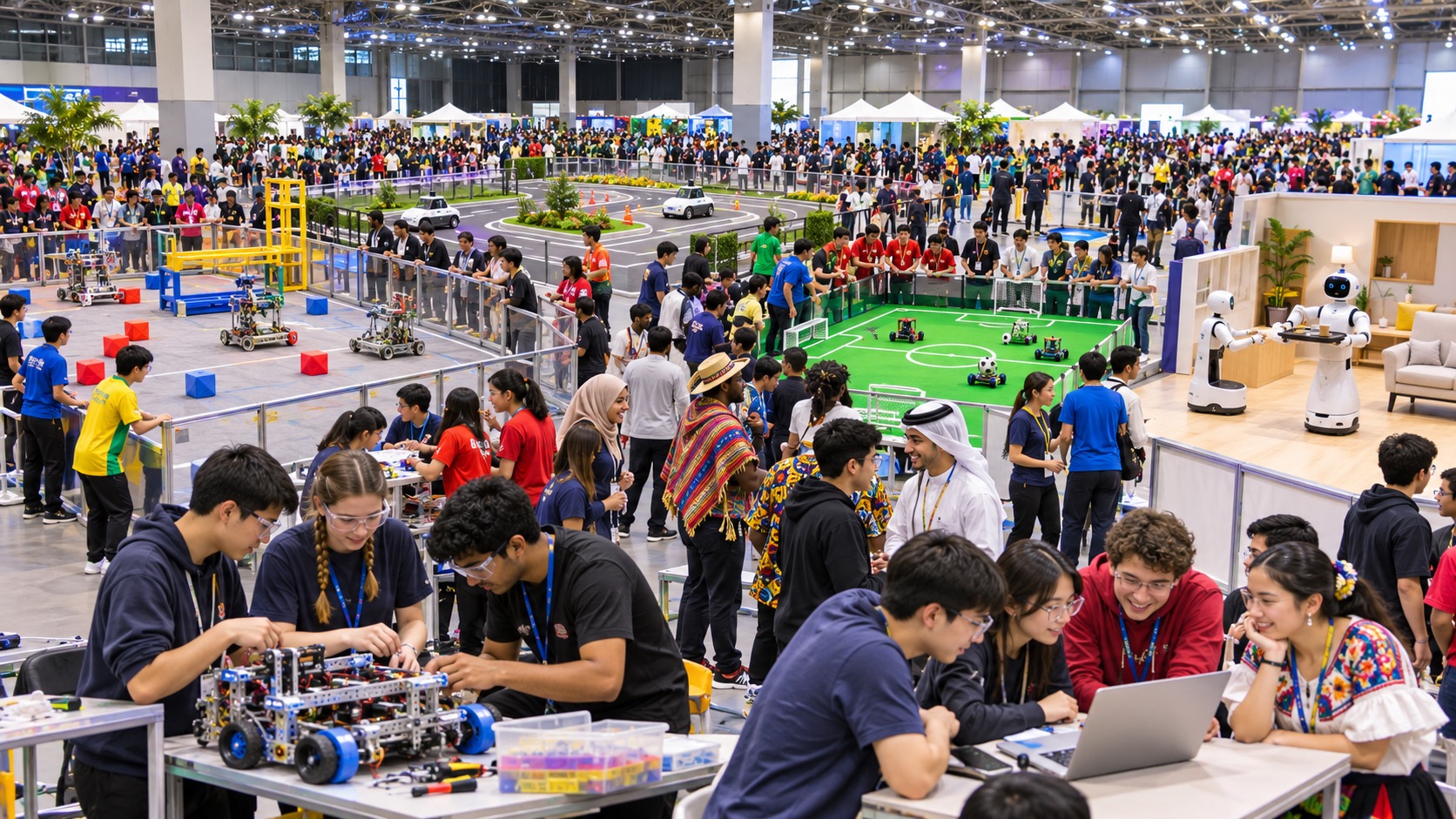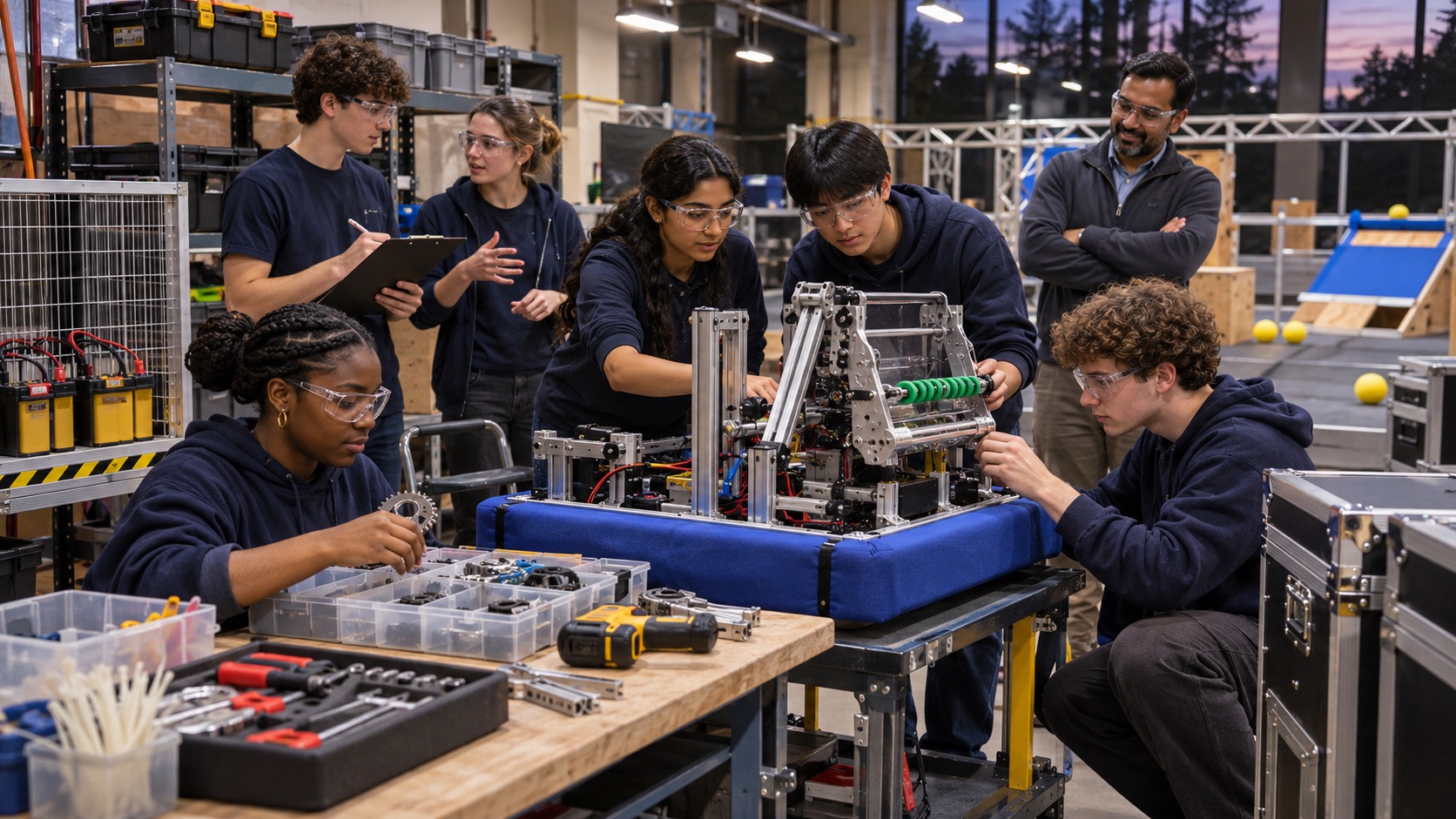
Your First Competition Starts With Eligibility and a Calendar
A first-time team can lose a season before building anything by choosing an event it cannot enter, missing registration, or underestimating the time between a rule release and the first official inspection. Major robotics competitions differ in age limits, school affiliation, national qualification, team size, hardware rules, mentor roles, fees, travel, and safety requirements. Begin by identifying a program whose entry pathway, technical level, and cost fit the people and facilities you actually have. Then create a calendar working backward from the event. Registration, grants, procurement, design reviews, practice-field construction, shipping, visas, and documentation may have deadlines as consequential as the robot. The goal of a rookie season is not to imitate an established champion. It is to field a legal, safe, maintainable machine; give every member real work; and finish with a process the team can repeat. A modest robot that passes inspection and performs one task reliably creates a stronger foundation than an ambitious machine that reaches the venue unfinished.
A: Choose the strongest fit for eligibility, local support, budget, schedule, and technical readiness.
A: Immediately after official release, with several readers comparing interpretations and tracking clarifications.
A: Build the smallest legal capability that contributes reliably, then add features only after repeated success.
A: Finance, safety, documentation, logistics, communications, testing, scouting, and event operations all need ownership.
A: Test the interaction most likely to invalidate the concept, using a quick instrumented experiment.
A: Early checks expose access, legality, and safety problems before the venue and final-week pressure.
A: Count consecutive complete cycles and faults; do not rely on a general feeling that the robot usually works.
A: Robot-specific spares, approved tools, batteries, chargers, cables, documents, protective equipment, and deployment backups.
A: Only with strong evidence and a recovery path; untested upgrades can destroy a known baseline.
A: Safe participation, real member learning, repeated field capability, honest review, and a stronger process for next year.
Choose the Program Before Choosing the Robot
Compare competitions by participant age, qualification route, annual schedule, travel distance, hardware freedom, game format, and support available in your region. A local league with a clear rookie pathway may provide more learning than a prestigious final that requires national selection. Contact the official regional organizer or program partner when the pathway is unclear.
Estimate the complete commitment. Registration may be only one expense. Materials, tools, batteries, field elements, safety equipment, transport cases, lodging, shipping, and replacement parts can dominate the budget.
Watch a full event, including inspection and ordinary qualification rounds. Highlight videos rarely show queuing, repairs, judging interviews, or the hours required to keep a robot operating.
Read the Rules as a Team Engineering Document
Assign several members to read the entire current rule set independently, then compare interpretations. Separate game scoring, robot construction, inspection, conduct, safety, judging, and event procedures. Create a question log with citations to rule numbers and official clarifications. Do not rely on a forum answer when the organizer maintains a formal question system. Rules change during a season, so name one person to track updates and communicate their effect to design owners.
Turn important constraints into tests. Maximum dimensions need a sizing fixture. Starting configuration needs a repeatable checklist. Software restrictions, radio settings, battery types, fastener rules, and protective covers should be verified before the final week.
Register the Organization, Not Just the Machine
Complete accounts, consent forms, roster requirements, background checks, school approvals, tax documents, and payment through the official system. Confirm who is legally responsible for the team and who can make event changes. If grant funding is pending, follow the organizer’s guidance rather than paying through an improvised route that complicates reimbursement.
Store confirmations and deadlines in a shared administrative folder with limited access to personal information.
Registration often opens before the robot challenge is known. Treat organizational readiness as a technical advantage: a settled roster, budget owner, meeting space, and purchasing process let the team act when rules arrive.
Build Roles Around Work That Must Happen
A first team needs responsibility for mechanics, electronics, software, testing, documentation, safety, finance, communications, logistics, and event operations. These are functions, not permanent identities. Members can cross-train, and small teams may combine roles, but every critical task needs a named owner and backup.
Leadership should make decisions visible. Record what was decided, who owns the next action, and when evidence will be reviewed. Unrecorded consensus disappears when meetings end.
Set a Minimum Competitive Capability
Read the scoring system and identify the smallest legal robot that can contribute consistently. The minimum may be mobility plus one easy scoring action, reliable autonomous points, defensive positioning, or a mechanism that supports alliance partners. Design this baseline first and freeze a date when it must work. Optional mechanisms begin only after the baseline passes repeated tests. This approach is not surrender; it creates a functioning platform on which ambitious improvements can be evaluated.
Create a Budget With Decision Gates
Divide spending into registration, core robot, tools, practice field, spares, travel, and contingency. Mark purchases that are reusable across seasons separately from consumables. Establish who approves orders and how members report receipts.
Gate expensive choices with evidence. A prototype should demonstrate geometry or load before the team buys every component. Borrowed tools, community makerspaces, sponsors, and donated material can extend access, but each dependency needs confirmed availability.
Fundraising promises also create obligations. Be accurate about sponsor recognition, student privacy, tax status, and what the team can deliver. A short honest update builds more trust than an elaborate benefit that volunteers cannot maintain.
Prototype the Highest-Risk Interaction First
Do not begin by manufacturing the final chassis. Identify the mechanism, sensor condition, or rule interpretation most likely to make the concept fail. Build a rough test that answers one question: can the object be acquired, can the wheel cross the obstacle, can vision detect the target under venue-like light, or can the manipulator remain inside the legal envelope?
Use inexpensive material and instrument the test. Record dimensions, forces, current, time, success rate, and failure mode. A prototype earns value by changing a decision.
Design for Inspection and Repair
Inspectors need access to electrical protection, batteries, wiring, frame boundaries, identification, firmware settings, or safety features specified by the program. Make those checks easy. A legal component hidden behind a mechanism still consumes precious event time if the team must dismantle the robot to show it.
Repairability belongs in the layout. Use connectors that can be reached, label both ends of critical cables, standardize fasteners, protect wires from motion, and make common failure parts replaceable without removing unrelated assemblies.
Create a robot inspection checklist from the current rules and perform internal inspections during the build, not only before departure.
Treat Software as a Deployed System
Keep code in version control, require meaningful changes to be reviewed, and tag known-working releases. Separate configuration for hardware IDs, limits, and calibration from core behavior. The drive team should be able to return to a stable version quickly after an experiment fails.
Log commands, sensors, state transitions, and faults within the platform’s constraints. A match problem that cannot be reproduced still leaves clues if timing and state were recorded.
Practice the competition deployment procedure on the actual event computer and network arrangement. Remove unnecessary updates and background services only through methods allowed by the platform, and carry approved offline installers or backups where rules permit.
Assign one release owner during the final testing period. That person does not write every line; they protect the baseline, record what is deployed, and prevent several hurried changes from reaching the robot without integration testing.
Build a Practice Field That Answers the Rules
Reproduce the critical geometry and material, not every decorative element. Exact heights, clearances, object mass, surface friction, and starting boundaries matter more than paint. If official field drawings are available, verify the team’s construction against them.
Practice variation deliberately. Change object placement within allowed tolerances, introduce worn game pieces, vary lighting, and begin from small alignment errors. A robot trained on one perfect setup will be surprised by a legal field.
Test Reliability as a Count, Not an Impression
Define a complete match or mission cycle and run it repeatedly without intervention. Record successes, partial results, faults, repair time, battery state, and operator observations. Ten consecutive cycles reveal more than ten demonstrations separated by adjustments.
Use a defect list with severity and owner. Safety failures and events that disable the robot outrank cosmetic problems. Close a defect only after the fix survives the condition that originally produced it.
Run with the event crew, not only developers. Queuers, drivers, operators, pit technicians, and speakers need procedures and handoffs. Human reliability is part of system reliability.
Make Safety Authority Explicit
Train members on tools, batteries, stored energy, lifting, sharp edges, soldering, protective equipment, and emergency response. Establish who can stop work and make it clear that anyone may call a safety halt without debate. Separate charging from fabrication, inspect batteries, control keys or enable devices, and secure the robot during mechanism testing. Follow the organizer’s rules and venue instructions even when the team’s home practice differs.
Prepare Documentation Before the Robot Is Finished
Judged programs may require an engineering notebook, portfolio, technical paper, presentation, or outreach evidence. Start on the first day. Record problem statements, alternatives, prototypes, data, decisions, failures, and individual contributions. Reconstructing a season during the final week produces a polished story but loses the evidence judges and future teammates need.
Prepare short explanations at several depths: one sentence for a visitor, one minute for a judge, and a technical discussion for an expert. Every member should be able to describe the team’s goals and their own work honestly.
Do not let documentation become publicity detached from engineering. Photographs and claims should correspond to the machine, code, and tests that actually existed.
Plan Travel and Shipping Like a Deployment
Confirm venue access, load-in times, power, pit dimensions, tool restrictions, battery transport, shipping labels, customs documents, insurance, lodging, meals, supervision, accessibility, and emergency contacts. International travel may require passports or visas months before qualification is final.
Pack from an inventory. Separate must-have robot-specific spares from tools available at any hardware store. Protect the robot against shock, moisture, and unauthorized power-up. Photograph the packed configuration and weigh cases before arriving at a carrier.
Rehearse the Event Day
Simulate check-in, inspection, queuing, a match or mission, post-run triage, battery change, repair, and return to the field. Put the robot on the clock. The rehearsal reveals missing adapters, unclear authority, slow fasteners, and communication gaps while they are still cheap to fix.
Create role cards or concise procedures without burying the team in paperwork. Identify who carries the robot, who communicates with officials, who records field observations, and who decides whether a risky repair is attempted.
Practice gracious interaction. Officials, volunteers, alliance partners, competitors, and venue staff are part of the operating environment. Clear respectful communication solves problems faster.
At the Venue, Establish a Known Baseline First
Inspect shipping damage, set up the pit safely, confirm software and communication, and run the smallest permitted functional check. Do not install a major untested improvement because another team’s robot creates anxiety. Event time magnifies regression risk.
Pass inspection early, even if optional features are disabled. The resulting feedback gives the team time to correct issues and understand the process.
Use Each Round as a Controlled Experiment
Before a run, state the configuration and intended behavior. Afterward, record what happened before memories converge into a convenient story. Change one major factor when time permits and preserve the last stable configuration.
Scout ethically and specifically. Observe task timing, field conditions, alliance needs, opponent behavior, and common faults rather than ranking teams by reputation. Strategy should fit the robot available for the next round.
Celebrate working subsystems as well as scores. A rookie team that communicates clearly, repairs methodically, and improves across an event is building competitive capacity that a single ranking cannot measure.
Run a Review Before Everyone Disperses
Within days, gather evidence and discuss what to preserve, change, and stop. Separate robot design, project management, fundraising, inclusion, safety, travel, and event operations. Thank sponsors and volunteers with accurate results, then archive code, CAD, configuration, receipts, inventories, contacts, and rule interpretations.
Assign offseason actions with owners. Repair the robot while failures are understood, train new members on the actual system, and update documentation so the next team does not repeat the same discovery. A first competition becomes successful when it creates a second season with better judgment.