Free Source Code Becomes Valuable When It Reveals a Learning Path
A robotics repository can be free to download and still be a poor first project. Code may assume discontinued hardware, hide calibration in undocumented files, or leap from assembly to autonomy without explaining the interfaces between them. The strongest free projects give a maker several usable entry points: build an existing design, run one subsystem, inspect how messages and commands move, then change something whose effect can be measured. Beginners need short feedback loops and low-energy mechanisms. Advanced builders need architecture, extensibility, and enough source material to replace major components. This guide organizes projects by what they teach rather than by spectacle. It includes microcontroller rovers, phone-powered vehicles, ROS 2 platforms, learning-oriented cars, quadrupeds, manipulators, and humanoids. “Free” describes access to files, not the cost of motors, fabrication, batteries, tools, or time. Always check the current official repository, license, component availability, and safety guidance before committing to a build.
A: A low-speed two-wheel rover with separate motor and sensor examples usually provides the shortest debugging loop.
A: Its accessible form can still teach servo centering, printed tolerances, calibration, and coordinated motion.
A: The phone supplies cameras, inertial sensing, networking, and higher-level computation already owned by many builders.
A: It develops transferable understanding of interfaces, transforms, recorded data, mapping, localization, and navigation.
A: Yes, Jetson boards and software images evolve, so original instructions may not fit later hardware.
A: Many joint offsets, structural dimensions, timing, balance, and current demand interact during each gait.
A: Yes, it supports joint control, kinematics, trajectories, vision experiments, and measured repeatability.
A: Its fabrication, alignment, energy, and integration burden make it better suited to experienced makers.
A: No, a hand, arm, or head can serve as a substantial independent project.
A: Tag code, configuration, CAD revision, parts substitutions, and calibration as one known-good combination.
A Two-Wheel Rover Is Still the Best Debugging Classroom
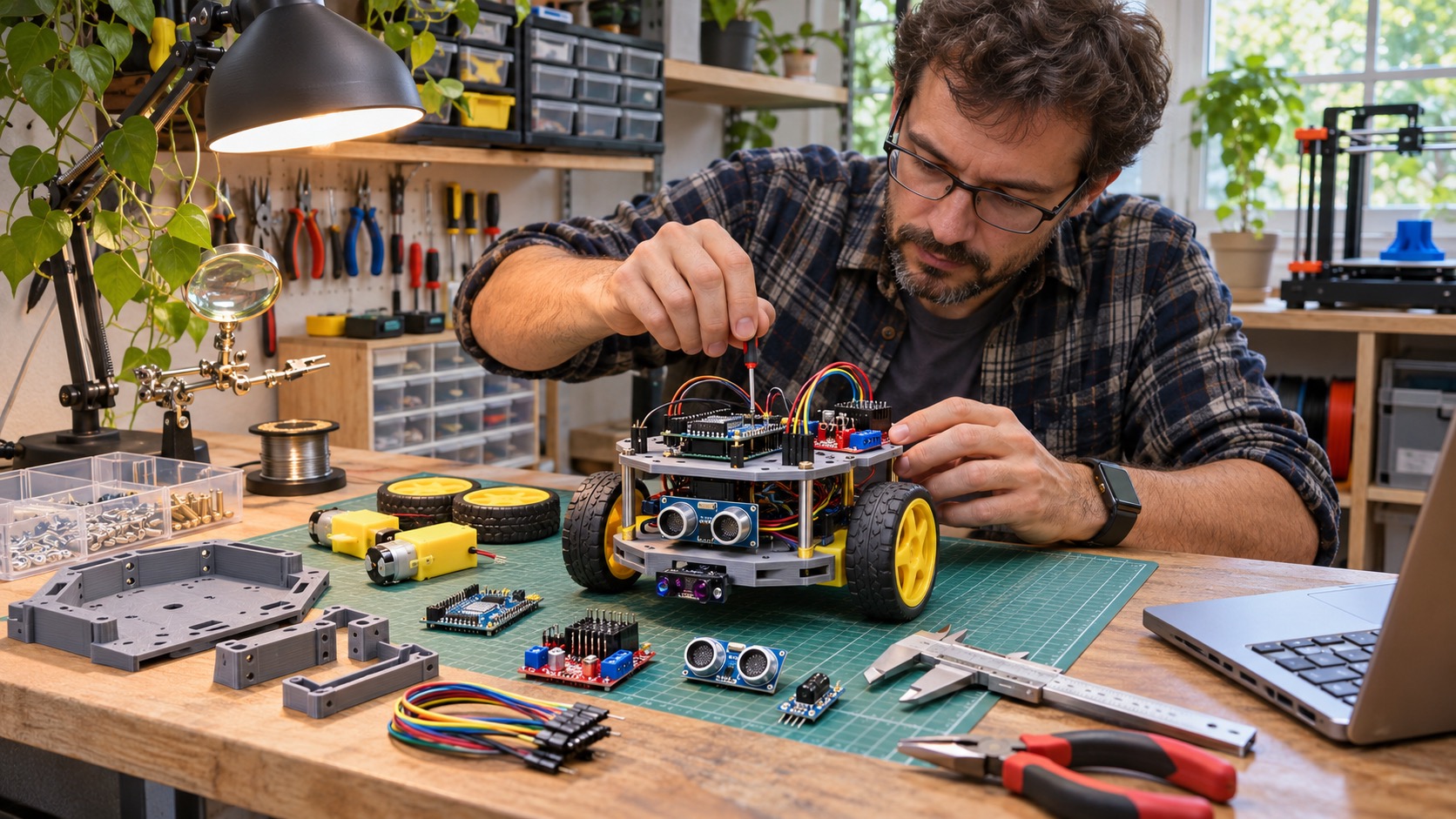
A basic differential-drive rover exposes the essential loop: command two motors, measure or infer motion, read a range sensor, and decide what to do next. A beginner can start with timed motion and discover why battery voltage, wheel mismatch, and surface friction make open-loop turns inconsistent. Adding encoders creates a natural transition to feedback control.
The best free rover repositories publish wiring, pin assignments, a clear bill of materials, and small programs that work independently. Avoid beginning with a monolithic sketch that enables every sensor and behavior at once. The project should let you prove power, one motor, both motors, and one sensor before running the complete application.
Otto DIY Connects Printed Mechanics With Expressive Motion
Otto DIY offers a compact biped form built around printable parts, small servos, and accessible microcontroller programming. It is attractive to beginners because walking, sound, and gestures produce immediate visible results. The robot also teaches a difficult truth: repeated motion depends on physical assembly. Servo centering, horn alignment, foot geometry, friction, and battery condition can matter as much as the sequence in code. Builders who document neutral positions and change one gait parameter at a time can turn a playful machine into a serious calibration exercise.
OpenBot Makes the Smartphone Part of the Architecture
OpenBot uses a phone for sensing and higher-level computation while a comparatively simple vehicle handles motors and low-level control. This division gives makers access to cameras, inertial sensing, networking, and substantial compute without buying a separate embedded AI board. The source includes mobile applications and robot-side components, so the learning task extends beyond assembling a chassis.
Compatibility deserves close attention. Android versions, development tools, application releases, firmware, and controller choices evolve on different schedules. Follow the current official repository rather than an old video, and identify the exact supported combination before fabrication.
For an intermediate maker, OpenBot is especially useful for studying system boundaries. Ask which decisions belong on the phone, which must remain on the controller, how commands are timed, and what happens when the connection disappears.
A ROS 2 Rover Teaches Reusable Robot Software
A generic rover becomes an advanced software platform when it publishes odometry, sensor data, transforms, and diagnostics through ROS 2. Builders can then add visualization, mapping, localization, and navigation without placing all logic in one program. The project teaches interfaces that transfer to other robots: message types, coordinate frames, launch configuration, parameter files, and recorded data.
Choose a rover repository that names a supported ROS 2 distribution and shows the boundary between hardware drivers and higher-level packages. A source tree with many packages is not automatically better. Clear ownership and one verified bring-up path matter more than feature count.
JetBot Introduces the Data Loop Behind Learned Behavior
JetBot pairs a small mobile base with an NVIDIA Jetson computer and learning-oriented notebooks or examples. Its educational value comes from the complete loop: collect data from the actual camera and environment, label or organize it, train or use a model, deploy inference, and observe physical consequences. That loop makes dataset bias and operating conditions tangible. Hardware generations and software images change, so builders must confirm current compatibility rather than assuming original instructions fit every Jetson board.
OpenCat Exposes the Coupling Inside a Quadruped
Petoi’s OpenCat framework provides source for small quadruped robots, including motion skills, calibration, and controller support. Four legs multiply the interactions a wheeled robot avoids. Joint offsets influence stance, body geometry changes foot placement, current demand rises during coordinated movement, and a small timing error can become a fall.
Begin with the supported mechanical configuration and standard firmware. Calibrate on a stand or with the body safely supported, then test slow postures before dynamic gaits. A maker who immediately redesigns the legs, changes servos, and rewrites the gait loses the baseline needed to locate a problem.
Advanced work can add perception, remote commands, or a higher-level computer, but the most transferable lesson is systematic tuning. Logs and repeatable poses matter more than a dramatic walking clip.
Poppy Ergo Jr Makes Manipulation Approachable
Poppy Ergo Jr is a compact multi-joint arm designed for education and experimentation. Its open ecosystem lets builders study configuration, motor control, kinematics, and behaviors without the energy of a large industrial-style arm. A desktop manipulator also creates rich projects: point to locations, sort lightweight objects, follow a trajectory, or coordinate with a camera.
Start by verifying joint identity, direction, limits, and neutral pose. Then measure repeatability before assuming an inverse-kinematics solution will place the tool accurately. Flex, backlash, camera alignment, and object variation often dominate the elegant geometry.
BCN3D Moveo Rewards Advanced Mechanical Discipline
BCN3D Moveo publishes designs for a larger printable arm and appeals to makers who want a substantial fabrication challenge. The build demands more than printing parts. Bearing fits, belt or transmission tension, joint alignment, fastener access, wiring paths, and structural deflection all influence performance. Stored energy and reachable workspace also raise the safety stakes.
Treat Moveo as a long project with subsystem gates. Assemble and validate one joint, document modifications, and build conservative software limits before coordinating the full arm.
A builder should also examine repository age and community adaptations. Older source can remain valuable, but controllers, libraries, and available components may require a carefully documented modernization rather than direct reproduction.
InMoov Turns a Humanoid Into Many Independent Projects
InMoov is a life-size printable humanoid effort whose hands, arms, head, torso, electronics, and behaviors can be approached separately. That modularity is the sensible way to use it. A hand alone provides substantial work in tendon routing, servo placement, calibration, gesture control, and mechanical maintenance. Attempting the entire body as one beginner build multiplies cost and unresolved interfaces.
Advanced makers can use the platform to study expressive motion, voice interaction, vision, teleoperation, or human-scale fabrication. They should preserve safe joint limits and recognize that human appearance can create expectations beyond the system’s actual understanding.
Poppy Humanoid Supports Research-Scale Experimentation
Poppy Humanoid is a modular open platform with many actuators and a body designed for modification. It offers a bridge among education, art, morphology research, and whole-body control. The official project publishes hardware and software under separate open licenses, an important reminder to inspect each layer.
The platform is advanced because its cost and integration burden are real. Balance, synchronized actuation, communication, power, structural wear, and fall protection demand planning. Simulation can reduce risk, but physical validation remains necessary.
Builders who do not need a complete humanoid can still learn from its source organization, component choices, and modular models. Studying a project is a legitimate use even when reproducing it is impractical.
Simulation Projects Remove Cost but Not Engineering Work
A simulated mobile robot or arm can teach coordinate frames, controllers, planning, and sensor processing before hardware is available. Free worlds and robot descriptions allow rapid resets and repeatable experiments. Simulation becomes misleading when idealized friction, perfect timing, or noise-free sensors are treated as reality. Add disturbances, record assumptions, and define what must later be measured on a physical platform.
Repository Health Changes the Real Difficulty Level
Recent commits are only one signal. Look for clear releases, resolved issues, complete setup instructions, documented hardware revisions, and maintainers who distinguish supported configurations from experiments. A quiet repository with stable files can be easier than an active one undergoing constant change.
Read open issues before interpreting them as defects. They may reveal successful substitutions and troubleshooting knowledge unavailable in the main guide. Conversely, many unanswered reports of the same failure indicate hidden work.
Pin the version that you tested. “Latest” is not a reproducible dependency, especially when firmware, mobile applications, operating systems, and CAD evolve independently.
Source Code Should Be Read Before It Is Modified
Trace the program from input to action. Find configuration values, initialization, the main update loop, safety limits, actuator commands, and error handling. Run the smallest example and change one observable parameter. A beginner learns more by predicting a modification before flashing it than by collecting libraries that compile without comprehension.
Advanced makers should map module boundaries and tests. A clean extension often uses an existing interface rather than inserting a feature into the main loop. Preserve a working branch while experimenting.
Choose the Project by the Skill You Want Next
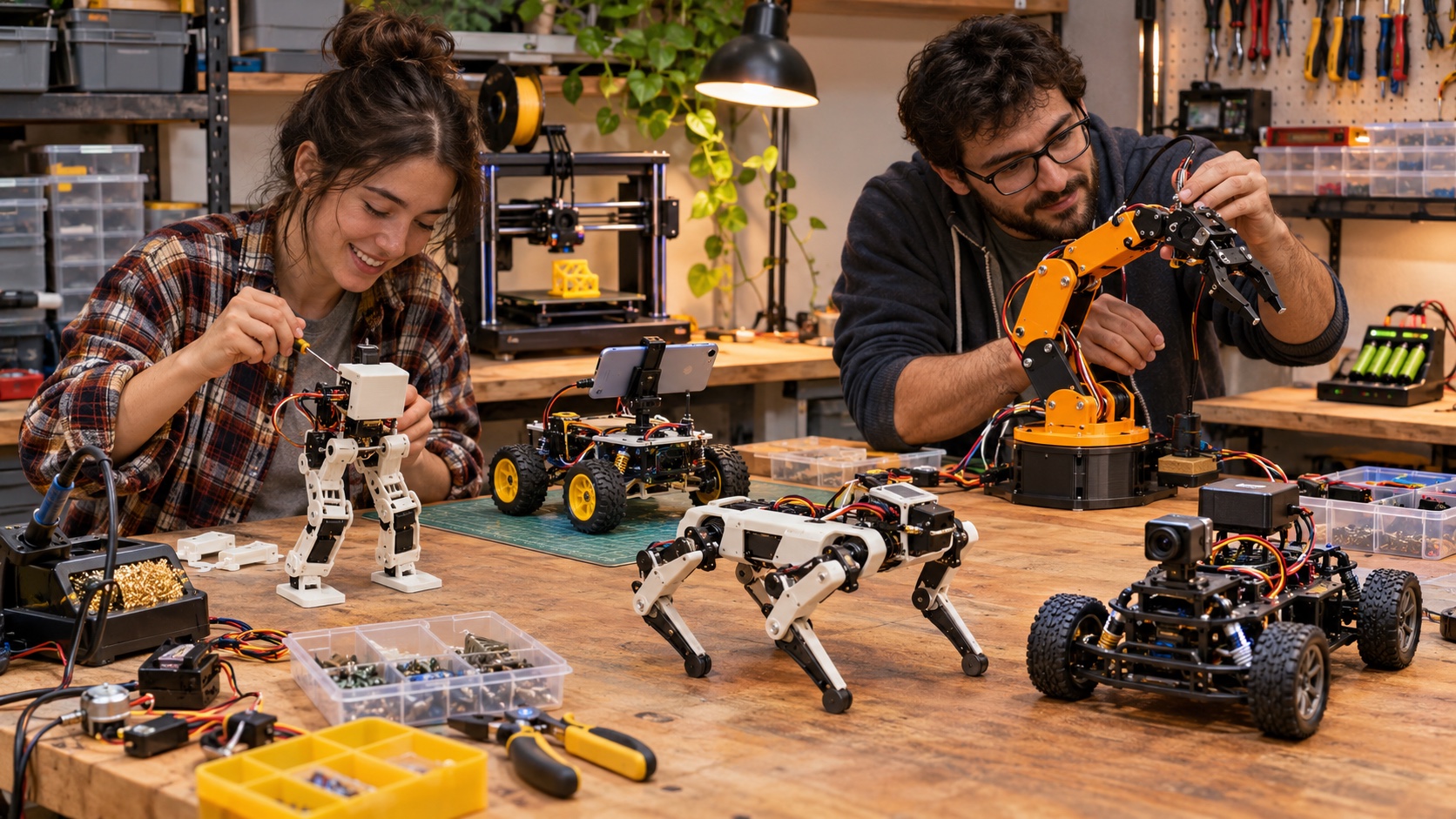
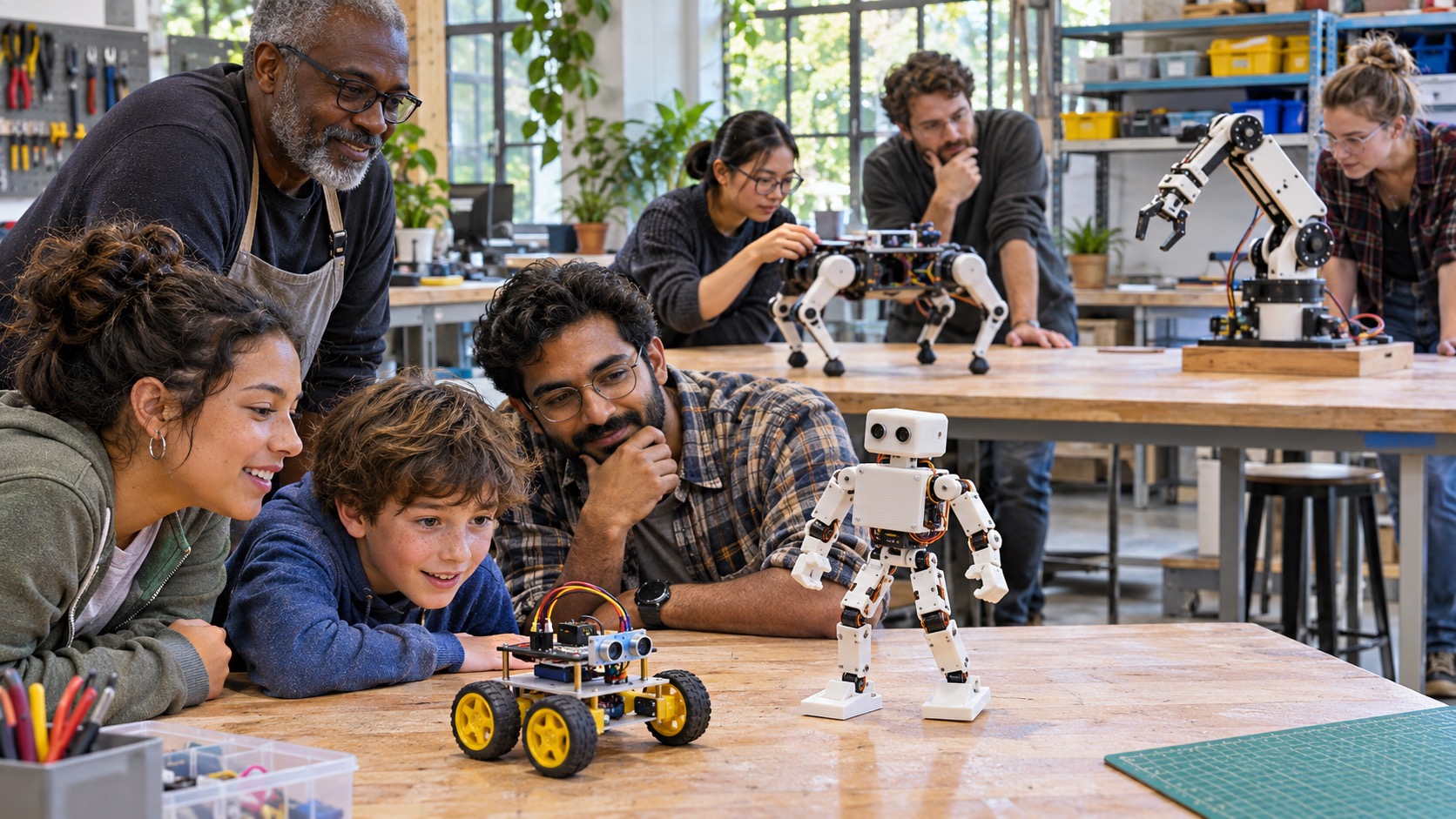
A first rover suits wiring and feedback. Otto adds printed fit and servo calibration. OpenBot adds mobile development and distributed responsibility. A ROS 2 rover develops reusable software interfaces. JetBot focuses the data-to-deployment loop. OpenCat teaches coupled motion. Ergo Jr introduces manipulation, while Moveo, InMoov, and Poppy demand increasingly serious fabrication and integration.
The best sequence is not strictly linear. An experienced programmer may begin with ROS 2 but still need a low-energy chassis. A machinist may handle an arm mechanically while requiring simpler software. Select the project that makes one important skill difficult enough to learn without making every unfamiliar skill fail at once.
Define an exit milestone before starting: reproduce the reference behavior, measure it, and complete one original modification. That boundary prevents an educational project from becoming an indefinitely unfinished collection of parts.
Use a Fork to Preserve a Coherent Experiment
A project fork is useful when a modification changes enough files that a small patch no longer tells the story. Name the supported hardware, explain how the fork differs, and keep upstream history intact so future builders can trace its origin. Do not present an experimental branch as a universally compatible replacement. Periodically review upstream security or reliability fixes, but merge only after testing them on the physical robot. A disciplined fork gives advanced makers freedom without confusing beginners about which instructions, parts, and configurations belong together.
Give Back the Knowledge That the Original Files Could Not Contain
Publish exact substitutions, photographs, configuration, test results, and failure modes. If a library update breaks the build, record the last working version and the verified fix. If a printed joint needs a different tolerance on another process, state the machine, material, orientation, and measurement.
A useful contribution respects the project’s scope and license. Open an issue or focused change rather than assuming maintainers can support an entirely different robot. Clear community evidence is what keeps free source code useful after the original hardware ages.