International Ambition Is Measured by Coordination, Not Geography
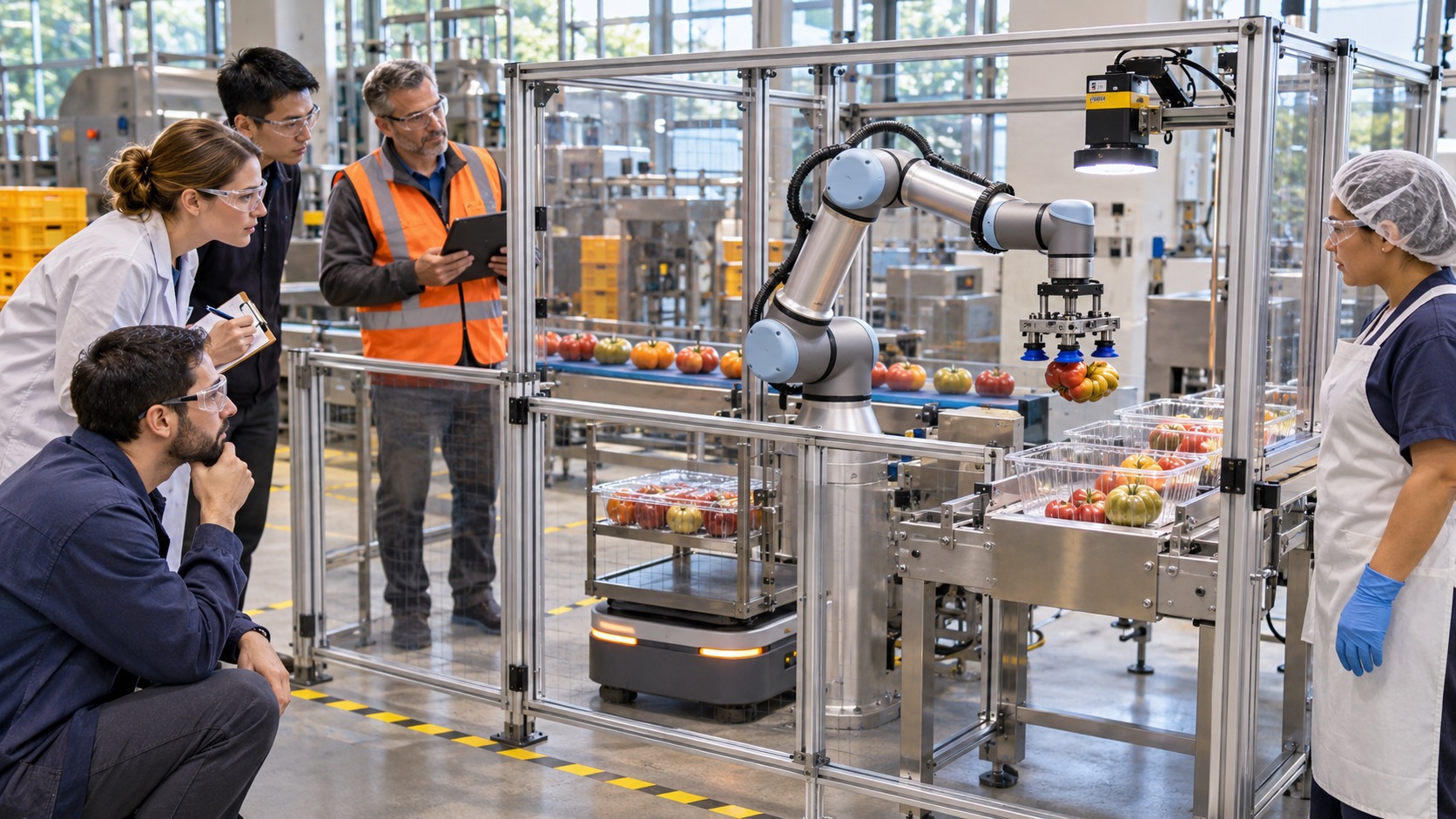
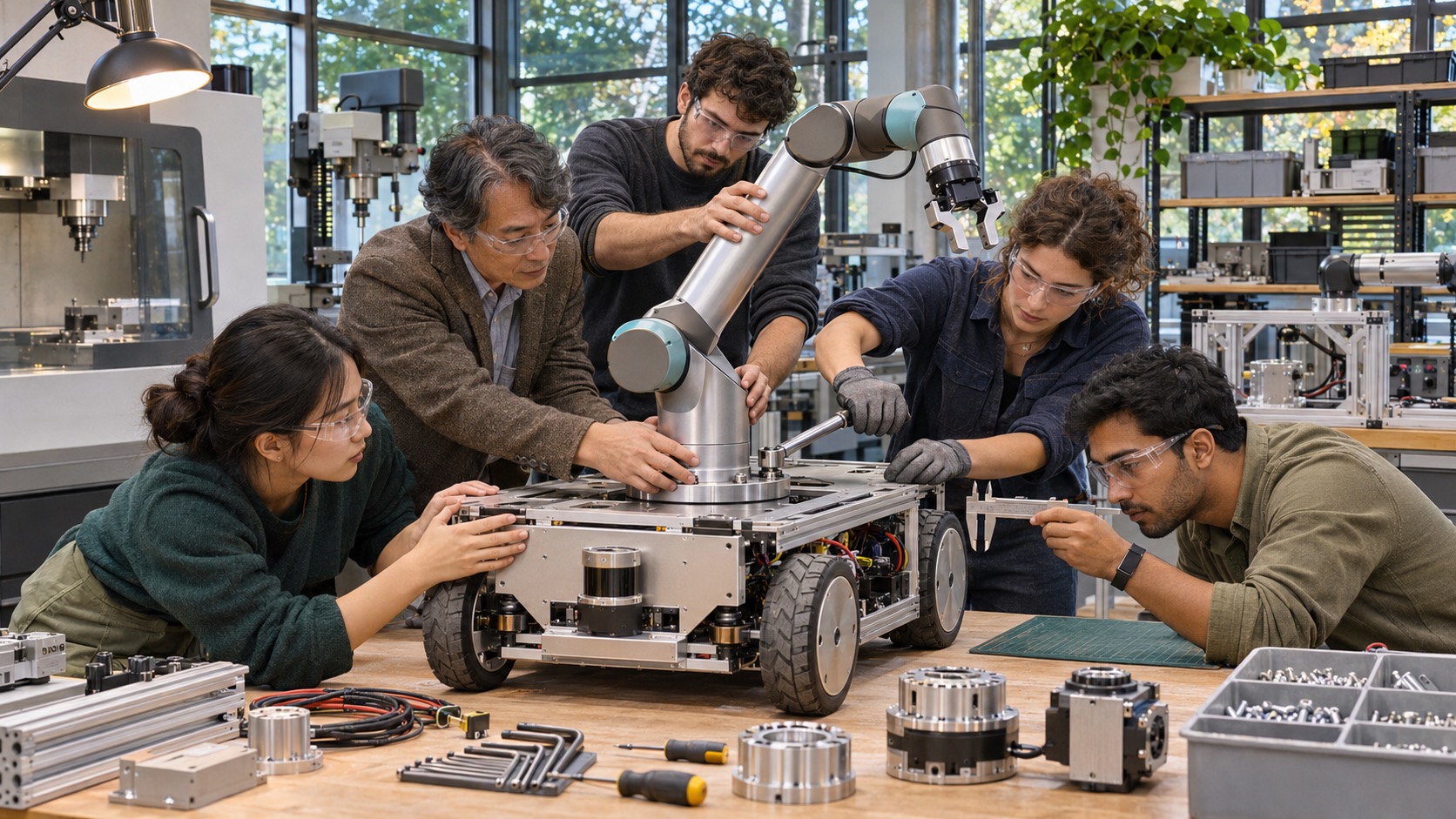
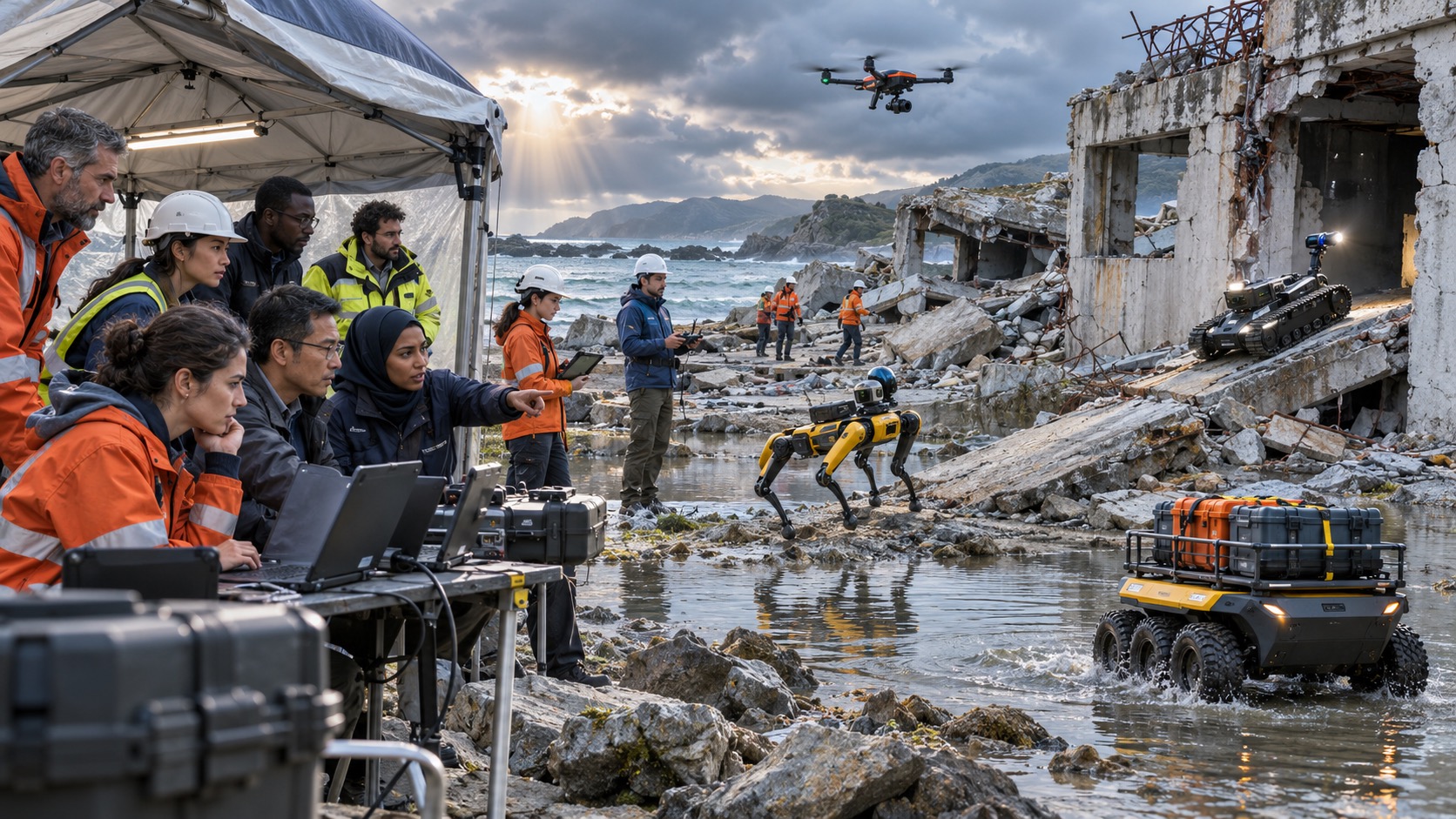
A robotics project does not become ambitious merely because its partner list spans several countries. The difficult work is making different machines, institutions, funding rules, safety cultures, languages, datasets, and research incentives produce one dependable result. The best international collaborations attempt tasks too broad for a single laboratory: transferring robot skills across platforms, mapping an ocean with heterogeneous vehicles, caring for spacecraft, testing disaster autonomy under shared conditions, or building reusable infrastructure for an entire research community. Their scale creates scientific opportunity and organizational risk at the same time. Success depends on modular technical architecture, credible governance, common evaluation, and the willingness to publish failures that reveal where cooperation breaks down.
A: It tackles a consequential shared problem while coordinating different machines, institutions, evidence, and operating constraints.
A: Platforms differ in bodies, sensors, dynamics, interfaces, compute, and safety assumptions that software alone cannot erase.
A: Versioned artifacts, licenses, dependencies, tests, robot descriptions, limits, and people responsible for maintenance.
A: They create common scenarios where teams integrate work, compare outcomes, and reveal failures under shared conditions.
A: No. Core comparisons should be supplemented by local environments, populations, regulations, and workflows.
A: Shared orbital facilities create carefully governed opportunities for agencies, researchers, students, and payload teams.
A: They exposed mobility, communication, manipulation, reliability, and supervision limits through visible common tests.
A: Administrative boundaries may divide dependencies that interact physically in the complete robot.
A: Maintained infrastructure, standards, datasets, trained people, recurring tests, or an institution with clear ownership.
A: A reusable way for independent teams to exchange capabilities, validate them, resolve failures, and extend shared work.
euROBIN Is Building a Network for Transferable Robot Knowledge
The European Robotics and AI Network brings laboratories together around physical interaction, robot learning, knowledge representation, and human-centered design. Its central ambition is transfer: skills and software should move between robots, research groups, tasks, and application domains instead of remaining trapped inside one demonstration.
That goal is harder than sharing code. Hardware differs in geometry, sensors, dynamics, interfaces, and safety limits. Reusable knowledge needs explicit assumptions, adapters, tests, and descriptions of where transfer fails.
Collaborative competitions and repositories provide common work. Manufacturing, personal assistance, and outdoor robotics become proving grounds where partners can compare methods while contributing to a wider technical base.
EuroCore Treats a Repository as Research Infrastructure
A shared repository can connect software, data, and knowledge only when contributions are discoverable and reproducible. Versioned dependencies, robot descriptions, licenses, benchmark conditions, and maintainers matter as much as the algorithm. Otherwise, collaboration becomes a list of links that each new team must reverse-engineer.
International Challenge Teams Make Heterogeneous Robots Cooperate
Door-to-door delivery experiments have combined aerial, wheeled-legged, and mobile-manipulation systems from several institutions. The ambitious part is not any one platform. It is the handoff of maps, objects, task state, and responsibility across machines built by teams with different technical histories.
Shared field tests expose integration assumptions early. Coordinate frames, object identifiers, network timing, and recovery rules that looked obvious inside one lab become negotiation points. Resolving them produces infrastructure useful beyond the challenge.
COROB Coordinates Multi-Robot Manufacturing Across a Consortium
Cooperative welding and additive-repair projects connect robotics, inspection, process monitoring, artificial intelligence, and industrial pilots. Multi-robot work magnifies timing and safety issues because each machine changes the workspace available to the others.
International consortia contribute different expertise and facilities, but integration needs one technical authority. Interfaces and acceptance tests must be owned across work packages, or every component can pass while the complete cell fails.
External participants can widen experimentation when open calls provide clear hardware access, evaluation, and IP terms. Adding partners without integration support increases activity, not capability.
PIPEON Connects Robotics With Europe’s Hidden Infrastructure
Autonomous sewer inspection and maintenance requires experts in in-pipe mobility, mapping, sensing, manipulation, and utility networks. Different regions also bring different pipe geometries, records, and maintenance practices. Those variations make international evaluation valuable.
Ocean Collaboration Requires Machines to Work Through Silence
International ocean projects coordinate autonomous underwater vehicles, surface vessels, aerial systems, fixed sensors, ships, and shore teams. Because underwater communication is sparse, vehicles cannot depend on continuous supervision or high-bandwidth sharing. Mission plans must decide what each robot can infer independently.
Scientific collaboration adds another layer. Measurements need common calibration, time, location, and provenance before researchers can combine them. A technically successful dive can still fail scientifically if records cannot support comparison.
Space Robotics Makes International Interfaces Physical
The International Space Station is already an international technical system, so robots operating there interact with multinational modules, procedures, crews, and ground teams. Free-flying Astrobee activities and the Kibo Robot Programming Challenge show how shared orbital infrastructure can support research and education across borders.
Space access demands staged validation. Simulation, ground replicas, safety review, uploaded software, crew procedures, and limited flight time form a chain in which every partner depends on the previous evidence.
The challenge is governance as much as autonomy. A robot command has operational consequences in a shared facility, so authority, logging, rollback, and responsibility must remain unambiguous.
Robonaut Joined Government and Industrial Engineering
NASA and General Motors collaborated on Robonaut 2, joining space requirements with industrial experience in dexterous machines and human work. The project illustrates how a partnership can produce sensing, actuation, and control knowledge with uses beyond the original mission.
Disaster Challenges Create a Common Test Without Prescribing One Robot
The DARPA Robotics Challenge brought university, company, and government teams to shared disaster-response tasks. Some built humanoids; others pursued stable multi-limbed machines or adapted existing platforms. Common scenarios allowed radically different architectures to confront comparable obstacles.
The lasting value included public failure evidence. Falls, communication losses, slow manipulation, and operator burden revealed the distance between laboratory capability and field autonomy. International teams could learn from one another without pretending a single design had won the entire problem.
Multi-Robot Triage Projects Coordinate Sensing Under Pressure
Recent challenge teams have combined aerial mapping, ground navigation, perception, and medical indicators to support mass-casualty assessment. The ambition lies in delivering useful information to responders, not replacing clinical authority with an algorithm.
International participation broadens technical approaches and exposes systems to different institutional assumptions. It also requires careful definitions for casualty identity, uncertainty, communication loss, and human decision rights.
Evaluation must penalize confident error, not merely reward detection volume. In high-stakes work, a shared metric shapes the behavior teams optimize.
RoboCup Uses a Distant Goal to Sustain a Global Community
RoboCup’s long-term challenge of robot soccer has created annual pressure on perception, motion, coordination, and strategy while supporting rescue, service, and education leagues. Common rules let teams compare progress, yet regular changes prevent overfitting to one frozen task.
International Standards Turn Project Lessons Into Durable Agreements
Collaboration often reveals that robots cannot share environments or components without common terminology, tests, safety concepts, and interfaces. Standards groups translate repeated project experience into documents that outlast a consortium.
Consensus is slower than one team’s implementation because participants represent manufacturers, users, researchers, regulators, and regions. That friction is useful when it uncovers assumptions a local design treated as universal.
Common Benchmarks Need Local Context
A shared benchmark makes results comparable, but it can reward performance irrelevant to actual deployment. International projects should combine a core test with regional or domain-specific trials. The core reveals method differences; local variants reveal whether conclusions travel.
Datasets require the same care. Languages, built environments, work practices, bodies, and regulations differ. Broader collection can improve robustness, but only when consent, governance, labeling, and known gaps remain visible.
Benchmark leadership should rotate or include independent review. Otherwise, the partner controlling the test may unintentionally favor its own platform and research history.
Funding Structures Can Fragment the Robot Into Work Packages
International grants often divide tasks among institutions for accountability. Robots, however, fail across boundaries: mechanical compliance affects perception, networking affects control, and user workflow affects planning. Integration milestones must cut across administrative packages.
Governance Decides What Happens When Partners Disagree
A consortium needs technical leadership, change control, data policy, publication rules, conflict resolution, and a process for adding or removing components. These mechanisms should be exercised before a crisis. A paper plan is insufficient if nobody knows who can stop a field test.
Credit also matters. Hardware teams, integration engineers, dataset stewards, and field operators can disappear behind algorithm publications. Transparent contribution records improve fairness and make future collaboration more trustworthy.
Sustainable Collaboration Leaves an Institution Behind
Projects end, but a maintained repository, recurring challenge, shared facility, standard, training network, or independent association can preserve their value. Sustainability requires owners, funding, and scope. Declaring a platform permanent does not create maintenance capacity.
The strongest international programs teach partners how to collaborate again. They retain interface decisions, field protocols, legal patterns, and relationships that lower the cost of the next ambitious mission.
Succession must be planned before original investigators depart. New maintainers need access, documentation, decision history, and authority to retire components that no longer serve the community. Preservation without renewal turns shared infrastructure into an archive rather than an operating platform.
The World-Scale Result Is a Reusable Way of Working
One spectacular robot can attract attention, but the deeper achievement is a system that lets many groups contribute without erasing their differences. International robotics advances when teams can exchange capabilities, test them honestly, resolve failures, and preserve the shared infrastructure. Ambition is therefore visible not only in the machine’s task, but in the number of institutions that can extend the result after the original demonstration is over.
Language and Travel Are Technical Infrastructure Too
Meetings conducted in one language can concentrate decision power among fluent speakers even when the consortium is formally equal. Written proposals, diagrams, recorded decisions, and asynchronous review give partners time to interpret complex issues. Translation of safety material deserves particular care because ambiguous instructions can become physical hazards.
Travel cannot be the only route to influence. Visa barriers, cost, caregiving, disability, and institutional restrictions shape who reaches integration events. Remote access to logs, hardware replicas, simulation, and decision forums helps preserve technical participation between field trials.
Supply Chains Test Whether a Shared Design Is Truly Global
A component easily purchased in one country may be restricted, unsupported, or prohibitively expensive in another. International teams should record export constraints, lead times, certifications, and substitutable interfaces while choosing hardware. Otherwise, a supposedly reusable platform reproduces only at the coordinator’s site.
Local fabrication can improve resilience, but drawings must state tolerances, materials, finishes, and inspection methods. “Build from CAD” is not enough when performance depends on machining practice or unavailable processes. Cross-site builds are valuable experiments in whether documentation captures the design.
Long-term projects also need plans for obsolete sensors, batteries, and compute modules. A controlled replacement procedure keeps partners aligned while allowing regional substitutions. That is less glamorous than a field demonstration, but it determines whether the collaboration survives its original bill of materials.
Public Communication Should Match the Consortium’s Evidence
Large projects face pressure to present a unified success story. Communications teams should distinguish a simulated result, laboratory integration, controlled field trial, and routine operation. They should also state which partners performed the work and which claims remain hypotheses.
Honest communication protects technical cooperation. When publicity exaggerates autonomy or readiness, field partners bear expectations they did not create and researchers may become reluctant to share failures. A consortium that reports limitations clearly is more likely to attract collaborators who can solve them.
Ambition Should Include Who Can Join the Next Experiment
A truly global program is substantially stronger when participation is not limited to institutions that already own expensive platforms. Simulation access, shared datasets, travel support, loaned hardware, documented interfaces, and open challenge tracks can bring smaller laboratories into meaningful work. Inclusion should not mean lowering technical standards; it means exposing the standards early and providing credible routes to meet them. New partners contribute different environments and failure cases, making the system more likely to generalize. A collaboration that widens the community capable of testing its ideas leaves a deeper legacy than one that only concentrates resources among its founders.