Influence in Robotics Is a Chain of Ideas, Machines, and Institutions
Robotics has no single inventor because a robot combines mechanical design, control, sensing, computation, power, manufacturing, and ideas about human purpose. Its history stretches from programmable automata to feedback theory, industrial arms, artificial intelligence, mobile machines, and robots designed to communicate with people. The most influential figures did more than create memorable devices. They supplied concepts others could reuse, built institutions that trained new researchers, converted laboratory principles into durable platforms, or changed what society expected a machine to do. A useful history therefore resists hero worship. It connects each person to collaborators, prior art, technical limits, and the later systems that made the contribution consequential.
A: Modern robotics combines too many separately developed layers for one inventor; the answer also changes of modern robotics; the answer changes with definitions of automata, control, industrial robots, and autonomy.
A: No. His play popularized the word, while its artificial workers were biological rather than metal machines.
A: Cybernetics provided a general framework for feedback, control, and communication in animals and machines.
A: His programmable article-transfer invention helped establish stored instruction as an industrial robot architecture.
A: He built an organization that commercialized industrial robots, developed applications, and built the organizational system required for adoption.
A: It integrated sensing, world representation, planning, and mobile action in one influential research platform.
A: His computer-controlled articulated arms became important platforms for manipulation research and industrial development.
A: It strengthened an embodied approach in which layered behavior and real-time interaction could precede complete internal modeling.
A: She helped establish social robotics as a field concerned with expression, attention, interaction, and human interpretation.
A: Complex robots depend on distributed mechanical, electrical, software, integration, operational, and institutional contributions.
Al-Jazari Joined Mechanical Ingenuity With Programmable Sequence
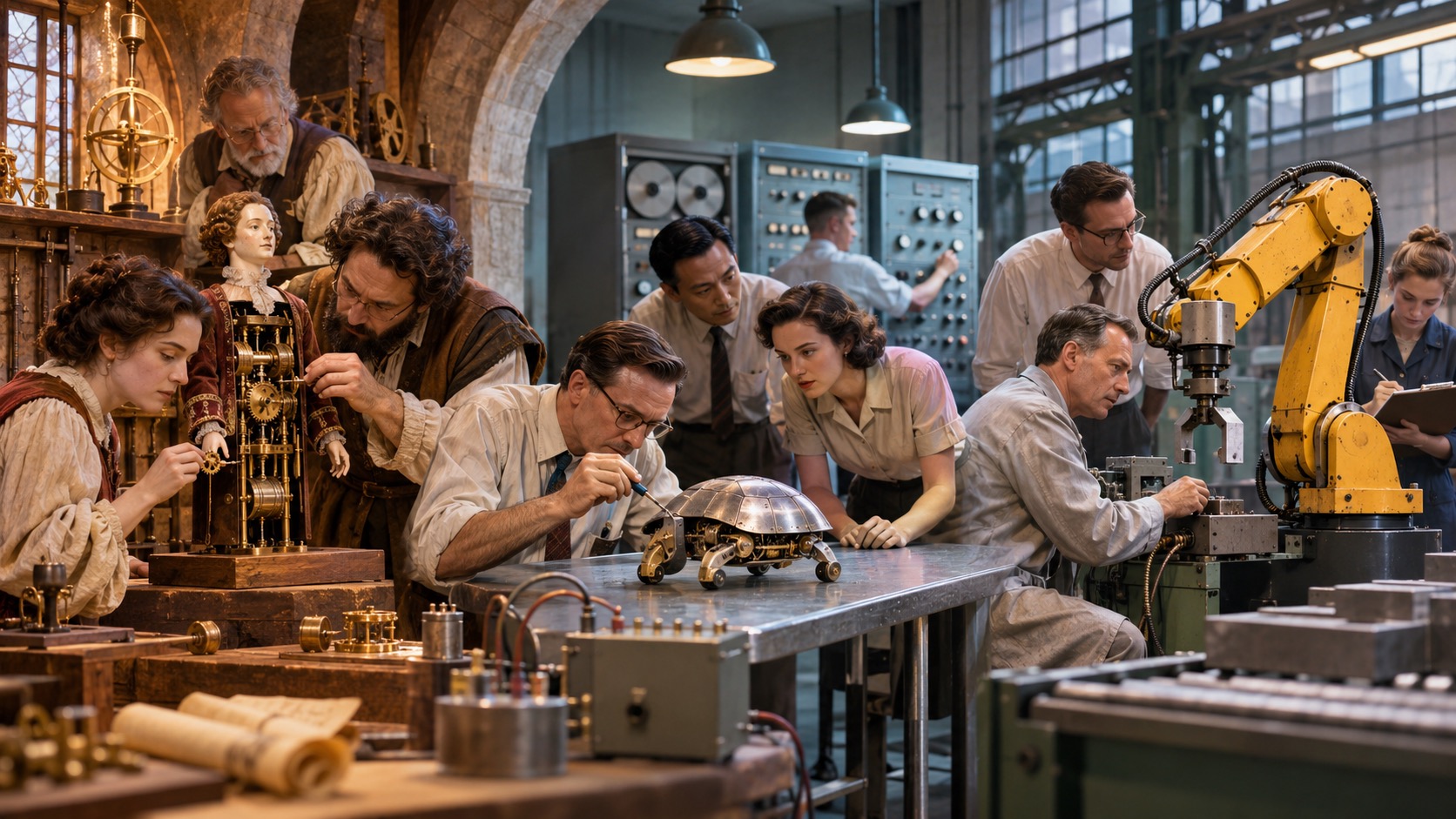
In the early thirteenth century, engineer Ismail al-Jazari documented water- and weight-driven machines, clocks, pumps, and automata. His work matters to robotics history because it combined mechanisms, control of sequence, and detailed engineering description. A celebrated musical-boat automaton could vary performance through configurable pegs, an early example of behavior shaped by a physical program.
These devices were not robots in the modern electronic sense. Their influence lies in showing that complex, timed behavior could be embodied in a machine and communicated through drawings and instructions. Documentation allowed mechanical knowledge to travel beyond the original workshop.
Leonardo da Vinci Treated Human Anatomy as a Mechanical System
Leonardo’s studies of anatomy, gears, pulleys, and motion included designs later interpreted as a mechanical knight. Whether reconstructed devices match every original intention matters less than the method: observe a body, decompose its movement, and imagine mechanisms that reproduce selected functions.
That approach remains central to robotics. Humanoid joints, tendon-driven hands, walking machines, and surgical devices all translate biological movement into engineering abstractions rather than copying appearance alone.
Leonardo also illustrates the limit of private invention. Ideas have little technical influence until drawings, materials, fabrication, and institutions permit others to build, test, and extend them.
Karel Čapek Gave the World a Word for Manufactured Workers
The 1920 play R.U.R., written by Karel Čapek, introduced “robot” to a wide public, drawing on a Czech word associated with forced labor; Čapek credited his brother Josef with suggesting the term. The fictional workers were artificial biological beings, not metal machines, yet the word became attached to automation.
Norbert Wiener Made Feedback a General Language
Norbert Wiener’s cybernetics connected control and communication in animals and machines. Feedback explained how a system could compare observed behavior with a goal and act on the difference. That language unified problems previously treated separately across engineering, biology, and computation.
Modern robots still depend on feedback at many levels: motor current, joint position, balance, visual tracking, force control, and task progress. Wiener’s influence is not a single robot but a way to reason about purposeful behavior under disturbance.
W. Grey Walter Built Simple Machines With Emergent Behavior
Neurologist W. Grey Walter created small turtle-like robots called Machina speculatrix in the late 1940s and early 1950s. With modest sensing and circuitry, they could seek light, avoid obstacles, and return toward charging. Their behavior appeared richer than the number of components suggested.
The machines demonstrated that lifelike behavior need not require a detailed internal model. Interaction among simple control loops, a body, and the environment could produce patterns worth studying.
Walter also used public demonstrations to make cybernetic ideas tangible. That visibility encouraged both serious research and exaggerated interpretation, a tension robotics still faces whenever a compact behavior is mistaken for general intelligence.
George Devol Turned Programmable Handling Into a Patentable Machine
George Devol’s programmable article-transfer invention described stored instructions controlling a machine that could move objects through a sequence. The concept separated a reusable mechanism from one permanently fixed cycle, helping establish the architecture of industrial robotics.
Joseph Engelberger Built the Industry Around the Invention
Joseph Engelberger worked with Devol to commercialize the Unimate through Unimation. His influence came from converting an invention into a product, persuading manufacturers, building an organization, and defining applications where robots could handle dangerous or repetitive work.
The first industrial deployments required more than an arm. Reliability, installation, programming, service, and customer confidence had to develop together. Engelberger’s career shows why commercialization is an engineering contribution when it creates the system around a mechanism.
Victor Scheinman Made the Computer-Controlled Arm More General
Victor Scheinman developed influential electrically powered, computer-controlled manipulators, including the Stanford Arm, and later contributed to the PUMA lineage. Articulated geometry and direct digital control supported more general positioning and research experimentation than earlier task-specific machines.
These arms became platforms on which others could study sensing, planning, calibration, and assembly. A good research robot expands influence by making many questions physically testable.
Scheinman’s work also linked university laboratories and industrial products. The path from prototype to production illustrates how people, patents, and companies overlap rather than forming separate chapters.
Charles Rosen Led the Team That Built Shakey
At SRI, Charles Rosen led the project that produced Shakey, an early mobile robot integrating perception, planning, and action. The robot used cameras, range sensing, and remote computers to reason about a simplified environment and execute multi-step tasks.
Nils Nilsson Helped Give Mobile Robots Search and Planning
Nils Nilsson contributed to artificial intelligence methods associated with Shakey, including work on search, planning, and the STRIPS representation developed by the project team. These tools gave a robot a structured way to connect actions with preconditions and effects.
The environment was highly constrained and the machine moved slowly, but the conceptual architecture endured. Planning remains central whenever robots must choose actions whose consequences unfold over time.
John McCarthy Expanded the Computational World Robotics Could Inherit
John McCarthy helped establish artificial intelligence as a field, developed Lisp, and advanced ideas about machine reasoning. He did not need to build every physical robot for those contributions to matter; robotics inherited languages, laboratories, students, and research questions from AI.
This inheritance was productive and sometimes misleading. Symbolic reasoning could be elegant while perception and physical interaction remained brittle. The gap forced later roboticists to integrate computation with bodies and uncertain environments.
McCarthy’s institutional influence also mattered. Research communities determine which problems receive names, funding, tools, and generations of attention.
Ichiro Kato Made Humanoid Robotics a Systems Discipline
Ichiro Kato led work at Waseda University on WABOT-1, often described as an early full-scale anthropomorphic robot. The project combined walking, manipulation, sensing, and communication rather than treating each as an isolated mechanism.
Takeo Kanade Connected Vision With Machines That Move
Takeo Kanade made foundational contributions to computer vision and led robotics work spanning autonomous vehicles, manipulation, and large experimental systems. Vision matters to robotics when an image becomes a reliable estimate that changes physical action.
His career demonstrates the importance of sustained platforms and teams. Autonomous driving experiments require vehicles, sensors, computing, field access, and evaluation at a scale beyond a single algorithm.
Rodney Brooks Recentered Intelligence on Embodied Behavior
Rodney Brooks challenged approaches that placed elaborate internal reasoning before robust interaction. Subsumption architecture organized behavior in layers that could produce useful action without relying on one complete world model. The work helped redirect attention toward embodiment and real-time response.
Brooks also crossed academia and industry, contributing to mobile robots that reached ordinary users. That transition exposed autonomy to clutter, maintenance, price, and millions of uncontrolled environments.
The broader lesson was not that models are unnecessary. It was that intelligence claims must survive contact with a body and the world.
Marc Raibert Made Dynamic Balance a Repeatable Experiment
Marc Raibert’s work on legged robots emphasized dynamic motion, using machines that hopped, ran, and recovered rather than moving only through statically stable poses. This reframed locomotion as controlled falling supported by rapid feedback and mechanical design.
Cynthia Breazeal Established Social Interaction as Robot Engineering
Cynthia Breazeal’s work on Kismet and social robotics treated expression, attention, timing, and human interpretation as parts of the control problem. A robot interacting with people needs more than task accuracy; it must make behavior legible enough for humans to respond appropriately.
Social robotics opened technical and ethical questions about trust, attachment, deception, culture, and evaluation. Influence here includes defining the questions a responsible field must ask, not merely producing a face that moves.
Ruzena Bajcsy Made Perception Active and Robotics Interdisciplinary
Ruzena Bajcsy’s work in active perception emphasized that sensing is shaped by movement and purpose. A robot can reposition a camera, touch an object, or choose another view to reduce uncertainty rather than passively accepting whatever data arrives.
Her leadership also strengthened connections among robotics, vision, engineering, and human-centered research. Institutions and mentoring multiply influence through people whose later work may look very different from the founder’s own projects.
Active perception remains visible in manipulation, exploration, medical robotics, and autonomous vehicles wherever the next action is chosen partly to improve knowledge.
Influence Should Include the Teams History Often Compresses
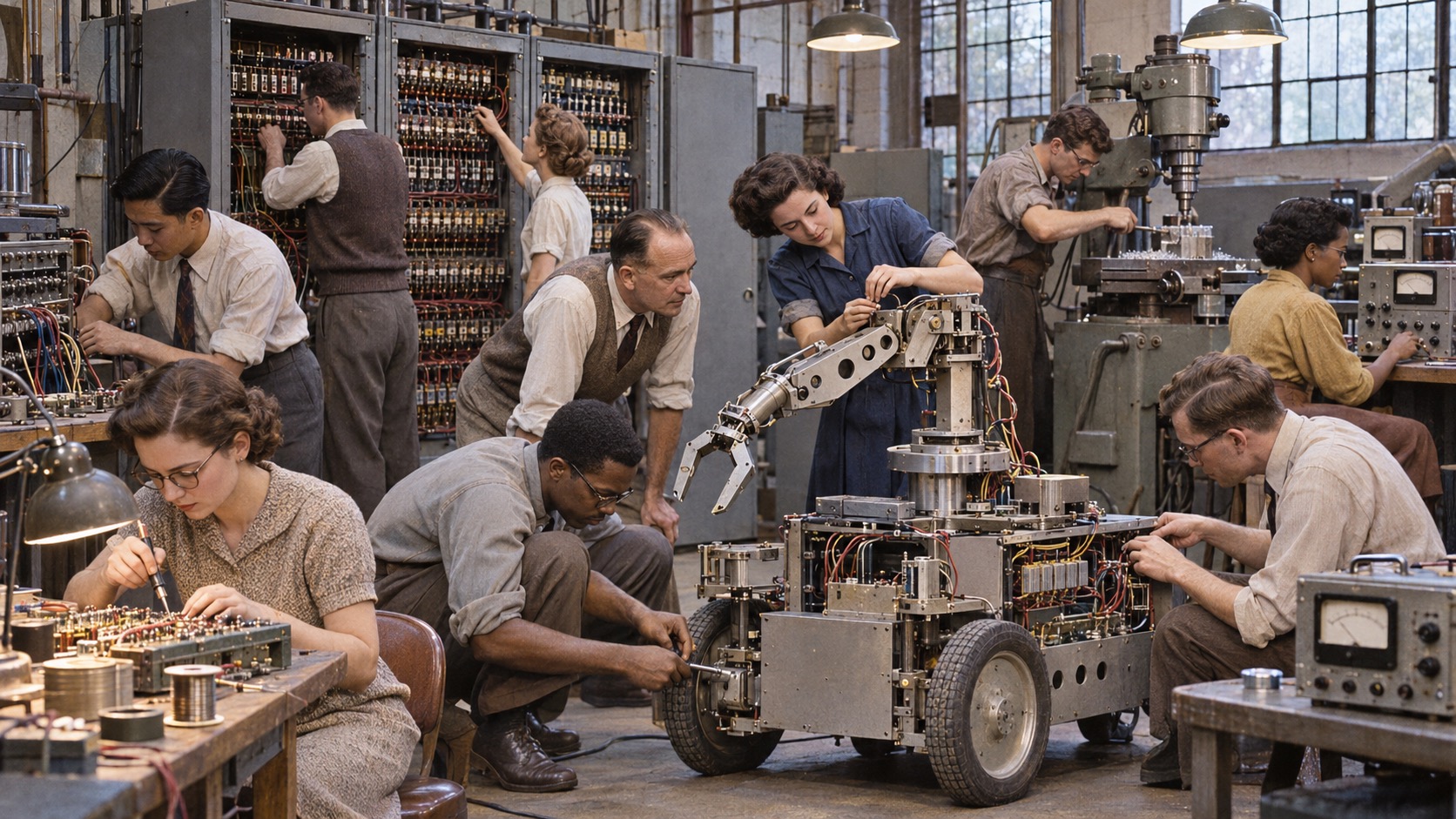
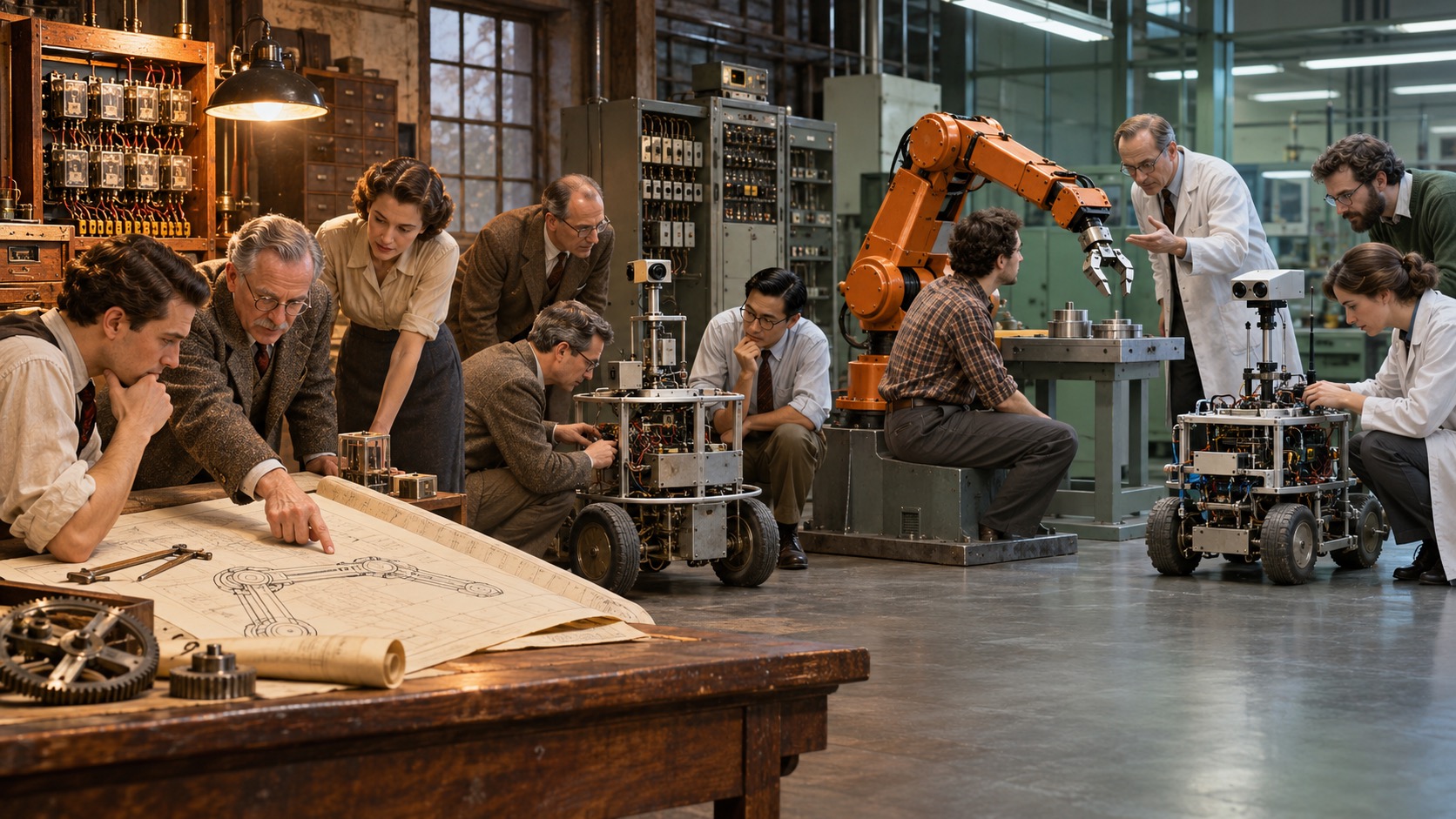
Shakey, WABOT, industrial arms, legged robots, and social machines were produced by teams of engineers, technicians, students, machinists, programmers, operators, and sponsors. Naming a leader is useful shorthand, but it should not erase the distributed work that made the system function.
The Most Influential Person Depends on the Question
For industrial adoption, Devol and Engelberger are difficult to avoid. For feedback, Wiener changes the conceptual foundation. For AI planning, the Shakey team and its intellectual descendants matter; for manipulation, Scheinman; for embodied behavior, Brooks; for dynamic legs, Raibert; for social interaction, Breazeal.
A responsible history compares kinds of influence instead of forcing a single ranking. It asks which idea survived, which machine became a platform, which institution trained successors, and which deployment changed practice.
The chain is still growing. Today’s roboticists inherit mechanisms, control theory, software, datasets, ethical debates, and institutional choices from these figures and many less visible contributors. Their obligation is not to repeat the mythology, but to preserve the evidence and build the next link carefully.
Museums and Archives Preserve More Than Finished Machines
A robot in a display case cannot explain its own development. Source code, laboratory notebooks, calibration fixtures, test films, maintenance records, patents, oral histories, and failed components reveal how the system actually worked. Preserving those materials lets historians separate contemporary evidence from legends added later. It also gives engineers access to design tradeoffs that a polished retrospective may omit.
Reading History Can Improve Present Engineering Judgment
Historical systems show that many current problems have earlier forms: unreliable sensing, limited compute, difficult programming, operator workload, exaggerated autonomy claims, and the gap between demonstration and service. Studying how earlier teams framed those constraints can uncover alternatives obscured by today’s terminology.
History also encourages humility about prediction. Some celebrated ideas remained impractical for decades, while modest mechanisms became foundations for entire industries. Engineers should evaluate present claims through evidence, architecture, and operating context, while leaving room for combinations that no individual pioneer could have anticipated.
Robotics History Is Strongest When Credit Remains Revisable
New archives, oral histories, translated documents, and restored machines can change who appears central to an invention. Good history welcomes that revision. It distinguishes being first from being influential, and influence from sole authorship. That approach does not diminish famous pioneers; it places their achievements inside the technical networks that allowed ideas to survive, spread, and become useful.