A Shared Robot Is Built From Two Different Kinds of Urgency
Universities are structured to investigate questions whose answers may take years, while technology companies must ship, support, and improve products on a commercial clock. Robotics partnerships become powerful when those differences are designed into the work instead of hidden behind a sponsorship announcement. A laboratory may develop a new manipulation method, but a company knows the cost, supply chain, calibration burden, safety case, and service conditions that determine whether it can leave the bench. The resulting robot is not simply academic research handed to industry. It is a negotiated system built through shared experiments, moving personnel, protected and publishable knowledge, and repeated decisions about what must be understood now versus what can remain an open research problem.
A: They gain access to deep expertise, long-horizon inquiry, specialized facilities, talent, and alternative technical approaches.
A: No. Research investigates uncertainty; productization requires separate evidence for reliability, cost, safety, manufacturing, and support.
A: Ownership and licensing depend on the agreement, inventorship, institutional policy, funding terms, and applicable law.
A: They transfer tacit knowledge and expose researchers to real product constraints while strengthening company mentoring links.
A: Sometimes, through defined access, de-identification, secure evaluation, or approved derived datasets with transparent limitations.
A: Use it when broader reuse, scrutiny, interoperability, or ecosystem growth supports the project and responsibilities are clear.
A: It needs safety rules, access controls, scheduling, network boundaries, maintenance ownership, and usable documentation.
A: A rigorous negative result can prevent costly development and improve the next research question.
A: Reproduction, documentation, researcher support, dependency removal, and company ownership of continued engineering matter beyond the contract.
A: Both institutions gain durable capability, trained people, trustworthy evidence, and a clearer path for future collaboration.
The Partnership Begins With a Question Neither Side Can Answer Alone
A useful collaboration starts with a technical uncertainty, not a shopping list disguised as research. The company may need manipulation that tolerates product variation, while the university may study general learning from limited demonstrations. The overlap creates a question with scientific depth and commercial consequence.
Partners should write separate definitions of success before merging them. A paper-quality improvement, a reliable prototype, a patentable mechanism, and a field-ready subsystem are different outcomes. Naming them prevents one side from celebrating while the other believes the project failed.
The question also needs an honest boundary. A laboratory cannot solve an entire product roadmap, and a company should not expect unrestricted access to every adjacent idea. A focused problem creates room for depth and accountability.
Sponsored Research Buys Inquiry, Not a Guaranteed Product
Companies fund faculty-led projects to explore uncertain methods and gain access to specialized expertise. The agreement usually defines scope, reporting, publication review, intellectual-property rights, and budget. It should not promise a deployment whose feasibility is the very subject of the research.
Shared Laboratories Shorten the Distance Between Insight and Hardware
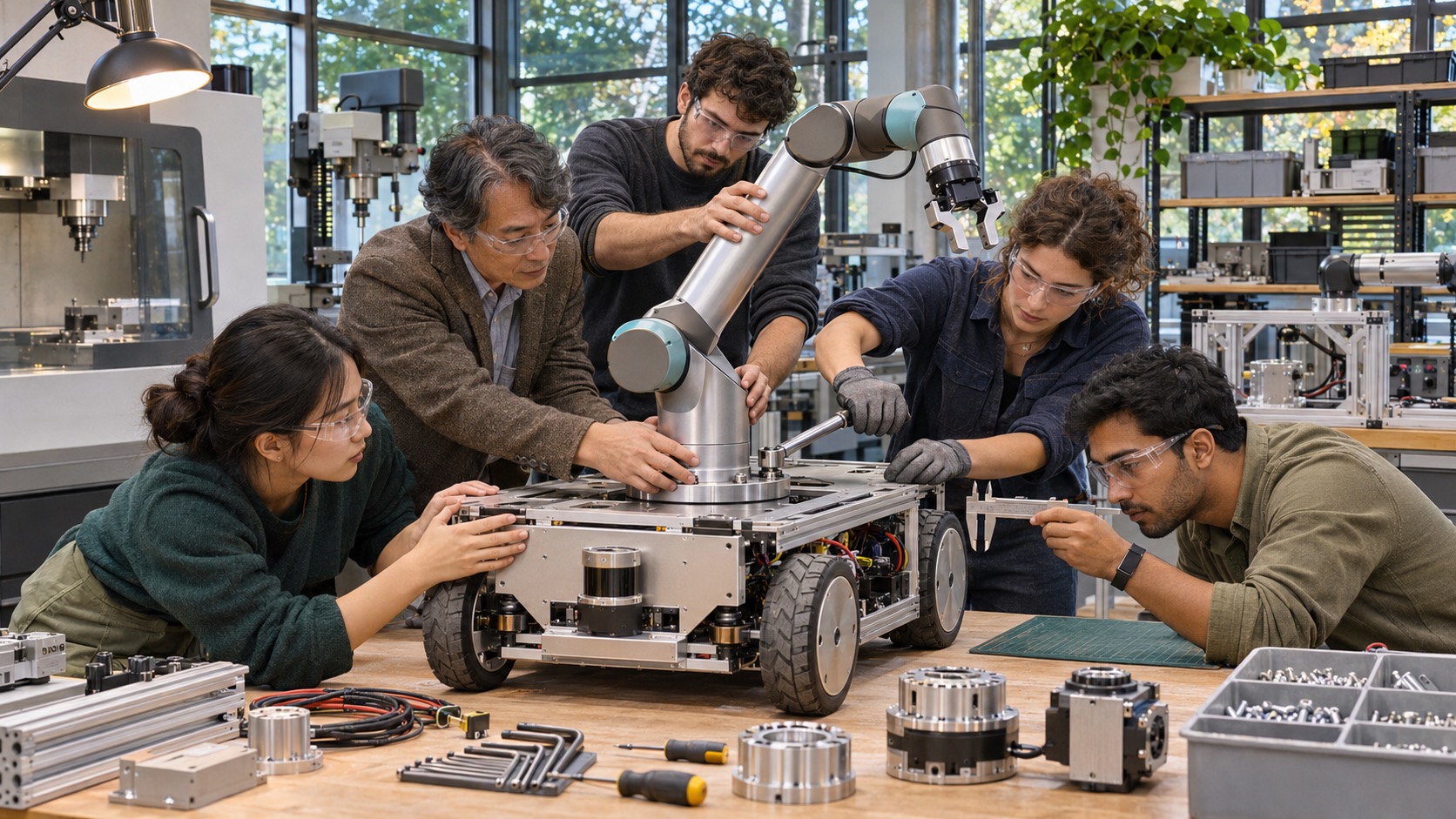
A joint facility can place company engineers, faculty, students, test equipment, and representative robot platforms in the same environment. Questions are resolved at the machine rather than across monthly slide decks. A control limitation can be checked against sensors; a mechanical redesign can be evaluated against the algorithm it changes.
Shared space needs operational rules. Equipment ownership, safety training, network separation, data access, tool scheduling, and responsibility for repairs must be explicit. Without them, the most expensive platform may sit idle whenever a boundary is unclear.
Research Programs Create a Portfolio Instead of One Bet
Large university programs, including Toyota Research Institute’s collaborative model, connect company researchers with teams at several institutions. A portfolio can explore multiple approaches to robotics, machine learning, materials, and human interaction while sharing technical context across projects.
The advantage is not only diversification. Results from one team may expose a sensor need, dataset weakness, or evaluation method useful to another. Program leadership can identify those links without forcing every group into one architecture.
Portfolio work still requires discipline. Too many disconnected projects produce impressive annual reviews without a cumulative capability. Themes, shared benchmarks, and clear renewal decisions keep breadth from becoming drift.
Students Carry Knowledge Across the Institutional Boundary
Graduate students often perform the daily integration that turns an idea into a working robot. Internships and residencies let them encounter product constraints while company mentors see the assumptions behind the research. This movement is one of the most durable forms of technology transfer.
Company Engineers Make Product Constraints Concrete
An academic prototype may rely on an expensive sensor, manual resets, a narrow object set, or a workstation that cannot fit the product. Engineers can translate those issues into measurable requirements for latency, power, thermal limits, component availability, calibration, cybersecurity, and service access.
Their role should not be to eliminate every risky idea. Instead, they help identify which constraint is fundamental and which belongs to a later productization phase. That distinction protects research novelty while preventing irrelevant optimization.
Faculty Protect the Long Question
Faculty members preserve continuity when company priorities change. They connect a sponsored task to prior literature, challenge convenient assumptions, and train students to explain why a result generalizes. This independence is valuable precisely because a commercial team faces immediate pressures.
A healthy partnership allows disagreement. If every result confirms the sponsor’s plan, the research may be too constrained. Negative findings can prevent a costly product path and should be treated as useful evidence rather than disloyalty.
Publication supports external scrutiny and academic careers. Reasonable review can protect confidential information and patent timing, but indefinite suppression damages the institution’s mission and the talent pipeline the sponsor hoped to support.
Representative Hardware Changes the Research Question
Company-provided platforms expose noise, tolerances, interfaces, and failure modes absent from simplified laboratory rigs. Researchers can test whether a method survives the real actuator, camera placement, compute budget, and control frequency. That evidence makes both papers and products stronger.
Digital Twins and Simulation Need a Route Back to the Machine
Simulation enables rapid experiments and safer testing, particularly for learning and rare failures. Companies may provide models or synthetic environments while universities develop algorithms at scale. Yet success depends on a defined transfer procedure, not visual similarity alone.
Teams should track which physical effects the model omits and measure performance after each transfer. Calibration error, contact, wear, lighting, and communication delay can overturn simulated gains. A shared discrepancy log turns the sim-to-real gap into a research object.
Data Agreements Shape What the Robot Can Learn
Industrial data may contain personal information, facility details, customer material, or proprietary processes. Universities need enough access to reproduce and publish research; companies need legal and competitive protection. Data-use agreements should define purpose, retention, security, derivative datasets, publication, and deletion.
Sometimes the right solution is not moving raw data. Secure enclaves, de-identified subsets, federated methods, or company-run evaluations can answer parts of the question. Each choice limits what outsiders can verify, so papers and reports should state the boundary clearly.
Dataset stewardship continues after collection. Sensor configurations, labels, exclusions, and version history must be preserved or later comparisons become misleading.
Intellectual Property Should Be Discussed Before the Breakthrough
Background IP belongs separately from inventions created during the project. Agreements should address inventorship, ownership, licensing options, open-source contributions, patent expenses, and publication review. Waiting until a prototype works turns ordinary differences into conflict.
Open Source Can Expand the Partnership’s Technical Reach
Releasing software, models, designs, or benchmarks can attract users who find errors and extend the work. Universities gain research impact; companies may gain an ecosystem and a larger hiring pool. The release must be intentional about licenses, trademarks, security, and unsupported experimental components.
Not every layer needs the same strategy. A company might protect a manufacturing method while supporting an open interface, or publish a benchmark while keeping customer data private. Clear boundaries are more credible than calling a project open while essential pieces remain inaccessible.
Prototype Reviews Need Both Scientific and Product Evidence
A joint review should show what the robot did, under which conditions, and with how many interventions. Researchers explain hypotheses, baselines, uncertainty, and generalization. Product teams examine setup, cost, reliability, safety, manufacturability, and support burden.
These views may recommend different next steps. More research can be correct even when a demo works; product integration can be correct even when the method is not scientifically novel. Leadership should decide explicitly which track the evidence supports.
Video is useful but insufficient. Logs, configurations, failed trials, and repeatable test procedures keep a charismatic demonstration from dominating the decision.
Field Sites Turn the Customer Into a Third Partner
When a robot enters a factory, hospital, farm, warehouse, or home, local participants reveal constraints neither the university nor company owns. Pilot agreements should specify training, safety authority, data collection, support, and the right to stop the trial.
Standards Work Converts Private Learning Into Shared Infrastructure
Partnerships often discover that progress depends on interfaces, tests, terminology, or safety practices used beyond one product. Participating in standards groups can turn that learning into a common foundation while leaving room for competition above it.
Students who observe standards development learn how technical evidence, stakeholder interests, and implementation realities interact. Companies gain early understanding of requirements; universities contribute measurement methods and independent analysis.
Licensing Is a Beginning, Not a Handoff
A patent or software license gives permission to use an invention, but it does not transfer tacit knowledge automatically. Company teams may need documentation, consulting, prototype access, and the participation of researchers who understand failure modes. The university technology-transfer office can structure the agreement, but engineers still perform the translation.
Milestones should reflect technical maturation rather than only paperwork. Reproducing the result on company hardware, removing laboratory dependencies, and training a new operator are stronger indicators than signing day.
Some projects should end without a license. A well-supported negative result can redirect investment, improve future research questions, and preserve trust for the next collaboration.
The Best Partnerships Build Capability on Both Sides
A lasting university–company project leaves more than a prototype. Students learn rigorous engineering constraints, employees learn to reason about uncertain research, laboratories gain better platforms, and companies gain methods they can evaluate rather than merely admire. When governance, publication, IP, data, and field testing are designed with the robot, different institutional clocks can produce one coherent technical advance.
Joint Roadmaps Need Decision Gates, Not False Certainty
A research roadmap should identify what evidence unlocks the next commitment. Early gates may test physical feasibility; later ones may address generalization, integration, safety, cost, and field support. Dates can be planned, but results cannot be promised. Each gate should permit continuation, redirection, or a disciplined stop.
Separate scientific uncertainty from execution risk. A missing theory, an unreliable supplier, an unavailable field site, and a delayed student hire require different responses. Combining them under one red project status hides what leadership can actually change.
Research Prototypes Need a Deliberate Path Toward Product Architecture
University code often optimizes for experimentation: components are easy to replace, parameters are exposed, and logs are extensive. Product architecture prioritizes predictable interfaces, security, updateability, fault containment, and support across many units. Translation should preserve the proven method while reconsidering the surrounding implementation.
A useful bridge is a reference system jointly owned for a limited period. Researchers reproduce their result there, company engineers harden dependencies, and both sides compare behavior against a locked test suite. This avoids rewriting everything before anyone knows which details are essential.
The handoff is complete only when a team without the original student can deploy, diagnose, and update the capability. That requirement encourages documentation of calibration, data flow, fallback behavior, and known failure signatures while the people who discovered them remain available.
Alumni Networks Become a Quiet Technology-Transfer System
Graduates often carry practical understanding into startups, established robotics firms, public laboratories, and later faculty positions. Their movement spreads methods, evaluation habits, and professional relationships more widely than one license. Partnerships should support that benefit without treating students as company labor or restricting their careers. Clear authorship, portable skills, mentoring from both institutions, and permission to describe nonconfidential contributions help people translate the experience. Years later, those alumni may become the engineers who recognize when a research result is ready for another commercial attempt.