
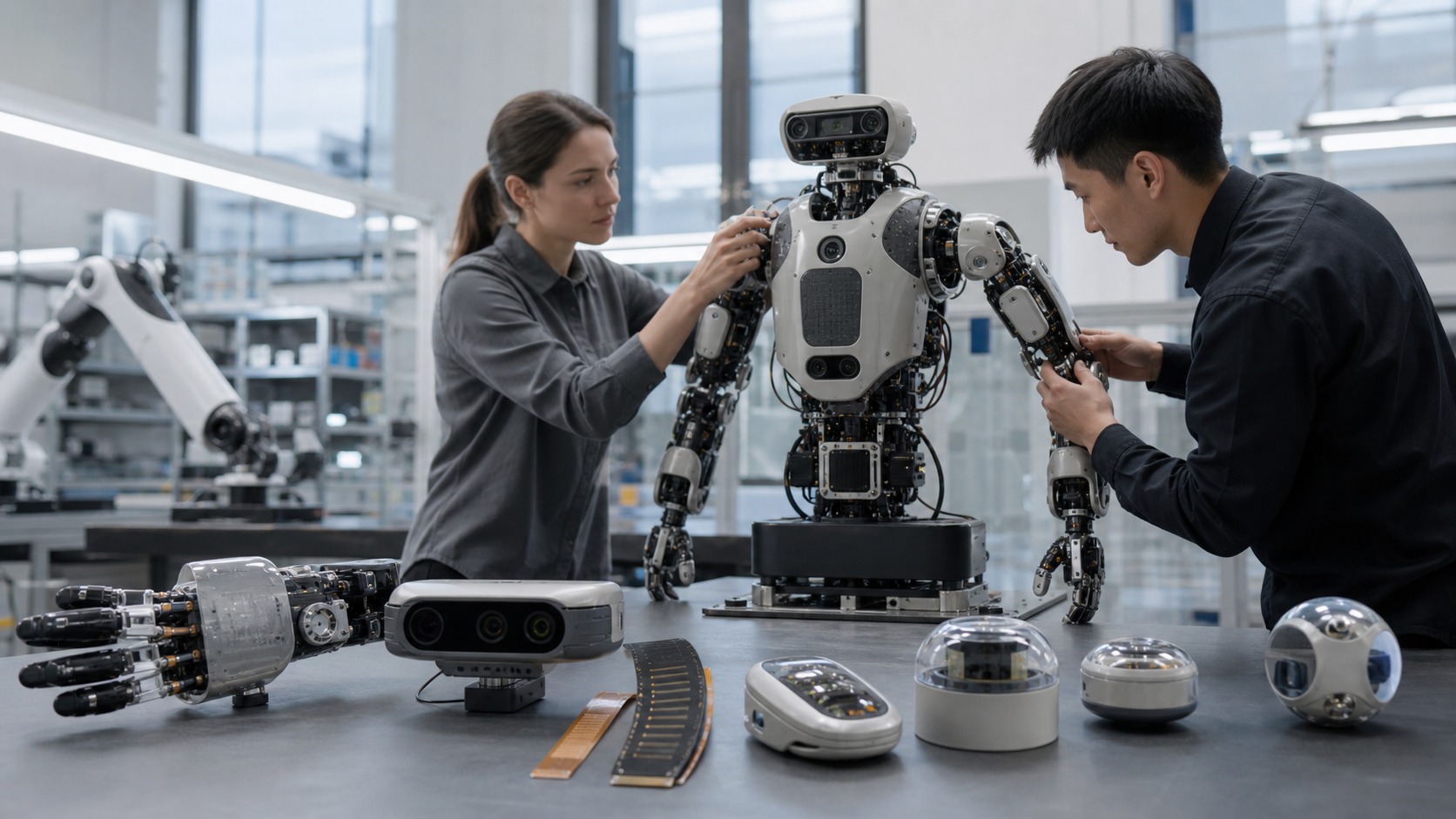
Future Robot Sensors Will Be Smaller, Smarter, and More Integrated
The future of sensor innovations in robotics points toward robots that sense more richly, interpret measurements closer to the hardware, and explain uncertainty more clearly. Better cameras and lidar matter, but the bigger shift is integration. Sensors will move into joints, skins, grippers, wheels, tools, batteries, and structures. Robots will monitor their own condition while reading the environment, giving them a deeper understanding of both task and body.
A: It places measurement inside joints, frames, grippers, skins, or modules instead of attaching devices later.
A: Touch helps robots handle contact, pressure, slip, and delicate objects more carefully.
A: The robot adjusts trust based on context, confidence, and task conditions.
A: Local processing reduces delay, bandwidth, and unnecessary raw data movement.
A: They report drift, blockage, heat, contamination, or weak confidence before failure.
A: No. Purpose, reliability, service access, and privacy matter more than sensor count.
A: Flexible and stretchable materials expand sensing across curved or soft robot surfaces.
A: Rich sensing may capture sensitive spaces, people, or behaviors without careful limits.
A: Clear confidence and fault reports make robot behavior easier to understand.
A: Robots are moving toward integrated awareness rather than isolated measurement parts.
Sensing Will Move Into the Robot Body
Future sensors will be less like accessories and more like parts of the robot's body. Joint modules may include torque, temperature, vibration, position, and wear indicators. Grippers may measure pressure across fingertips. Frames may include strain sensing. Protective skins may detect touch across broad surfaces. A joint that senses load and heat, a cover that senses touch, and a gripper that senses pressure create a robot that understands its body at the points where work actually happens. That is a different kind of awareness than simply adding another external camera.
This embedded approach matters because many robot decisions depend on physical condition. A robot that knows a joint is warming, a panel is stressed, or a fingertip is slipping can adjust behavior before a fault becomes visible to people.
The challenge is packaging. Sensors inside structures must survive vibration, heat, moisture, repeated motion, and service work without becoming fragile.
Embedded sensing also reduces the gap between robot design and robot awareness. Instead of estimating everything from external perception, the machine can sense stress, load, and contact where those effects actually happen. That makes future robots more physically literate.
This does not remove the need for careful engineering. Placing sensors inside the body creates new reliability demands. The measurement must remain stable after repairs, impacts, cleaning, and long periods of motion. As this becomes normal, robot bodies may be designed around measurement pathways from the start. Space for wires, processors, calibration access, and protective covers will become part of the mechanical concept rather than a late packaging problem. This makes future sensor design part of the robot architecture, not a shopping step after the body is finished.
Tactile Sensing Will Change Contact
Robots have long been better at seeing than feeling. Future tactile sensors could change that balance by giving grippers, arms, mobile bases, and humanoid surfaces a more detailed sense of touch. Pressure maps, shear sensing, texture cues, and distributed contact detection would help robots handle objects with less force and more confidence. Touch also makes robots more useful in cluttered or changing environments. Vision may identify an object, but contact sensing tells the robot whether the object is seated, slipping, bending, or resisting movement in a way the camera cannot see.
This is especially important for irregular, delicate, or deformable items. A robot picking fruit, folding fabric, assisting a patient, or handling mixed warehouse goods needs contact information that vision alone cannot provide.
Tactile sensing also changes how robots recover from mistakes. If an object begins to slip, the robot can adjust grip before dropping it. If a surface contact is too sharp, the robot can soften motion before causing damage. Touch creates a second layer of evidence after vision. Better touch also supports safer human interaction. A robot that feels broad contact across an arm or shell can respond more naturally than one that only detects a hard collision after force rises.
Sensor Fusion Will Become More Context-Aware
Future sensor fusion will do more than combine readings mathematically. It will consider context: lighting, surface material, speed, vibration, task priority, recent faults, and confidence history. A perception system may treat a camera differently in glare, shift weight toward radar in dust, or ask a tactile sensor to confirm a visual grasp estimate. A future perception stack may therefore behave less like a fixed pipeline and more like a careful technician. It checks the situation, notices weak evidence, compares sources, and changes tactics before confidence collapses.
Context-aware fusion makes robots more adaptable. Instead of trusting every sensor equally, the robot uses evidence according to conditions. That approach resembles good human judgment: the same information does not deserve the same trust in every situation.
The important part is transparency. Teams need to know why a robot trusted one source over another, especially in safety-critical or expensive tasks.
Context-aware fusion also helps robots work outside carefully controlled labs. A farm robot, sidewalk robot, hospital robot, and factory robot face different sources of sensor confusion. Future sensing systems will need to adapt trust based on the environment rather than using one fixed recipe everywhere.
This kind of fusion will be judged by behavior, not by how many sensors are present. A robot that explains why it slowed down in dust or asked for help near glare will feel more dependable than one that hides its uncertainty. This matters for public and service robots because the environment changes constantly. Lighting, crowds, weather, dust, and object variety all push perception systems away from comfortable assumptions.
Edge Processing Will Reduce Delay
More sensor processing will happen close to the device. Smart cameras, event sensors, tactile arrays, radar modules, and force systems can filter data before sending it across the robot. That reduces bandwidth, protects timing, and helps fast control loops respond quickly. Edge processing also supports robots that work in places with limited connectivity. Farms, warehouses, hospitals, construction sites, and public spaces cannot assume constant high-bandwidth links for every sensor stream.
Local processing also supports privacy and reliability. A robot may not need to transmit raw images if the sensor can report obstacle position or object pose. A wearable or medical robot may keep sensitive readings local while still acting safely.
Edge processing also makes sensor systems easier to scale. A fleet of robots sending every raw reading to a central system can create unnecessary cost and risk. Local interpretation lets the robot share useful events, confidence levels, and health signals instead of every detail. Local interpretation does not mean every sensor becomes a separate brain. It means useful filtering, confidence scoring, and event detection happen early enough to protect timing and reduce clutter.
Self-Diagnostics Will Become Normal
Future sensors will increasingly report their own condition. A camera could detect blur or blocked lenses. A lidar unit could report contamination or alignment trouble. A force sensor could flag drift. A battery monitor could report health instead of charge alone. Diagnostics become even more important when sensors are embedded and distributed. If a tactile skin, joint sensor, or smart camera weakens, the robot needs to identify the affected behavior instead of leaving technicians to hunt blindly.
Self-diagnostics make robotic systems easier to maintain. Instead of discovering a bad sensor after a failed task, the robot can warn that the measurement quality has changed. That warning helps fleets avoid preventable failures.
This also changes operator trust. A robot that explains weak sensing feels less mysterious than a robot that simply stops or behaves oddly.
Self-diagnostics also support better product design. When many robots report the same sensor blockage, drift pattern, or mounting vibration, engineers can improve the next hardware revision. Field evidence becomes a design input rather than a pile of isolated complaints.
The best diagnostic sensors will avoid flooding operators with noise. A useful alert names the likely issue, the affected behavior, and the next inspection step. That keeps sensor intelligence practical. The maintenance benefit is especially strong for fleets. A single robot fault may look random, but repeated diagnostic patterns across many machines reveal design and environment trends.
New Materials Will Expand What Robots Feel
Flexible electronics, printed sensors, soft materials, optical fibers, conductive textiles, and stretchable circuits may let robots measure contact across curved surfaces. These materials could support soft grippers, wearable robots, service machines, and humanoid platforms that need broad, gentle awareness. These materials may also help robots become less rigid in how they meet the world. A machine that senses pressure across a soft surface can behave with more care than one that only notices contact at a few hard points.
The engineering problem is not only sensitivity. Future materials must survive cleaning, bending, abrasion, temperature changes, and replacement. A sensor skin that works beautifully in a lab but tears easily in service has limited value.
New sensing materials may also change robot shape. If touch and strain sensing can follow curved shells, fingers, pads, and wearable supports, engineers gain more freedom than rigid boxed sensors allow. Form and measurement begin to develop together. Durability will decide which materials leave the lab. Stretch, softness, and sensitivity are useful only if the sensor survives cleaning, impact, replacement, and daily wear.
Sensor Data Will Need Better Boundaries
Richer sensing creates new questions about privacy, storage, security, and responsibility. Robots in homes, hospitals, stores, and public spaces may collect visual, audio, location, or interaction data. Future sensor innovation must include controls over what is captured, processed, saved, and shared. The most responsible future systems will treat data as a design material. Engineers will decide what to measure, what to discard, what to summarize, and what to protect with the same seriousness they bring to power or safety.
Good robotics design will minimize unnecessary data. If a robot only needs obstacle distance, it may not need to preserve identifiable images. If a maintenance system only needs health metrics, it may not need raw interaction records.
The future of sensing is therefore not only technical. It is also about designing respectful evidence systems.
Those boundaries also affect public acceptance. People are more likely to welcome robots that collect the minimum data needed for the task and handle sensitive readings predictably. Sensor innovation will need good engineering and good restraint. Privacy-aware design may also become a selling point. Customers will want robots that perform useful sensing without keeping more raw evidence than the task requires.
Where Sensor Innovation Is Headed
The future of sensor innovations in robotics is a move from isolated devices toward integrated awareness. Robots will sense through their structures, grippers, joints, surfaces, power systems, and perception stacks. Measurements will include not only what is nearby, but also how trustworthy the reading is and how healthy the robot feels. That combination of richer measurement and tighter restraint is what makes future sensing promising. The goal is not constant surveillance; it is better evidence for safer, more useful robotic behavior.
The best sensor advances will help robots act with more care. They will make machines gentler around people, more capable with varied objects, more honest about uncertainty, and easier to maintain over time.
Progress will not come from adding every possible sensor. It will come from matching measurement to purpose, protecting the data path, and giving both robots and humans clearer evidence for decisions. The most successful sensor advances will therefore feel invisible during normal operation. The robot simply becomes calmer, safer, easier to diagnose, and better at noticing when its evidence is weak. That is a practical vision of progress: better sensing that makes robots less surprising and easier to trust.

