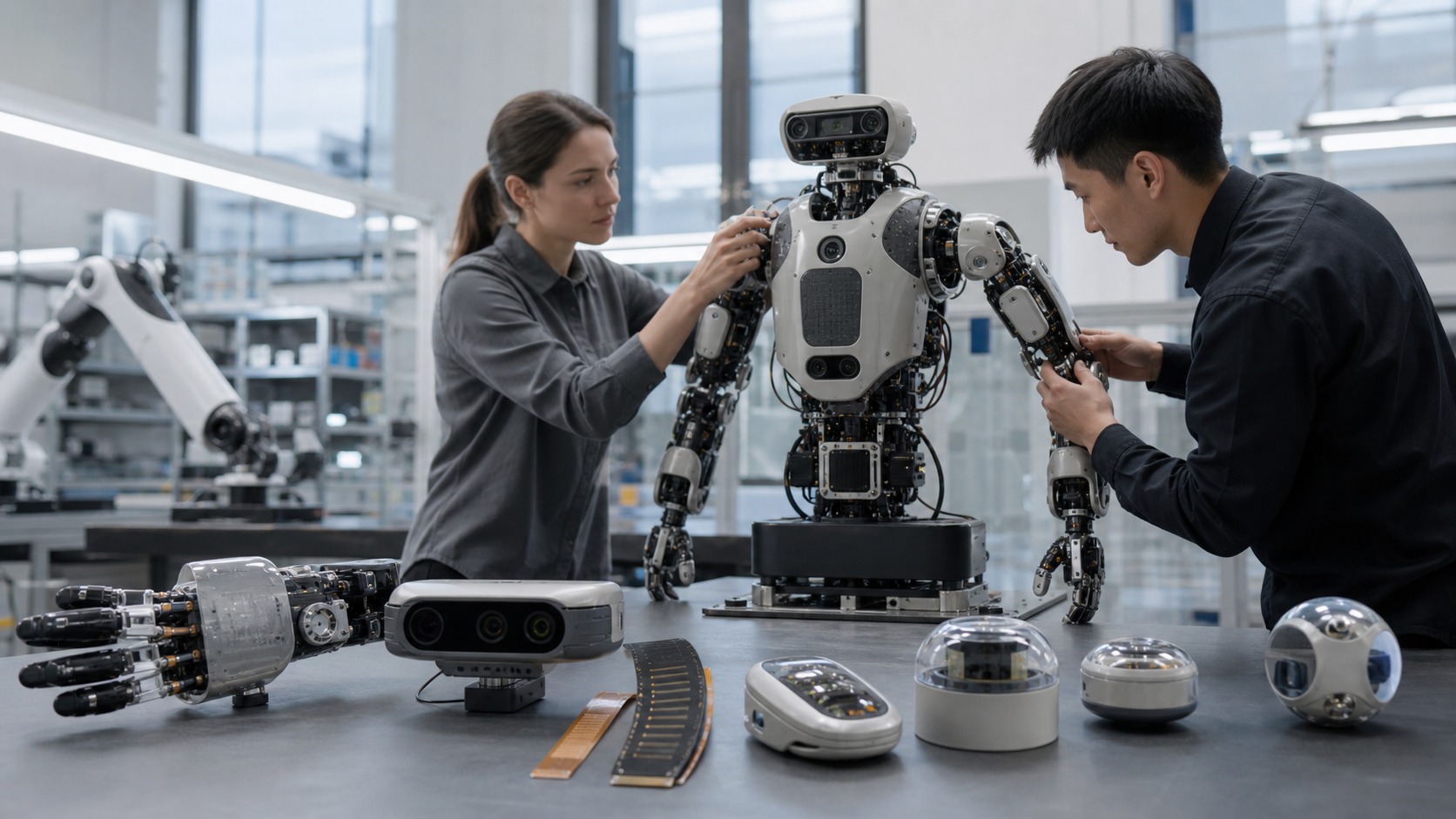
Sensors Give Robots Evidence Instead of Guesswork
Sensors power modern robotics by giving machines a measured connection to their own bodies and the world around them. A robot without feedback is mostly executing guesses: it commands a wheel, closes a gripper, lifts an arm, or follows a path without knowing enough about what actually happened. Sensors turn those actions into evidence. They measure distance, motion, force, position, temperature, electrical load, contact, slip, and visual context so the robot can compare intention with reality.
A: They give robots measured evidence about motion, contact, surroundings, and health.
A: Only when each measurement supports a decision, diagnosis, or safety behavior.
A: It blends different measurements into a stronger estimate than one source alone.
A: They tell the robot which measurements describe the same moment in motion.
A: They expose obstacles, contact, heat, overload, and abnormal movement early.
A: Calibration connects readings to real geometry, units, timing, and mounting positions.
A: Poor placement, noise, damage, dirt, drift, bad lighting, or weak interpretation.
A: They preserve evidence about heat, load, faults, blocked devices, and wear.
A: The right choice depends on the decision the robot needs to make.
A: Sensing links robot commands to physical reality.
Feedback Turns Motion Into Control
Modern robots rely on feedback loops. A controller sends a command, a sensor measures the result, and the controller adjusts the next command. That loop appears in wheel speed control, joint positioning, balancing, gripping, docking, tool alignment, and obstacle avoidance. Without feedback, small physical errors accumulate until the robot drifts away from the task. This is why feedback is central to robots that drive, grasp, balance, dock, inspect, or assemble. The task may look different on the surface, but the underlying pattern is similar: measure the result, compare it with the goal, and adjust before the error grows.
Encoders are a simple example. They report how far a motor or wheel has rotated, which helps the robot estimate position and detect mismatch between commanded and actual motion. If a wheel slips, the encoder reading alone may not tell the whole truth, so the robot compares it with inertial or environmental sensors.
This layered measurement is why modern robots feel smoother and more deliberate than simple machines. They are not merely moving; they are checking motion against evidence.
Feedback also keeps small design compromises from becoming major behavior problems. A wheel may never be perfectly round, a gearbox may never be perfectly smooth, and a floor may never offer the same traction everywhere. Sensors let the robot see the difference between the command it issued and the result it received, which gives the control system a chance to correct the next movement instead of repeating the same error.
That correction is what makes modern robotics feel precise even when the physical world is not precise. The robot is constantly comparing, adjusting, and checking. It does not need perfect hardware to behave well, but it does need honest measurements from the hardware it has. That loop is the quiet reason modern robots can repeat work in spaces that are never perfectly repeatable.
Perception Sensors Build a Working Picture
Cameras, lidar, radar, depth sensors, ultrasonic sensors, and proximity sensors help robots understand surrounding space. A warehouse robot uses them to detect pallets, people, shelves, and open paths. A service robot uses them to find doors, furniture, and charging docks. A manipulator may use cameras or depth sensors to locate parts before reaching.
The robot does not need a perfect picture of the world. It needs a useful picture for the decision at hand. A docking maneuver needs close-range alignment, while navigation through a hallway needs obstacle position and open space. Good sensor design starts with the behavior the robot must perform.
Perception becomes powerful when it is tied to motion. A camera that only records images is not enough; the robot needs to know how those images relate to its body, its path, and its task. Sensor calibration connects what the robot sees to where it can move, reach, stop, or turn. That connection is also why sensor placement and robot behavior must be designed together. A range sensor mounted too low, too high, or behind a cover may technically work while still missing the evidence the robot needs during a turn, dock, or handoff.
Force and Contact Make Robots Safer
Force sensors, torque sensors, tactile pads, pressure sensors, and current readings help robots understand contact. That matters whenever a robot touches an object, a tool, a surface, or a person. A gripper needs enough force to hold an item without crushing it. A collaborative arm needs to detect unexpected resistance. A legged robot needs to know how its feet meet the floor. In practical deployments, this also protects trust. People accept robots more readily when the machines slow down near uncertain contact, release pressure when something feels wrong, and recover from imperfect interactions without creating drama.
Contact sensing changes robot behavior from blind pushing to measured interaction. The robot can slow down, retry a grasp, release pressure, or stop motion when contact looks wrong. Safety improves because the machine has a way to notice that the physical world is not matching the plan.
This is especially important as robots leave fenced industrial spaces. Machines that work near people need soft limits, clear stopping behavior, and sensing that catches contact before it becomes damage.
Force and contact sensing also improve quality. A robot that assembles parts can notice whether a component seated correctly, whether a tool met resistance too early, or whether a surface contact happened at the expected point. Those signals help prevent silent defects that might otherwise travel down a production line.
Contact measurements are especially useful when objects vary. Packages, produce, textiles, medical supplies, and household items rarely behave like identical metal blocks. Sensors give the robot a way to adapt pressure and motion to the object in front of it.
Internal Sensors Protect the Robot Itself
Robots also need sensors that watch their own health. Temperature sensors warn about overheated motors or processors. Current sensors reveal overloaded actuators. Battery monitors track voltage, charge, and discharge behavior. Limit switches protect mechanical endpoints. Vibration sensors expose loosening parts or bearing wear.
These internal measurements help the robot avoid self-inflicted failures. A mobile robot might reduce speed when a drive module gets hot. An arm might stop when current suggests a jam. A fleet manager might schedule service when vibration changes over time.
Internal sensing is also a form of self-preservation. Robots work inside limits, and those limits change with temperature, age, payload, and environment. A machine that watches itself can avoid pushing a worn drive, hot motor, or weak battery into a more expensive failure. This kind of protection becomes more valuable as robots work without constant supervision. A machine that notices its own stress can choose a conservative behavior before a person has to rescue it.
Sensor Fusion Creates Stronger Estimates
No single sensor is perfect. Cameras struggle in poor lighting or glare. Lidar can be confused by reflective surfaces. Wheel encoders miss slip. IMUs drift. Force readings vary with mounting and calibration. Sensor fusion combines different measurements so the robot has a more reliable estimate than any one sensor provides alone. The value appears during edge cases. A shiny floor, soft package, worn wheel, or moving person can make one sensor less reliable, while another source still provides enough evidence for a cautious decision.
A mobile robot often blends wheel encoders, IMU data, lidar, camera observations, and map information. Each source covers weaknesses in the others. The result is not magical certainty; it is a practical estimate with known confidence.
Fusion also helps the robot respond to changing conditions. If one measurement becomes noisy or blocked, the system can lean more heavily on another source until confidence improves.
Sensor fusion becomes easier to understand when you think in jobs rather than devices. One sensor may answer short-term movement, another may correct long-term position, and another may warn about nearby hazards. Each source has a role, and the estimate improves when those roles are clear.
The weakest fusion systems hide uncertainty. The strongest ones preserve confidence, expose disagreement, and let the robot choose safer behavior when evidence becomes thin. That is why fusion is both a math problem and a design problem. The design goal is not to make uncertainty disappear, but to keep it visible enough for safer choices.
Timing Makes Sensor Data Useful
Sensor power depends on timing as much as measurement. A camera frame, encoder tick, force reading, and motion command need timestamps that make sense together. Stale information can be worse than missing information because it makes the robot react to a world that has already changed.
Fast control loops usually stay close to the hardware. Higher-level perception and planning may run more slowly on larger processors. A well-designed robot knows which sensor data belongs to immediate safety and which belongs to slower decisions.
Timing also affects debugging. If logs show a sensor reading without a reliable timestamp, engineers may not know which command or physical event it belongs to. Accurate timing turns scattered readings into a story the team can reconstruct. In practice, this timing discipline separates polished robots from fragile ones. The robot does not simply gather data; it gathers data at the moment when that data still matters.
Modern Robots Turn Sensing Into Service
Sensors also power maintenance and support. Logs from batteries, motors, temperature sensors, contact sensors, and perception systems help teams understand why a robot stopped or behaved strangely. A robot that records useful evidence is easier to repair than one that fails silently. That shared evidence matters because modern robots rarely belong only to engineers. Operators, technicians, managers, and safety teams all need understandable clues about what the robot sensed and why it chose a behavior.
In fleets, sensor evidence becomes operational knowledge. Teams can see which routes create heat, which docks cause alignment trouble, which payloads overload actuators, and which environments reduce perception confidence. Sensor data then improves layouts, maintenance schedules, software updates, and training.
This is where sensing becomes more than a technical feature. It becomes a way for robots and people to share evidence about work.
Service teams benefit when sensor evidence is presented in plain operational terms. A warning about rising drive temperature, repeated docking correction, or lower camera confidence is easier to act on than a vague fault code. The best robots translate raw measurements into maintenance clues.
What Sensor Power Really Means
Sensors power modern robotics because they turn physical uncertainty into measured information. They let robots move, touch, navigate, protect themselves, and recover with more awareness than open-loop machines. The strongest robot designs connect each sensor to a decision, protect the measurement from noise and damage, and record enough evidence for future debugging.
The practical lesson is simple: a sensor is valuable when it changes behavior. If it helps the robot choose a safer path, grip more gently, stop before harm, detect wear, or explain a fault, it is part of the robot's intelligence. Modern robotics depends on that measured link between action and reality.
As robots become more common in factories, hospitals, farms, homes, and public spaces, sensor quality will remain one of the main differences between impressive demos and dependable machines. The robot that senses well has a better chance of working well. That is why sensor choices should be evaluated through real tasks. A spec sheet can describe range or resolution, but only the task shows whether the measurement leads to better robot behavior. That standard keeps sensor discussions grounded in outcomes instead of hardware quantity. It also helps teams choose simpler, sturdier sensing when the task does not require exotic hardware.