Logistics Is Becoming a Continuously Measured Physical Network
Logistics has always depended on movement, but robotic systems are changing how that movement is planned, observed, and corrected. A pallet arriving at a dock can be identified, routed, stored, retrieved, broken into orders, packed, sorted, and staged with machines recording each handoff. Inside warehouses, mobile robots reduce long walks and separate transport from skilled picking. Robotic arms handle a growing range of cartons and products. Outside, autonomous vehicles and compact delivery machines extend controlled movement toward the customer. The deeper transformation is coordination. Robots make delays, blocked routes, empty travel, inventory errors, and workstation queues visible as operating data. They also force organizations to define exceptions that people once resolved informally. Logistics is not becoming a chain of unattended machines. It is becoming a network in which people, software, equipment, buildings, carriers, and inventory must share a more precise picture of what should move next.
A: They connect physical movement with detailed task, location, and exception data.
A: No, but they can remove long repetitive travel from selected workflows.
A: Packing, stations, docks, inventory, or carriers may remain the limiting step.
A: It records identity and condition before errors spread into storage and picking.
A: No. Fixed conveyors remain effective for stable, high-volume routes.
A: Safe stops, task reconciliation, manual priorities, and controlled recovery are required.
A: Floors, doors, aisles, power, wireless coverage, and service access shape movement.
A: Exception owners who understand both operations and machine behavior are essential.
A: Terrain, weather, regulation, payload, security, and handoff access limit coverage.
A: Use customer-level accuracy, service, safety, resilience, and total operating cost.
Transport Is Separating From Productive Work
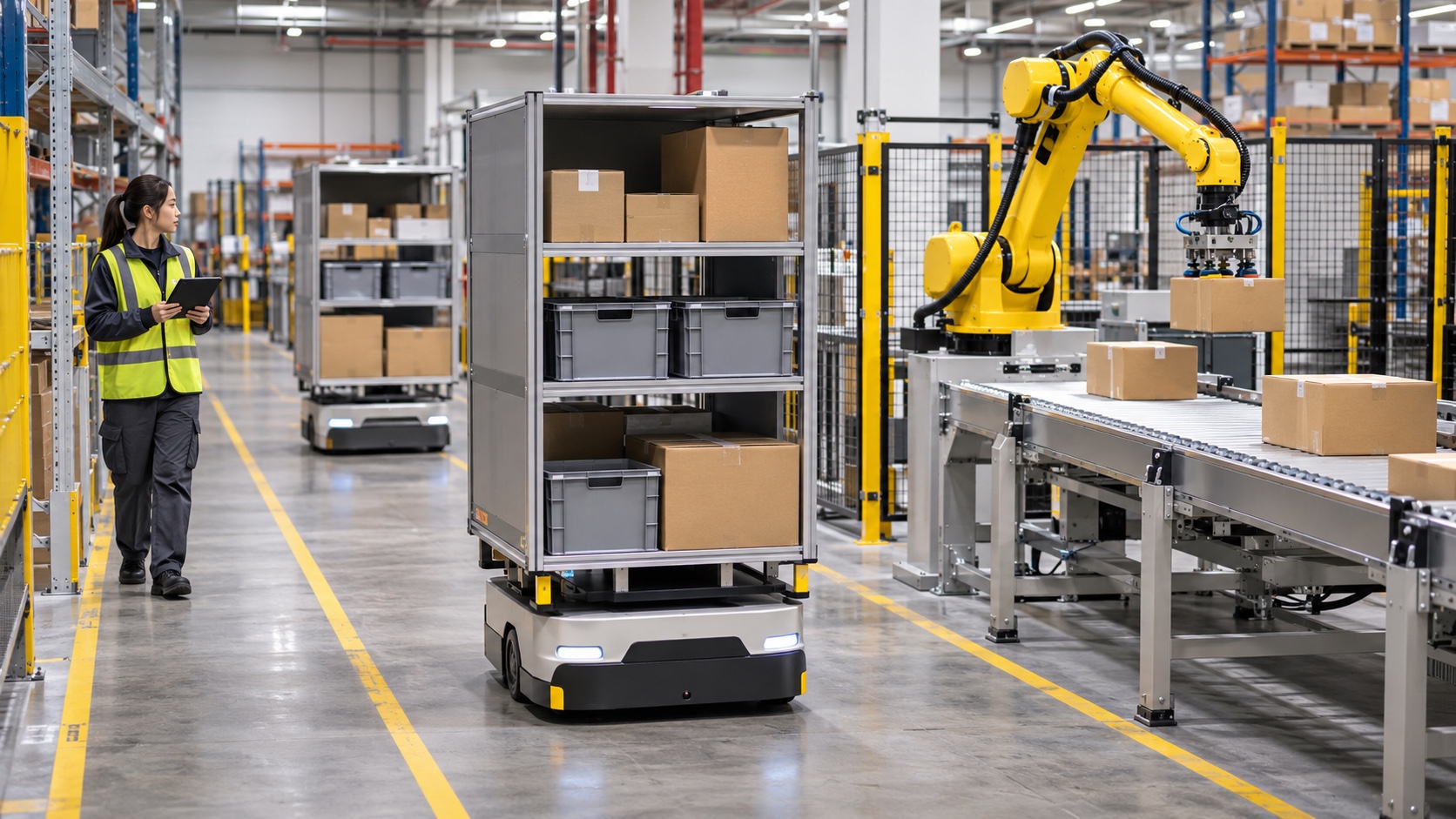
Traditional warehouse jobs often combine judgment with travel. A worker walks to a location, finds the item, confirms it, and carries or pushes it onward. Mobile robots separate those activities. The machine performs predictable transport while a person works at a station or within a smaller zone. This does not merely replace footsteps. It allows managers to balance transport capacity independently from picking skill, shift labor between stations, and see when a queue comes from travel rather than from handling. When implemented well, employees spend more time resolving product questions, checking quality, and completing actions that require dexterity.
Goods-to-Person Systems Change the Shape of Picking
In a goods-to-person operation, robots bring shelves, totes, or pallets to a fixed workstation. The worker no longer searches a large storage area. Software sequences containers so the correct inventory arrives with the right order and destination. Ergonomic presentation can reduce reaching, bending, and pushing while lights or displays guide confirmation.
The station becomes a production system of its own. If inbound robots arrive too slowly, the picker waits. If they arrive too quickly, buffers fill and traffic spreads into nearby aisles. The transformation therefore depends on station design, replenishment, order grouping, and reliable identification, not simply on the top speed of a mobile base.
Receiving Is Becoming an Active Control Point
Robotics gives receiving more influence over everything that follows. Automated unloaders, dimensioners, scanners, and pallet movers can record size, weight, identity, damage, and destination as goods enter the building. That early information supports storage decisions and exposes discrepancies before an order depends on the stock. A mislabeled case caught at the door is an ordinary correction; the same case discovered during an urgent pick can stop a shipment. Robotic receiving also encourages consistent presentation. Loads must arrive within workable limits, labels need usable placement, and unstable packaging cannot be treated as someone else’s later problem.
Storage Locations Are Becoming Dynamic
Fixed addresses once made a warehouse understandable to people. Robots and inventory software can use more fluid placement. A tote may occupy any compatible opening as long as the system preserves its identity and access priority. Fast-moving goods can migrate toward stations, while slower goods use distant capacity.
Dynamic storage increases density but raises the cost of inaccurate records. A human may notice that a familiar product is in the wrong bay; a robot follows the location it receives. Cycle-counting robots, weight checks, and scan confirmations help maintain trust. The real change is that location knowledge moves from employee memory into a continuously updated digital record.
Robotic Picking Is Expanding Beyond Uniform Cases
Industrial arms have long handled identical products in factories. Modern warehouse picking adds vision, adaptable grippers, force sensing, and software that estimates which object can be removed without disturbing the rest. The system may select one product from a tote, transfer cases from a pallet, or place items into an order container. Performance varies sharply with packaging. Rigid boxes and sealed bags are easier than reflective film, soft apparel, tangled goods, or fragile objects. Successful deployments classify inventory honestly and create a clear route for uncertain grasps. Robots increase useful coverage when they hand difficult items to people rather than damaging them in pursuit of a perfect automation rate.
Sortation Can Respond to Changing Destinations
Conventional conveyor sorters excel at stable, high-volume routes. Robotic sortation adds flexible destinations. Small mobile units can carry parcels across a grid, while arms move pieces between induction points and containers. Operators can open or close routes in software as carrier cutoffs, regional demand, or dock assignments change.
Flexibility does not remove physical limits. Every parcel must be identified before the decision point, induction must maintain spacing, and destination containers need timely removal. A damaged label or full chute still creates an exception. The advantage is that route logic can change faster than permanent conveyor steel.
Pallet Work Is Moving From Strength to Planning
Depalletizing and palletizing robots reduce demanding lifts and repeated twisting. Vision locates cases, grippers adapt to surfaces, and planning software chooses a removal or placement sequence. Building a mixed pallet is especially complex because weight, crush resistance, stability, delivery order, and trailer geometry interact. Robotic systems turn those constraints into an explicit plan. They can also record which case was placed where, improving traceability when a load shifts or arrives damaged. People remain essential for irregular products, packaging failures, rework, and safe recovery when the physical load differs from the expected model.
Cross-Docks Are Becoming Orchestrated Transfer Networks
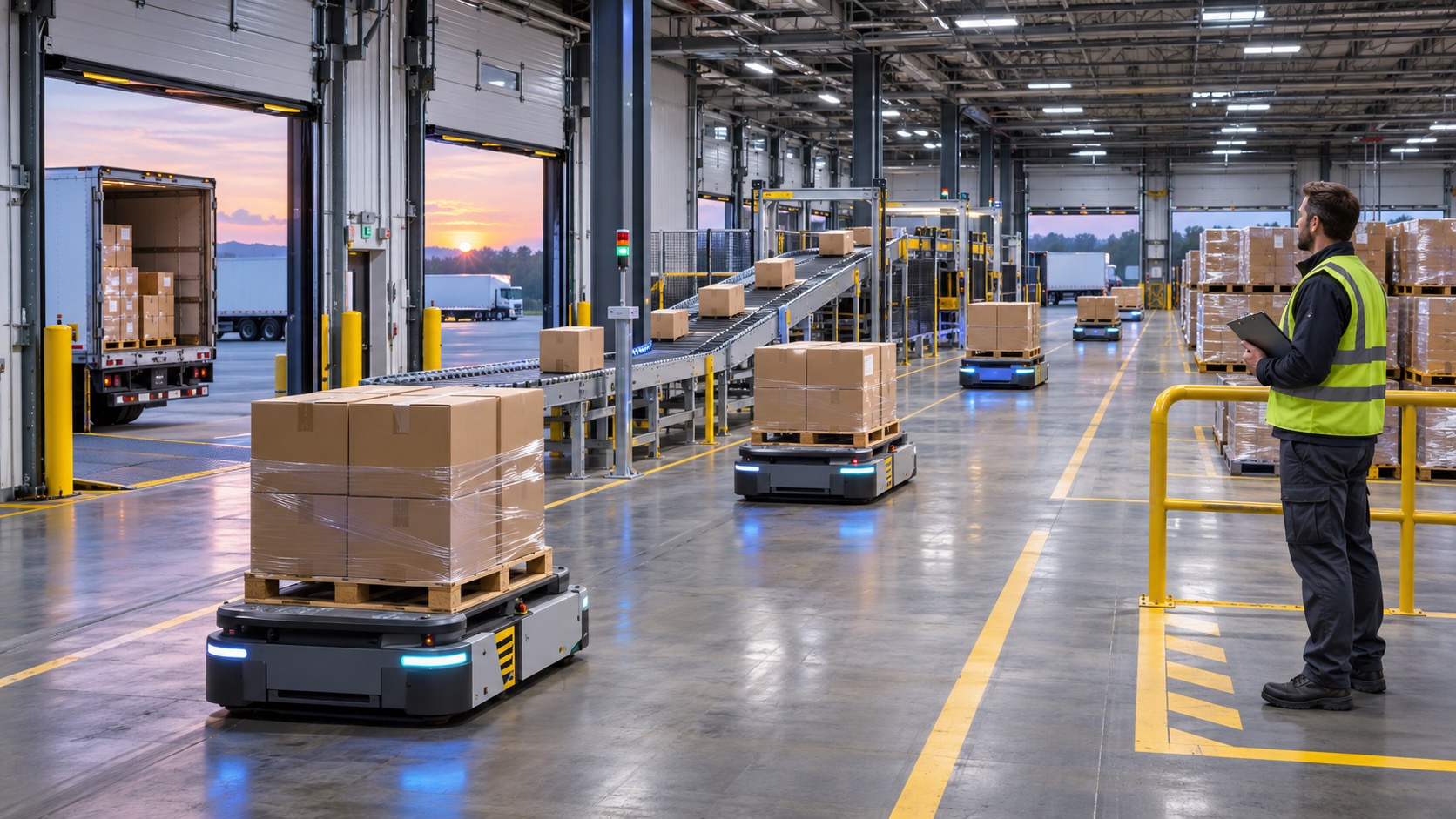
A cross-dock moves goods from inbound to outbound with little storage. Timing matters more than long-term location. Autonomous pallet movers can carry freight between doors, but their value comes from synchronization with appointments, unloading, inspection, staging, and trailer readiness.
A late inbound vehicle may change dozens of planned moves. Fleet software can reprioritize routes and preserve urgent transfers, provided the operation has trustworthy status data. Floor space remains finite, so staging discipline and congestion control become central. Robotics makes the transfer plan more adaptable while also exposing every missing scan and blocked lane.
Last-Mile Automation Is Linking Depots With Recipients
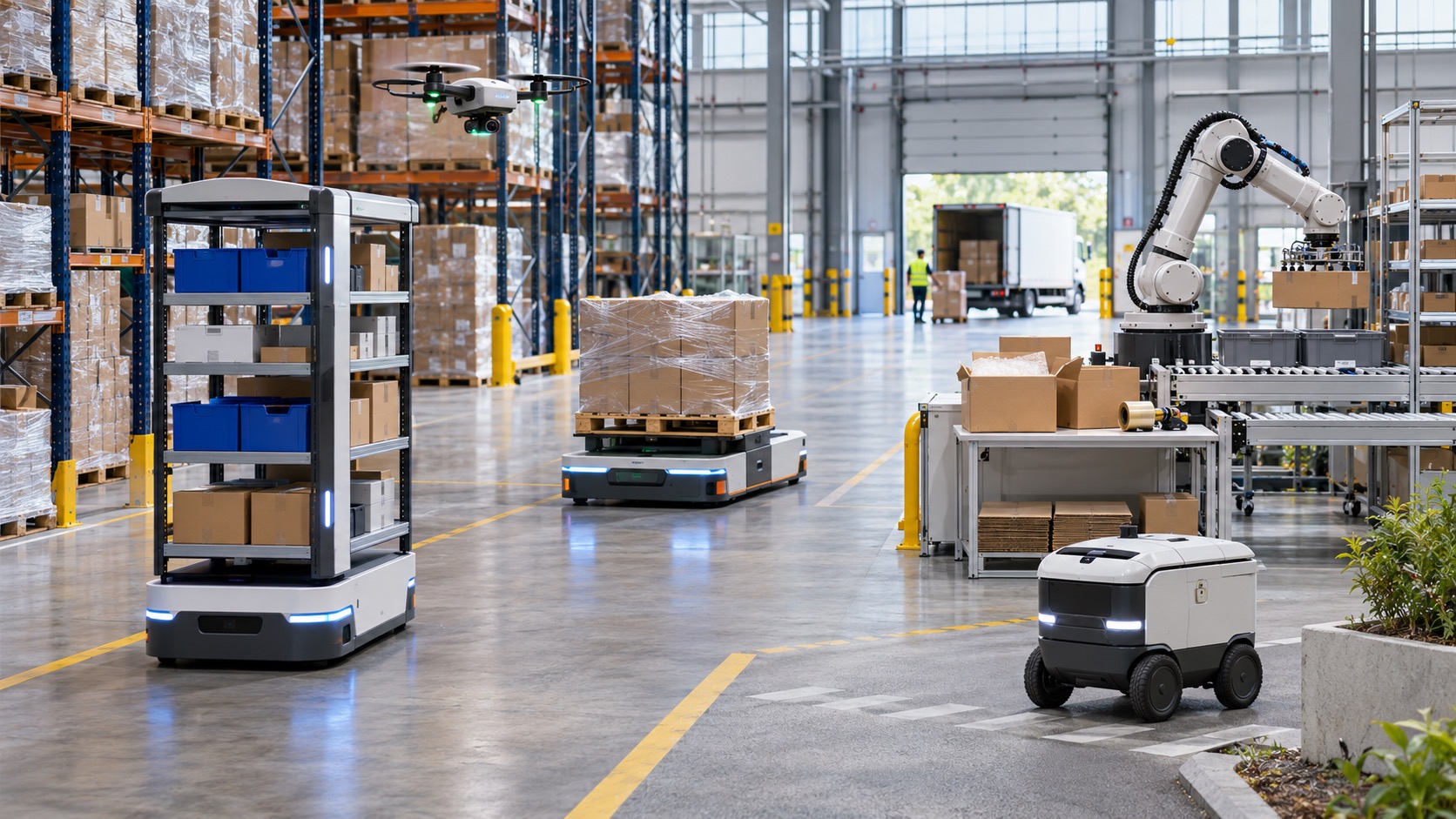
Sidewalk robots, delivery drones, and autonomous road vehicles address the expensive final segment between a local facility and the customer. They are most practical where routes, payloads, handoff points, and regulations are well defined. A campus meal run differs greatly from an apartment delivery in a dense city. Secure compartments, remote assistance, weather limits, curb access, and recipient authentication can determine whether the service works.
Fleet Software Is Becoming a Logistics Dispatcher
A large robot fleet needs more than shortest-path routing. The dispatcher considers task priority, travel distance, battery state, payload capability, congestion, one-way aisles, station demand, maintenance status, and promised departure times. Sending every unit toward the most urgent queue can gridlock the same intersection.
Good orchestration protects the entire flow. It may delay one move so a trailer can depart, redirect a robot around cleaning work, or send a healthy unit to cover for a charger fault. Simulations help establish rules, while live data reveals assumptions that fail under actual order mix.
This layer also connects different automation islands. Conveyors, arms, mobile robots, doors, lifts, and warehouse software must agree on task ownership. Clear state transitions prevent work from being released twice or forgotten between systems.
Operational Data Is Changing Management Decisions
Robots create timestamped records of assignments, routes, waits, stops, battery use, failed grasps, and completed handoffs. Managers can distinguish a slow vehicle from a starved station or a congested aisle. They can compare planned and actual cycle time without relying only on observations taken during a short study. Yet abundant data can mislead when definitions are weak. A completed robot trip is not a completed customer order. Useful metrics connect machine events to accepted picks, shipped parcels, service level, rework, damage, and worker exposure. The transformation is strongest when telemetry explains the process rather than decorating a dashboard.
Safety Is Moving Into Traffic and Work Design
Mobile robots detect obstacles and stop, but safe operation starts before a scanner sees a person. Facilities define crossings, speed zones, blind-corner rules, pedestrian refuges, charging areas, recovery methods, and load limits. Workstations prevent hands from entering dangerous motion. High-speed arms remain separated where collaboration is unnecessary.
Robotics can reduce forklift traffic, heavy carrying, repetitive lifting, and entry into cold or unstable storage. New risks appear around quiet vehicles, unexpected restart, dropped loads, batteries, and maintenance. Training must explain normal behavior and the precise response to faults, not encourage employees to step around safeguards to maintain rate.
Jobs Are Shifting Toward Exception Ownership
Automation changes the content of work before it changes headcount. Employees replenish stations, investigate inventory differences, recover disabled equipment, validate packaging, tune workflows, and coordinate priorities. These responsibilities require operational knowledge as much as technical skill. A technician can repair a sensor, but an experienced lead may recognize that recurring stops come from a badly placed pallet or an unrealistic release rule. Strong programs involve workers in layout and pilot design, then create advancement paths around controls, maintenance, quality, and process improvement. Weak programs hide new exception labor inside existing roles and blame people for system conditions they cannot change.
Buildings Are Being Designed Around Robotic Movement
Floor flatness, aisle width, door timing, rack geometry, wireless coverage, charging power, fire protection, and maintenance access affect fleet performance. New facilities can preserve direct routes and separate conflicting traffic. Existing buildings often need smaller robots, transfer points, controlled lifts, or manual bridges.
The design question is not how to maximize robot space. People, emergency egress, cleaning, service, and future product changes also need room. Flexible infrastructure lets a facility revise traffic patterns without making every operating change a construction project.
Economics Depend on System Throughput
A robot may perform its assigned motion reliably and still fail to improve the business. The investment case must include integration, mapping, fixtures, network changes, charging, maintenance, spares, support, training, and transition time. Savings may come from reduced walking, lower injury exposure, extended hours, smaller buffers, or fewer errors rather than from direct labor alone. Utilization is decisive. Equipment serving a short peak may be better rented or supplied as a service. A year-round flow can justify ownership and internal expertise. Managers should compare accepted orders per hour and total cost through the complete operation, not a vendor’s isolated demonstration cycle.
Resilience Is Becoming a Designed Capability
Highly connected logistics can fail broadly when software, power, identity, or network services are disrupted. Resilient sites segment equipment, maintain recovery procedures, preserve critical manual paths, and practice restoring queues after an interruption. They keep configuration backups and know which orders or shipments deserve priority when capacity returns.
A robot that stops safely has done only the first part of failure handling. The operation must identify stranded loads, prevent duplicate tasks, move disabled equipment, and reconcile inventory before normal release resumes.
Transformation Will Be Judged at the Customer Handoff
Customers rarely care which machine moved a parcel. They care whether the correct item arrives intact, on time, with a usable delivery experience. Robotics succeeds when better internal coordination survives every handoff to carriers, stores, lockers, sidewalks, and doors. Faster picking offers little value if packaging cannot keep up or a trailer misses its cutoff. The enduring change is disciplined flow: physical movement tied to trustworthy identity, capacity, and exception handling from receiving through delivery.