Service Robots and Industrial Robots Solve Different Kinds of Work
Service robots and industrial robots are both machines that sense, move, and perform useful tasks, but they are designed for different worlds. Industrial robots usually work inside controlled production systems around parts, fixtures, tools, and trained staff. Service robots work around people in hospitals, hotels, homes, offices, stores, campuses, restaurants, and public spaces. The difference is not only where the robot is located. It is the kind of task, environment, safety case, interface, support model, and human expectation the robot must satisfy.
A: Industrial robots usually fit controlled production and processing environments.
A: Service robots usually handle tasks in spaces designed primarily for people.
A: It depends on the workflow; hospital delivery is service, while factory material movement may be industrial logistics.
A: Not necessarily. They solve a different problem with navigation, usability, and shared-space behavior.
A: Many are guarded, but collaborative and smaller systems use different safety approaches.
A: Repeatability, tooling, uptime, safety control, and process quality.
A: Safe navigation, clear interaction, useful handoffs, support, and user trust.
A: A platform may cross categories when the task, users, and environment change.
A: Start with the environment, task, user, and failure recovery.
A: Industrial robots serve processes; service robots serve people-facing tasks.
The Main Difference Is the Work Environment
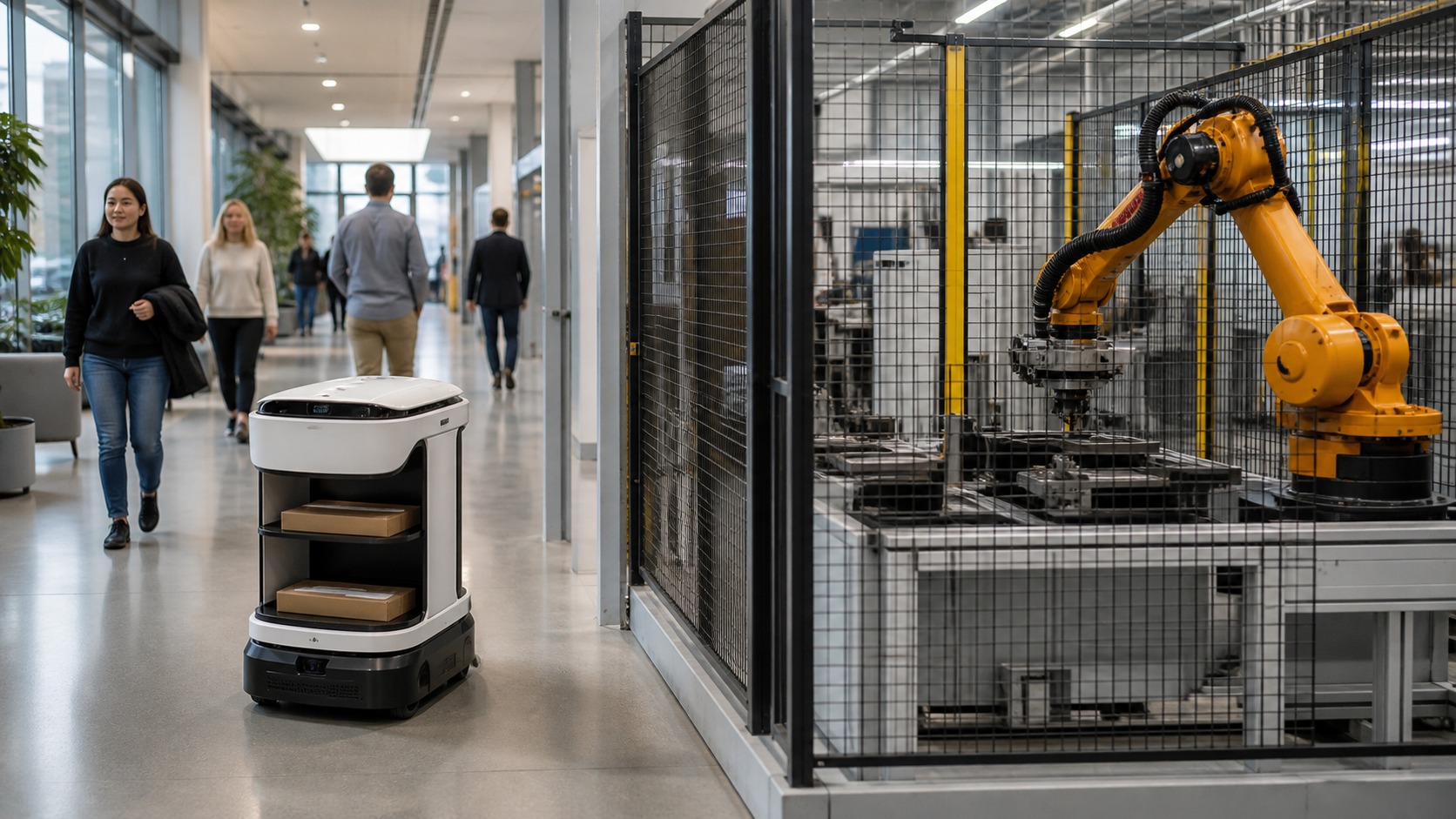
Industrial robots usually operate in engineered spaces. A factory cell can use fences, fixtures, conveyors, machine signals, and defined part locations to make the robot's world repeatable. That structure lets the robot move quickly, carry payloads, follow precise paths, and repeat the same cycle through long shifts. The environment is designed around the process.
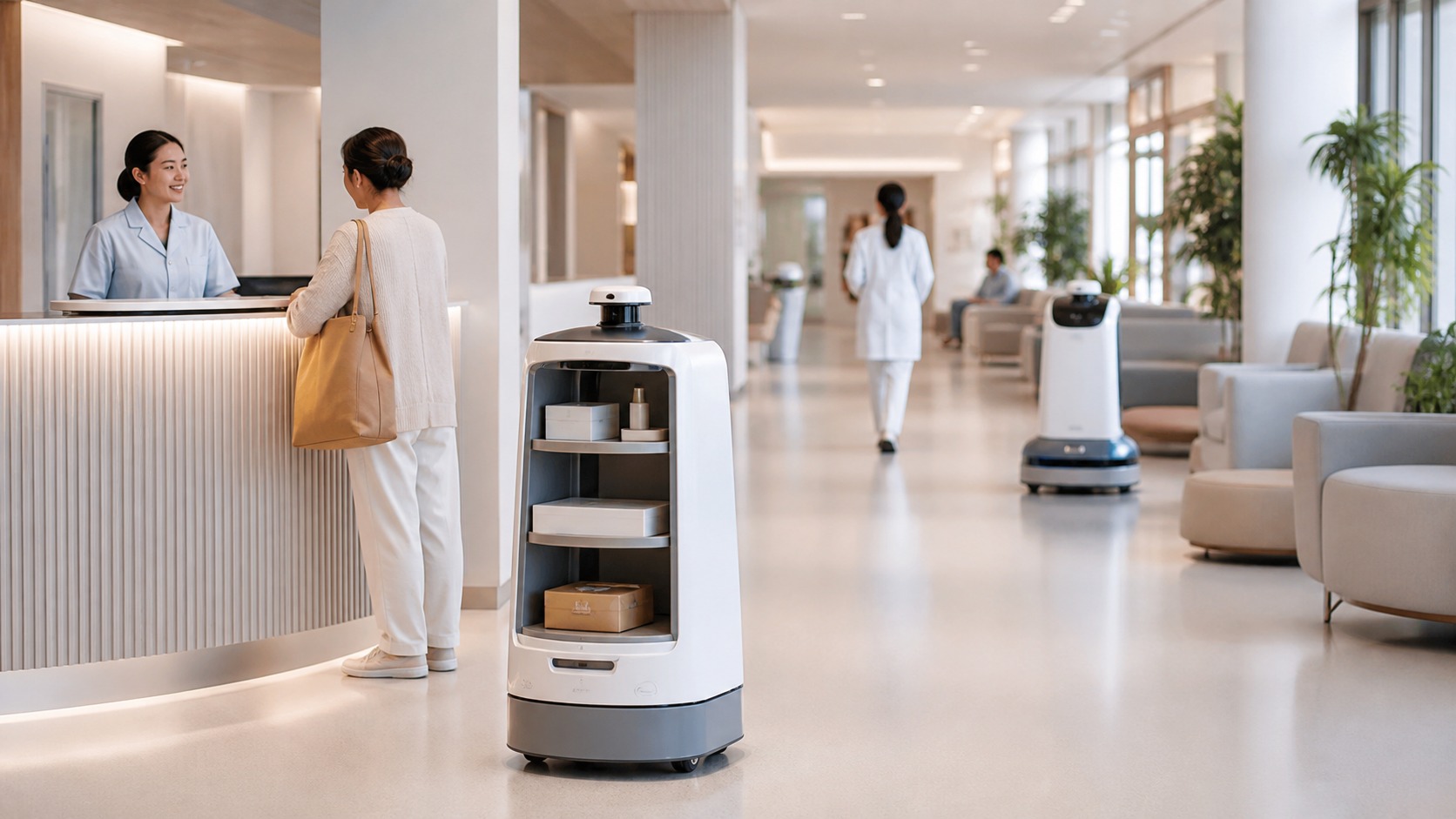
Service robots usually operate in human spaces. A hospital hallway, hotel lobby, restaurant aisle, office corridor, classroom, or home changes constantly. People walk through, chairs move, doors close, carts block routes, and staff routines shift. The robot must handle ambiguity rather than rely on perfect repeatability.
This difference shapes almost every design choice. Industrial robots are often optimized for process stability. Service robots are optimized for shared-space behavior, navigation, recovery, and acceptance by people unfamiliar with robotics.
A beginner can remember it this way: industrial robots usually get a prepared workspace, while service robots must adapt to a workspace people already use.
That does not make one category more advanced than the other. It means the difficulty lives in different places. Industrial robotics often struggles with process precision and uptime, while service robotics often struggles with social spaces and changing conditions. The service robot in a lobby and the industrial arm behind a guard may both use motors, sensors, batteries, software, and safety logic, but the surrounding world asks them to behave differently. In the lobby, the robot must negotiate eye contact, hesitation, blocked routes, noise, and people who may not understand its purpose. In the factory cell, the arm benefits from fixtures, scheduled cycles, trained operators, and controlled access. That environmental contrast explains more than the robot shape does.
Industrial Robots Focus on Production Processes
Industrial robots are commonly used for welding, painting, palletizing, machine tending, inspection, packaging, assembly, dispensing, cutting, polishing, and material handling. Their value comes from repeatable physical work. The task is usually measured through cycle time, quality, uptime, scrap reduction, safety improvement, or labor availability.
The robot is part of a production chain. If a gripper misses a part, a fixture wears, a sensor gets dirty, or a machine handshake fails, the downstream process may stop. That is why industrial robot deployments spend so much effort on tooling, fixtures, sensors, spare parts, and recovery procedures.
An industrial robot does not need to charm anyone. It needs to perform the process correctly, stop safely, report faults clearly, and return to work quickly after maintenance. Production robots also live inside performance numbers that are usually easy to measure. A cell either reaches the cycle time, produces acceptable parts, avoids damage, and recovers from faults, or it does not. This makes industrial robot projects highly concrete. The robot is valuable when the process becomes more stable, safer, easier to staff, or easier to inspect. If the surrounding process remains chaotic, the robot arm alone cannot create a reliable factory.
Service Robots Focus on Human-Facing Tasks
Service robots are used for delivery, cleaning, guidance, telepresence, monitoring, hospitality, healthcare logistics, restaurant support, retail scanning, campus transport, and domestic assistance. Their value comes from helping people, reducing routine effort, or making a service more consistent.
A service robot must fit into a human workflow. A delivery robot needs a clear handoff. A cleaning robot needs to avoid people and furniture. A guidance robot needs to be understandable. A hospital robot needs secure compartments and quiet motion. The task is technical, but the experience is social.
This is why a service robot that completes a task but confuses staff may still fail. If people do not know how to request the robot, retrieve items, clear a fault, or trust its movement, the machine creates work instead of reducing it.
Service robots therefore need human-centered design. Speed matters, but predictability, clarity, and recovery often matter more.
The strongest service robots are modest in the right way. They do a useful job, make their status easy to understand, and avoid demanding attention when everything is normal. A service robot's success is measured through a softer mix of outcomes. It may save walking time, keep floors cleaner, make deliveries predictable, or guide visitors, but it also needs to avoid irritation. Staff acceptance, guest comfort, patient trust, and simple recovery steps can matter as much as navigation accuracy. A service robot that technically completes tasks but makes people anxious, confused, or interrupted has not solved the service problem.
Safety Priorities Are Different
Industrial robots are often separated from people by fences, interlocks, scanners, guarded cells, lockout procedures, and trained operating rules. The robot may move fast or carry heavy loads because the cell controls access. Safety is built around predictable zones and controlled energy.
Service robots often share space with untrained people. They need safe speeds, stable bodies, rounded surfaces, obstacle detection, careful stopping behavior, and clear signals. The robot may meet children, visitors, patients, guests, pets, or distracted workers. It cannot assume everyone understands its path.
Collaborative industrial robots blur the line somewhat, but the safety case still depends on the tool, payload, speed, part shape, pinch points, and workspace. A cobot in a factory is not automatically the same as a service robot in a hallway. This is why risk assessment sounds different across the two categories. An industrial cell may focus on reach envelopes, stored energy, tool hazards, lockout steps, and entry procedures. A service robot may focus on low-speed contact, trip hazards, hallway etiquette, privacy, elevator use, and what happens when an untrained person touches the robot. The safety case follows the kind of human exposure the robot creates.
Autonomy Means Different Things
An industrial robot may be highly automated while still operating in a structured sequence. It waits for a signal, follows a path, performs a tool action, checks a sensor, and repeats. The autonomy is often process autonomy: the system knows how to complete a defined production cycle.
A service robot often needs navigation autonomy. It must plan routes, avoid obstacles, update maps, dock, pause politely, reroute, and ask for help when a human environment blocks the plan. The robot may have less force or precision than an industrial arm, but more need for real-time situational judgment.
Both forms of autonomy are hard. The industrial robot must be reliable inside a precise process. The service robot must be resilient inside a messy human environment.
That is why comparing them only by intelligence can be misleading. A robot can be very sophisticated in one domain and poorly suited to the other.
The better question is whether the autonomy matches the job the robot is expected to do. A factory robot may repeat one process thousands of times with only minor variation. A service robot may face a new hallway arrangement, a distracted visitor, a cart in the way, and an elevator delay within one trip. The industrial challenge is making a process repeat with quality. The service challenge is making helpful behavior survive ordinary human messiness without overreacting.
Interfaces and Users Change the Design
Industrial robot users are often operators, integrators, technicians, engineers, and maintenance staff. They may use teach pendants, HMI panels, safety procedures, maintenance logs, and production dashboards. The interface can assume some training.
Service robot users may be nurses, hotel staff, customers, visitors, office workers, residents, students, or homeowners. The interface often needs to be much simpler: compartments, buttons, lights, sounds, phone apps, or clear physical behavior. People should not need a robotics background to benefit.
This changes documentation and support. Industrial robots may have technical manuals and trained support teams. Service robots need fast onboarding, simple troubleshooting, and clear ownership in the place where they work. This difference also affects training. Industrial teams can train a smaller group of operators and technicians on specific procedures. Service robots often need to be understandable to a wider group of people who may only interact briefly. That pushes designers toward plain status signals, simple compartments, gentle motion, and recovery behavior that does not require a manual.
The Categories Are Starting to Overlap
The line between service and industrial robots is not always sharp. Warehouses use mobile robots that look like service robots but support industrial-scale logistics. Hospitals use delivery robots with operational discipline similar to factory automation. Collaborative arms may work in small shops, labs, or food service settings.
The overlap matters because it shows that robot categories are shaped by use, not just shape. A mobile robot in a hotel is a service robot. A similar mobile base carrying parts between manufacturing stations may be an industrial or logistics robot. The same hardware family can serve different categories when the workflow changes.
For buyers and builders, the important step is defining the task, users, environment, risk, and support model before choosing a category name.
A robot's label should clarify expectations, not replace careful design.
If the robot works around the public, service design matters. If it works inside production, process reliability matters. If it does both, the project needs both kinds of thinking. Overlap creates useful lessons. Service robots can borrow industrial habits around uptime, preventive maintenance, logs, and clear fault ownership. Industrial robots can borrow service-robot habits around human-centered interfaces and easier setup. The best modern robot deployments increasingly combine both views rather than defending old category boundaries.
Practical Takeaway
Service robots and industrial robots differ mainly in their environment, users, tasks, and safety assumptions. Industrial robots are built around controlled production work. Service robots are built around useful tasks in human spaces.
A beginner should compare them by asking four questions: where does the robot work, who interacts with it, what does success look like, and what happens when something goes wrong?
Those questions make the difference clear. Industrial robots turn structured motion into production. Service robots turn practical autonomy into help for people. When the distinction is understood, project planning becomes more honest. A company buying a robot for a hallway should not evaluate it like a welding arm. A factory team should not expect a production robot to succeed without fixtures, tooling, and process discipline. The right category helps the team ask the right questions before the robot arrives. The decision also affects procurement language. A buyer looking at service robots should ask about mapping, user interaction, route exceptions, charging behavior, cleaning, and support for frontline staff. A buyer looking at industrial robots should ask about reach, payload, repeatability, tooling, guarding, and integration with the production process. Those questions lead to very different vendor conversations and better project expectations.