An Open-Source Robot Begins With a Behavior You Can Test
Building your own robot becomes manageable when the first objective is a bounded behavior rather than a machine that can do everything. A small rover that drives a measured route, stops before an obstacle, and reports what it sensed creates enough work in mechanics, power, embedded code, and testing to teach genuine systems engineering. Open-source hardware and software make that work inspectable: you can study design files, change the mechanism, trace a driver, and publish a correction. They do not eliminate cost, calibration, or failure. The Open Source Hardware Association defines open hardware around access to preferred modifiable design files, while software repositories add their own licenses and dependencies. A successful build therefore joins technical design with source evaluation. This guide treats the robot as a stack of interfaces. Each layer is brought up separately, measured, and only then connected to the next, producing a platform you understand rather than an assembly whose behavior depends on unexplained instructions.
A: Not necessarily, but the project should state clearly which layers are open and which proprietary dependencies remain.
A: Editable source CAD is far more useful because builders can make meaningful design changes.
A: They may share a battery, but regulation, grounding, noise, and peak current require deliberate design.
A: After basic electronics, sensing, manual motion, stopping, and communication work reliably.
A: Time-sensitive input, actuator output, local limits, and communication-loss protection are strong candidates.
A: It preserves the exact design and instructions used even when the main project changes later.
A: Accurate enough for the intended test, with a repeatable method and a known residual error.
A: No, a clear license is needed to grant reuse, modification, and distribution rights.
A: A tested correction, substitution, or failure report with exact version and conditions.
A: When it safely repeats its acceptance test and the working configuration can be reconstructed.
Write One Acceptance Test Before Choosing Parts
Describe the first useful run in observable terms. “The robot moves autonomously” is too vague. “From a marked start, the rover travels three meters, stops at an obstacle between twenty and sixty centimeters away, and remains stopped until reset” identifies distance, sensing, motion, and safe state. Add a time limit and acceptable error if measurement matters. This single test prevents exciting features from displacing the core build.
Record the environment as carefully as the behavior. Smooth indoor flooring, outdoor gravel, table edges, pets, wireless coverage, payload, and available workspace lead to different chassis and sensor choices. A robot designed for a quiet bench should not be assumed safe on stairs.
Verify Which Layers Are Actually Open
A project may publish source code while withholding editable CAD, schematics, or board files. Another may open the mechanical design but depend on proprietary firmware. Inspect licenses and source formats separately for hardware, software, documentation, and datasets. Editable CAD is more useful than a mesh alone; a schematic is more useful when the board layout and bill of materials are included. Open does not mean free to manufacture, and a public repository without a clear license may still restrict reuse. Choose a project whose degree of openness supports the modifications you intend.
Draw the System as Power, Signals, and Structure
Sketch the robot before ordering. Separate the structural path that carries load, the power path from battery to regulators and actuators, and the signal path among sensors, controllers, and computers. Label voltages, expected currents, communication buses, connector types, and mechanical mounting points. The drawing can be simple, but it must reveal where one subsystem depends on another.
This architecture exposes common mistakes early. A single-board computer may require a stable supply that a noisy motor rail cannot provide. A camera may consume the only high-speed port. A sensor mounted behind a bumper may lose the field of view assumed by the software.
Define interfaces that can survive replacement. If a motor driver fails or becomes unavailable, a documented voltage, current, command, and feedback interface gives the build an upgrade path. Modularity is not extra complexity when it isolates uncertainty.
Choose Mechanics That Can Be Rebuilt
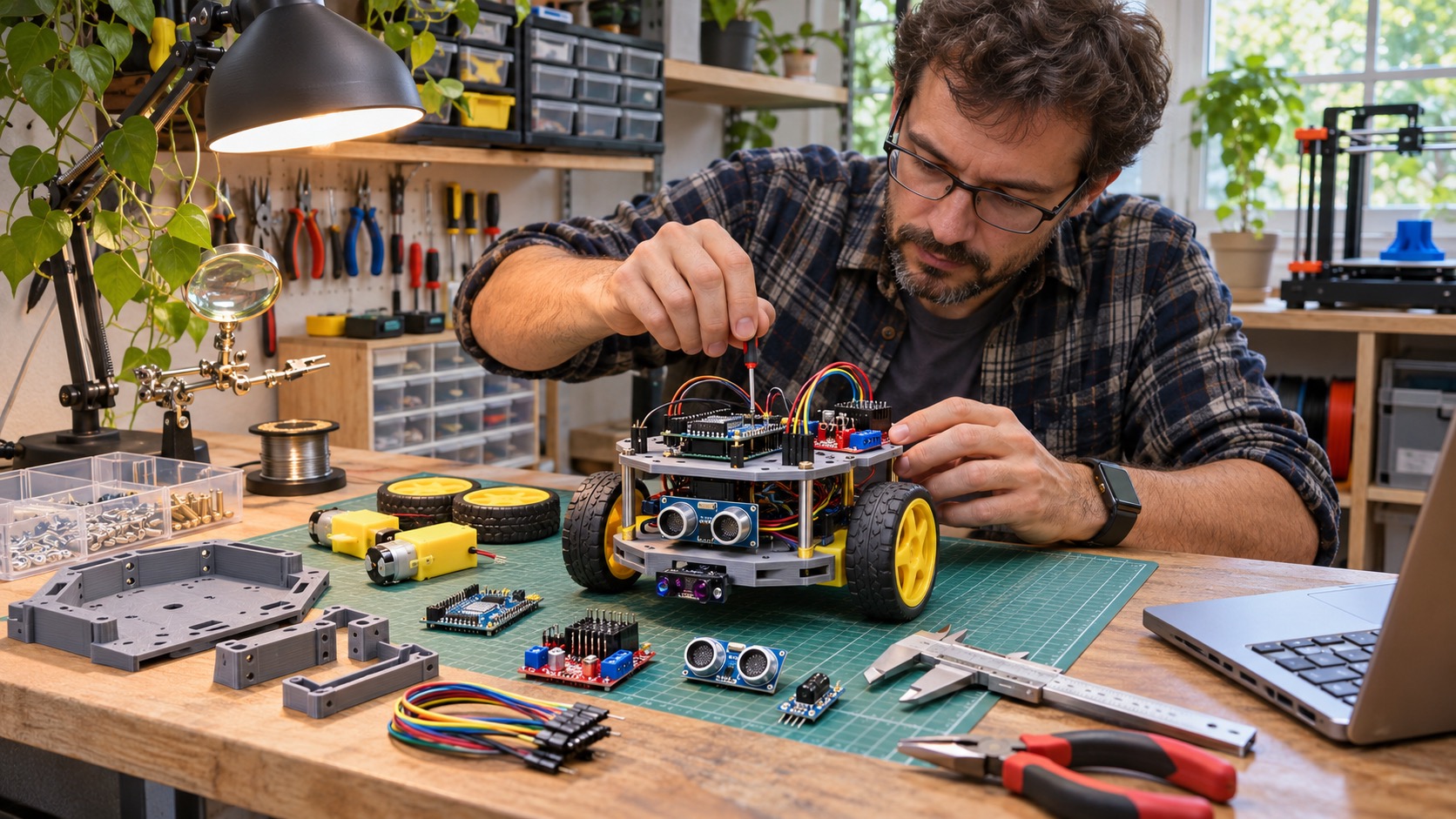
For a first mobile robot, two driven wheels and a caster remain valuable because steering is simple and parts are accessible. Select wheel diameter and gearing from required speed, torque, and terrain rather than appearance. Check shaft compatibility, fastener access, cable routes, and whether the chassis can be opened without removing every sensor.
Printable parts help when the source includes editable models and sensible tolerances. Print a small fit test before committing to a long chassis job. Layer direction affects strength, and a visually clean part can still split around a fastener or soften near a warm motor.
Budget Current Before Selecting the Battery
List each load at idle, typical use, and credible peak. Motors can draw several times their running current when starting or stalled, and servo-heavy robots create simultaneous peaks. Size wiring, connectors, regulators, fuses, and the battery for those events rather than adding average currents alone. Keep logic power stable, protect against reverse polarity, and place a physical disconnect where it can be reached immediately. Use the correct charger and enclosure for the chosen chemistry, and never treat a battery as an interchangeable block.
Bring Up Electronics Without Motion
Inspect every connection with power removed. Check continuity between power and ground, connector polarity, exposed conductors, and strain relief. Power the logic rail first through a current-limited supply when possible, then verify voltage at each board. Unexpected consumption, heat, odor, or repeated resets means stop.
Load a minimal firmware program that reports a heartbeat without enabling actuators. Confirm serial or network communication, then read one sensor at a time. Save raw values so you can distinguish wiring faults from later filtering problems.
Test each motor with the robot supported, using a low command and short duration. Establish positive direction, encoder sign, and a conservative limit. A software stop is useful, but the first test still needs a physical way to remove energy.
Keep the Microcontroller Responsible for Timing
A microcontroller is well suited to reading encoders, producing motor commands, sampling simple sensors, and enforcing fast safety rules. It should continue to stop the mechanism if a higher-level computer freezes or communication disappears. Use explicit message fields, units, ranges, and update rates. A command called “speed” is incomplete until its meaning is defined as wheel angular velocity, body velocity, duty cycle, or something else.
Version the firmware with the wiring and board revision it expects. Small hardware changes often break pin assignments or timing assumptions, so a working binary without its matching source and configuration is not a reliable recovery plan.
Add Higher-Level Software Only After Manual Control Works
Before mapping or autonomy, command the robot slowly from a wired or local controller and observe measured wheel motion. Confirm that stop commands always win, communication timeouts behave correctly, and sensor timestamps advance. This stage creates a known-good boundary: higher-level software can request motion, while the embedded layer retains local protection. If manual control is unreliable, adding a navigation framework will produce more places to search without fixing the original defect.
Use ROS 2 as an Interface Framework, Not a Repair
ROS 2 can connect drivers, transforms, visualization, localization, planning, and logging through nodes and defined message interfaces. Begin with a small graph: a hardware node publishes encoder and sensor data, accepts velocity commands, and reports diagnostics. Name coordinate frames deliberately and measure the physical offsets between them.
Choose a supported ROS 2 distribution and document the operating system, package versions, and build method. Mixing instructions from several distributions is a common source of dependency failure. Containers can improve repeatability, but access to serial devices, cameras, graphics, and networks must still be understood.
Record data before tuning advanced behavior. A short bag containing commands, encoder feedback, range measurements, and timestamps lets you replay a failure without repeatedly driving the robot. Logging turns an intermittent impression into evidence.
Treat a Repository as Evidence, Not a Promise
Read the bill of materials, assembly guide, issue tracker, release history, and license before buying. Identify the exact revision you intend to reproduce. A project can be valuable even when inactive, but obsolete controllers, broken package sources, or undocumented substitutions change the real scope. Search for independent build reports using the same major version. Fork or archive the chosen commit so a future update cannot silently alter the instructions you are following.
Compare the repository with the parts in hand. Mark every substitution and explain why it should be compatible. Mechanical dimensions, motor constants, sensor voltage, and communication protocol matter more than a similar product photograph.
Calibrate With Measurements the Robot Can Repeat
Measure wheel diameter under load rather than copying a nominal catalog value. Determine axle spacing from turning behavior, establish sensor offsets, and record encoder counts against known travel. Calibration should produce stored values, a method, and an expected residual error. If repeating the procedure yields widely different results, the problem may be backlash, wheel slip, loose hardware, or inconsistent timing rather than a number that needs more decimal places.
Add Autonomy in Observable Increments
First command a fixed distance and compare requested with measured motion. Next close the loop on wheel velocity, then on heading, and only afterward introduce obstacle response or route planning. Each stage should have a test that can fail independently.
Use a simple baseline beside any learned or complex method. A threshold stop or proportional controller may not be the final behavior, but it reveals whether a new approach truly improves performance. Complexity earns its place through measured benefit.
Expand the operating area gradually. Blocks, a tether, low speed, and a clear indoor zone reduce consequences while faults are common. Outdoor tests add lighting, traction, weather, communication, and bystander variables that deserve separate preparation.
Document the Build While Decisions Are Fresh
Photograph cable routes, connector orientation, and assembly steps that CAD cannot show. Maintain a bill of materials with part numbers, quantities, suppliers, and substitutions. Save configuration beside code, and tag a known-working combination of firmware, software, mechanical revision, and calibration. An unexplained folder of final files is less reusable than a short history showing why changes were made.
Write recovery instructions for a blank computer and replacement controller. If you cannot recreate the software environment, the robot is dependent on a machine that will eventually fail.
Respect Licenses, Trademarks, and Safety Boundaries
Hardware, code, media, and documentation may use different licenses. Preserve notices, attribute contributors, and understand whether derivative designs must be shared under the same terms. Do not imply that the original project endorses your modified hardware, and do not reuse protected branding as if your build were official. Licensing is part of engineering because it determines what collaborators can lawfully reproduce and distribute.
Return a Tested Improvement to the Community
A contribution does not need to be a new robot. A corrected dimension, replacement component, clearer wiring photograph, repeatable calibration script, or carefully described failure can be more useful. State the exact version, test conditions, and evidence. Separate confirmed results from ideas you have not tried.
Follow the project’s contribution process and keep a change focused enough to review. Maintainers may choose a different solution, especially when a fix supports only one local substitution. The discussion still preserves useful knowledge for later builders.
When you publish a fork, identify what remains compatible with the original and what changed. This honesty helps users choose the right instructions and prevents support requests from being sent to the wrong team.
A Finished Robot Is One You Can Explain and Reproduce
The first build is complete when it performs the acceptance test safely, the result can be repeated, and you can trace failures across power, mechanics, firmware, and software. Extra sensors and sophisticated autonomy can follow from that stable base. Open-source practice strengthens the platform because the design, dependencies, measurements, and limitations remain available for inspection. The deeper achievement is not that the robot moved once. It is that another builder—or your future self—can understand why it moved, rebuild the working combination, and improve it without starting from mystery.
Preserve a final test record with video, logs, configuration, and observed tolerances. That package turns a personal milestone into a credible engineering reference.