A Remarkable Robot Changes the Definition of What Machines Can Do
The most memorable robot inventions are not always the largest, fastest, or most humanlike. They become remarkable because they open a new category of action. An industrial arm proves hazardous factory handling can be programmed. A planetary rover turns a distant world into a place where mobile science is possible. A household robot transforms autonomy from a laboratory topic into an everyday appliance. Behind each machine stands a visionary—or more often a determined team—who selected the right problem, accepted the constraints of available technology, and designed an entire system around a clear purpose. Their inventions combine mechanics, control, sensing, software, interfaces, testing, and institutions. Looking at the people behind these robots reveals why progress so often comes from reframing a task rather than waiting for a universal machine. The following inventions earned their place in robotics history by making one previously doubtful capability real enough for others to build upon.
A: Its product, controller, application, manufacturing, and support established an industrial category.
A: It worked in a simplified research environment and depended on substantial external computing.
A: A Canadian program led by the National Research Council used Spar Aerospace as the industrial prime contractor.
A: It handled nearby hazards while mission teams selected broader scientific targets.
A: It made a bounded autonomous mobile robot affordable and familiar to mass consumers.
A: The da Vinci system translates a surgeon's commands rather than independently performing surgery.
A: It visibly demonstrated dynamic balance and disturbance recovery on a large legged machine.
A: It showed that timing and readable social signals can shape human-robot exchange.
A: Their deformation complicates modeling but can provide valuable adaptation and safer contact.
A: It defines a useful new capability and leaves principles that later teams can extend.
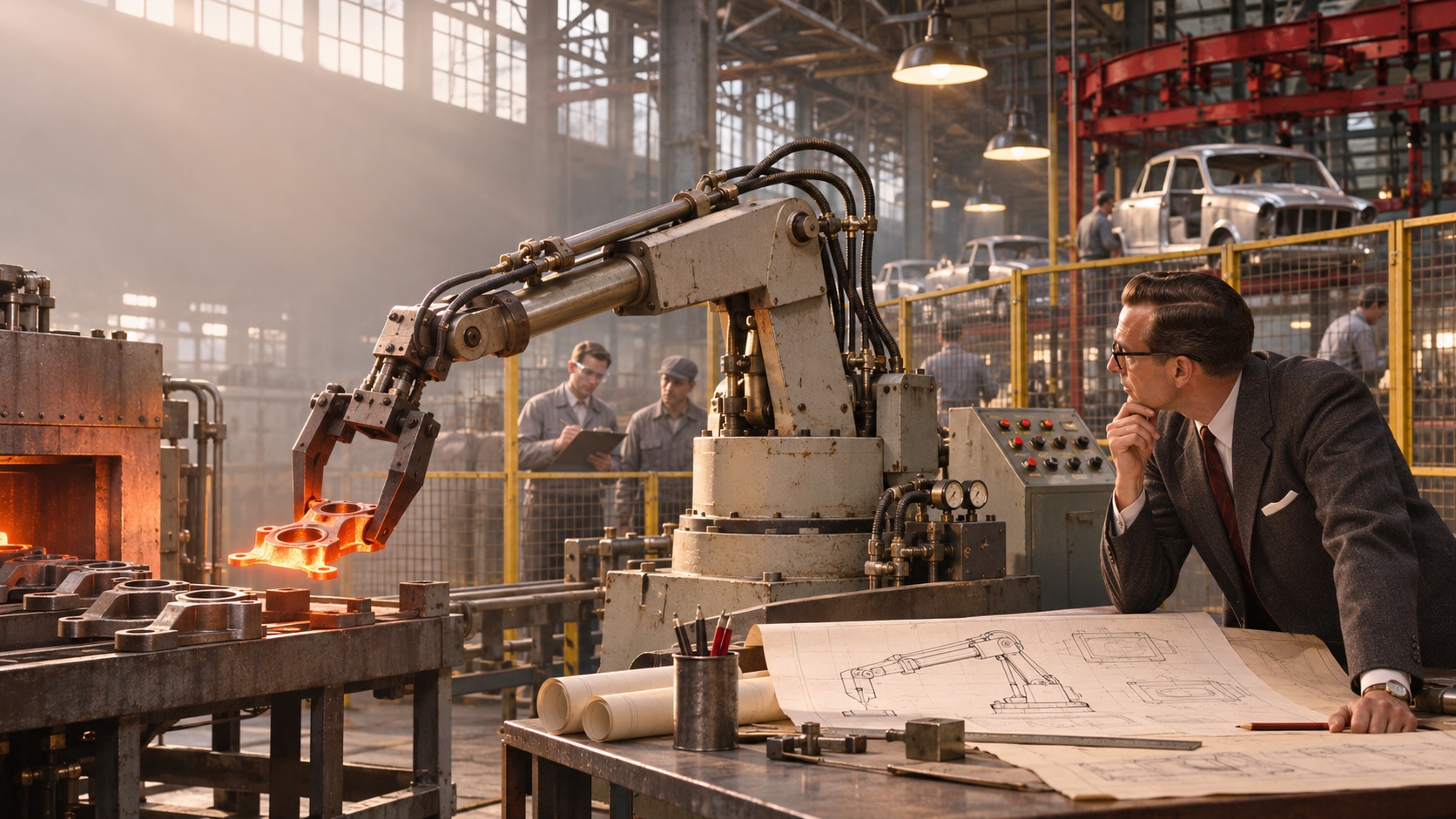
Unimate Established the Industrial Robot
George Devol’s programmed article-transfer concept and Joseph Engelberger’s commercial drive converged in Unimate. The early hydraulic arm was neither graceful nor easy to sell, but it could repeatedly handle hot die-cast parts without placing a worker next to the hazard. That application gave automation a defensible economic and safety case. Unimation then turned the prototype into a manufactured product, trained customers, demonstrated it publicly, and licensed the technology abroad.
Unimate’s importance lies in the complete proposition it introduced: a programmable manipulator, a controller, an application, and an organization responsible for supporting it. Later industrial robots changed almost every technical detail. They retained the category that Devol, Engelberger, their engineers, and early manufacturing partners proved could exist.
Shakey Made a Robot Reason About Where to Go
Charles Rosen assembled an interdisciplinary SRI team to build Shakey, a mobile platform that could perceive a simplified room, plan a sequence, and move toward a goal. The robot’s deliberation took far longer than its motion, and its world contained carefully designed landmarks and objects. Yet Shakey integrated computer vision, planning, navigation, and action at a scale no prior mobile robot had achieved. Its creators made the difficulties of embodied artificial intelligence concrete, producing algorithms and questions that shaped decades of research.
The Stanford Arm Brought Precision to Computer Manipulation
Victor Scheinman designed the Stanford Arm for accurate electrical control at a time when industrial manipulators were dominated by heavy hydraulics. Its six joints enabled researchers to connect software with precise movement, supporting experiments in vision-guided assembly and manipulation. Scheinman’s later Vicarm traveled from the laboratory toward industry and evolved into the PUMA family after Unimation acquired it.
The invention illustrates the power of research instrumentation. A capable arm did not solve manipulation by itself; it let computer scientists investigate calibration, trajectory planning, grasping, and visual feedback on a shared physical platform. Scientific access was part of the invention’s influence.
WABOT Turned the Humanoid Into a Systems Challenge
Ichiro Kato and Waseda University researchers completed WABOT-1 in the early 1970s by integrating bipedal locomotion, manipulation, vision, and communication. No component matched human ability, but the combination required coordination across mechanical and computational specialties. WABOT made the humanoid body a legitimate experimental architecture rather than a purely fictional silhouette.
Successors explored performance, expression, and cooperation, while other Japanese programs pursued dynamic walking and practical assistance. The visionary move was to accept integration itself as a research problem. Humanoid projects could expose how balance, perception, reach, energy, and human expectations interact.
The form also forced researchers to confront a continuing question: is human compatibility worth mechanical complexity? That question still guides designs intended for stairs, tools, workstations, and social spaces.
Canadarm Extended Human Capability Into Orbit
Canada’s National Research Council led the development program that produced the Space Shuttle Remote Manipulator System, widely known as Canadarm, with Spar Aerospace as the industrial prime contractor. First flown in 1981, the long articulated arm deployed, captured, and positioned payloads while astronauts controlled it from inside the shuttle. Its design had to operate reliably through launch loads, vacuum, radiation, thermal change, and the unusual dynamics of moving masses in microgravity.
Sojourner Put a Mobile Geologist on Mars
NASA’s Jet Propulsion Laboratory developed Sojourner for the 1997 Mars Pathfinder mission. The small six-wheeled rover carried cameras and an instrument for examining rocks, using autonomy to navigate local hazards under the communication delay between Earth and Mars. Its modest range did not diminish its conceptual impact. Sojourner proved that a mobile robot could leave a stationary lander, approach multiple targets, and conduct science on another planet.
Rover engineering is inseparable from mission design. Power, thermal survival, communication, wheel interaction, instrument placement, and fault protection must fit a spacecraft’s mass and energy budget. JPL teams turned those constraints into a lineage that enabled Spirit, Opportunity, Curiosity, and Perseverance to conduct increasingly ambitious field science.
Roomba Made Autonomous Navigation Ordinary
Rodney Brooks, Colin Angle, and Helen Greiner co-founded iRobot, where teams eventually developed Roomba. Introduced in 2002, the circular vacuum did not need a perfect map or humanlike understanding. It combined sensors, compact actuation, cleaning hardware, simple behavior, and a price that reached consumers. Millions of households encountered a robot not as a spectacle but as an appliance that completed a bounded chore.
The da Vinci System Reframed Surgical Manipulation
The da Vinci surgical system, developed by Intuitive Surgical teams building on earlier teleoperation research, translated a surgeon’s hand movements into scaled instrument motion inside the patient. A stereoscopic view and articulated instruments supported minimally invasive procedures through small incisions. The system is not an autonomous surgeon; the clinician remains in control. Its innovation was a carefully engineered human-machine interface joining visualization, dexterity, and stable motion.
Clinical robotics depends on more than mechanical novelty. Training, procedure evidence, sterilization, maintenance, regulation, hospital economics, and team coordination determine whether an invention improves care. The system’s broad impact came from building those surrounding capabilities along with the console and instruments.
Its success also clarified a valuable model for robotics: augment expert skill rather than attempting to remove the expert. Many medical, industrial, and field robots now pursue that partnership.
BigDog Showed Dynamic Legs Could Withstand Disturbance
Marc Raibert founded Boston Dynamics after years of legged-locomotion research at Carnegie Mellon and MIT. BigDog, developed with support from DARPA, became famous for maintaining balance on rough terrain and recovering from strong disturbances. Its loud hydraulic system and experimental role limited practical adoption, but the machine made dynamic quadrupedal stability visible to a global audience.
Later electric platforms became quieter and more deployable, carrying inspection sensors through facilities and difficult terrain. The durable invention was not one commercial product but a control tradition: legs could be treated as active, continuously managed systems that redirect forces rather than as slow sequences of static poses.
Kismet Made Expression Part of the Control Loop
Cynthia Breazeal created Kismet at MIT to study social exchange between people and robots. Its eyes, brows, ears, mouth, gaze, and vocal responses conveyed attention and affective state. The robot did not understand conversation like a person, yet people adjusted their own behavior in response to its cues. Kismet demonstrated that successful interaction involves timing, legibility, and mutual regulation, not only speech recognition.
Soft Robots Reimagined What a Machine Could Be Made Of
Researchers including Cecilia Laschi and teams at the Sant’Anna School of Advanced Studies drew inspiration from octopus arms to build manipulators without rigid skeletal joints. Soft materials and distributed actuation can conform to objects, move through constrained spaces, and make contact with reduced impact. The approach challenges the assumption that a robot must be a collection of rigid links.
Soft robotics introduces hard engineering problems: shape sensing, durable materials, efficient actuation, accurate models, and repeatable manufacturing. Its visionary contribution is a new design vocabulary. Instead of controlling every contact by avoiding deformation, an engineer can use deformation as a functional property.
Inventions Become Remarkable When Others Can Extend Them
These robots differ radically in form because they answered different questions. Unimate addressed hazardous repetition; Shakey connected planning with movement; Canadarm manipulated payloads in orbit; Sojourner performed remote field science; Roomba packaged autonomy for the home; surgical systems mediated expert action; and soft robots reconsidered the material basis of machines.
The visionaries behind them paired ambition with constraint. They defined an achievable first capability, constructed the tools around it, and gave later teams something concrete to improve. That pattern is more instructive than a search for the most advanced robot. A remarkable invention changes the design space, creates a community of practice, and makes yesterday’s extraordinary capability available as tomorrow’s component.
Extension also depends on documentation and continuity. Engineers need drawings, interfaces, data, publications, trained colleagues, and organizations able to preserve hard-won knowledge. A spectacular prototype may disappear if no one can reproduce it, while a modest platform can reshape a field when thousands of researchers or customers learn from it. The social architecture around an invention is part of its technical reach.
The Next Remarkable Robot May Be Remarkably Specific
Popular imagination often reserves the word “remarkable” for a general humanoid, but historical evidence points toward focused systems. Sojourner did not need to explore every terrain; it needed to survive Mars and examine nearby rocks. Roomba did not need to understand a home; it needed to cover floors safely enough to provide recurring cleaning value. A future breakthrough may likewise be a harvesting tool that handles one delicate crop, a rehabilitation device that adapts to one patient’s progress, or an inspection robot that reaches one previously inaccessible asset.
Specificity provides a laboratory for general progress. A bounded task generates measurable failures, exposes the right sensor and control problems, and supports repeated improvement. When a team solves that problem thoroughly, the resulting components—grippers, planning methods, interfaces, safety cases, or service practices—can migrate elsewhere. The next visionary may therefore be the person who chooses a narrow challenge whose solution unlocks a much broader capability.
Remarkable Inventions Need Remarkable Test Programs
A compelling prototype shows that an idea can work once; a consequential robot needs evidence that it can work repeatedly under relevant conditions. Space systems undergo environmental and mission testing because repair may be impossible. Surgical platforms face controlled training, maintenance, sterilization, and clinical oversight. Consumer robots encounter tangled cords, dark furniture, pets, thresholds, and owners who will not behave like laboratory technicians. Each test program is an extension of the original vision because it defines what reliable capability means outside the demonstration.
Testing also changes the invention. Failure logs reveal which components deserve redundancy, which interface cues confuse users, and which environmental assumptions are unrealistic. Teams that preserve this feedback turn a celebrated machine into a platform for cumulative learning. The public may remember the dramatic first, but dependable repetition is what allows the invention to alter science, work, or daily life.
A strong test program preserves failed trials as knowledge rather than embarrassment. It distinguishes a limitation of the underlying concept from a repairable implementation flaw and makes operating boundaries visible to future users. That discipline is how a visionary invention earns the right to leave a controlled laboratory.