Robotics History Was Built by Connected Leaps of Imagination
No single inventor created the robot as people know it today. The field emerged when clockmakers, writers, electrical engineers, computer scientists, entrepreneurs, and manufacturing teams solved different pieces of a much larger problem. Some gave machines repeatable motion; others supplied programmability, perception, planning, or a viable place to work. Their breakthroughs often looked limited by modern standards, yet each changed what later researchers believed could be built. Following those connections produces a richer history than a list of famous machines. It reveals how an entertainment automaton influenced mechanical design, how a patent became a factory industry, how an awkward mobile laboratory established artificial intelligence as a physical discipline, and how researchers repeatedly challenged the assumption that robots belonged only behind fences. The inventors who changed robotics forever did more than produce devices. They created durable ideas that other people could test, improve, commercialize, and carry into entirely new settings.
A: There is no single answer because automata, industrial robots, and intelligent mobile robots have different origins.
A: Karel Čapek's 1920 play R.U.R. popularized a term derived from Czech language about compulsory labor.
A: He designed a programmable article-transfer device able to record and repeat movements.
A: He led the development, commercialization, and international promotion of Unimate.
A: No, it was a research platform whose planning and integration ideas proved historically important.
A: Accurate electric control enabled computer experiments in manipulation and assembly.
A: Selective compliance matched the mechanical design to fast planar assembly and vertical insertion.
A: Their motion was limited, but they integrated systems that defined a long-term research agenda.
A: It emphasized responsive sensing and action over dependence on one detailed internal model.
A: Fiction supplied names, expectations, and ethical questions that shaped how engineers and the public understood robots.
Automata Made Complex Motion Visible
Long before electronics, skilled makers demonstrated that a mechanism could reproduce surprisingly lifelike sequences. In the eighteenth century, Jacques de Vaucanson built celebrated automata driven by cams, gears, and carefully coordinated linkages. Pierre Jaquet-Droz and his collaborators created figures that wrote, drew, and played music. These machines were not autonomous robots, but they established an essential design lesson: complicated behavior can be decomposed into physical actions and encoded in a mechanism.
Their cultural influence mattered as much as their engineering. Audiences saw a machine perform an ordered sequence rather than merely provide power. Later inventors would replace fixed cams with electrical controls and computer programs, but the fundamental act of representing behavior in a controllable system remained. Automata also exposed a tension that still shapes robotics: observers easily attribute intelligence to convincing motion, even when the underlying mechanism follows a narrow script.
Writers Gave the Field a Name and a Moral Vocabulary
Karel Čapek’s 1920 play R.U.R. introduced the word “robot” to a global audience, drawing it from a Czech term associated with forced labor. The play’s artificial workers were biological rather than mechanical, yet its language permanently linked robots with labor, power, and human responsibility. Isaac Asimov later popularized the word “robotics” and used his fictional laws to explore safety and obedience. Engineers did not literally implement those laws, but the stories helped frame robots as systems whose behavior must be designed around consequences for people.
George Devol Turned Repetition Into a Programmable Machine
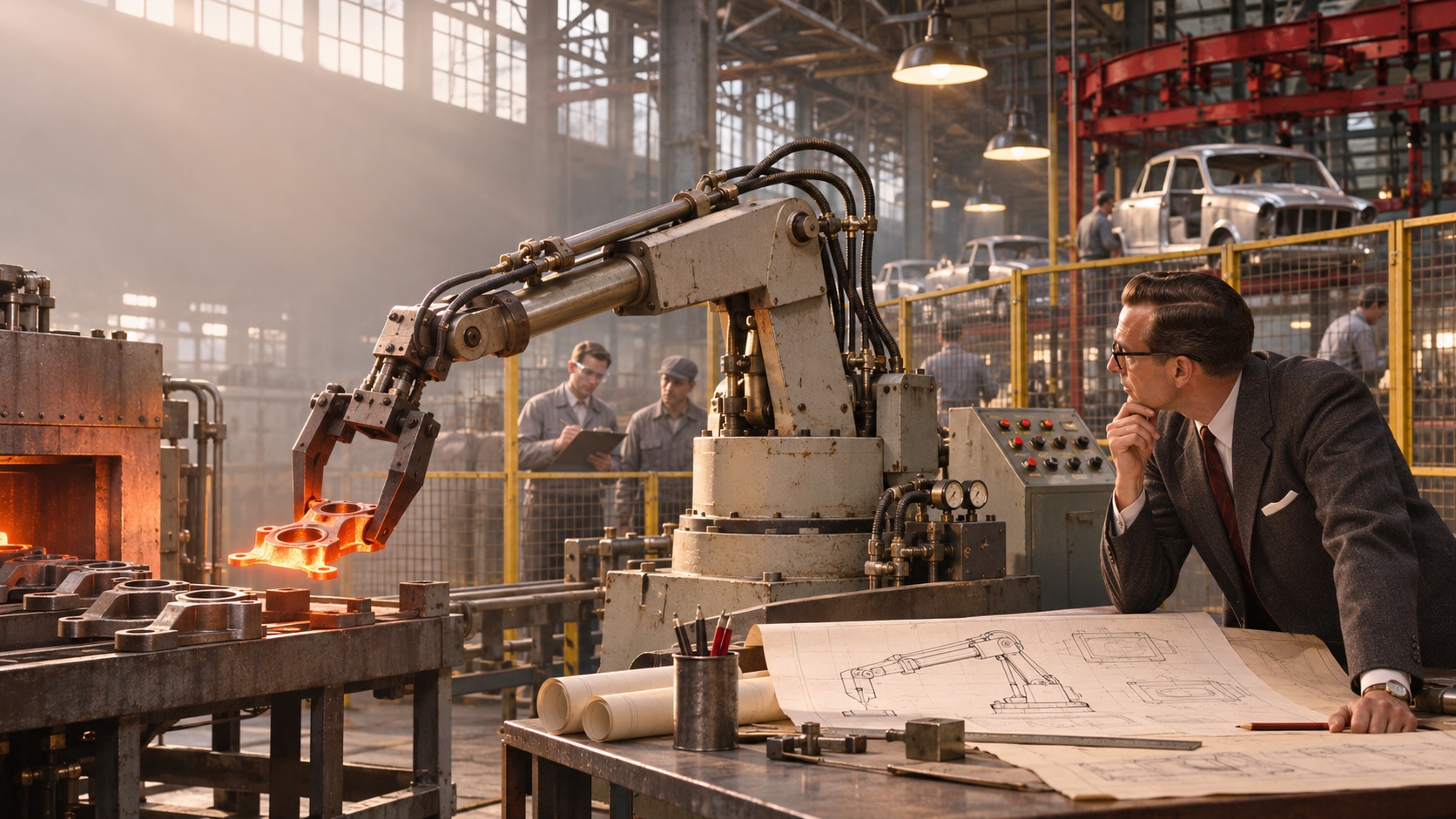
In the 1950s, American inventor George Devol developed the idea of a programmed article-transfer device. His design combined a mechanical manipulator with a memory system capable of recording and repeating motions. The key conceptual change was programmability: instead of building a dedicated mechanism for one motion, a general machine could be taught a sequence and redeployed. Devol filed the patent application in 1954, and the patent was granted in 1961.
A patent alone did not create an industry. The early system was heavy, hydraulic, expensive, and unfamiliar to manufacturers. Devol’s contribution nevertheless supplied the architecture from which the first commercial industrial robot could grow. Modern robot arms use vastly different sensors, drives, controllers, and programming tools, but they still embody his central insight that useful mechanical work can be represented as a repeatable program.
Joseph Engelberger Built the Bridge From Patent to Production
Joseph Engelberger met Devol in 1956 and recognized that the programmed transfer device could become the kind of robot imagined in fiction. Trained in physics and experienced in automation, he persuaded his employer’s leadership to finance development. Their collaboration produced the Unimate, and a prototype entered a General Motors die-casting operation in New Jersey in 1959. It handled hot, heavy parts in conditions where removing people from exposure offered a clear advantage.
Engelberger’s invention was partly organizational. He gave the machine a market category, assembled engineering and sales capability, and explained its value to skeptical manufacturers. Unimation, established in 1961, became the first industrial robotics company. Public demonstrations made the technology legible, while licenses with companies in Finland and Japan helped the concept travel beyond the United States.
The partnership also shows why credit in robotics is rarely simple. Devol supplied the pivotal patent; Engelberger led development and commercialization; engineers converted concepts into reliable hardware; and factory customers proved the application. The historical breakthrough was an ecosystem, not a solitary flash of inspiration.
Victor Scheinman Made Robot Arms More Versatile
Early hydraulic robots excelled at large, repetitive transfers, but research demanded lighter and more controllable manipulators. At Stanford, Victor Scheinman developed the electrically powered Stanford Arm in the late 1960s. Its joints could be controlled accurately enough for computer-based manipulation experiments. He later created the Vicarm, whose design became the foundation for Unimation’s PUMA arm. These machines helped move robotics toward assembly, research, and tasks requiring coordinated multi-axis motion rather than raw handling strength.
Charles Rosen’s Team Put Artificial Intelligence on Wheels
At SRI, a group led by Charles Rosen developed Shakey between 1966 and 1972. The tall, wheeled platform used a television camera, range sensing, radio links, and a computer system to reason about a simplified environment. Shakey could interpret a command, form a plan, navigate between rooms, and manipulate large objects such as blocks and ramps. It was slow and depended on carefully prepared surroundings, but it joined perception, planning, and action in one experimental system.
The project’s software contributions outlived the hardware. Researchers developed planning methods and representations that influenced artificial intelligence far beyond mobile robots. Shakey made a consequential claim: intelligence could be evaluated through a machine’s physical behavior in the world, where uncertainty and imperfect sensing could not be ignored.
Hiroshi Makino Reframed Assembly Around Selective Compliance
Industrial arms designed for general positioning could struggle with fast insertion work. Japanese engineer Hiroshi Makino conceived the SCARA configuration, whose selective compliance allowed motion in the horizontal plane while maintaining useful rigidity vertically. That geometry suited operations such as inserting parts into circuit boards. The design demonstrated that a robot need not imitate a human arm to be important; a mechanism shaped around the physics of a specific process could deliver greater speed, simplicity, and reliability.
Ichiro Kato’s Laboratories Advanced the Humanoid Question
At Waseda University, Ichiro Kato led teams that investigated anthropomorphic machines as integrated research platforms. WABOT-1, completed in the early 1970s, combined legs, arms, vision, and communication capabilities. Its movements were rudimentary, but bringing those systems together made it a landmark in humanoid robotics. Later Waseda projects explored musical performance, facial expression, and human-machine communication.
Kato’s work did not argue that every robot should resemble a person. It used the human form as a demanding research framework for locomotion, sensing, manipulation, and interaction. Japan’s long-running humanoid programs grew from that institutional commitment and later influenced entertainment robots, research platforms, and public expectations worldwide.
The projects also established a model for robotics education: ambitious machines could organize the work of many students and specialists across years. A laboratory became a place where mechanical, electrical, and computational ideas matured together rather than as isolated demonstrations.
Rodney Brooks Challenged the Need for a Complete World Model
In the 1980s, Rodney Brooks argued that useful robot behavior could emerge from layered connections between sensing and action instead of depending on a single, elaborate internal model. His subsumption architecture organized behaviors such as avoiding obstacles and exploring so that higher layers could build on lower survival functions. Robots including Allen, Herbert, and Genghis showed responsive action using comparatively modest computation.
This approach shifted attention toward embodiment and real-time interaction. It encouraged researchers to test robots in the messiness of the physical world, not only in abstract plans. Brooks later co-founded iRobot and Rethink Robotics, carrying ideas about practical autonomy and accessible manipulation into commercial products. Whether or not a modern system uses subsumption directly, the insistence that intelligence must survive contact with reality remains influential.
Cynthia Breazeal Made Social Interaction an Engineering Domain
While many robots were designed to move objects or navigate, Cynthia Breazeal investigated how a machine could communicate through gaze, expression, timing, and voice. Kismet, developed at MIT in the 1990s, used an expressive face and responsive behavior to sustain simple social exchanges. The project helped establish social robotics and human-robot interaction as serious research fields, connecting engineering with psychology, design, and communication.
The Most Lasting Inventions Became Platforms for Other People
The history of robotics is not a straight march toward a single ideal machine. It is a branching record of reusable principles: encoded motion, programmable control, task-specific kinematics, planning under uncertainty, responsive behavior, and socially understandable interaction. Each principle became powerful when communities could reproduce it and apply it to new problems.
That is why the inventors who changed robotics forever include entrepreneurs, team leaders, and institution builders alongside patent holders. A robot becomes historically significant when it changes the questions that others can ask. Unimate made factory automation a commercial category; Shakey made embodied AI a research program; SCARA made geometry a source of application advantage; and social robots made human response part of the system specification. Their legacy is visible less in exact replicas than in the choices engineers make today.
Modern Robotics Still Recombines the Pioneers’ Core Ideas
A warehouse mobile manipulator may look unrelated to an eighteenth-century writing automaton, yet both depend on encoding an ordered physical performance. The modern machine replaces cams with software, adds perception, and adjusts its route, but it still turns intended behavior into coordinated mechanisms. An industrial cobot similarly combines Devol’s programmability with Scheinman’s accurate electric control and decades of safety engineering. Historical layers remain present even when the components have become smaller, faster, and more capable.
Artificial intelligence has also returned to Shakey’s central problem at a far larger scale: how can a machine connect a human instruction with perception, planning, and action in an imperfect world? New learning models interpret richer scenes, but a robot still needs localization, collision avoidance, recovery, and a way to know when its information is inadequate. Brooks’s insistence on real-time contact with the environment serves as a useful counterweight to systems that appear intelligent only when their physical assumptions hold.
Human-facing robots now inherit the social questions raised by Breazeal and the safety questions Engelberger framed through hazardous work. Designers must decide what the robot should communicate, which decisions remain human, and how capability will be represented without encouraging misplaced trust. The future therefore does not erase robotics history. It repeatedly recombines its most durable inventions while adding new materials, computation, evidence, and responsibility.
Why the Historical Record Still Matters to Builders
Robotics history protects engineers from mistaking an old tradeoff for a new discovery. Current debates about specialized machines and general platforms echo the contrast between SCARA’s task-shaped geometry and ambitious humanoid integration. Questions about embodied intelligence revisit the tension between Shakey’s planning and Brooks’s direct behavioral response. Knowing those precedents does not supply a design automatically, but it reveals which assumptions have failed before, which ideas awaited better components, and where today’s evidence genuinely changes the answer. Historical literacy makes novelty easier to judge and genuine technical progress much easier to recognize clearly.