Joseph Engelberger Invented More Than a Robot Company
Joseph Engelberger did not originate every technical element of the industrial robot, and the machine that made him famous began with George Devol’s patented programmed article-transfer concept. Engelberger’s singular contribution was seeing what that concept could become—and then constructing the engineering, business, and public framework that allowed it to become an industry. He persuaded a company to fund an improbable machine, matched it with factory work where its weaknesses mattered less than its endurance, and gave manufacturers a vocabulary for discussing programmable automation. He demonstrated robots to executives and television audiences, formed international licensing relationships, organized professional communities, and later argued that robots should move beyond factories into hospitals and elder care. His career shows that invention can be a form of systems building. A transformative idea succeeds not merely when a prototype moves, but when customers, engineers, operators, financiers, and institutions can understand how to use it.
A: No, George Devol created the patented concept and a larger team developed and commercialized the robot.
A: He saw a programmable manipulator that could become an industrial robot category.
A: It involved hot, heavy, repetitive handling where reducing human exposure had clear value.
A: Engelberger established it as a Condec subsidiary in 1961.
A: The playful actions made programmable motion understandable to a mass audience.
A: Its licensing relationship helped manufacture and market Unimate technology in Asia.
A: Unimation acquired Victor Scheinman's Vicarm work and developed the electric assembly robot family.
A: It transported supplies through hospitals as an early service robot.
A: No, real safety depended on engineering, guarding, procedures, and validated operation.
A: He built the commercial, international, and institutional framework around programmable robotics.
A Chance Meeting Connected Two Complementary Talents
In 1956, Engelberger met inventor George Devol at a social gathering. Devol had filed a patent application for a device that could store and repeat a sequence of movements. Engelberger, a physicist and automation engineer who admired Isaac Asimov’s robot stories, immediately interpreted the machine as a robot. The recognition sounds simple in retrospect, but it supplied a powerful category for an invention then described in the technical language of article transfer.
Their skills were complementary. Devol brought the foundational control concept and continued contributing to the partnership. Engelberger brought engineering leadership, financing access, application strategy, and an ability to explain the machine’s future. Treating the story as one lone genius obscures the essential lesson: modern robotics began when invention and commercialization reinforced one another.
He Persuaded an Existing Company to Fund a New Category
Engelberger directed Consolidated Controls, part of Condec, and convinced corporate leadership to support development. That decision placed the robot inside an organization with engineers, manufacturing experience, and capital rather than leaving it as an isolated workshop experiment. After roughly two years of work, the team had the Unimate #001 prototype. The machine was large, hydraulic, and costly, with none of the compact electronics or intuitive programming associated with current robots, but it could execute stored motion repeatedly.
The First Application Made Danger Part of the Value Proposition
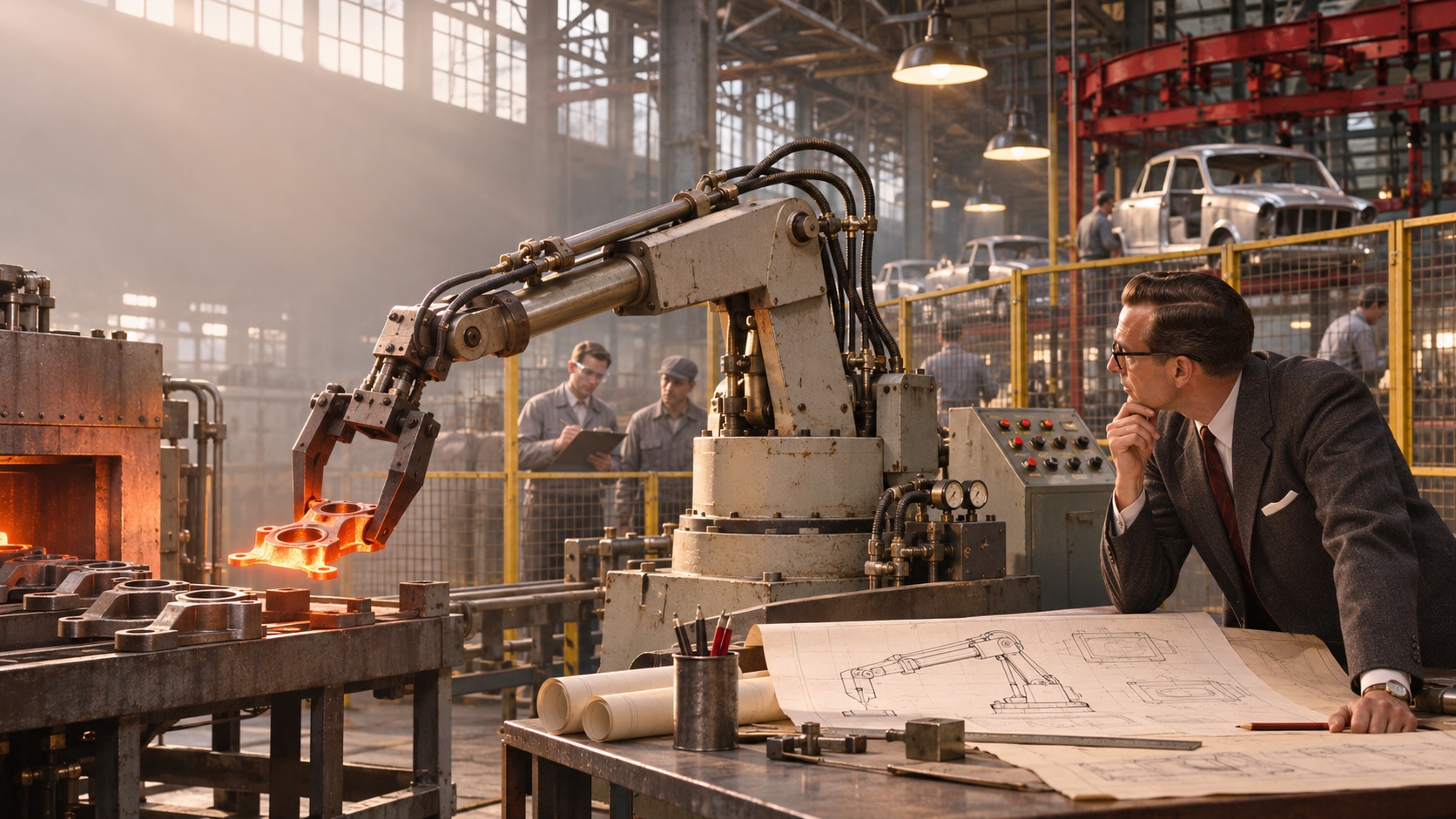
General Motors installed an early Unimate at a die-casting plant in Trenton, New Jersey. Handling freshly cast metal exposed workers to heat, fumes, weight, and repetitive physical risk. A robot did not need subtle perception or humanlike dexterity to create value there. It needed to withstand a harsh environment and repeat a defined transfer reliably.
Engelberger repeatedly emphasized applications that were unpleasant or hazardous for people. This was both an ethical position and an astute adoption strategy. It gave managers and workers a concrete reason to tolerate an unfamiliar machine’s expense and limitations. Modern robotics companies still search for similar entry points: tasks where safety, consistency, or access makes automation worthwhile before it becomes broadly capable.
Unimation Turned a Prototype Into a Product Organization
In 1961, after Devol’s patent was granted, Engelberger established Unimation as a Condec subsidiary. Productization required drawings, supply chains, assembly, testing, documentation, field support, and sales. The Unimate 1900 series made the robot a repeatable commercial offering rather than a single experimental installation.
Early customers also needed integration. A bare arm could not produce value without tooling, work positioning, controls, safeguards, and process knowledge. Unimation’s experience helped define what a robotics supplier had to provide and what integrators and factory engineers would contribute.
The company struggled financially for years, demonstrating that technical importance does not guarantee an easy market. Engelberger continued selling a long-term change to manufacturers whose existing equipment, budgets, and labor arrangements were built around other assumptions. His persistence established an expectation that robot companies must educate markets while they refine products.
He Made Demonstration a Serious Commercial Tool
Engelberger understood that a machine called a robot carried fear, fantasy, and confusion. Trade-show demonstrations let potential customers see repeatability and range directly. A 1966 appearance with a Unimate on The Tonight Show used playful acts—including pouring a drink and making a golf putt—to translate industrial machinery into something a broad audience could grasp. The spectacle did not describe a factory business case, but it made the category memorable and showed deliberate programmable motion.
Global Licensing Accelerated an International Industry
The American market alone did not provide enough early growth. Engelberger pursued partners that could manufacture and sell the technology in other regions. Unimation licensed Nokia for parts of Europe and later reached an agreement with Kawasaki Heavy Industries for the Asian market. Kawasaki’s manufacturing reach and Japan’s interest in automation helped establish a major robotics ecosystem.
Licensing exchanged control for speed, capital, and local capability. It spread engineering knowledge, created customer support closer to factories, and encouraged competing robot programs. Today’s robotics supply chain is multinational, with important manufacturers and component suppliers across Asia, Europe, and the Americas. Engelberger’s partnerships helped set that geography in motion.
He Treated Robotics as a Discipline That Needed Institutions
A new industry requires shared terminology, professional exchange, measures of progress, and recognition. Engelberger supported the development of industry associations and international symposia, wrote about the economic and social effects of robots, and communicated continually with manufacturers, policymakers, researchers, and the public. The award that bears his name later became a prominent form of recognition in the field.
Institution building can appear secondary to hardware, yet it reduces the isolation of early adopters. Conferences let engineers compare applications; associations collect market information; publications train managers to evaluate systems; and professional honors make contributions visible. Engelberger understood that a durable market needed a community capable of remembering and extending its lessons.
He also gave robotics a confident public advocate. His forecasts were sometimes more ambitious than near-term technology could support, but they expanded the set of problems companies and researchers considered legitimate.
The PUMA Story Showed the Value of Acquiring Research Ideas
Unimation acquired Victor Scheinman’s Vicarm technology and developed it into the PUMA, or Programmable Universal Machine for Assembly. Compared with the heavy Unimate, the electric articulated arm was suited to lighter, more precise work. The move demonstrated that a robotics company could extend its product range by recognizing important university research and translating it for industrial use.
Engelberger Saw Service Robotics Before the Market Was Ready
After Unimation, Engelberger founded Transitions Research Corporation in 1984 and pursued robots for service settings. Its HelpMate platform transported supplies in hospitals, navigating corridors so staff could spend less time pushing carts. He believed aging populations and care needs would create demand for machines that assisted people outside manufacturing.
The vision anticipated today’s hospital delivery robots, autonomous mobile platforms, and renewed interest in home assistance. Yet service environments are harder to standardize than factory cells. They involve pedestrians, elevators, doors, variable objects, privacy, and subtle expectations. HelpMate’s story demonstrates both Engelberger’s foresight and the long distance between identifying a social need and building a scalable market.
It also broadened the economic question. A factory robot could be justified against a high-volume process, while a hospital platform created value through time returned to staff, dependable logistics, and service quality. Measuring those benefits required managers to look beyond machine cycle time. Modern service-robot vendors still work to connect autonomy with operational outcomes that a customer can budget and verify.
His Safety Philosophy Was Practical, Not Magical
Engelberger often referenced Asimov and the principle that robots should not harm people, but real safety could not come from fictional laws. Industrial systems relied on guarded workspaces, interlocks, operating procedures, training, and engineering analysis. The robot’s assigned application and surrounding cell determined how risk was controlled.
That distinction remains vital as robots become mobile, collaborative, and increasingly software-driven. High-level intentions must be converted into speed limits, protective stops, validated behaviors, secure updates, and clear responsibility. Engelberger’s preference for removing people from dangerous tasks is still persuasive, but a robot must not introduce a different unexamined danger.
His Greatest Idea Was That Robots Needed an Industry Around Them
Engelberger’s legacy cannot be reduced to a title such as “father of robotics.” Devol’s patent, the Unimation engineering team, customer factories, international licensees, academic researchers, operators, and component makers all shaped the field. Engelberger’s distinct achievement was orchestration. He aligned enough of those actors to make programmable robots commercially and culturally durable.
Modern founders can learn from both his success and his difficulties. Choose applications where the robot’s strengths match an urgent operational problem. Build integration and service into the product plan. Demonstrate capability in language the audience understands. Use partnerships to reach markets the company cannot support alone. Create institutions that help customers and practitioners learn together. Finally, keep a long view without confusing a social need with immediate technical readiness.
The modern robotics industry now includes factory arms, mobile warehouse systems, surgical platforms, inspection machines, agricultural robots, and experimental humanoids. Engelberger did not design all of them. His ideas helped establish the conditions in which people could plausibly build companies around them—and that may be the most consequential kind of invention.
His Career Also Reveals the Cost of Being Early
Pioneers often operate before supply chains, trained customers, accepted standards, and financing models exist. Unimation had to explain why a programmable manipulator was different from conventional machinery while simultaneously proving that it could survive production. Every sale carried education and integration work that a mature market later distributes among vendors, integrators, consultants, and experienced users. The company created public value that it could not capture fully because competitors and international partners learned from the category it established.
Service robotics made the timing problem even clearer. Engelberger correctly identified the social value of helping hospitals and older adults, but need alone could not supply robust navigation, affordable sensors, reliable manipulation, or a scalable service organization. Modern founders face the same gap when a compelling demonstration arrives before its unit economics or operating infrastructure. His career encourages ambition, yet it also recommends sequencing: prove a bounded job, build evidence, improve reliability, and expand only when the surrounding system can support the promise.
Category Creation Remains Engelberger’s Most Relevant Lesson
Robotics entrepreneurs today often confront markets that lack standard budgets, trained buyers, service channels, and agreed performance measures. Engelberger’s response was to build those missing pieces alongside the machine. The approach was expensive and imperfect, but it explains why Unimate changed manufacturing while many technically clever mechanisms vanished. A founder shaping a new category must decide which capabilities to own, which partners to recruit, what evidence customers need, and how the story will remain credible when reality advances more slowly than the vision. This work includes naming the product so buyers can discuss it, defining applications narrowly enough to test, and training people who can operate and repair it. It also requires candor about immature capabilities, because disappointment can slow an entire market rather than one company. Engelberger’s achievement was sustaining informed belief while enough practical infrastructure, customer knowledge, professional expertise, and engineering capacity steadily caught up around the world successfully and commercially.