Robotics History Remembers Machines More Easily Than Teams
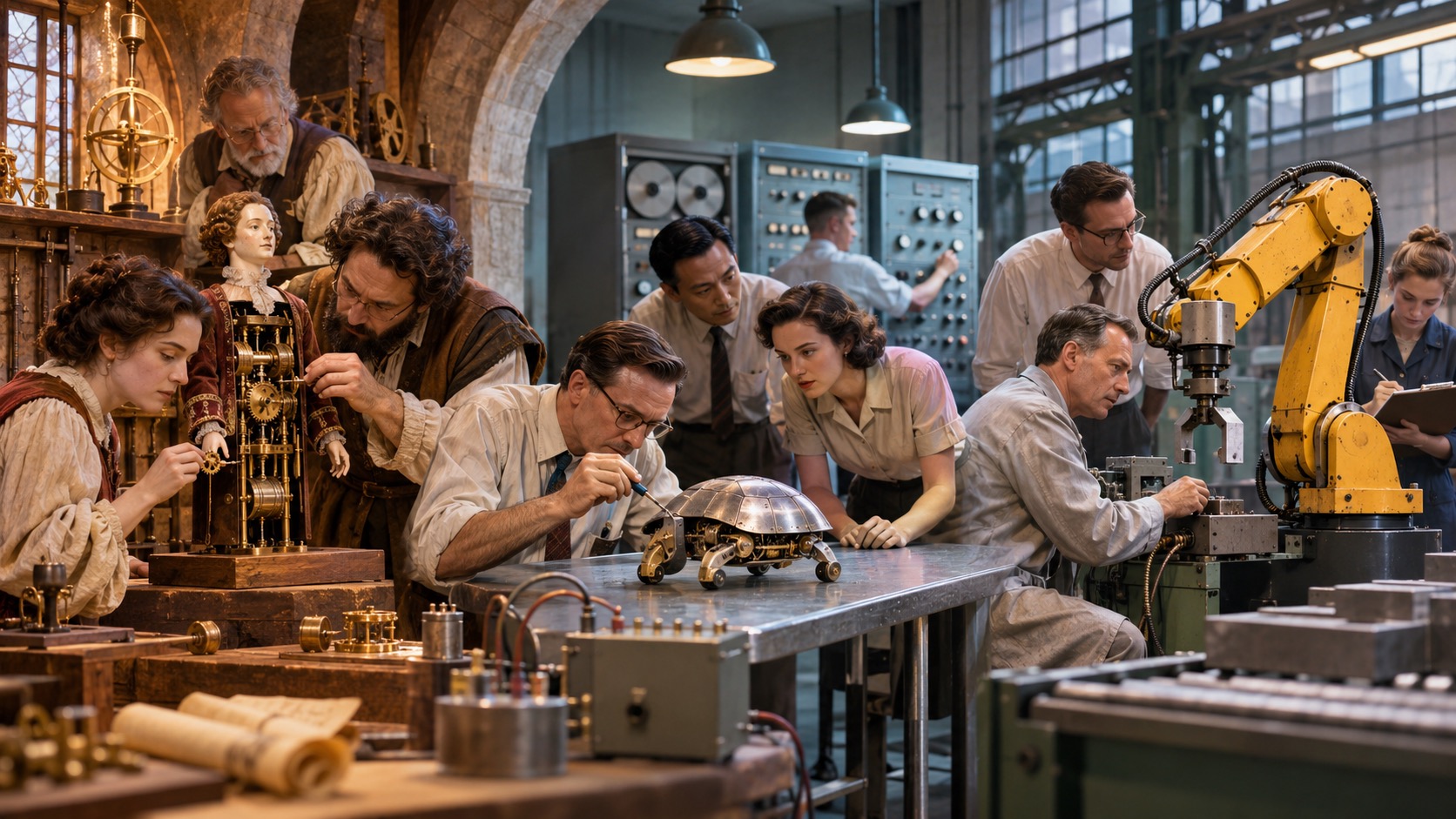
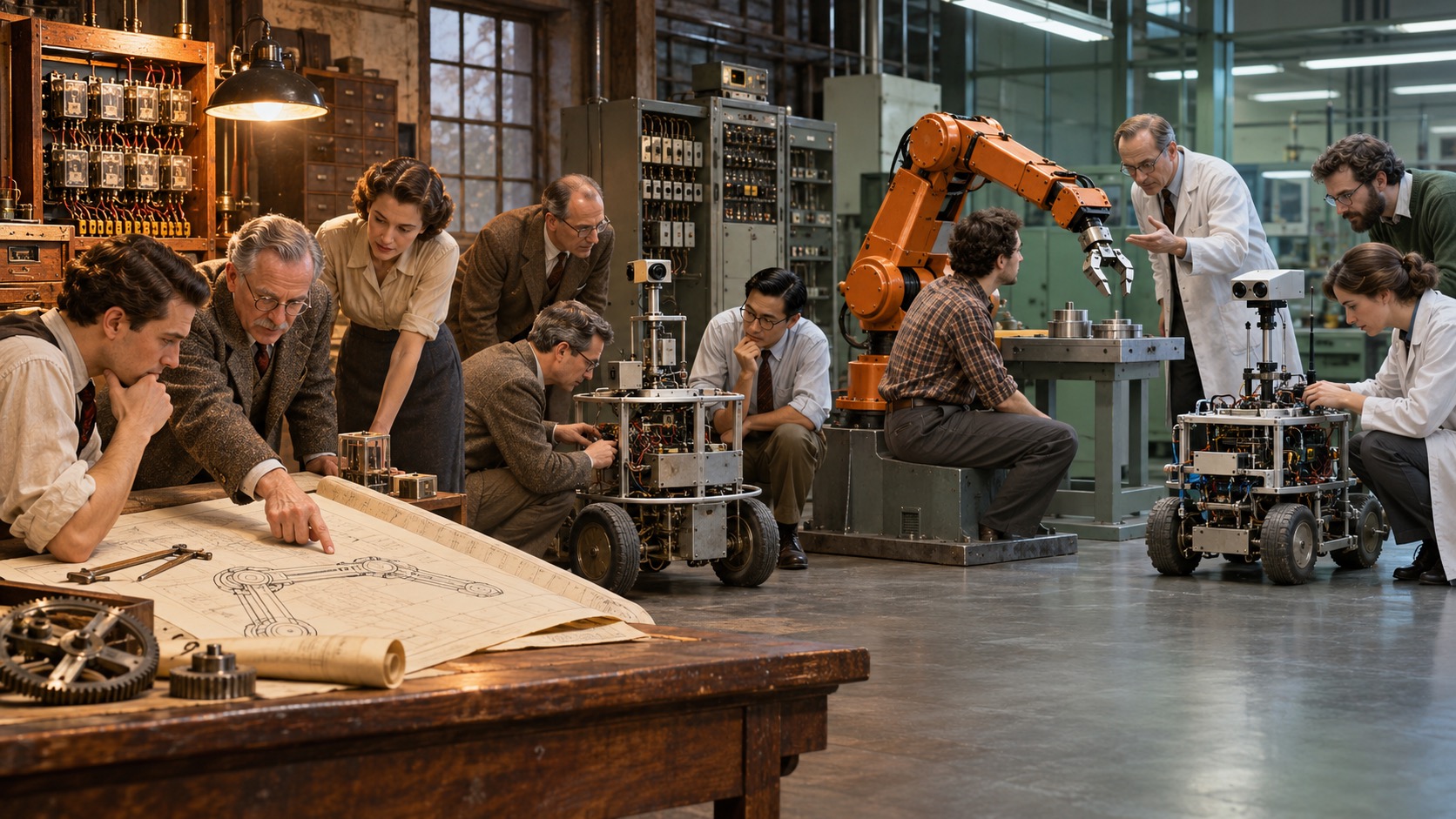
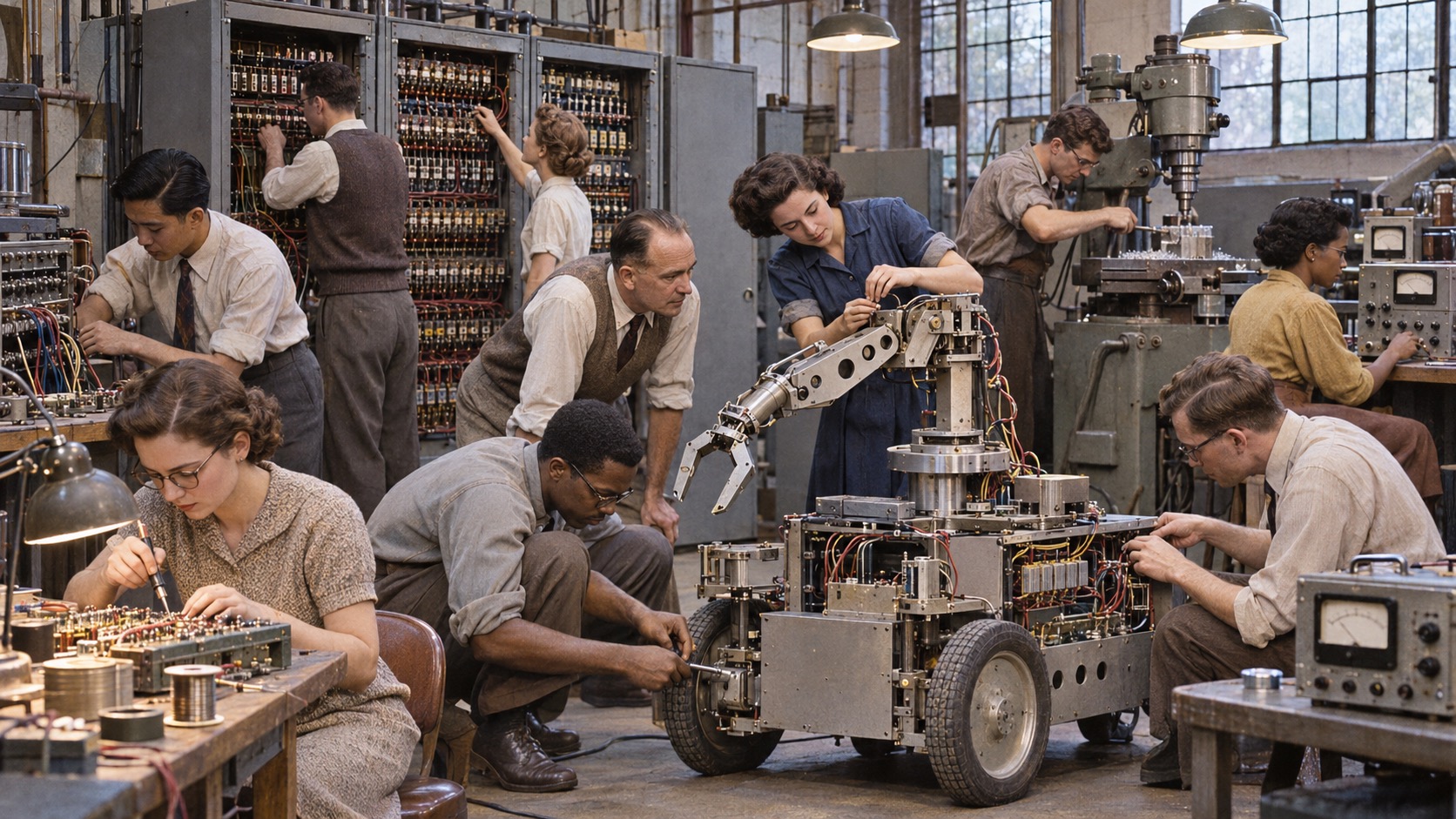
Famous histories often compress a robot into one inventor, one patent, or one laboratory director. The machine itself tells a different story. Someone machined the joints, designed the power electronics, wrote the planner, aligned the camera, recorded failed trials, operated the prototype, and translated a fragile experiment into instructions another person could follow. Many of those contributors appear only in captions, acknowledgments, payroll records, or oral histories. Others worked before “robotics” existed as a recognized field, so their automata, control devices, and programmable machines were filed under entertainment, textiles, physiology, or computing. Recovering these people is not a ceremonial exercise. It reveals how invention actually happens and restores technical connections that simplified hero stories conceal.
A: Popular accounts favor leaders and visible machines, while technical labor may remain in captions, logs, acknowledgments, or inaccessible archives.
A: They were automata rather than modern electronic robots, but their regulation and sequencing belong to robotics' mechanical ancestry.
A: He was the engineer credited by the Smithsonian with building its surviving W. Grey Walter tortoise robot.
A: Project records place her among the team operating and programming experiments, work hidden by machine-centered retellings.
A: His mechanical design work helped give Shakey the physical platform on which AI research could be tested.
A: Kinematics, search, estimation, and control methods make mechanisms usable rather than merely movable.
A: Leadership can be real and important, but it should coexist with precise recognition of distributed contributions.
A: They are valuable evidence but should be compared with contemporary documents, artifacts, and other accounts.
A: It shows failure modes, modifications, maintainers, and tacit knowledge absent from the original design.
A: Preserve contribution records, versions, operators, failures, and technical decisions alongside the finished robot.
Forgotten Does Not Mean Unimportant or Completely Unknown
A contributor may be respected by specialists yet absent from general accounts. “Forgotten” can describe a person overshadowed by a project leader, a craftsperson excluded from patents, a programmer hidden behind hardware, or an inventor whose work was classified in another discipline.
The goal is not to replace one pantheon with another. It is to connect specific evidence to specific contributions and admit when archives remain incomplete.
Banū Mūsā Preserved Ingenious Automatic Control
The ninth-century Banū Mūsā brothers described trick vessels, fountains, valves, and self-regulating mechanisms in the Book of Ingenious Devices. Their machines used pressure, floats, siphons, and feedback-like arrangements to create repeatable behavior without electronic control.
They are often placed outside robotics because their work belongs to medieval mechanics. Yet automatic regulation and cleverly encoded physical behavior are part of the field’s ancestry.
Translation and manuscript survival shape modern recognition. What seems absent from a technology timeline may have existed in another language, archive, or category.
Hero of Alexandria Was More Than a Name Attached to Automata
Hero documented pneumatic, hydraulic, and mechanical systems for theater and temples. His automated stage machinery coordinated timed events through ropes, drums, weights, and pegs. The devices show that sequence control was a serious engineering problem long before programmable electronics.
Pierre and Henri-Louis Jaquet-Droz Built Writing Into Machinery
The Jaquet-Droz workshop created eighteenth-century automata including The Writer, The Musician, and The Draughtsman. The Writer used configurable cams to form characters, demonstrating how a mechanical body could execute a changeable symbolic sequence.
Popular retellings often credit Pierre alone, but family members, artisans, and workshop practice were essential. Luxury automata were collective products even when commercial identity concentrated around one name.
Jean-Frédéric Leschot Carried Automaton Knowledge Across the Workshop
Leschot, an associate and adopted son in the Jaquet-Droz enterprise, contributed to building, maintaining, and commercializing complex automata. His role illustrates how technical continuity often depends on people who preserve mechanisms after the celebrated inventor leaves the scene.
Maintenance is historical evidence. A machine that survives, travels, and performs reveals the value of adjustment, documentation, and tacit craft that patents rarely capture.
Robotics still depends on that work. Calibration specialists and field technicians often determine whether a sophisticated design remains an artifact or becomes an operating system.
Edvard Scheutz Helped Turn a Famous Idea Into a Working Engine
Georg and Edvard Scheutz built a working difference engine inspired by Charles Babbage. It was a calculating machine rather than a robot, but its automatic production of numerical tables connected programmable machinery with reliable physical output. Edvard’s contribution is easily lost when histories prefer one senior inventor.
Josef Čapek’s Suggested Word Outlived His Credit
Karel Čapek publicly credited his brother Josef with suggesting “robot” while Karel wrote R.U.R.. The word became globally influential, yet Josef often disappears from the compressed statement that Karel coined it.
This is a small but revealing case. Cultural invention also has collaborators, and repeated shorthand can eventually replace the creator’s own account.
W. J. Warren Built the Smithsonian’s Surviving Tortoise
W. Grey Walter originated the cybernetic tortoise experiments, but engineer W. J. Warren built the machine now held by the Smithsonian. Turning a theory into a working electronic body required mechanical construction, wiring, adjustment, and practical interpretation.
When a device is named after the scientist whose theory it tests, the builder can vanish. Museum records help restore the difference between intellectual leadership and physical realization.
That difference is not a hierarchy. Both are necessary, and precise credit makes the experiment more understandable.
Elsie and Elmer Also Owed Their Behavior to Experimental Care
Walter’s machines are remembered for apparently lifelike responses, but the behavior depended on batteries, sensors, motors, analog circuits, floor conditions, light sources, and charging arrangements. Technicians who prepared demonstrations shaped what audiences saw.
Sven Wahlstrom Gave Shakey a Physical Body
Shakey is often narrated through AI algorithms, but mechanical designer Sven Wahlstrom appears in the project record with the robot. Mobile intelligence needed a chassis, steering, sensor mounts, power, and a structure stable enough for cameras and electronics.
Hardware choices influenced the software problem. Shaking images, slow motion, and limited manipulation were not background details; they shaped perception and planning research.
Helen Chan Wolf Helped Operate and Program Shakey
Photographs and team records identify Helen Chan Wolf among the people operating Shakey. Operation was not passive. Researchers had to prepare environments, manage equipment, observe failures, and connect physical behavior with software diagnosis.
Women’s technical labor has frequently been described as assistance even when it included programming, mathematics, or experimental responsibility. Captions, oral histories, and author lists can correct later assumptions.
Recognizing operation also improves technical history: it tells us how much human work surrounded a supposedly autonomous system.
Richard Fikes and Peter Hart Made Planning More Reusable
Fikes and Nilsson developed STRIPS in the Shakey project, while Hart, Nilsson, and Raphael are associated with A* search. These names are familiar within artificial intelligence but less visible in popular robot histories centered on a machine or lab director.
Bertram Raphael Connected Knowledge Representation With Action
Raphael contributed to the Shakey effort and AI research on representation and reasoning. A robot needs a form in which goals, objects, places, and actions can be related. That invisible conceptual machinery can be as foundational as motors.
Software contributions age differently from hardware. Code may disappear while an algorithm survives in textbooks, detached from the team and robot that made its value concrete.
Donald Pieper Helped Formalize Manipulator Motion
Pieper’s Stanford work on the kinematics of manipulators contributed methods for solving robot arm configurations. Inverse kinematics sounds abstract until a tool must reach a pose through real joints. Analytical structure made some problems tractable enough for practical control.
Mathematical foundations are easily omitted from visual histories because equations do not photograph like machines. Yet every smooth arm movement depends on choices about geometry, singularities, limits, and computation.
Remembering this work shifts attention from who built the arm to who made it controllable.
Tom Binford Expanded Robot Vision and Manipulation
Binford’s work at Stanford connected computer vision, perception, and manipulation, and he mentored researchers who later shaped the field. His influence illustrates how laboratories propagate ideas through students, shared platforms, and research problems rather than one celebrated product.
Ichiro Kato’s Teams Deserve More Than a Single Name
WABOT is often attached to Kato, but full-scale humanoid robotics required teams working on legs, hands, sensing, communication, control, and integration. Japanese contributions are also underrepresented in histories told primarily through American industrial robots and AI labs.
Team credit need not erase leadership. It can name the leader while preserving the architecture of contribution underneath.
Machinists and Technicians Encode Knowledge That Rarely Reaches Papers
A drawing may specify dimensions without describing how a joint was fitted, a cable routed, or a sensor protected from vibration. Skilled makers resolve those gaps. Their decisions become part of the robot’s performance even when they are not formal research claims.
Laboratory notebooks, shop travelers, repair marks, and spare parts can expose this hidden design history. Preserving only the final machine removes the process that made it work.
Modern open hardware projects should treat build notes and maintenance histories as first-class technical outputs, not informal leftovers.
Operators Reveal How Much Autonomy a Demonstration Required
Who reset the robot, moved obstacles, selected goals, or intervened after failure? Those details determine what a historical demonstration proves. Operators are valuable witnesses because they know the difference between the public sequence and the ordinary experimental routine.
Archives Can Redistribute Credit Without Inventing Certainty
Patents, photographs, correspondence, oral histories, payroll records, code, and equipment logs each capture different parts of contribution. None is complete. A patent may exclude technicians; a photograph may include someone whose role is unknown; memory changes over time.
Responsible recovery triangulates sources and marks uncertainty. It avoids turning a newly discovered name into another unsupported lone-genius claim.
A Better Robotics History Names Roles as Well as People
Instead of asking only who invented the robot, ask who conceived the mechanism, built it, programmed it, operated trials, diagnosed failures, obtained funding, documented results, maintained hardware, and carried the work into another institution.
This role-based history is technically useful. It shows which capabilities a project needed and where knowledge traveled. It also makes modern teams more thoughtful about authorship, acknowledgments, documentation, and credit before their own records become history.
Contribution statements can preserve that architecture while memories remain current. They should describe technical judgment, integration, operation, and stewardship, not assign status through vague labels such as assistance. Precision benefits both fairness and reproducibility.
Patent Conventions Exclude Important Work by Design
Patent inventorship follows contribution to claimed subject matter, not every task required to make a prototype succeed. A machinist, test engineer, or programmer may be essential yet properly absent from the patent. Reading the inventor list as a complete project roster therefore creates false history.
Authorship Practices Can Hide Integration Labor
Academic papers usually foreground the novel method, while the labor of maintaining a robot platform may be spread across students and staff. Integration work is difficult to publish because its achievement is that many components function together without becoming the paper’s headline.
Repositories, technical reports, artifact appendices, and dataset documentation can make that work visible. They also let later teams reproduce the actual configuration instead of guessing from a compressed methods section.
Recovery Changes How Future Machines Are Built
Restoring overlooked contributors is not only about the past. Modern teams that see how credit disappeared can improve project records, mentorship, authorship, and archival practice now. They can preserve the people who made an experiment reliable before public attention turns one leader or machine into shorthand.
Recognition Should Remain Specific Enough to Be Meaningful
Broad claims that everyone contributed equally can be as unhelpful as a lone-genius story. Historical recovery should state what a person built, calculated, programmed, operated, documented, or sustained, and which evidence supports that statement. Specificity lets different kinds of work remain visible without pretending they were identical.
It also helps living teams learn from the past. When a restored credit links a technician to a sensor redesign or a programmer to a planning method, the contribution becomes technical knowledge rather than a name appended to a commemorative list. It also gives museums and educators a stronger basis for explaining how complex machines emerge from interdependent work across many technical roles.