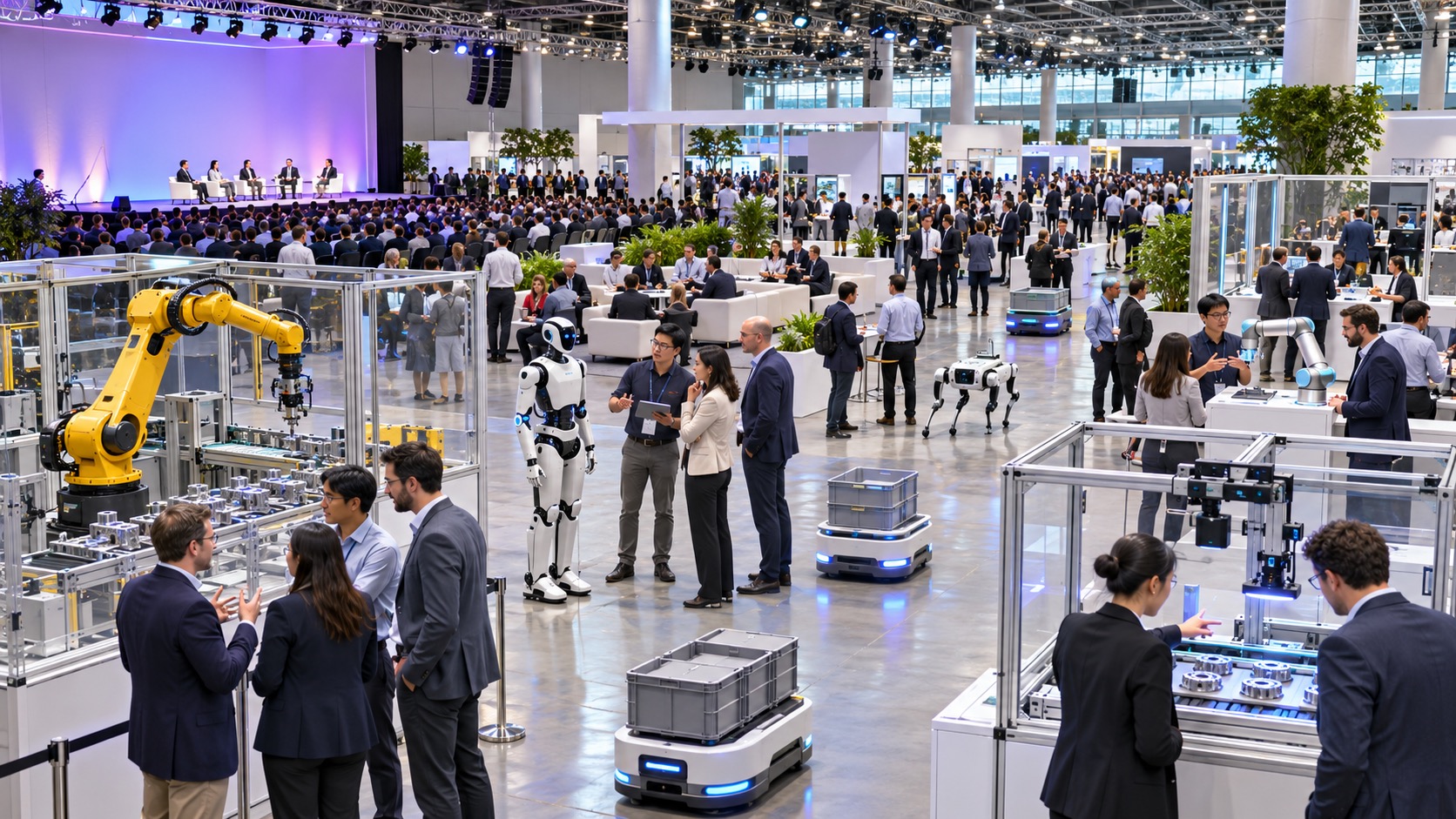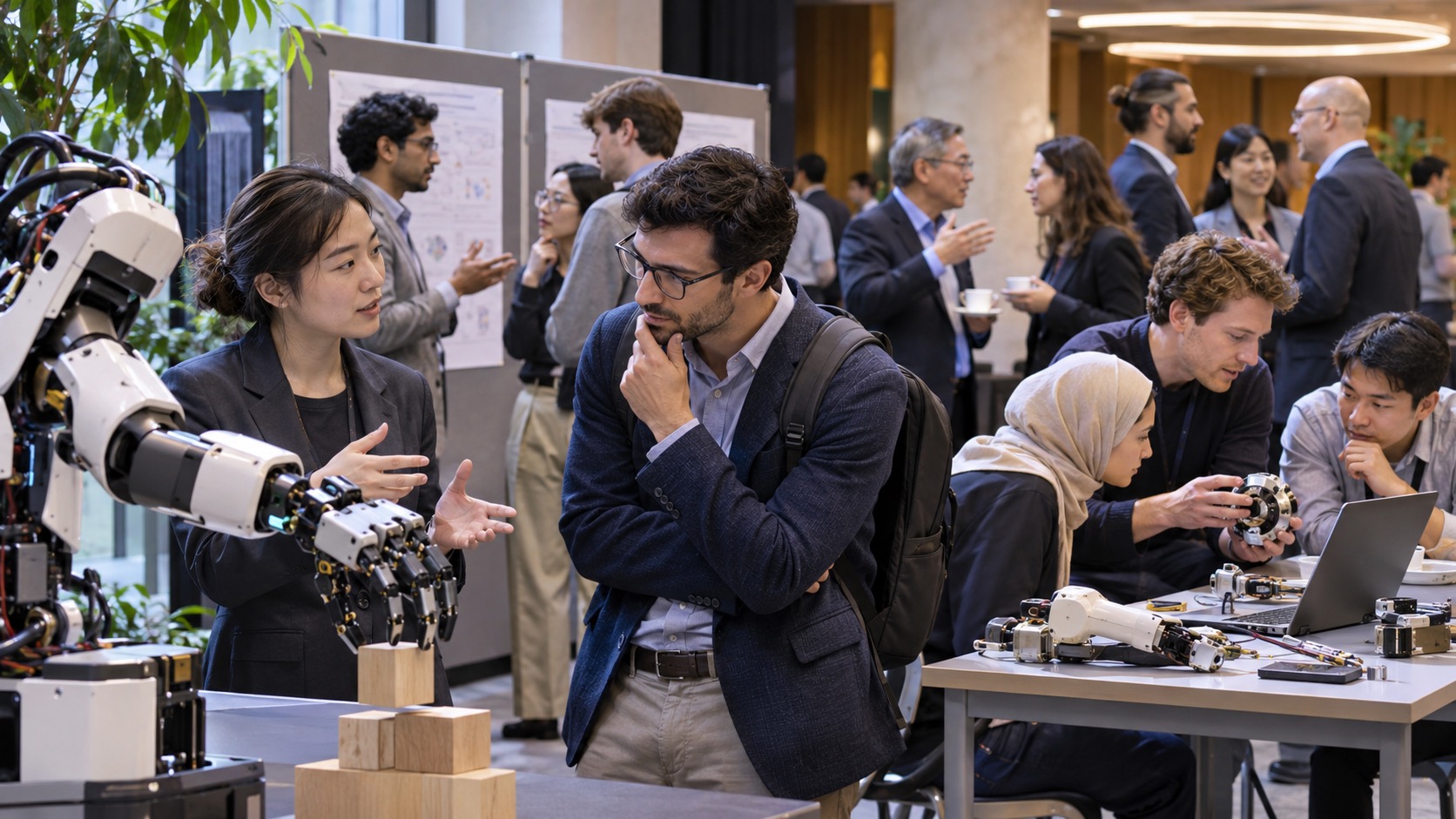
An Important Robotics Event Is One You Can Use Before, During, and After Attendance
The international robotics calendar contains more worthwhile events than one professional can attend. Importance is therefore personal and operational. A research scientist may need a selective venue where methods receive serious criticism. A manufacturing engineer may need to compare integrators against a defined process. A startup founder may need component suppliers, pilot customers, and peers who understand hardware economics. A software lead may learn more at ROSCon than in a vast show hall, while a human-robot interaction specialist needs a community that treats behavior and study design as core engineering. The right event produces an outcome that survives the flight home: a revised experiment, vendor test, recruiting pipeline, standards contribution, customer interview, or partnership with clear next steps. This guide organizes attendance by purpose and includes global research conferences, industrial exhibitions, developer gatherings, specialist meetings, and commercialization summits. Always verify current dates, submission deadlines, visa requirements, access, and program details through the organizer.
A: Select the event most closely aligned with one current research, product, sourcing, or customer decision.
A: No, annual programs, geography, workshops, and relevant communities determine the better fit.
A: Researchers and product teams working where machine learning directly affects robot perception, control, planning, or data.
A: It can reveal trust, communication, workflow, inclusion, and study-design problems while changes remain possible.
A: Yes, especially when architecture, migration, performance, security, or upstream contribution affects the product.
A: Choose the expo when comparing deployable products, integrators, components, service, and purchasing options.
A: It exposes the real workflow, regulation, budget, alternatives, and language shaping customer decisions.
A: Following them can expose future safety, interoperability, and testing requirements before architecture becomes expensive to change.
A: Fewer prepared conversations with clear next steps usually outperform an exhausting calendar of introductions.
A: Evidence enters a decision, experiment, product change, hire, partnership, standard, or qualified customer action.
Attend ICRA When the Question Crosses Several Robotics Fields
ICRA is a strong choice when work spans manipulation, control, perception, planning, field robotics, medical systems, learning, or interaction. Its breadth makes it possible to test an idea against several communities in one trip.
Researchers can submit papers, workshops, tutorials, demos, or competition proposals according to the annual call. Industry attendees can recruit, sponsor, exhibit, and arrange technical meetings.
The event is most useful when the attendee identifies a cross-cutting question. For example, a mobile-manipulation team can visit planning papers, gripper workshops, perception demos, and safety discussions rather than following one program label.
Choose IROS for Broad Research With a Different Global Network
IROS offers comparable breadth with its own international rotation, organizing communities, workshops, and technical emphasis. Attending both ICRA and IROS every year may not be necessary for every company, but alternating can broaden geographic relationships and expose different research clusters.
Study accepted papers and workshop programs before choosing. The best fit depends on the year’s content, not a permanent hierarchy between two flagship conferences.
Use RSS for Deep Technical Conversation Across a Shared Program
RSS is particularly valuable when a researcher wants focused attention and repeated interaction with a concentrated community. A single-track structure means attendees hear the same main presentations, making later discussion easier.
Product teams should attend with advanced technical staff who can evaluate assumptions and connect early work to a roadmap. RSS is not primarily a procurement fair.
Posters and workshops can provide more value than headline talks because detailed questions are possible. Schedule time to read papers beforehand and arrive ready to discuss evidence rather than request a summary.
Select CoRL When Learning Is Central to Physical Behavior
CoRL is important for teams working on imitation, reinforcement learning, representations, robot foundation models, learned control, data, or combinations of learning and planning. Its focus helps attendees compare methods that might be diluted inside a general AI conference.
Ask how results transfer to new hardware, environments, and tasks. Examine demonstrations, data requirements, compute, safety constraints, and negative results.
Attend HRI Before Human Use Becomes a Late Product Problem
HRI brings technical and behavioral disciplines together around how people understand and work with robots. Attend when the product depends on trust, intent communication, shared control, social behavior, public acceptance, remote operation, or collaboration.
A company can use the venue to improve study design and avoid conclusions drawn from novelty or tiny convenience samples. Researchers can connect theory with real deployments and industry needs.
The event is also a reminder that “the user” is not one body, culture, workplace, or ability. Inclusive methods can reveal failures that a homogeneous development team will miss.
Go to ROSCon to Improve the Software Beneath the Product
ROSCon matters when a team depends on ROS, Gazebo, ros-controls, Open-RMF, middleware, or the wider open-source robotics ecosystem. Maintainers and experienced users share architecture, migration, performance, security, and deployment lessons.
Bring a reproducible technical problem or a well-developed proposal. Community events work through reciprocal contribution, and commercial users benefit when they fund, review, document, or upstream improvements.
Choose Automate for Comparative Vendor Discovery in North America
Automate is valuable when a project needs arms, vision, motion, sensors, controls, integrators, safety products, or working application examples. A manufacturer can inspect alternatives rapidly and move from marketing claims to engineering questions.
Before attending, send requirements to selected vendors and request a meaningful meeting. Bring representative parts only with permission and a plan for handling confidential information.
Use the conference program for foundational education and the show floor for comparison. Keep notes in one structured format so different conversations remain comparable.
Choose automatica for European Partners and Full-Chain Automation
automatica is a strong event for companies serving or buying within European manufacturing. It brings together robots, components, machine vision, software, integrators, and production systems.
Attend for regional partnerships, supply-chain discovery, standards awareness, and customer conversations. Global vendors may display different products or messages according to the European market.
Visit World Robot Conference for China Strategy
Professionals evaluating China’s robotics market, suppliers, competitors, customers, or policy environment should understand World Robot Conference. The exhibition and forums provide a dense view of local activity, particularly in industrial, service, and humanoid systems.
Prepare for language, business, data, cybersecurity, and regulatory context. A visit should be part of a broader regional strategy rather than a standalone tour.
Validate demonstrations through follow-up. Ask where systems operate, for how long, under which support model, and with what customer evidence.
Use Robotics Summit to Solve Product-Engineering Bottlenecks
Robotics Summit is designed for people building commercial robots. Hardware and software leaders can investigate components, development tools, sensing, motion, compute, testing, manufacturing, and architecture.
The focused audience makes it easier to discuss constraints such as supply continuity, thermal design, certification, serviceability, and prototype-to-production transition.
A commercialization-focused West event can complement the engineering conversation with scaling, field operations, and company-building concerns. Check the current program to decide which side of the product problem is most urgent.
The event is especially valuable when a team has a prototype but lacks a repeatable route to manufacturing, certification, or field support. A useful meeting request names the integration bottleneck, describes what has already failed, and asks for one comparable deployment. That level of specificity attracts engineers who can discuss design tradeoffs instead of delivering a generic product pitch.
Attend CASE When the Real Problem Is the Operation Around the Robot
Automation Science and Engineering is useful when scheduling, logistics, workflow, healthcare operations, or production systems dominate. It can help teams avoid optimizing a robot while leaving the larger process inefficient.
Operations leaders, industrial engineers, and researchers can connect machine capability with queues, resources, humans, and decision systems.
Choose Humanoids for Whole-Body Technical Depth
Specialists in bipedal locomotion, dexterous manipulation, actuation, balance, teleoperation, or whole-body learning gain more from a concentrated humanoid community than from a general display event.
Component suppliers can learn which bottlenecks persist across laboratories. Product strategists can observe the distance between controlled demonstrations and dependable work.
Attend with technical questions, not only market enthusiasm. The most useful result may be discovering which supposedly solved capability remains fragile.
Use Industry-Specific Events to Meet the Actual Buyer
Medical, logistics, agriculture, construction, packaging, semiconductor, and machine-tool events may be more important than robotics conferences for customer discovery. Buyers describe workflow, regulation, maintenance, and purchasing constraints in their own language.
A robotics startup should attend where the problem owner gathers. The robot becomes one possible tool rather than the center of the conversation.
Standards Meetings Matter Before Rules Become Fixed
Safety, interoperability, cybersecurity, terminology, and testing standards shape robotics markets. Working groups and associated meetings may lack the spectacle of an expo, but they influence requirements that products must satisfy.
Participation requires preparation and sustained contribution. Read drafts, understand consensus procedures, disclose relevant interests, and coordinate with technical and legal experts.
Small companies can gain foresight by following standards even when they cannot attend every meeting. Surprises become expensive when discovered after product architecture is frozen.
Submit a Workshop When the Community Needs a New Conversation
A workshop can gather researchers and practitioners around an emerging problem before it has a mature main-track identity. Strong proposals define the gap, include varied perspectives, plan interaction, and produce an artifact beyond a sequence of talks.
Organizers take responsibility for access, review, conflicts, communication, and follow-through. A workshop is not simply a way to secure a speaking slot.
Plan International Attendance Around Deadlines Beyond Registration
Paper abstracts, full submissions, workshop proposals, demonstrations, visa letters, travel grants, early registration, housing, shipping, and exhibitor services follow different calendars. Work backward from the event and assign owners.
International travelers should allow time for passports, visas, invitation letters, insurance, accessibility, and equipment customs. Never assume an accepted paper automatically solves entry requirements.
Budget opportunity cost. The true expense includes preparation and the work delayed while key people travel.
Design the Week Around Conversations, Not Session Volume
Schedule a limited number of high-value meetings and leave space for follow-up. Read the other person’s work or product material first. State the shared question and the evidence you can contribute.
Attend sessions outside the immediate specialty when they challenge an assumption. A manipulation engineer may learn from human factors; a founder may learn from maintenance; a researcher may discover a deployment dataset.
Convert Attendance Into a Thirty-Day Action Plan
Within forty-eight hours, consolidate notes, contacts, claims, and promised materials. Separate verified facts from impressions. Thank people and deliver anything you offered.
Assign each useful lead a next step: reproduce a paper, request a sample, run a vendor test, schedule a customer interview, open an upstream issue, or draft a partnership scope.
After thirty days, review which actions changed a decision. This is the real measure of an important event. Attendance becomes valuable when knowledge enters experiments, products, hiring, standards, or customer work rather than remaining in a badge collection.
Preserve the Informal Knowledge That Proceedings Cannot Capture
International events create valuable context that rarely appears in a paper or exhibitor brochure. A hallway explanation may reveal why a benchmark was chosen, which component caused repeated field failures, or why a promising prototype was never commercialized. Record those observations with the speaker’s permission, separate direct evidence from interpretation, and note who should validate the point later. A disciplined field notebook turns fleeting conversation into a useful research trail without pretending that informal remarks are published fact.
Balance a Global Calendar With Regional Communities
A prestigious international conference should complement, not replace, nearby user groups, standards meetings, and industry associations. Regional communities provide continuity between annual trips and make it easier to observe how local regulations, labor conditions, suppliers, and customer expectations shape deployment. They also create repeated contact, which is often more useful for trust than a single crowded meeting abroad.
Build the calendar as a portfolio. Choose one event for broad discovery, one for a current technical specialty, and smaller gatherings for sustained relationships. Review the portfolio after each cycle by asking which trip changed a decision, created a qualified collaboration, or exposed a risk early. That evidence produces a better attendance strategy than ranking events by size or reputation alone.