One Environment, Many Very Different Machines
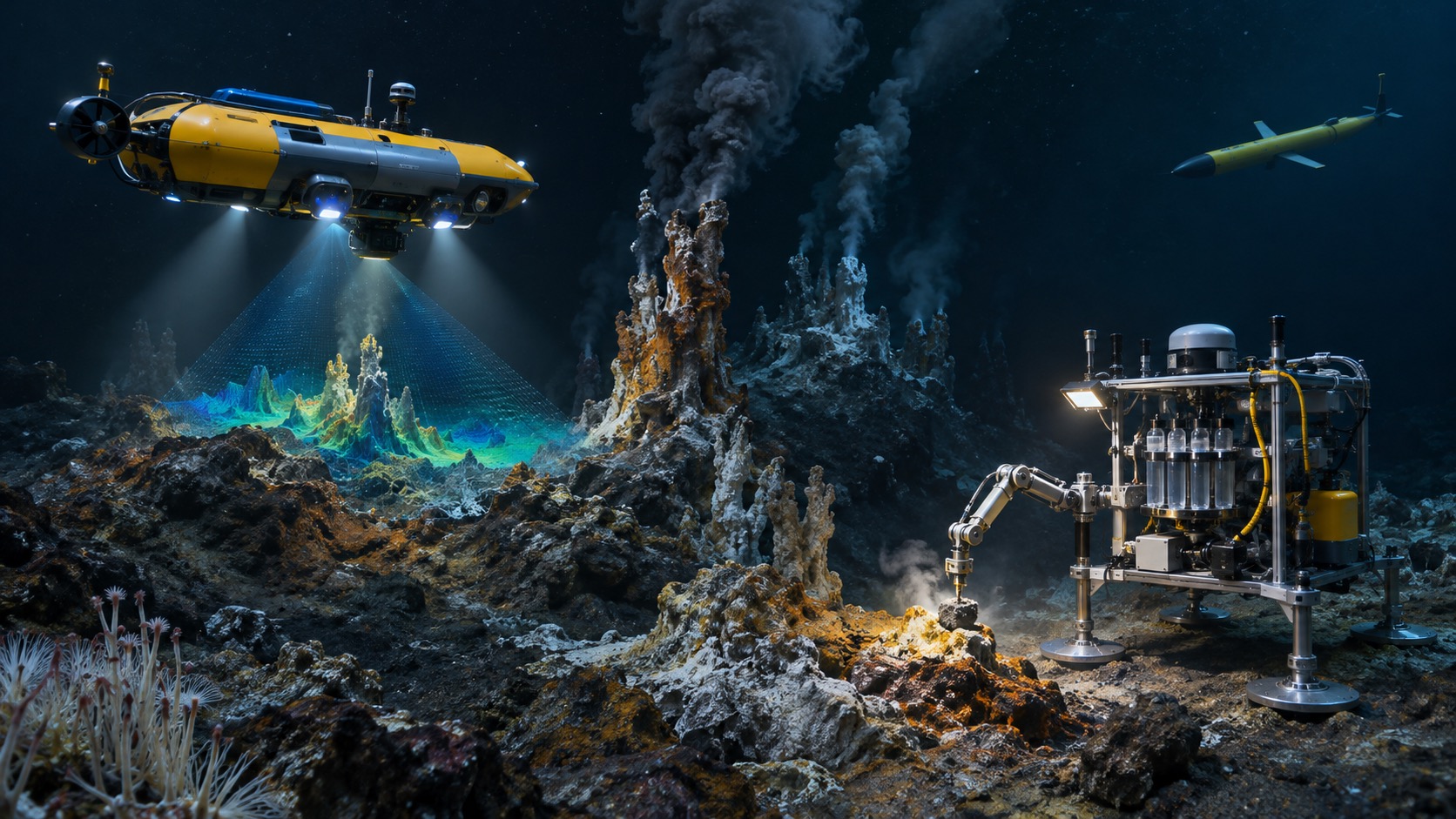
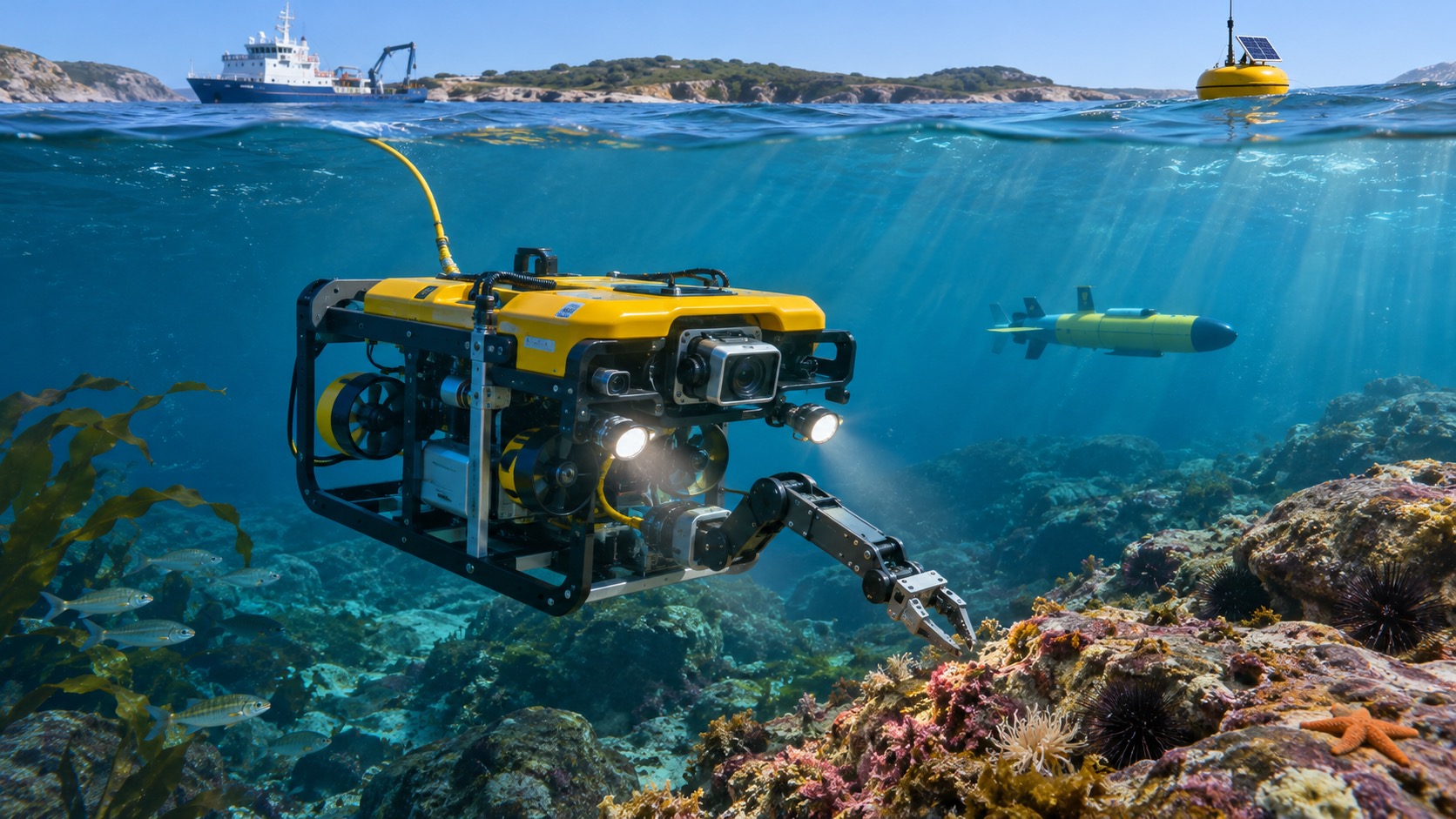
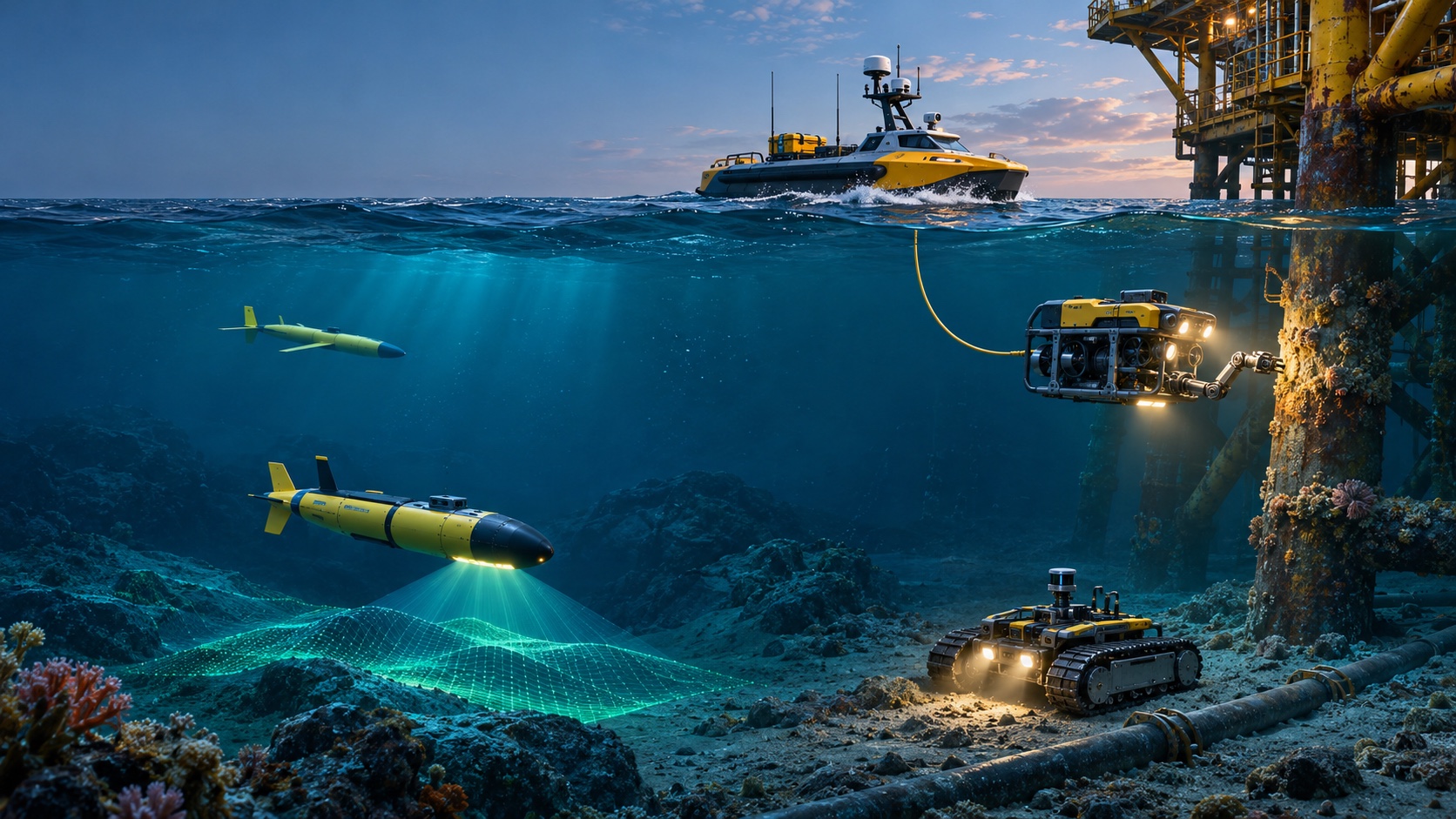
Aquatic robots are machines that operate on the water, beneath it, or along the bottom. They include unmanned surface vessels that resemble small boats, remotely operated vehicles connected to a pilot by a tether, autonomous underwater vehicles that follow planned missions, slow gliders that travel for months, drifting floats that profile the ocean, and tracked crawlers that work on the seabed. Those forms are not interchangeable. Water blocks ordinary radio, limits visibility, carries vehicles in currents, corrodes hardware, and makes recovery difficult. A useful taxonomy therefore begins with where a robot moves, how it receives power and commands, and what physical work it must perform. The right type is the simplest platform that can reach the target, carry the necessary sensors or tools, return trustworthy data, and be recovered safely.
A: An ROV is tethered and piloted; an AUV executes an onboard mission.
A: Seawater severely limits radio, so robots use acoustics, optics, or tethers.
A: They convert buoyancy changes into efficient forward motion to save energy.
A: Yes, programmed buoyancy and sensing let them conduct autonomous missions.
A: Traction helps with heavy tools, strong current, and stable bottom work.
A: No; some floats and low-cost instruments are not routinely recovered.
A: They combine inertial, depth, velocity, acoustic, and occasional satellite references.
A: Waves move suspended loads near crews, vessels, cables, and hard structures.
A: No; endurance, control, payload, depth, and intervention needs conflict.
A: Choose the simplest recoverable system that answers the defined question.
Uncrewed Surface Vessels Stay at the Air-Water Boundary
Uncrewed surface vessels, often called USVs, carry cameras, radar, sonar, weather instruments, or communication relays while remaining afloat.
Catamarans provide a stable deck; compact monohulls move efficiently; wave-powered designs trade speed for endurance.
Because antennas remain above water, operators can often use satellite or cellular links unavailable to submerged vehicles. USVs map shallow water, patrol ports, inspect bridges, measure water quality, and support underwater robots. Waves, traffic, fishing gear, and changing rules of navigation complicate autonomy. A mission plan must include collision avoidance, remote supervision, visible markings, and a safe response to lost communication.
Remotely Operated Vehicles Keep a Human in the Loop
An ROV is connected to a surface station by a tether that carries commands, video, and sometimes electrical power. Pilots see through cameras and sonar while controlling thrusters, lights, and manipulators. Observation-class ROVs are small enough for a two-person team. Work-class machines are much larger and can turn valves, cut cable, recover objects, or service offshore equipment.
The tether enables continuous control but creates drag and snag risk. A tether-management system may deploy the vehicle from a cage near the worksite. ROVs excel when judgment and dexterity matter more than covering enormous areas.
Autonomous Underwater Vehicles Survey Without a Tether
AUVs carry their power, navigation, mission computer, and payload inside a streamlined pressure hull. Before launch, a team defines depth limits, waypoints, sensor settings, and responses to faults. The robot then maps terrain, inspects pipelines, searches for objects, or samples water without a continuous cable to the ship. Navigation combines inertial sensors, depth, velocity measured against the bottom or water, acoustic positioning, and occasional satellite fixes at the surface. Energy must cover the survey and recovery reserve. AUVs are efficient area surveyors, but they cannot provide the same immediate intervention as a piloted ROV.
Underwater Gliders Convert Buoyancy Into Long Endurance
A glider changes its buoyancy to sink and rise, then uses wings to turn that vertical motion into slow forward travel. It may shift an internal mass to control pitch. With no propeller running continuously, a glider can observe temperature, salinity, oxygen, currents, or biological signals across long distances using relatively little energy.
Gliders surface periodically for position and data exchange. Their slow speed makes them vulnerable to strong currents and unsuitable for hovering beside a structure. They are best understood as persistent ocean observers rather than underwater aircraft.
Profiling Floats Drift With Water Masses
Profiling floats spend most of a mission drifting at depth. At intervals they change buoyancy, descend or rise through the water column, record measurements, and transmit data after reaching the surface. Unlike an AUV, a float generally does not steer toward detailed horizontal waypoints. That simplicity supports large distributed networks and multi-year observation. Oceanographers use floats to reveal broad patterns that a ship could never sample continuously. Their trajectories also contain information about circulation, though recovery is often not part of the operating concept.
Seafloor Crawlers Trade Free Swimming for Traction
Tracked or wheeled crawlers move across sediment, rock, tanks, and submerged structures. Contact with a surface lets them hold position in current and carry heavy tools. They inspect cables, bury lines, measure sediment, clean hulls, or perform repeated observations at a fixed site.
Soft mud can trap a heavy platform, while rocks, vegetation, and debris challenge mobility. The vehicle may be tethered for power and control or carry batteries for autonomous operation. Route planning must protect the habitat as well as the machine.
Benthic Landers Wait Rather Than Travel
A lander descends to the bottom, rests on a frame, and records a location over hours or months. Cameras, current meters, chemical sensors, baited instruments, or sample chambers operate without propulsion noise. Ballast may be released when an acoustic command tells the lander to return. Landers are robots in the broad sense when programmed mechanisms and sensors conduct a mission, even though they do not roam. Their strength is patient observation with a stable reference. Their risks include burial, biofouling, failed release hardware, and uncertain acoustic contact.
Towed Systems Borrow Motion From a Vessel
Towfish and instrument sleds follow a ship while carrying sonar, cameras, magnetometers, or sampling equipment. They can cover long lines without the batteries and navigation complexity of an AUV. Operators adjust cable length and vessel speed to control altitude.
The ship, cable, and sensor are one coupled system. Turns are wide, seafloor relief changes clearance, and deep-water commands arrive through mechanical rather than autonomous behavior. Towed systems remain valuable when dependable coverage matters more than close maneuvering.
Hybrid Vehicles Change Modes During a Mission
Hybrid ROV-AUV systems operate autonomously for survey and accept a fiber tether or acoustic commands for close work. Amphibious robots may swim, crawl, or climb through surf and flooded infrastructure. A docking AUV can recharge, upload data, and receive a new mission without a ship recovering it. Every added mode creates interfaces, weight, failure paths, and training demands. Hybrid design earns its complexity when a mission truly needs both broad autonomous reach and detailed human-guided intervention.
Bio-Inspired Robots Use Fins, Flexible Bodies, and Pulses
Fishlike tails, ray-shaped fins, eel bodies, and jellyfish pulses can move quietly or maneuver in confined water. Flexible propulsion may disturb animals and sediment less than exposed propellers. Small robotic fish can explore reefs, tanks, or cluttered spaces where a conventional thruster cage would struggle.
Biomimicry does not automatically create superior performance. Soft mechanisms can be hard to seal, power, model, and repair. Engineers select them when their motion offers a measurable advantage, not simply because it resembles nature.
Swarm Systems Divide Work Across Many Units
A group of small robots can spread sensors across a plume, coastline, harbor, or ice edge. Losing one unit need not end the mission. Coordinated paths can improve coverage, revisit unusual measurements, or form a temporary communication network. Underwater coordination is difficult because acoustic channels are slow and shared. Useful swarms rely on local rules, time synchronization, and plans that tolerate incomplete messages. Recovery and data management may be harder than launching the fleet.
Inspection Robots Are Defined by Their Target
Hull cleaners, pipe crawlers, tank inspectors, dam robots, and confined-space swimmers are optimized around a structure. Magnetic wheels may grip steel; suction systems hold a cleaning head against a hull; miniature thrusters navigate flooded pipes. Their sensors measure cracks, thickness, corrosion, leakage, or marine growth.
A compact purpose-built robot can outperform a general vehicle because it controls distance and viewing angle. The tradeoff is limited use outside the target geometry.
Sampling Robots Must Protect Context
Manipulators, corers, water bottles, filters, and suction samplers collect material for laboratory study. A successful grab is not enough. The robot must document location, orientation, depth, surrounding habitat, container identity, and possible contamination. Some systems preserve temperature or pressure during ascent. Sampling plans limit disturbance and define how much material is justified. Scientists, pilots, and deck teams share custody from target selection through storage.
Communication Separates Surface and Submerged Design
Radio and satellite links work well above water but penetrate seawater poorly. Submerged robots use acoustics for modest data rates over distance, optical links for fast exchange at short clear ranges, and physical tethers when continuous video or power is required. Many vehicles surface to transmit full records.
Mission autonomy grows as communication becomes weaker. A robot must detect faults, protect its energy, and choose a safe behavior without waiting for an operator.
Power Architecture Determines Range and Work
Batteries support quiet independent travel but place a firm limit on endurance. Tethers can deliver sustained power for bright lights, heavy manipulators, and hydraulic tools, while adding drag and dependence on a surface platform. Gliders stretch battery life by minimizing propulsion. Solar panels help some surface vessels. The energy budget includes sensors, computers, heaters, communication, and emergency recovery. Published endurance means little without payload, current, speed, and reserve assumptions.
Launch and Recovery Belong to the Robot System
A vehicle that performs perfectly underwater can still be unsafe to deploy from a rolling deck. Cranes, A-frames, cages, lifting points, tag lines, and trained crews manage concentrated loads around people. Shore launches face surf, rocks, mud, and limited access.
Teams plan for the robot’s wet weight, entangled tether, damaged battery, and loss of propulsion. Recovery beacons and high-visibility surfaces help turn a fault into a retrieval rather than a disappearance.
Payloads Often Matter More Than the Vehicle
Cameras reveal appearance, sonar works through darkness and turbidity, chemical probes measure the water, and acoustic instruments map current or depth. Manipulators convert observation into intervention. The platform exists to place those payloads at the right location with the right stability. Mounting can introduce bubbles, vibration, magnetic interference, or thruster wash. Calibration, synchronized clocks, navigation uncertainty, and preserved raw data determine whether a beautiful mission becomes reliable evidence.
Select the Type From the Mission Backward
Begin with the decision the mission must support. Define depth, distance, duration, current, visibility, required measurements, physical contact, communication, and acceptable risk. A USV may map a lake efficiently; an AUV may cover a deep pipeline; an ROV may inspect one questionable joint; a lander may wait for a rare event.
No category wins every comparison. The strongest choice meets the requirement with the least unnecessary complexity and includes the people, vessel, software, maintenance, data process, and recovery equipment that make the robot useful.
Environmental Conditions Redefine Every Category
Fresh water, seawater, ice, surf, rivers, reservoirs, and flooded tunnels impose different loads even on vehicles that share a label. Salt accelerates corrosion and creates electrical leakage paths. Cold changes batteries, seals, buoyancy, and lubricant behavior. Turbidity defeats cameras while bubbles weaken sonar. Current raises propulsion demand and moves tethers into structures. Pressure compresses volumes and challenges housings as depth increases. Operators qualify a particular configuration for the actual environment rather than assuming that the words ROV or AUV guarantee suitability. Materials, connectors, ballast, lighting, acoustic settings, navigation aids, and recovery plans may change from one water body to another. Classification is a useful starting map; environmental qualification decides whether the selected robot can complete the mission without becoming another object to recover. Teams also document what was tested so later operators do not mistake one successful deployment for universal proof. Those records turn experience into a safe operating envelope.
Field Judgment Completes the Taxonomy
Categories organize choices, but experienced operators still read the water, equipment, and mission together.
They revise the plan when real conditions contradict assumptions.