Great Robotics Laboratories Build Knowledge, Machines, and People
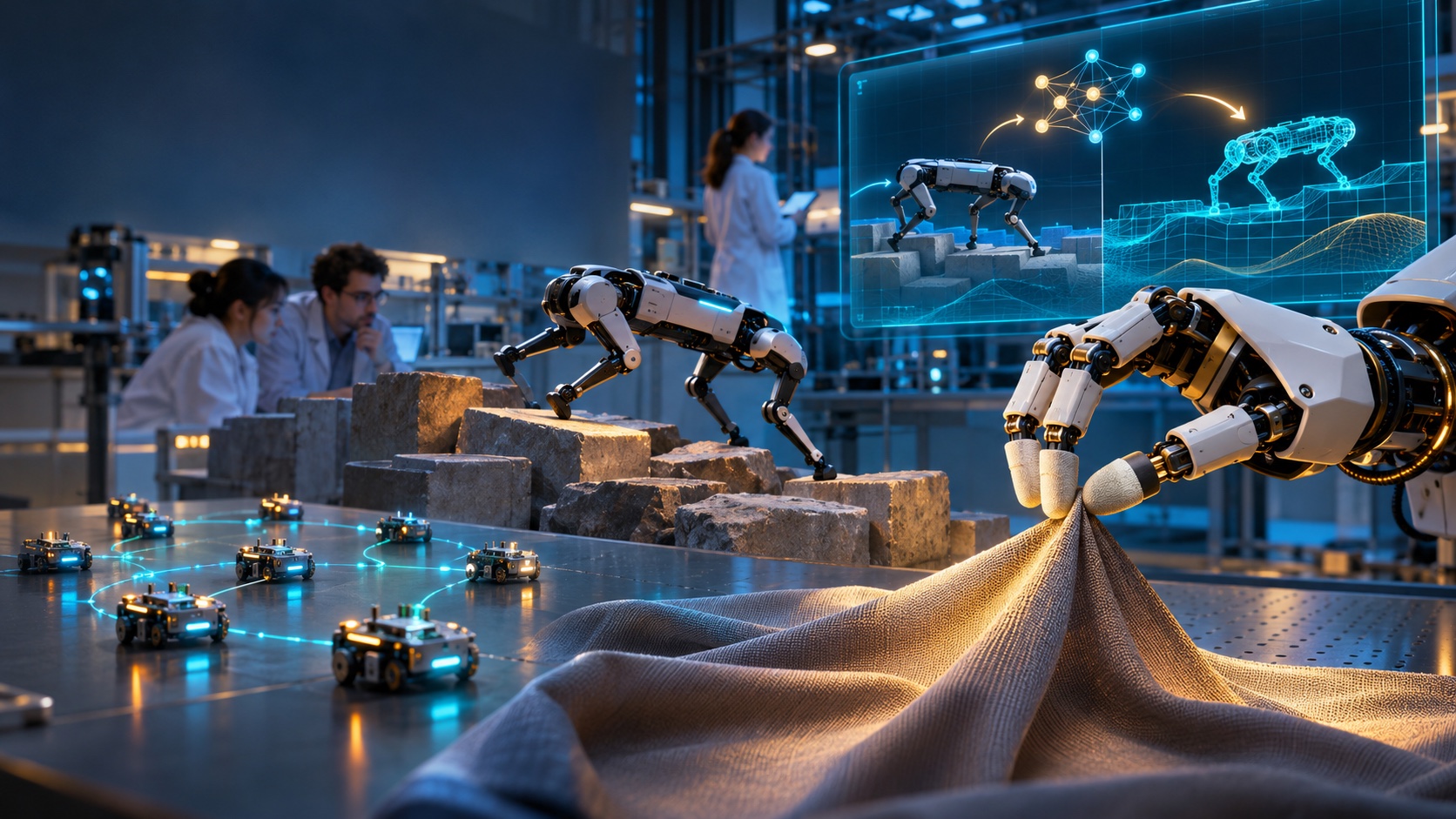
The world’s leading robotics laboratories are not ranked by one robot, publication count, or viral demonstration. They earn influence by connecting fundamental ideas with machines that survive demanding experiments, by sharing tools or data that other researchers can test, and by training people who carry knowledge into universities and industry. Their strengths differ. Some focus on manipulation and learning, others on field autonomy, medical systems, legged mobility, human-robot interaction, or computational design. Large institutes coordinate many groups, while smaller labs can define an entire specialty. This tour highlights influential academic environments and the research cultures behind them rather than declaring a permanent league table. Faculty move, projects change, and breakthroughs often involve several institutions. What matters is how each laboratory frames important questions, builds experimental evidence, and translates lessons into a wider robotics community.
A: Sustained influential research, strong experiments, shared tools, and trained people.
A: No, focused groups can define specialties with modest resources.
A: New scientific questions may require capabilities unavailable in commercial platforms.
A: They preserve safe facilities, reliable hardware, and experimental continuity.
A: They expose integration problems and create shared tests that inspire research.
A: Open artifacts let others inspect, reproduce, and extend claimed results.
A: Yes, especially for theory, though physical validation strengthens embodied claims.
A: They may fund projects, provide hardware, data, sites, or engineering expertise.
A: No, faculty, students, funding, facilities, and research directions change.
A: In publications, open tools, graduates, standards, spinouts, and deployed systems.
MIT CSAIL Connects Robotics With the Full Computing Stack
MIT’s Computer Science and Artificial Intelligence Laboratory brings robotics together with machine learning, algorithms, fabrication, perception, systems, and human-computer interaction.
Its distributed and interactive robotics groups examine collaboration, task teaching, safety, soft machines, and robots that operate around people.
The scale of CSAIL encourages ideas to cross boundaries. A new hand can be studied alongside learning, formal guarantees, or intuitive interfaces. The laboratory’s living environments and industry partnerships also connect research questions with homes and manufacturing.
Carnegie Mellon Treats Robotics as a Complete Discipline
Carnegie Mellon’s Robotics Institute spans perception, autonomy, manipulation, field robotics, computer vision, human-robot interaction, and robot design. Its history and dedicated educational programs make robotics more than a specialty nested inside one department.
Researchers can work across ground vehicles, aerial systems, agriculture, medicine, space, and manufacturing. The institute’s culture emphasizes complete deployed systems as well as theory, exposing students to the compromises that appear when algorithms meet weather, hardware, and users.
Stanford Studies Manipulation and Human-Centered Control
The Stanford Robotics Lab has made influential contributions to manipulation, operational-space control, human motion, haptics, and robots that interact with people in unstructured environments. Its Ocean One work also connects whole-body control and touch with remote exploration. Stanford’s broader ecosystem links robotics with AI, medicine, design, and autonomous systems. The laboratory illustrates how mathematical control frameworks can support machines whose movement must remain understandable and responsive to human intention.
Berkeley BAIR Makes Robot Learning a Central Question
Berkeley AI Research includes groups focused on adaptable behavior, reinforcement learning, vision, manipulation, human feedback, and humanoid intelligence. The Robotic AI and Learning Lab asks how machines can acquire flexible skills rather than rely entirely on explicit programming.
Berkeley’s strength comes from combining learning research with real robot experiments and open scientific exchange. Work on dexterity, locomotion, safety, and interaction tests whether data-driven methods generalize beyond benchmark settings.
ETH Zurich Pushes Legged Robots Into Difficult Terrain
ETH Zurich’s Robotic Systems Lab develops machines with arms and legs for rough and challenging environments. Its research spans actuation, design, locomotion, manipulation, perception, navigation, space, and construction. Field testing has helped turn dynamic mobility into a serious engineering discipline. ETH’s Computational Robotics Lab adds simulation, algorithms, data, control, and design. Together these environments show how new morphology, physics models, and learning can reinforce each other.
Oxford Robotics Institute Emphasizes Deployed Autonomy
The Oxford Robotics Institute brings together research in driving, flying, grasping, running, inspection, haptics, mapping, planning, multispectral sensing, and embodied intelligence. Its groups frequently test systems in demanding outdoor and industrial settings.
Oxford’s multi-robot scouting, radar perception, legged systems, and human-machine collaboration demonstrate the value of diverse sensing and robust autonomy. The institute treats deployment as a way to discover scientific problems, not merely as a final demonstration.
University of Michigan Builds Robotics Across Departments
Michigan’s dedicated robotics department supports work in autonomy, perception, manipulation, human-centered systems, multi-robot coordination, and field deployment. Laboratories study scalable spatial intelligence, assistive robots, legged systems, vehicles, and robots that reason about everyday environments. This breadth lets students connect mechanical design, controls, computing, and human factors. Open-source and reproducibility efforts help ensure that complete systems contribute knowledge beyond one campus.
Georgia Tech Links Robotics With Health and Manufacturing
Georgia Tech’s Institute for Robotics and Intelligent Machines coordinates faculty across engineering and computing. Research covers manipulation, mobility, healthcare, rehabilitation, swarm systems, perception, control, and human-robot collaboration.
The institute benefits from strong application environments. Medical partners, manufacturing problems, and interdisciplinary student teams let researchers test whether a method remains useful when safety, workflow, and physical design are considered together.
The University of Tokyo Advances Humanoids and Embodied Systems
Japanese university laboratories have shaped humanoid design, whole-body control, service robotics, and machines that operate in human environments. At the University of Tokyo, related groups combine mechanical engineering, intelligence, sensing, and long-running platform development. Their influence shows the value of sustained hardware programs. Successive robot generations preserve lessons about actuators, balance, hands, power, and integration that cannot be recreated from software alone.
KAIST Combines Advanced Robots With National Engineering Strength
Korea Advanced Institute of Science and Technology supports research in humanoids, mobile robots, autonomous vehicles, manipulation, and human-robot interaction. Its teams have demonstrated dynamic systems while contributing to the wider Korean robotics ecosystem.
Strong ties among research, education, electronics, and manufacturing help prototypes move toward practical engineering. The laboratory environment also trains teams to integrate perception, control, mechanics, and real-time computing.
EPFL Explores Learning, Bio-Inspiration, and Intelligent Systems
The Swiss Federal Institute of Technology Lausanne hosts laboratories in learning, control, aerial robotics, bio-inspired systems, rehabilitation, soft robotics, and human-machine interaction. Researchers often connect mathematical models with compact experimental platforms. EPFL’s interdisciplinary structure encourages work across neuroscience, materials, mechanical design, and computation. This is especially valuable when a robot’s body and intelligence must be developed together.
Imperial College London Works Across Medicine and Aerial Systems
Imperial robotics groups contribute to surgical technology, medical imaging, aerial vehicles, manipulation, control, and autonomous systems. Close relationships with healthcare and engineering create research questions where precision and safety are central.
Medical robotics laboratories must validate instruments, interfaces, and workflow with clinicians. Aerial teams face tight weight, energy, and reliability limits. Both domains reward careful integration rather than isolated algorithm performance.
TU Munich Connects Robotics With Industrial AI
Technical University of Munich supports robotics research across manipulation, autonomous systems, control, machine learning, mobility, and human-centered engineering. Its location within a strong European industrial region provides opportunities for manufacturing and vehicle collaboration. Large interdisciplinary initiatives can combine laboratories, compute, test facilities, and corporate partners. The challenge is preserving open scientific questions while translating methods into systems that industry can evaluate.
University of Pennsylvania Excels in Aerial and Multi-Robot Research
Penn’s GRASP Laboratory has a long history in robotics, automation, sensing, perception, control, and networks. It is especially influential in aerial robotics and coordinated systems, where fast dynamics and limited onboard resources make every design choice visible.
GRASP’s interdisciplinary model brings together computer science, electrical engineering, mechanical engineering, and applied mathematics. Shared facilities help theories become repeatable physical experiments.
NASA Laboratories Extend Robotics Beyond Earth
NASA’s Jet Propulsion Laboratory and university partners develop robotic systems for planetary exploration, autonomous navigation, manipulation, sampling, and operations under extreme communication delay. Missions impose unusual standards for testing and fault tolerance. Space robotics expands academic questions about autonomy, terrain, energy, and verification. The long path from concept to mission also teaches researchers how evidence, redundancy, and systems engineering support one irreversible deployment.
Research Laboratories Depend on Specialized Infrastructure
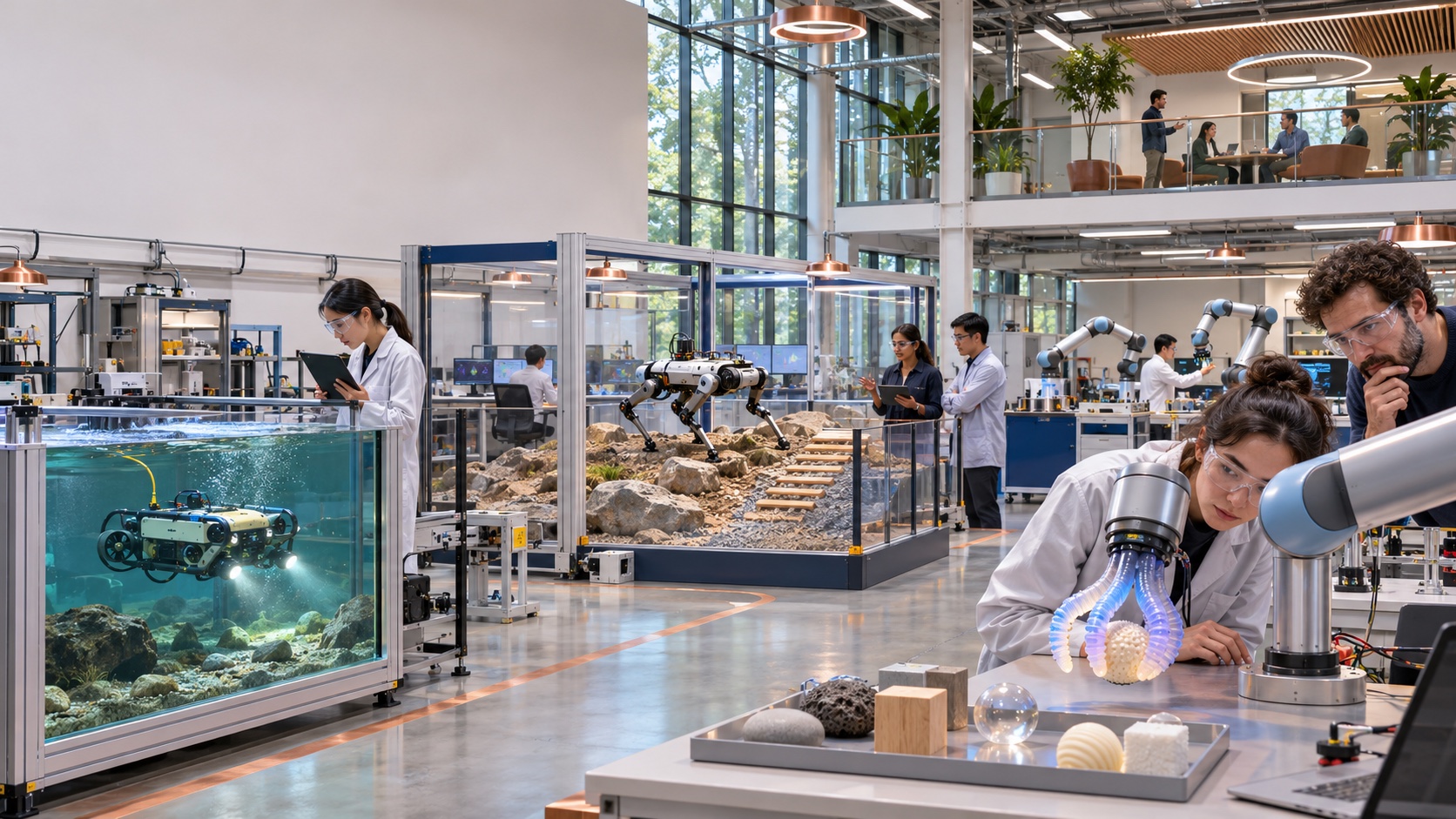
Robot progress requires more than desks and computers. Leading labs maintain machine shops, electronics benches, motion-capture rooms, terrain courses, flight cages, water tanks, kitchens, operating-room simulators, vehicles, and secure compute. Technical staff keep these environments safe and available.
Shared infrastructure lets researchers compare methods on common platforms. It also reveals practical limits such as calibration drift, battery wear, network delay, and maintenance effort that simulations may omit.
Open Tools Multiply a Laboratory’s Influence
A paper becomes more useful when other teams can inspect code, data, hardware files, models, and evaluation procedures. Open robot operating systems, simulators, data sets, benchmarks, and designs have allowed ideas from academic labs to spread far beyond their original institutions. Reproducibility is difficult with expensive physical systems. Good releases document equipment, training conditions, failures, and expected variation rather than offering only a final checkpoint.
Competitions Create Shared Pressure Tests
Challenges in subterranean exploration, autonomous driving, manipulation, rescue, and aerial robotics force teams to integrate complete systems under time and uncertainty. They reveal weaknesses in perception, communication, logistics, and recovery that narrow experiments miss.
Competition results are not the same as broad scientific proof, but the events create common problems and durable collaborations. Field lessons often generate the next set of research questions.
Industry Partnerships Can Accelerate Translation
Companies provide funding, hardware, production knowledge, data, sites, and problems that academic teams could not assemble alone. MIT CSAIL’s 2026–2031 physical-intelligence initiative with Pegatron is one example of research designed to connect tactile manipulation and embodied intelligence with manufacturing. Partnerships need publication terms, student protections, conflict management, and clear intellectual-property rules. The most productive relationships preserve independent inquiry while giving experiments realistic constraints.
Laboratory Leadership Is Ultimately a Community Practice
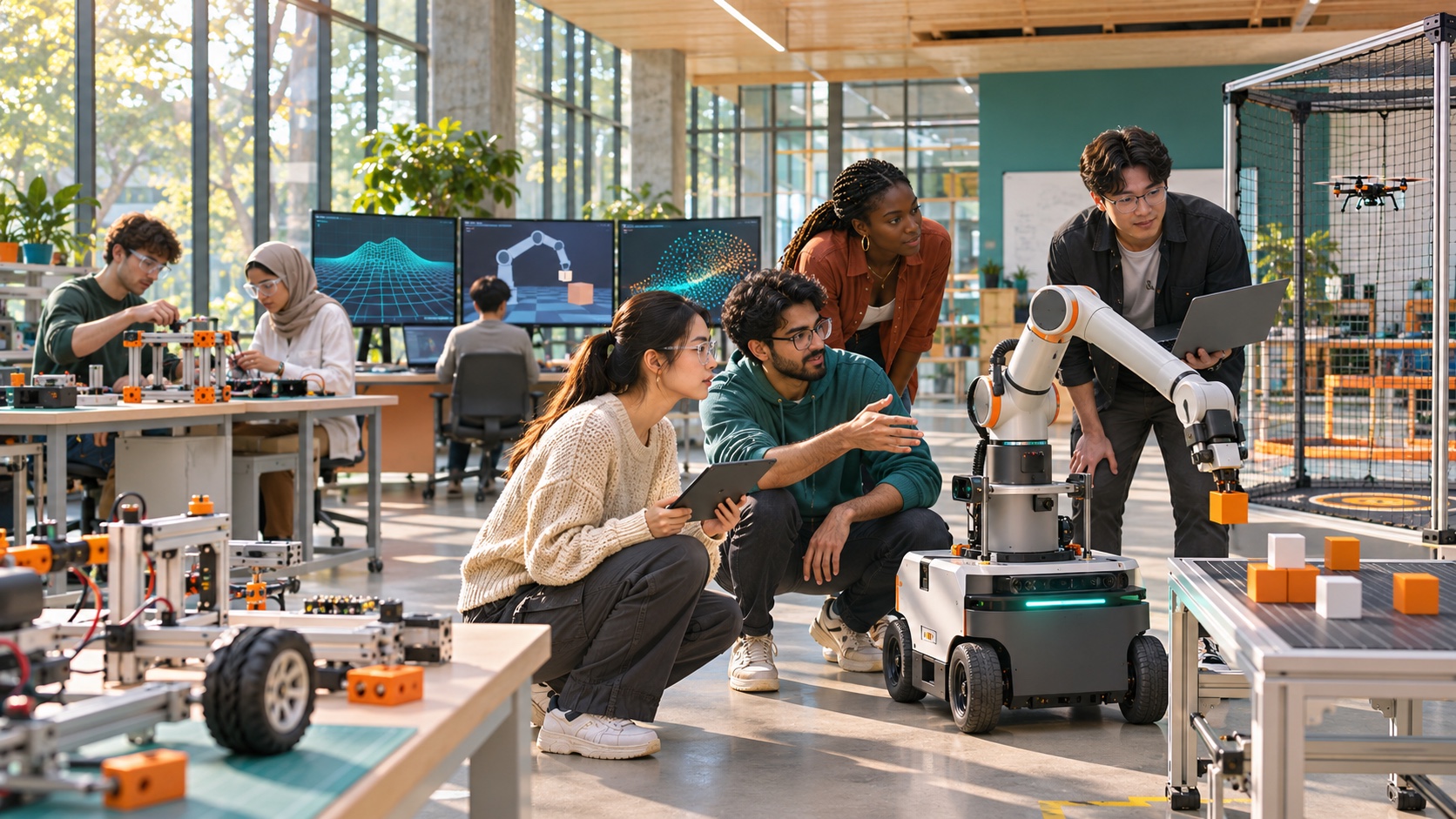
The best laboratories create an environment where students, research staff, technicians, faculty, and collaborators can challenge results and learn from failure. They maintain hardware, share credit, document experiments, and train people to connect theory with physical evidence.
Their influence continues through graduates, open tools, new companies, standards, and collaborations. A leading lab is not a room full of expensive robots. It is a durable method for turning questions into knowledge other people can use.
Laboratory Evaluation Begins With Research Questions
Visitors often notice polished robots first, but the better guide is the recurring question behind the hardware. One laboratory may study contact-rich manipulation, another long-term autonomy, and another communication between people and machines. A strong program produces a connected body of methods and evidence rather than unrelated demonstrations. Its robot platforms evolve because each experiment sharpens the next question.
Funding Diversity Supports Intellectual Resilience
University laboratories combine public grants, foundation support, industry sponsorship, shared institutional facilities, and sometimes philanthropic gifts. Different sources enable fundamental theory, expensive platforms, student training, and translation.
Dependence on one sponsor or short grant cycle can narrow questions and interrupt maintenance. Leading labs build portfolios that preserve continuity and disclose relevant relationships.
International Collaboration Expands Experimental Reach
Multi-university projects share environments, expertise, hardware, and data that one institution cannot supply. A field robot may combine a sensing group, control laboratory, domain scientists, and industrial site across several countries. Collaboration demands common interfaces, authorship practices, data governance, and patient integration. The reward is evidence that spans more than one local setup.
The Best Laboratory Tour Includes the Workshop
Machine shops, parts shelves, calibration rigs, battery areas, repair benches, and experiment logs reveal how research actually continues. They show whether a platform is maintainable and whether the team can reproduce yesterday’s configuration.
This infrastructure is less visible than a demonstration but central to credible science. Repeated experiments depend on disciplined preparation and technical care.
Leading Labs Teach How to Ask Better Questions
Robotics attracts broad claims because machines are easy to watch and difficult to evaluate. Strong laboratories teach students to define the task, identify assumptions, choose measurements, compare baselines, and explain failure before celebrating capability. That discipline makes the work transferable. A carefully bounded result can become a foundation, while an unexplained spectacle remains difficult for anyone else to use.