Universities Expand the Questions Robotics Is Allowed to Ask
University robotics laboratories shape intelligent machines by working at timescales and risk levels that commercial product teams often cannot. They can investigate a new actuator before a market exists, study why a learning method fails, build an unusual body, examine how people interpret robot behavior, or release a tool for anyone to test. Students move between theory, fabrication, experiments, and field work while faculty connect robotics with medicine, agriculture, ocean science, architecture, ethics, and design. Industry eventually absorbs many results, but the university contribution is broader than technology transfer. Academic labs establish shared concepts, benchmarks, safety questions, and generations of engineers. Their strongest influence comes from combining intellectual freedom with physical evidence and from making knowledge available beyond one product roadmap.
A: Unusual platforms let researchers test questions beyond current markets.
A: Graduates, publications, open tools, licenses, partnerships, and startups carry it outward.
A: No, they simplify reality and should be paired with broader experiments.
A: Failure reveals integration, measurement, maintenance, and design assumptions.
A: It lowers duplication and lets others inspect and extend research.
A: Yes, with clear publication, conflict, intellectual-property, and student protections.
A: Clinicians and patients provide needs, workflow, safety, and evidence context.
A: It expands experimentation while teaching the limits of modeled physics.
A: No, many spread through knowledge, people, standards, and public use.
A: It can combine long-term curiosity, education, openness, and physical experimentation.
Universities Protect Foundational Questions
Commercial teams must serve customers and schedules. Academic researchers can ask why a controller is stable, what information a tactile sensor truly provides, or which assumptions make a learning policy generalize. These questions may not produce a product immediately, but they create foundations later systems depend on.
Long-term inquiry also exposes limits. Negative results, theory, and careful comparisons help the field avoid building every new platform on untested intuition.
Students Learn by Integrating Complete Systems
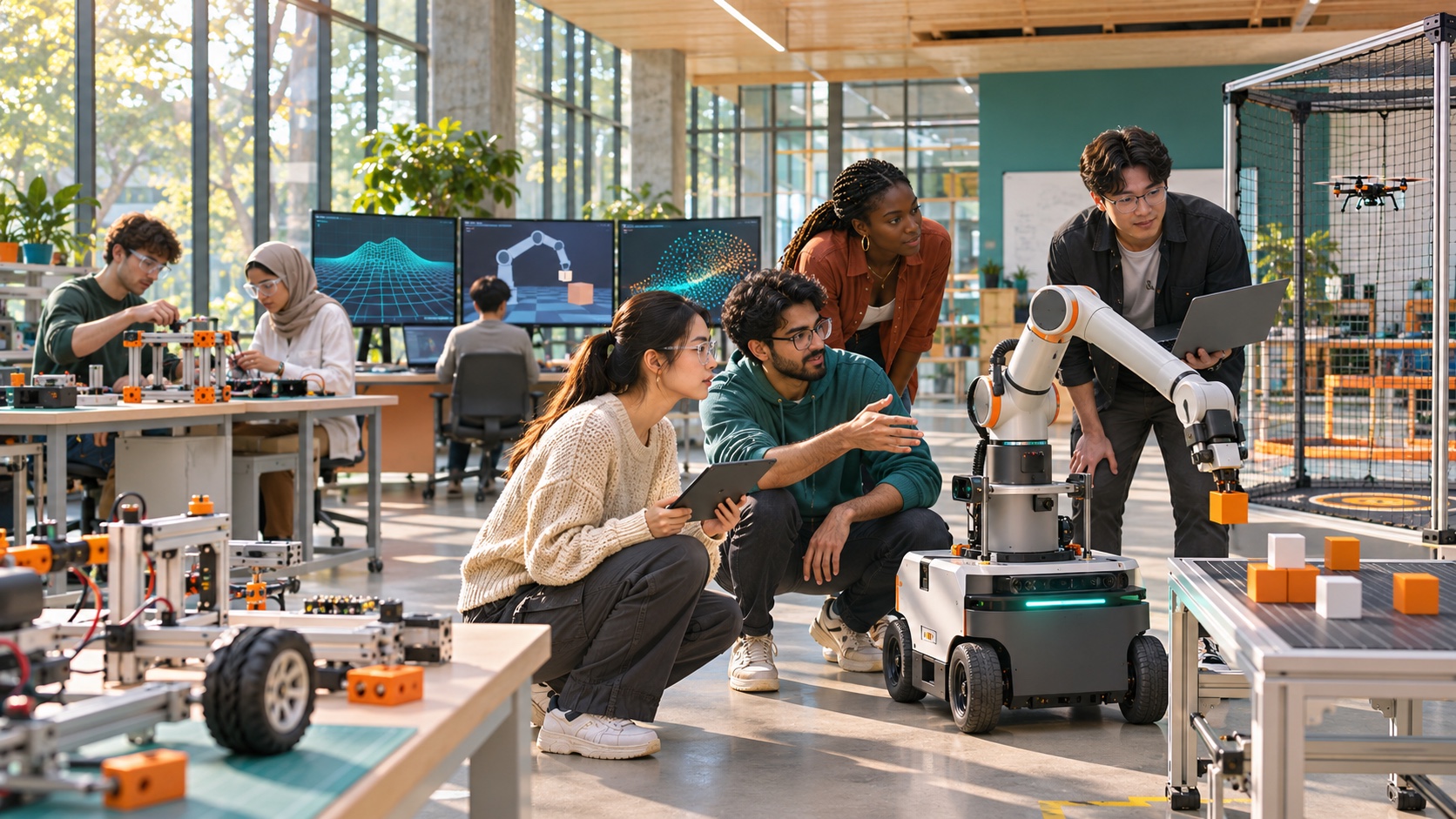
Robotics education forces ideas from mechanics, electronics, computing, controls, statistics, and human factors into one machine.
A student sees how sensor noise changes planning, how cable routing affects motion, and how an interface changes operator behavior.
This integration experience is valuable even when a prototype fails. Graduates enter industry able to communicate across disciplines and diagnose problems that do not belong to one software module.
Research Robots Make New Questions Physically Testable
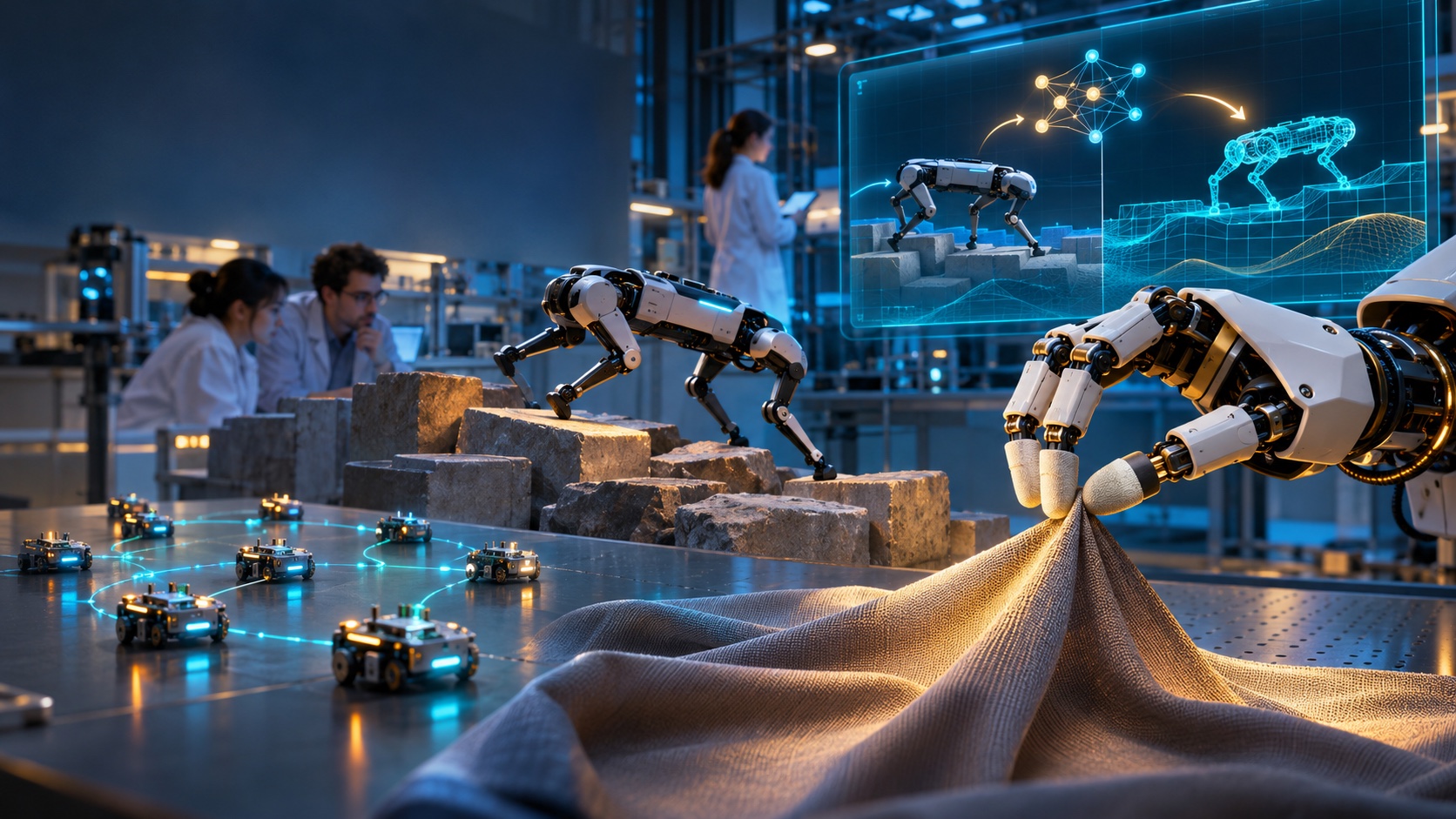
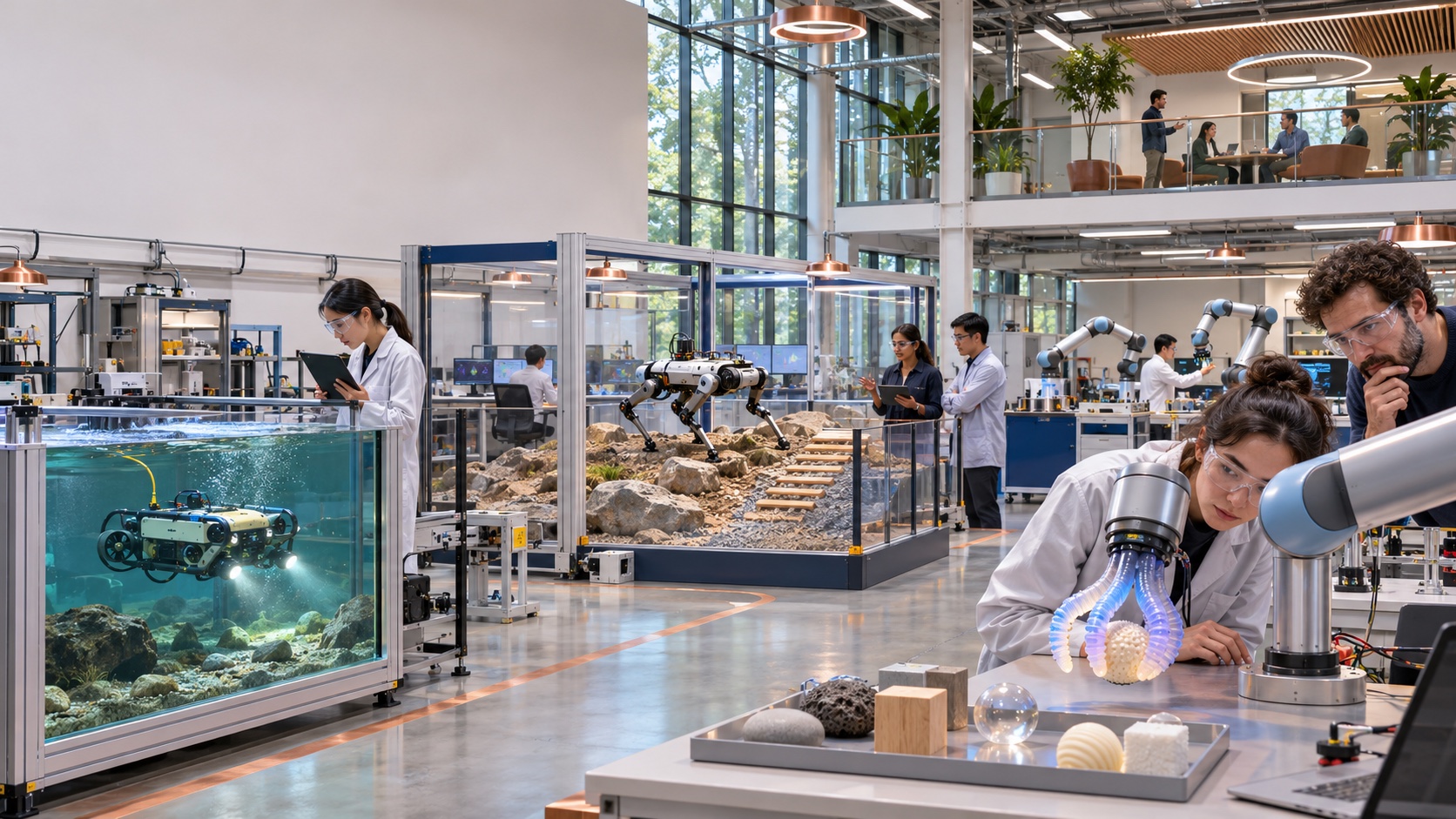
Universities build custom hands, legs, drones, underwater vehicles, exoskeletons, soft bodies, and miniature swarms because commercial platforms cannot answer every research question. New hardware lets researchers vary morphology, compliance, sensing, and actuation deliberately.
A research platform is also an argument about what matters. Its design makes assumptions visible and gives other teams a concrete system to challenge.
Open Source Turns One Lab Into Shared Infrastructure
Robot operating systems, simulators, data sets, controllers, design files, and benchmark suites often grow from academic work. Open releases let small laboratories and startups begin from a common foundation instead of recreating basic components. Maintaining open tools requires documentation, review, governance, and compatibility. Universities shape the future most effectively when releases remain usable after the original student graduates.
Benchmarks Create a Common Language for Progress
Standard tasks and data sets let researchers compare perception, grasping, navigation, locomotion, and planning methods. A benchmark can focus attention on a hard problem and reveal whether improvement holds across teams.
Every benchmark simplifies reality. Labs must refresh tasks when systems overfit the test and add measures for safety, energy, intervention, uncertainty, and robustness rather than rewarding one headline score.
Simulation Gives Students Access to Scale
Physical robots are expensive, slow, and subject to wear. Simulation lets researchers run many trials, explore rare failures, train policies, and test designs before fabrication. Students can experiment without monopolizing one machine. The university role includes studying the gap between simulated and physical behavior. Real-to-sim measurement and sim-to-real transfer turn simulation into an empirical tool rather than an alternate reality.
Robot Learning Is Becoming More Data Efficient
Academic labs explore imitation, reinforcement learning, self-supervision, video, language-conditioned control, and shared models across tasks. A central goal is learning useful behavior from fewer robot hours and transferring it beyond one object or body.
Universities can analyze why transfer succeeds, how uncertainty appears, and what safety constraints belong around a model. This scientific scrutiny is essential before broad deployment claims become trustworthy.
Human Feedback Is Entering the Training Loop
Researchers study demonstration, corrections, preferences, natural language, gestures, muscle signals, and shared control as ways for people to shape robot behavior. These methods let task experts contribute without writing low-level programs. Human teaching is inconsistent and context dependent. Labs examine how robots ask questions, resolve disagreement, communicate confidence, and avoid learning unsafe shortcuts from imperfect examples.
Tactile Research Gives Intelligence a Sense of Contact
University teams develop electronic skins, optical fingertips, force sensors, soft structures, and algorithms that infer slip or object properties. Touch is critical when cameras cannot see inside a grasp or when materials deform.
Research connects sensor construction with control and learning. It also addresses calibration, durability, data volume, and how contact can be interpreted across different hands.
Legged Robotics Tests Whole-Body Intelligence
Walking and climbing require perception, balance, actuation, planning, and fast recovery. University labs use quadrupeds and humanoids to study how machines coordinate many joints while interacting with uncertain terrain. These platforms advance more than locomotion. They create questions about energy, contact, manipulation, safety, and how a robot represents its own body.
Soft Robotics Changes the Relationship Between Body and Control
Compliant materials can bend, stretch, absorb impact, and adapt passively to objects. Academic work explores soft grippers, wearable devices, medical tools, inflatable structures, and robots inspired by animals.
Soft bodies are hard to model and manufacture consistently. Universities investigate materials, fabrication, sensing, and control together, creating design principles that product engineers can later use.
Multi-Robot Labs Study Intelligence as Coordination
Swarms and distributed teams can cover large areas, share sensing, transport objects, or remain useful after individual failures. University experiments investigate local rules, task allocation, communication, mapping, and collective decision-making. The research matters for warehouses, agriculture, disaster response, oceans, and space. It also reveals how small errors or delays can spread across a network.
Field Courses Turn Deployment Into Education
Students who take robots outdoors learn about weather, batteries, transport, permissions, terrain, radio, recovery, and public interaction. A field test compresses systems engineering into a clear lesson because every forgotten dependency becomes visible.
Universities shape capable engineers when they teach preparation and post-mission analysis alongside algorithms. Data custody and safe recovery are part of intelligence in practice.
Medical Partnerships Bring Clinical Reality Into Design
University hospitals and engineering labs collaborate on surgical tools, rehabilitation robots, assistive devices, imaging, prosthetics, and care support. Clinicians reveal workflow, anatomy, sterilization, training, and evidence requirements that an isolated engineering team may miss. Patients and caregivers also contribute essential perspectives. Responsible research begins with a meaningful need and evaluates benefit without treating novelty as a clinical outcome.
Agricultural Campuses Provide Living Laboratories
Universities with farms and plant science programs test robots for weeding, harvesting, scouting, phenotyping, and livestock care. Fields expose machines to light changes, dust, weather, growth, and biological variation.
These projects connect robotics with agronomy and economics. A technically successful robot must fit seasonal windows, crop value, farm labor, maintenance, and ecological goals.
Interdisciplinary Centers Change the Scale of Questions
Robotics centers bring together faculty from computing, engineering, design, medicine, social science, and policy. Shared facilities and seed funding help teams attempt work no single group could support. Centers can also become administratively diffuse. Strong programs define research themes, preserve technical depth, and create genuine collaboration rather than simply placing many lab names under one banner.
Industry Sponsors Accelerate Real-World Relevance
Companies give universities equipment, funding, data, sites, manufacturing expertise, and hard operational problems. Students gain exposure to constraints, while companies see ideas before they become standard products.
Universities protect publication, academic independence, student choice, and disclosure. Clear agreements prevent sponsorship from narrowing research to confidential engineering work.
Spinouts Translate Research Through Focused Organizations
Some results need dedicated product teams, capital, manufacturing, sales, and service. Faculty, students, or alumni create startups that carry a method from laboratory evidence into a customer workflow. University technology-transfer offices help manage intellectual property and licensing. A spinout is not the only measure of impact. Open tools, graduates, standards, and public-sector adoption may spread knowledge more broadly than one company.
Ethics and Policy Belong Beside Technical Experiments
Universities can study privacy, accessibility, labor, accountability, bias, environmental effects, dual use, and public expectations before systems become entrenched. Social scientists and community partners help identify consequences that technical benchmarks omit.
This work improves engineering when it changes requirements, data practices, interfaces, and deployment boundaries. Ethics is most useful when it participates in design rather than arriving after a demonstration.
The Future Is Shaped Through Reproducible Curiosity
University laboratories influence intelligent machines by asking durable questions, building physical evidence, teaching integrators, and sharing knowledge. They can pursue ambitious capabilities while remaining willing to explain failure and uncertainty. Their most important output may be a method another lab reproduces, a graduate who builds safer products, or a public question that changes which machines society chooses to deploy. Those contributions compound across decades.
Shared Hardware Programs Broaden Participation
University fleets and core facilities let students reserve arms, mobile bases, drones, cameras, and compute without each group buying its own platform. Common equipment supports courses, pilot studies, and collaborations while concentrating technical support.
Access rules, training, maintenance budgets, and fair scheduling determine whether shared facilities truly broaden participation. Well-run programs lower the cost of a first experiment.
Research Staff Preserve Continuity Between Student Generations
Doctoral and master’s projects end, but complex robots need ongoing software, calibration, repairs, and documentation. Research engineers and technical staff maintain platforms and help new students avoid repeating old integration failures. Universities shape better machines when they treat this continuity as scholarship-supporting infrastructure. Stable staff also improve safety and the quality of experimental records.
Community Engagement Tests Public Assumptions
Museums, schools, workshops, public demonstrations, and participatory design sessions let researchers hear how people interpret robots outside the laboratory. Communities may notice access, privacy, cultural, or work concerns that a technical team overlooked.
Engagement should influence design and research priorities rather than serve only as promotion. Honest demonstrations include limitations and invite questions about where robots should not be used.
Inter-University Reproduction Strengthens Claims
A robot-learning result becomes more persuasive when another team can run the method on different hardware or reproduce the effect from released materials. Cross-laboratory studies expose hidden dependencies in calibration, data, and setup. Universities can reward replication through shared challenges, publication venues, and funding. Reproduction turns isolated achievement into dependable scientific knowledge.
Curricula Evolve as Robotics Changes
Modern programs add machine learning, embedded systems, safety, ethics, cloud tools, field methods, and human-centered design without abandoning mechanics, control, probability, and mathematics. Students need foundations that outlast one software framework.
The best curricula connect concepts through progressive physical projects. Learners see how theoretical choices affect motion, energy, perception, interaction, and recovery.
Academic Freedom Supports Alternative Futures
Universities can investigate low-cost devices, open platforms, public-interest robots, environmental monitoring, disability-led design, and technologies for communities too small to attract immediate commercial investment. This wider possibility space matters. Intelligent machines will shape society more responsibly when research includes needs beyond the largest available markets.
Libraries and Data Stewardship Support Reproducibility
Research data needs metadata, storage, access rules, retention, and links to code and experimental configuration. University libraries and research-computing teams help laboratories preserve outputs beyond one student laptop.
Robotics adds sensitive video, large sensor streams, and proprietary partner information. Good stewardship balances reproducibility with privacy, security, and legitimate restrictions.
Universities Connect Local Experiments With Global Knowledge
Conferences, visiting scholars, exchanges, shared challenges, and joint papers let methods travel across institutions. A student learns that laboratory conventions are not universal and that a result gains strength when it survives new equipment and perspectives. Global exchange also broadens which problems matter. Intelligent machines develop through many environments, cultures, and public priorities rather than one technical center.