The Next Patent Battleground Is the Behavior of the Whole Automation System
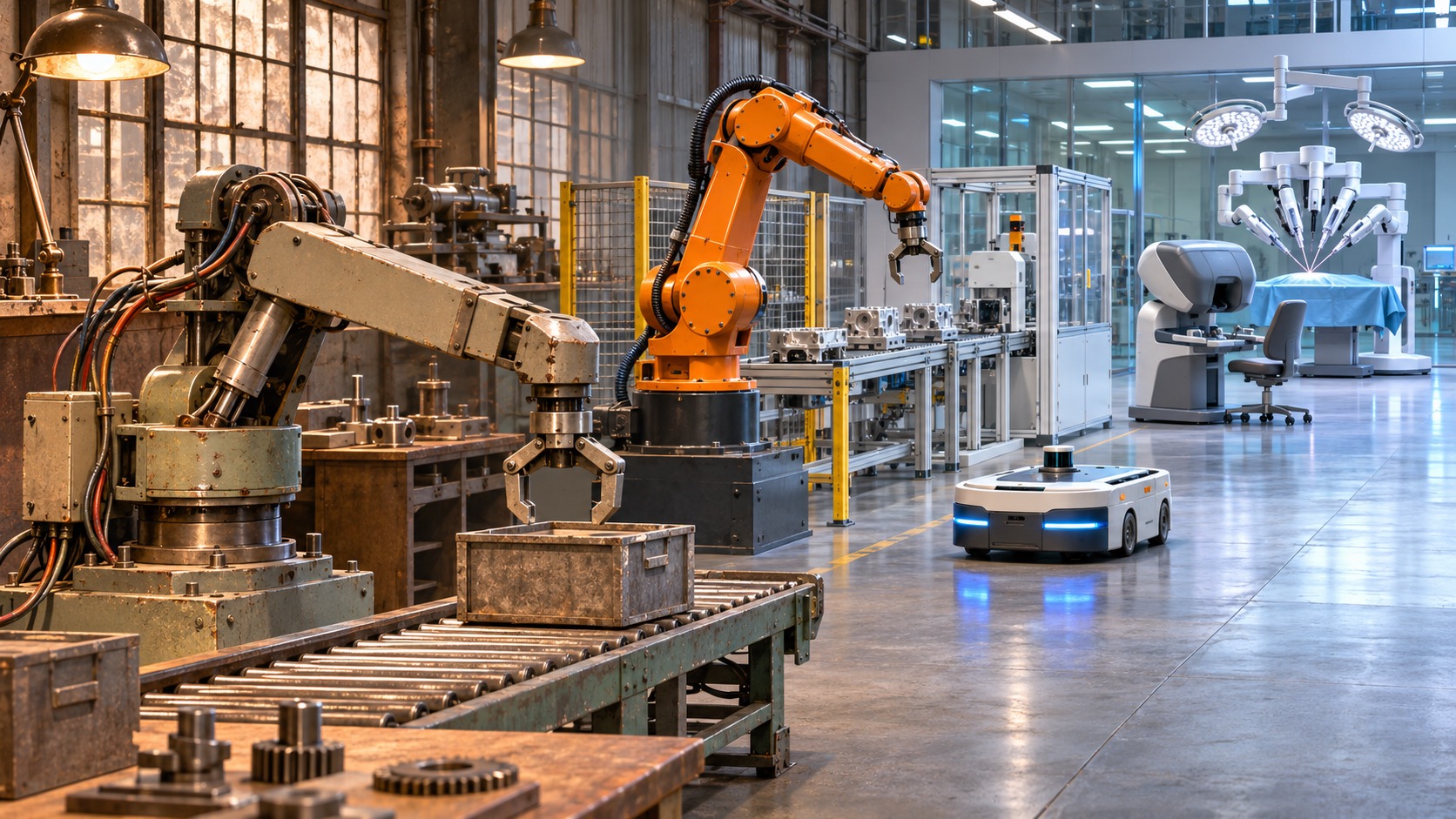
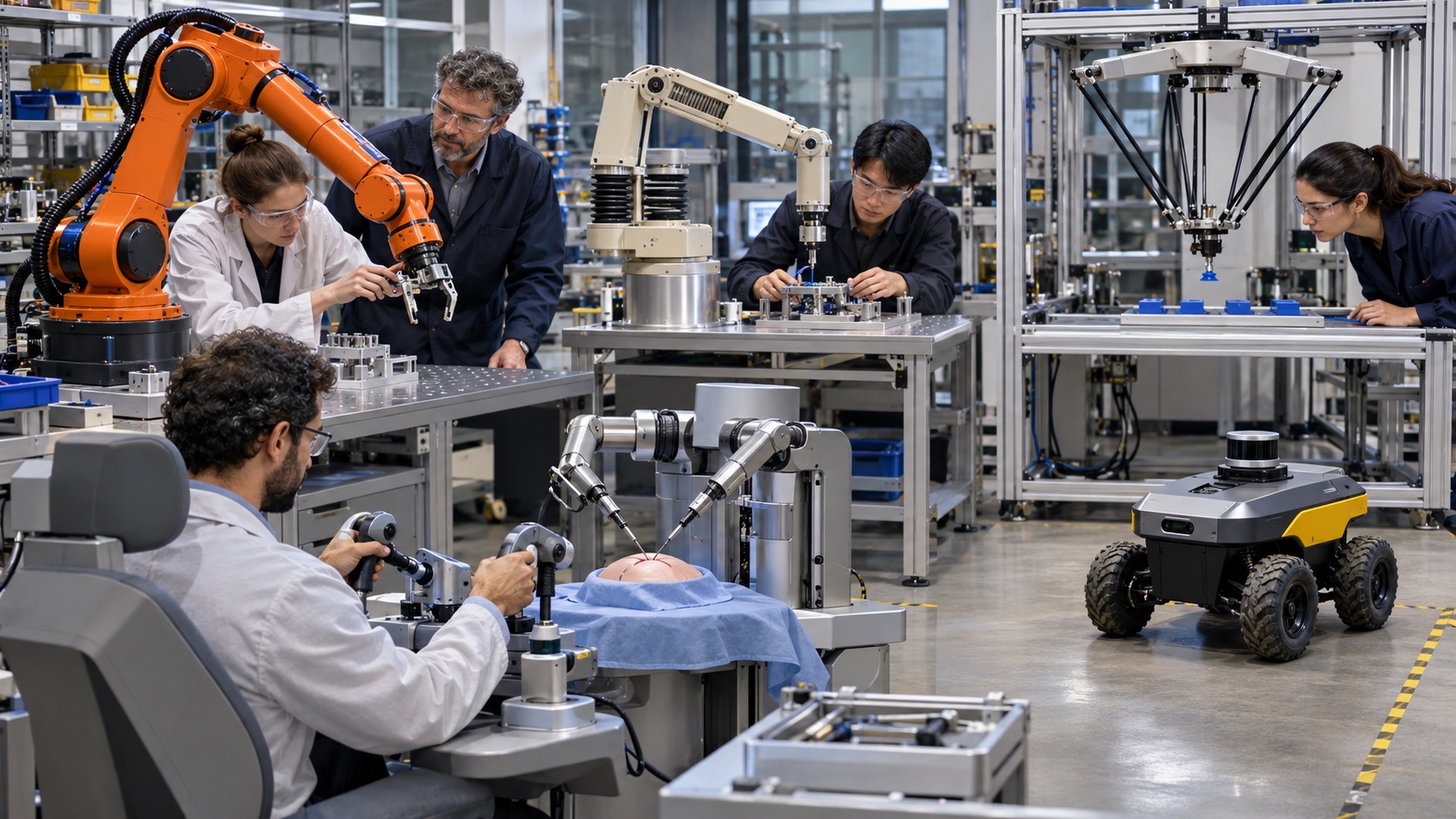
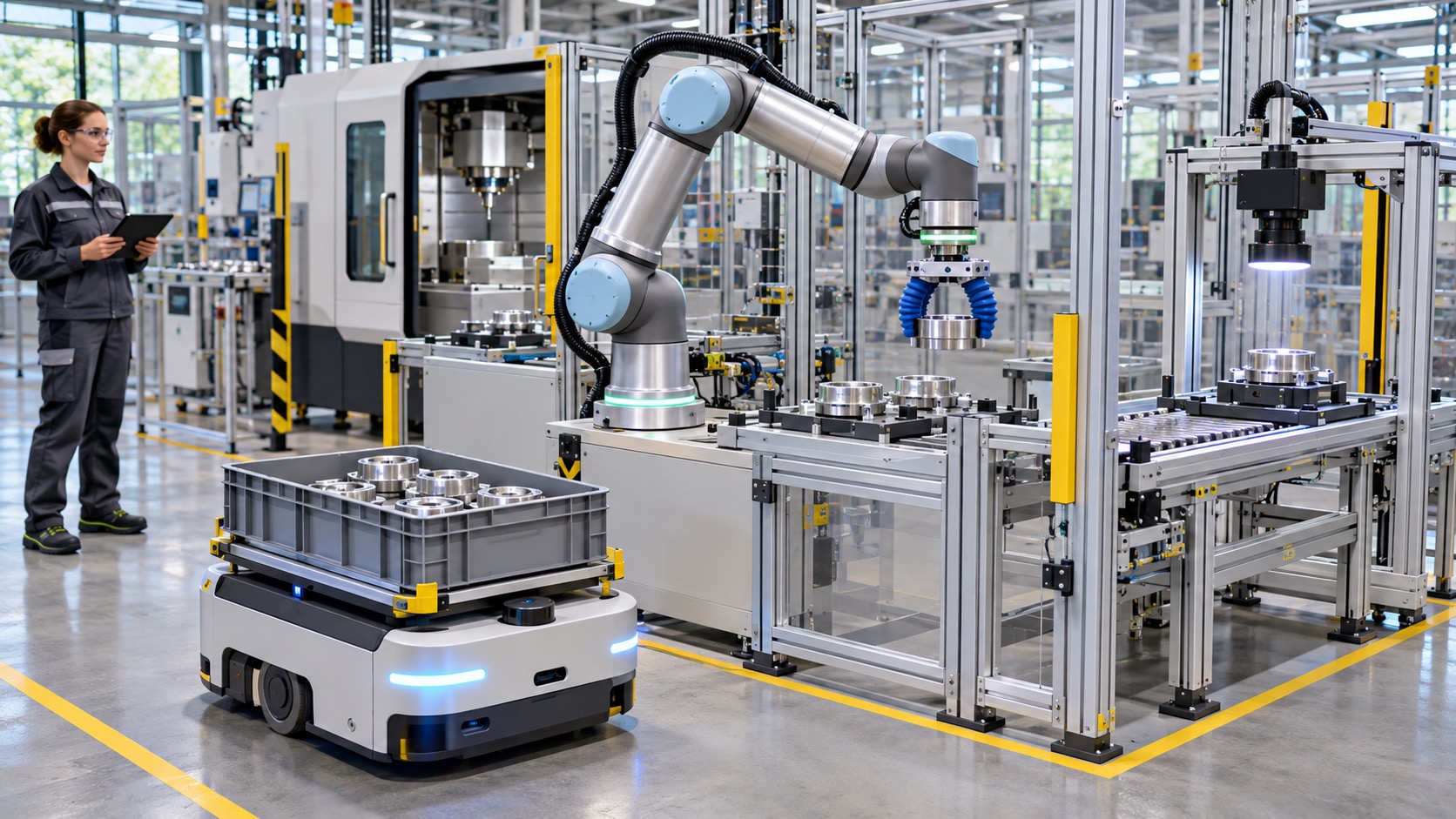
Automation patents once clustered visibly around a mechanism: an arm geometry, gripper, transmission, or material-handling machine. Those inventions remain important, but future value increasingly sits across boundaries. A mobile robot coordinates with doors and elevators; a collaborative arm adjusts motion from force data; a vision model identifies an object whose pose guides an adaptive gripper; fleet software negotiates traffic, charging, and work priorities. Patent applicants therefore try to protect specific combinations of hardware, sensing, control, data, and workflow. This does not mean every broad description will produce enforceable claims or a successful product. Patent offices examine novelty and nonobviousness against prior art, jurisdictions differ, and claim language matters more than marketing. The direction is still revealing. Industry is moving from isolated machines toward connected, configurable systems that learn from operation while satisfying safety, cybersecurity, and productivity requirements. The discussion below explains technical themes and business implications, not freedom to operate or legal advice.
A: No, valuable filings also cover mechanisms, sensing, safety, energy, interfaces, maintenance, and system integration.
A: Novel coordination of base, arm, perception, stability, task planning, or recovery may support specific claims.
A: They can detect contact, slip, force distribution, and grasp quality rather than merely closing around an object.
A: Patentability and scope depend on supported claims, prior art, examination, and jurisdiction, not fashionable terminology.
A: Filings may address task allocation, traffic, charging, maps, infrastructure, congestion, and failure recovery.
A: They can connect synchronized physical data with prediction, validation, and operational changes.
A: No, patents indicate technical and strategic activity; reliable economics and deployment evidence determine adoption.
A: Companies may choose patents, trade secrets, publication, standards, or open source according to enforceability and strategy.
A: Compromised commands, updates, identities, or sensors can disrupt production and create safety risks.
A: Those that measurably remove persistent deployment friction and become central to products customers can operate.
Collaborative Safety Is Becoming a Sensing-and-Control Stack
Future collaborative systems combine joint torque sensing, external force estimation, vision, proximity detection, speed limiting, workspace models, and safe stopping. Patents can target a sensor arrangement, a method for distinguishing intended contact from collision, or a controller that changes behavior as a person approaches.
The commercial opportunity is not simply removing a fence. A useful cell must maintain throughput while responding predictably to people, tools, payloads, and changing layouts.
Standards and risk assessment remain outside the patent bargain. Owning a safety-related invention does not certify an application, and a patented controller can still be integrated unsafely.
Mobile Manipulation Joins Two Previously Separate Products
An autonomous mobile base becomes more valuable when it can operate doors, machines, carts, shelves, or totes through an arm. The combination creates hard patent questions around stabilization, reach planning, base repositioning, perception, handoffs, and recovery. A claim may focus on how the base and arm divide motion rather than on either subsystem alone.
Industry interest is strong because mobile manipulation can bring automation to work that moves around a facility. The engineering penalty is also strong: navigation error becomes manipulation error, payload shifts affect stability, and a blocked aisle can interrupt an entire task sequence.
Adaptive Grippers Are Turning Variation Into a Product Feature
Rigid fingers work well for known parts and fixtures. New gripper patents explore compliant structures, soft materials, variable stiffness, underactuated fingers, suction arrays, tactile skins, and tool-changing systems that conform to object variation.
The patentable contribution may be geometry, materials, actuation, sensing, or the method that selects a grasp.
Future automation will reward grippers that report more than open or closed. Contact location, slip, force distribution, seal quality, and object state can support recovery before a drop. That information also feeds quality records and process improvement.
Machine Vision Claims Are Moving From Detection to Action
A model that labels an image is not yet a robotic system. Patent strategies increasingly connect perception with pose estimation, uncertainty, grasp selection, inspection, motion, and feedback after action. The valuable claim may describe what happens when confidence is low: request another view, change lighting, choose a different tool, or route the item to a person.
This emphasis reflects deployment reality. Production images differ from curated datasets through glare, dust, vibration, packaging changes, and rare defects. Automation needs bounded behavior when perception is uncertain.
Robot Learning Patents Must Survive a Crowded Prior-Art Landscape
Learning-based robotics draws from academic papers, open-source code, datasets, earlier patents, and rapid AI development. Applications that merely attach a fashionable model name to an ordinary robot may struggle to define a novel contribution. Stronger filings describe a concrete technical improvement: how data is collected, how a policy respects constraints, how simulation transfers to hardware, or how failure triggers recovery.
Disclosure quality matters. A patent should teach the invention rather than hide every enabling detail behind “artificial intelligence.”
Companies also choose among patenting, publishing, and trade secrecy. A model training recipe that cannot be detected in a competitor’s product may be hard to enforce, while a visible system behavior or hardware arrangement may suit patent protection better.
Foundation Models Are Creating New Robotics Interface Questions
Vision-language-action systems promise to connect instructions, perception, and motion across tasks. Patent activity can focus on grounding language in a robot’s capabilities, constraining generated actions, selecting skills, combining demonstrations, or validating a plan before execution.
The future depends on interfaces between general models and deterministic protection. A language instruction should not bypass joint limits, collision checking, access control, or task authorization.
Patents that matter commercially may protect the guardrails, data pipelines, and deployment architecture rather than the largest model. Reliable use at the edge is a systems invention.
The strongest filings will likely connect model behavior to a concrete robotic constraint: latency, calibration, safety state, tool use, data collection, or recovery after uncertainty. A generic claim to intelligent control is easier to challenge and harder to implement consistently. Detailed embodiments matter because physical automation exposes weaknesses that may remain hidden in a purely digital demonstration.
Fleet Orchestration Is Becoming Facility Infrastructure
As mobile robots multiply, patents target traffic management, task allocation, congestion prediction, map sharing, charging schedules, elevator use, and coordination among different vendors. The facility becomes an active participant through doors, sensors, workstations, and software interfaces.
A breakthrough will reduce the cost of exceptions. Fleets need to recognize blocked paths, unavailable stations, delayed humans, low batteries, and failed vehicles without collapsing throughput.
Interoperability Creates Both Opportunity and Defensive Patenting
Customers increasingly want robots, warehouse systems, manufacturing software, and building infrastructure to exchange information. Open standards can expand the market, while patents may protect particular optimizations implemented above or alongside those standards.
Companies must decide whether an interface should be proprietary, licensed, contributed to a standard, or opened to accelerate adoption.
Patent commitments within standards organizations can create obligations. Technical teams should involve legal and business colleagues before contributing patented technology or making compatibility promises.
Digital Twins Are Shifting From Visualization to Operational Control
A digital twin can represent robot state, geometry, process flow, maintenance history, or a complete cell. Future patents emphasize synchronization between physical equipment and simulation, testing a change before deployment, predicting wear, and selecting operating parameters from live data.
The difficult part is correspondence. A beautiful model has limited value if calibration, latency, payload, contacts, and controller behavior diverge from the physical system.
Automation patents in this area can connect data capture, model updating, decision logic, and a verified change to the real machine. That closed loop distinguishes operational twins from static diagrams.
Patent value here depends on the closed loop, not the visual model alone. The system must explain how field data updates the representation, how the representation changes a physical decision, and how unsafe or low-confidence changes are rejected. Those details distinguish an operational twin from a dashboard and determine whether the invention reduces downtime or merely produces another screen.
Energy Management Is Becoming Part of Robot Intelligence
Battery-powered fleets must schedule charging without starving production. Patents can cover state estimation, charger allocation, task selection based on remaining energy, opportunity charging, battery swapping, and coordination with facility power constraints.
Humanoids, drones, mobile manipulators, and outdoor robots make energy especially consequential because physical capability competes with runtime. A lighter battery changes payload and stability; faster charging changes heat and lifetime.
Cybersecurity Patents Will Follow Robots Into Connected Operations
Connected robots create attack surfaces through remote access, software updates, sensors, cloud services, wireless links, and third-party applications. Inventions may address device identity, signed updates, anomaly detection, segmented control, secure teleoperation, or safe degradation when trust is lost.
Security cannot be solved by a patent portfolio. It requires lifecycle maintenance, disclosure processes, inventory, access control, monitoring, and supported updates.
The business significance is growing because compromised robot behavior can affect physical safety and production. Cybersecurity is becoming a purchasing criterion rather than an invisible IT feature.
Humanoid Patents Are Testing Whether a Familiar Form Adds Value
Humanoid developers file around actuators, hands, balance, whole-body control, thermal design, teleoperation, data collection, and manufacturing. The humanlike form can use environments built for people, but it also introduces many joints, high energy demand, fall risk, and costly hardware.
The most consequential claims may concern components that succeed beyond humanoids: compact actuators, dexterous hands, force control, or efficient learning from demonstration.
Future market impact will depend on reliable work, not a convincing walk. Patent volume alone cannot establish that a general-purpose humanoid is economically ready.
The patent test is therefore not whether the machine resembles a person, but whether a particular body plan solves a measurable automation problem under realistic cost and reliability constraints. Valuable claims may emerge around balance recovery, compact actuation, whole-body manipulation, or safe failure. Market enthusiasm alone cannot establish that those choices outperform simpler purpose-built machines.
Soft Robotics Is Blurring the Boundary Between Material and Mechanism
Soft actuators, continuum structures, inflatable systems, variable-stiffness materials, and embedded sensing create inventions whose behavior emerges from shape and material properties. Claims may protect fabrication, internal channels, reinforcement, control, or a task-specific combination.
These technologies can improve delicate handling, wearable assistance, medical devices, and operation in confined spaces.
Commercialization must solve durability, repeatable manufacturing, cleaning, repair, and accurate modeling. A striking prototype is only the first step toward an automation component.
Patents Around Maintenance Can Be as Valuable as Motion
Industrial customers buy uptime. Predictive maintenance inventions combine motor current, vibration, temperature, cycle history, error logs, and fleet comparisons to estimate wear or recommend service. Other patents address self-checks, automatic calibration, modular replacement, and remote diagnostics.
The future cell may generate a service record as carefully as it generates parts. That data can improve warranties, spare planning, and design changes.
Patent Portfolios Are Becoming Maps of Product Architecture
A mature robotics company rarely depends on one breakthrough document. It layers patents around core mechanisms, sensing, control, user workflow, accessories, manufacturing, diagnostics, and system integration. Continuations and international filings align protection with product generations and markets.
Investors and competitors often read portfolios as signals, but counts can mislead. Claim relevance, remaining term, jurisdiction, enforceability, design-around options, and connection to revenue matter more than raw totals.
The strongest strategy also preserves room for others. Excessively closed interfaces can slow ecosystem adoption even when they strengthen short-term control.
The Future Will Reward Patents That Remove Deployment Friction
Automation still fails at integration boundaries: variable objects, changing facilities, unreliable handoffs, difficult programming, safety validation, energy, security, and maintenance. Breakthrough patents will matter when they reduce those costs in a way customers can verify.
The direction is from isolated capability toward managed operation. A robot that can grasp one object once is a demonstration; a system that understands uncertainty, recovers, documents its state, and works with surrounding infrastructure is automation. Patents that protect those concrete behaviors can shape future markets, provided the products deliver what the claims and specifications only describe.
Deployment Evidence Will Separate Durable Patents From Fashion
A patent portfolio can reveal where companies expect value, but filings alone cannot prove technical maturity or market demand. Watch for repeatable field performance, shorter commissioning, credible safety validation, maintainable hardware, and customers who expand after an initial deployment. When those signals align with protected technical features, patents may reinforce a durable product advantage. Without them, even an active filing category may describe strategic experimentation rather than the future of automation.